Building Blocks
This section contains fundamental products for the synthesis of organic and biological compounds. Building blocks are the essential starting materials used to construct complex molecules through various chemical reactions. They play a critical role in drug discovery, material science, and chemical research. At CymitQuimica, we offer a diverse range of high-quality building blocks to support your innovative research and industrial projects, ensuring you have the essential components for successful synthesis.
Subcategories of "Building Blocks"
- Boronic Acids & Boronic Acid Derivatives(5,756 products)
- Chiral Building Blocks(1,242 products)
- Hydrocarbon Building Blocks(6,095 products)
- Organic Building Blocks(61,055 products)
Found 199650 products of "Building Blocks"
Sort by
Purity (%)
0
100
|
0
|
50
|
90
|
95
|
100
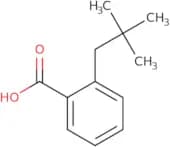
2-(2,2-Dimethylpropyl)benzoic acid
CAS:<p>2-(2,2-Dimethylpropyl)benzoic acid is an organic compound with the formula CH3COCH2C6H5CO2H. It is a white crystalline solid that is soluble in water and polar organic solvents. The compound is used in the synthesis of other compounds. 2-(2,2-Dimethylpropyl)benzoic acid can be prepared by reacting benzoic acid with magnesium to form a Grignard reagent, which reacts with chlorobenzene to yield the desired product. This compound has been shown to react selectively with substituents on benzyl chloride to produce substituted benzoates.</p>Formula:C12H16O2Purity:Min. 95%Molecular weight:192.25 g/mol5-(Bromomethyl)-1,3-oxazolidin-2-one
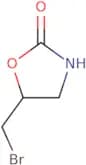
CAS:<p>5-(Bromomethyl)-1,3-oxazolidin-2-one is a synthetic compound that has been shown to be pharmacologically active in mice. It can be synthesized by the electrochemical oxidation of benzene and alcohols. 5-(Bromomethyl)-1,3-oxazolidin-2-one has been shown to have selectivities for cyclic and nucleophilic substrates over tetrafluoroborate substrates. The yields of this reaction are typically low due to the competing reactions between the substrate and oxidant. 5-(Bromomethyl)-1,3-oxazolidin-2-one has been shown to have selective chiral centers due to its spirocyclic structure. It also shows pharmacological effects in mice, which may be due to its ability to inhibit cyclooxygenase (COX) activity.</p>Formula:C4H6BrNO2Purity:Min. 95%Molecular weight:180 g/mol2-Amino-1-(3,4-difluorophenyl)ethan-1-ol hydrochloride
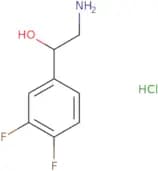
CAS:<p>Versatile small molecule scaffold</p>Formula:C8H10ClF2NOPurity:Min. 95%Molecular weight:209.62 g/mol2-Amino-1-(2,4-difluorophenyl)ethan-1-ol hydrochloride
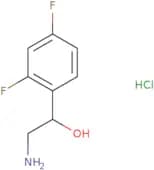
CAS:<p>Versatile small molecule scaffold</p>Formula:C8H10ClF2NOPurity:Min. 95%Molecular weight:209.62 g/mol2-Amino-1-(2,4-difluorophenyl)ethan-1-ol
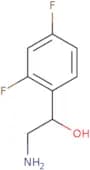
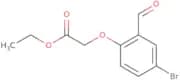
CAS:<p>Versatile small molecule scaffold</p>Formula:C8H9F2NOPurity:Min. 95%Molecular weight:173.16 g/molEthyl (4-bromo-2-formylphenoxy)acetate
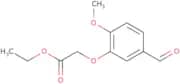
CAS:<p>Versatile small molecule scaffold</p>Formula:C11H11BrO4Purity:Min. 95%Molecular weight:287.1 g/molethyl 2-(5-formyl-2-methoxyphenoxy)acetate
CAS:<p>Versatile small molecule scaffold</p>Formula:C12H14O5Purity:Min. 95%Molecular weight:238.24 g/mol1-[5-(4-Chlorophenyl)-2-thienyl]-1-ethanone
CAS:<p>Versatile small molecule scaffold</p>Formula:C12H9ClOSPurity:Min. 95%Molecular weight:236.72 g/mol1-[5-(4-Bromophenyl)thiophen-2-yl]ethan-1-one
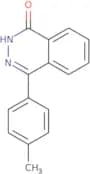
CAS:<p>Versatile small molecule scaffold</p>Formula:C12H9BrOSPurity:Min. 95%Molecular weight:281.17 g/mol4-(4-Methylphenyl)-1,2-dihydrophthalazin-1-one
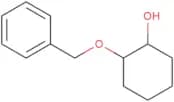
CAS:<p>Versatile small molecule scaffold</p>Formula:C15H12N2OPurity:Min. 95%Molecular weight:236.27 g/molrac-(1R,2R)-2-(Benzyloxy)cyclohexan-1-ol
CAS:<p>Versatile small molecule scaffold</p>Formula:C13H18O2Purity:Min. 95%Molecular weight:206.28 g/mol1-Amino-4-tert-butylcyclohexane-1-carbonitrile hydrochloride
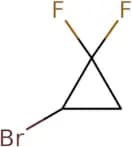
CAS:<p>Versatile small molecule scaffold</p>Formula:C11H21ClN2Purity:Min. 95%Molecular weight:216.75 g/mol2-Bromo-1,1-difluorocyclopropane
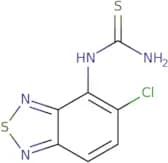
CAS:<p>Versatile small molecule scaffold</p>Formula:C3H3BrF2Purity:Min. 95%Molecular weight:156.96 g/mol(5-Chloro-2,1,3-benzothiadiazol-4-yl)thiourea
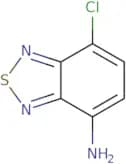
CAS:<p>Versatile small molecule scaffold</p>Formula:C7H5ClN4S2Purity:Min. 95%Molecular weight:244.7 g/mol4-Amino-7-chloro-2,1,3-benzothiadiazole
CAS:<p>Versatile small molecule scaffold</p>Formula:C6H4ClN3SPurity:Min. 95%Molecular weight:185.63 g/molN-Butyl-1H-1,3-benzodiazol-2-amine
CAS:<p>N-Butyl-1H-1,3-benzodiazol-2-amine is an organic compound that belongs to the group of benzimidazoles. It is a fungicide that inhibits the growth of fungi by inhibiting their DNA synthesis. This drug has been shown to inhibit the growth of fungi that cause plant diseases such as rice blast, wheat stem rust and barley yellow dwarf.</p>Formula:C11H15N3Purity:Min. 95%Molecular weight:189.26 g/molN-[4-(Hydroxymethyl)-2-thiazolyl]acetamide
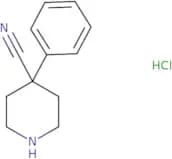
CAS:<p>Versatile small molecule scaffold</p>Formula:C6H8N2O2SPurity:Min. 95%Molecular weight:172.2 g/mol4-Cyano-4-phenylpiperidine hydrochloride
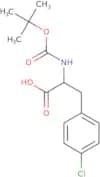
CAS:4-Cyano-4-phenylpiperidine hydrochloride is used as an intermediate in the synthesis of organic compounds. It is a white crystalline solid that reacts with water to form hydrogen cyanide and 4-phenylpiperidine. This compound has been shown to be a potent inhibitor of thionyl chloride and benzyl chloride, which are both toxic industrial chemicals. 4-Cyano-4-phenylpiperidine hydrochloride also reacts with diethanolamine to form a benzyl ether, which can then react with other nucleophiles such as piperidine to produce amines.Formula:C12H14N2•HClPurity:Min. 95%Molecular weight:222.71 g/mol2-((tert-Butoxycarbonyl)amino)-3-(4-chlorophenyl)propanoic acid
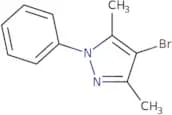
CAS:<p>Versatile small molecule scaffold</p>Formula:C14H18ClNO4Purity:Min. 95%Molecular weight:299.75 g/mol4-Bromo-3,5-dimethyl-1-phenyl-1H-pyrazole
CAS:Versatile small molecule scaffoldFormula:C11H11BrN2Purity:Min. 95%Molecular weight:251.12 g/mol

![1-[5-(4-Chlorophenyl)-2-thienyl]-1-ethanone](/_next/image/?url=https%3A%2Fstatic.cymitquimica.com%2Fproducts%2F3D%2Fthumb-webp%2FBCA33590.webp&w=3840&q=75)
![1-[5-(4-Bromophenyl)thiophen-2-yl]ethan-1-one](/_next/image/?url=https%3A%2Fstatic.cymitquimica.com%2Fproducts%2F3D%2Fthumb-webp%2FBCA33589.webp&w=3840&q=75)


![N-[4-(Hydroxymethyl)-2-thiazolyl]acetamide](/_next/image/?url=https%3A%2Fstatic.cymitquimica.com%2Fproducts%2F3D%2Fthumb-webp%2FBCA30738.webp&w=3840&q=75)