Building Blocks
Subcategories of "Building Blocks"
- Boronic Acids & Boronic Acid Derivatives(5,780 products)
- Chiral Building Blocks(1,241 products)
- Hydrocarbon Building Blocks(6,100 products)
- Organic Building Blocks(61,023 products)
Found 205289 products of "Building Blocks"
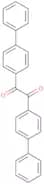
Bis(4-phenylphenyl)ethane-1,2-dione
CAS:Versatile small molecule scaffold
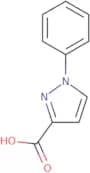
Formula:C26H18O2Purity:Min. 95%Molecular weight:362.4 g/mol1-Phenyl-1H-pyrazole-3-carboxylic acid
CAS:1-Phenyl-1H-pyrazole-3-carboxylic acid is an organic compound that has a pyrazole ring. It can be synthesized by the reaction of phenylhydrazine and formamide. The amido group in the molecule is bound to the carbonyl carbon atom, which makes it a carboxylic acid. This compound is also known as a morpholine amido ester. One example of this type of compound is 1-(4-Methoxyphenyl)-1H-pyrazole-3-carboxylic acid. The analogous compound in this series is 2-(2,6-dimethylphenyl)-1H-pyrrole-3-carboxylic acid.Formula:C10H8N2O2Purity:Min. 95%Molecular weight:188.18 g/mol2-(1H-Indol-2-yl)phenol
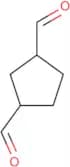
CAS:2-(1H-Indol-2-yl)phenol is a functional group that exhibits optical properties. It has a carbinol group and an acidic proton. In the excited state, it can transfer a proton to nucleophilic molecules and react with other compounds. 2-(1H-Indol-2-yl)phenol is also an important reaction product of indole synthesis. This compound has been shown to exhibit fluorescence and is a member of the phenols family.Formula:C14H11NOPurity:Min. 95%Molecular weight:209.24 g/molCyclopentane-1,3-dicarbaldehyde
CAS:Versatile small molecule scaffold
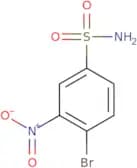
Formula:C7H10O2Purity:Min. 95%Molecular weight:126.15 g/mol4-Bromo-3-nitrobenzenesulfonamide
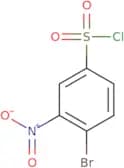
CAS:Versatile small molecule scaffoldFormula:C6H5BrN2O4SPurity:Min. 95%Molecular weight:281.08 g/mol4-Bromo-3-nitrobenzene-1-sulfonyl chloride
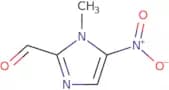
CAS:Versatile small molecule scaffoldFormula:C6H3BrClNO4SPurity:Min. 95%Molecular weight:300.52 g/mol1-Methyl-5-nitro-1H-imidazole-2-carbaldehyde
CAS:1-Methyl-5-nitro-1H-imidazole-2-carbaldehyde (MNNCA) is a synthetic fatty acid that has been shown to have genotoxic potential. It is also used as a clinical drug and as a test compound. MNNCA has been found to inhibit the activity of the antioxidant system, which may lead to an increased risk of nitrosative stress and DNA damage. In vitro assays have demonstrated that MNNCA can cause genotoxic effects in cultured cells. Studies using diminazene, a crosslinking agent, have shown that MNNCA can be metabolized by cytochrome P450 enzymes and this metabolism may lead to pharmacokinetic properties such as protein binding or changes in protein expression.Formula:C5H5N3O3Purity:Min. 95%Molecular weight:155.11 g/molN-[(4-Chlorophenyl)methyl]aniline
CAS:Versatile small molecule scaffold
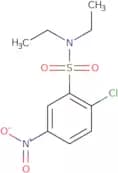
Formula:C13H12ClNPurity:Min. 95%Molecular weight:217.69 g/mol2-Chloro-N,N-diethyl-5-nitrobenzene-1-sulfonamide
CAS:Versatile small molecule scaffoldFormula:C10H13ClN2O4SPurity:Min. 95%Molecular weight:292.74 g/mol4H,5H,6H,7H,8H-Thieno[3,2-c]azepin-4-one
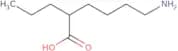
CAS:Versatile small molecule scaffoldFormula:C8H9NOSPurity:Min. 95%Molecular weight:167.23 g/mol6-Amino-2-propylhexanoic acid
CAS:Valproic acid is an organic compound with the formula (CHCO)COOH. It is a white crystalline solid that is insoluble in water and most organic solvents. Valproic acid has been used in medicine as an anticonvulsant, mood stabilizer, and bipolar disorder medication. Valproic acid is also used to treat hyperammonemia, although this use is limited by its side effects. To produce valproate semisodium, sodium carbonate and valproic acid are combined at high temperatures to form sodium valproate and carbon dioxide gas. The molecular weight of valproic acid ranges from 100-400 Da. The low molecular weight of this drug makes it suitable for oral absorption and rapid distribution throughout the body. This assay uses a chromatographic method for detection with fluorescence detection at excitation/emission wavelengths of 280/365 nm. The results show that 6-Amino-2-propylhexano
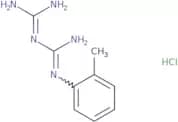
Formula:C9H19NO2Purity:Min. 95%Molecular weight:173.25 g/molo-Tolylbiguanide hydrochloride
CAS:o-Tolylbiguanide hydrochloride is a copper-containing antimicrobial agent that has been synthesised and used to treat Gram-negative bacteria. It is an anion, which means it can be reduced by agents such as formaldehyde and chloride. o-Tolylbiguanide hydrochloride binds to the anionic groups of the bacterial cell wall, which are found in proteins and lipids. This binding prevents the formation of a covalent bond between the copper ion and the bacterial cell wall, preventing further growth. The elimination of this compound in vivo is thought to be due to its organic ligands.
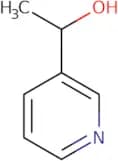
Formula:C9H14ClN5Purity:Min. 95%Molecular weight:227.69 g/mol3-(1-Hydroxyethyl)pyridine
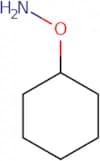
CAS:3-(1-Hydroxyethyl)pyridine is a levorotatory, white solid. It is used in animal studies to study the effects on the brain and other body systems. 3-(1-Hydroxyethyl)pyridine is synthesized by a three-step process that involves converting 3-acetylpyridine into 3-(2-hydroxyethyl)pyridine, which is then converted to 3-(1-hydroxyethyl)pyridine. This compound has been shown to be an adrenergic receptor agonist and may have some potential as a drug for treating Parkinson's disease. It also has acidic properties and substructures that are enantiopure, meaning they are composed of molecules with the same chirality.Formula:C7H9NOPurity:Min. 95%Molecular weight:123.2 g/molo-Cyclohexylhydroxylamine
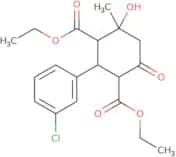
CAS:Versatile small molecule scaffoldFormula:C6H13NOPurity:Min. 95%Molecular weight:115.17 g/mol1,3-Diethyl 2-(3-chlorophenyl)-4-hydroxy-4-methyl-6-oxocyclohexane-1,3-dicarboxylate
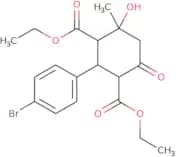
CAS:Versatile small molecule scaffoldFormula:C19H23ClO6Purity:Min. 95%Molecular weight:382.8 g/mol1,3-Diethyl 2-(4-bromophenyl)-4-hydroxy-4-methyl-6-oxocyclohexane-1,3-dicarboxylate
CAS:Versatile small molecule scaffoldFormula:C19H23BrO6Purity:Min. 95%Molecular weight:427.3 g/mol2-Bromomethyl-1,3,5-trimethylbenzene
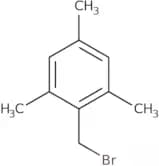
CAS:2-Bromomethyl-1,3,5-trimethylbenzene is a semivolatile organic compound with a bromophenol functional group. It has been shown to react with malic acid and pyridine ring to form two isomers. The reaction rate of this compound is higher at lower temperatures than at higher temperatures. It has been shown to be a ligand that binds metal ions and reacts with them electrochemically. 2-Bromomethyl-1,3,5-trimethylbenzene has also been used as an intermediate in the synthesis of trisaccharide ligands for coordination chemistry studies.
Formula:C10H13BrPurity:Min. 95%Molecular weight:213.11 g/mol2-acetyl-nicotinic acid ethyl ester
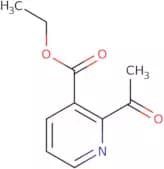
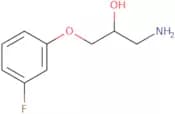
CAS:Versatile small molecule scaffoldFormula:C10H11NO3Purity:Min. 95%Molecular weight:193.2 g/mol1-Amino-3-(3-fluorophenoxy)propan-2-ol
CAS:Versatile small molecule scaffold
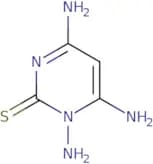
Formula:C9H12FNO2Purity:Min. 95%Molecular weight:185.2 g/mol1,4,6-Triamino-1,2-dihydropyrimidine-2-thione
CAS:1,4,6-Triamino-1,2-dihydropyrimidine-2-thione is a chemical compound that is soluble in water and methanol. It has been shown to cleave bonds by the use of sodium hydroxide solution.Formula:C4H7N5SPurity:Min. 95%Molecular weight:157.2 g/mol

![N-[(4-Chlorophenyl)methyl]aniline](/_next/image/?url=https%3A%2Fstatic.cymitquimica.com%2Fproducts%2F3D%2Fthumb-webp%2FEAA75061.webp&w=3840&q=75)
![4H,5H,6H,7H,8H-Thieno[3,2-c]azepin-4-one](/_next/image/?url=https%3A%2Fstatic.cymitquimica.com%2Fproducts%2F3D%2Fthumb-webp%2FEAA75159.webp&w=3840&q=75)