Building Blocks
This section contains fundamental products for the synthesis of organic and biological compounds. Building blocks are the essential starting materials used to construct complex molecules through various chemical reactions. They play a critical role in drug discovery, material science, and chemical research. At CymitQuimica, we offer a diverse range of high-quality building blocks to support your innovative research and industrial projects, ensuring you have the essential components for successful synthesis.
Subcategories of "Building Blocks"
- Boronic Acids & Boronic Acid Derivatives(5,756 products)
- Chiral Building Blocks(1,242 products)
- Hydrocarbon Building Blocks(6,095 products)
- Organic Building Blocks(61,055 products)
Found 199650 products of "Building Blocks"
Sort by
Purity (%)
0
100
|
0
|
50
|
90
|
95
|
100
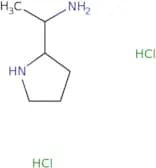
1-(Pyrrolidin-2-yl)ethan-1-amine dihydrochloride
CAS:<p>Versatile small molecule scaffold</p>Formula:C6H16Cl2N2Purity:Min. 95%Molecular weight:187.11 g/mol3-(Trifluoromethyl)thieno[3,2-b]thiophene-2-carboxylic acid
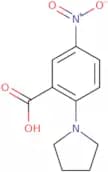
CAS:Versatile small molecule scaffoldFormula:C8H3F3O2S2Purity:Min. 95%Molecular weight:252.2 g/mol5-Nitro-2-(1-pyrrolidinyl)benzenecarboxylic acid
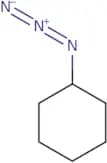
CAS:<p>Versatile small molecule scaffold</p>Formula:C11H12N2O4Purity:Min. 95%Molecular weight:236.22 g/molAzidocyclohexane
CAS:<p>Azidocyclohexane is an unsymmetrical azide that is used in pharmaceutical preparations. It is a non-selective cation, which means it can bind to both positive and negative ions. Azidocyclohexane has been shown to have a chemokine receptor activity, which may be related to its immunosuppressive effects on autoimmune diseases. Azidocyclohexane also has been found to inhibit the binding of adenosine receptors in cancer cells, which may lead to cancer cell death. In addition, azidocyclohexane may also be effective in treating inflammatory bowel disease due to its anti-inflammatory properties.</p>Formula:C6H11N3Purity:Min. 95%Molecular weight:125.17 g/mol2-{[(2-Methylphenyl)(phenyl)methoxy]methyl}oxirane
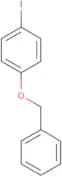
CAS:Versatile small molecule scaffoldFormula:C17H18O2Purity:Min. 95%Molecular weight:254.32 g/mol4-Iodobenzyloxybenzene
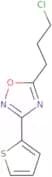
CAS:<p>4-Iodobenzyloxybenzene is an organic compound with a molecular formula of C6H5OHO. It is an aromatic hydrocarbon that can be used as a monomer for supramolecular chemistry. 4-Iodobenzyloxybenzene can also be used to introduce a clickable group to other molecules and is capable of forming nanowires in the presence of aluminium. The diameter of these nanowires can be controlled by changing the concentration of aluminium ions and temperature. This product has been shown to form complexes with water molecules, chloride, and halides.</p>Formula:IC6H4OCH2C6H5Purity:Min. 95%Molecular weight:310.13 g/mol5-(3-Chloropropyl)-3-(thiophen-2-yl)-1,2,4-oxadiazole
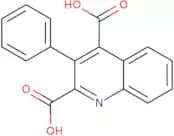
CAS:<p>Versatile small molecule scaffold</p>Formula:C9H9ClN2OSPurity:Min. 95%Molecular weight:228.7 g/mol3-Phenylquinoline-2,4-dicarboxylic acid
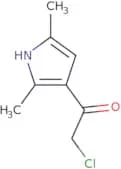
CAS:<p>Versatile small molecule scaffold</p>Formula:C17H11NO4Purity:Min. 95%Molecular weight:293.27 g/mol2-Chloro-1-(2,5-dimethyl-1H-pyrrol-3-yl)ethan-1-one
CAS:<p>Versatile small molecule scaffold</p>Formula:C8H10ClNOPurity:Min. 95%Molecular weight:171.62 g/mol2,7-Dichloro-[1,3]thiazolo[5,4-d]pyrimidine
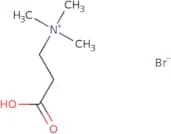
CAS:<p>Versatile small molecule scaffold</p>Formula:C5HCl2N3SPurity:Min. 95%Molecular weight:206.05 g/mol(2-Carboxyethyl)trimethylazanium bromide
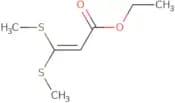
CAS:<p>Versatile small molecule scaffold</p>Formula:C6H14BrNO2Purity:Min. 95%Molecular weight:212.08 g/molEthyl 3,3-bis(methylsulfanyl)prop-2-enoate
CAS:<p>Versatile small molecule scaffold</p>Formula:C7H12O2S2Purity:Min. 95%Molecular weight:192.3 g/mol1-bromo-2-[(methylsulfanyl)methyl]benzene
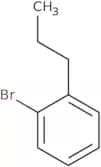
CAS:<p>Versatile small molecule scaffold</p>Formula:C8H9BrSPurity:Min. 95%Molecular weight:217.12 g/mol1-Bromo-2-propylbenzene
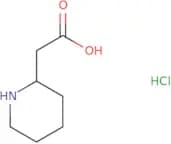
CAS:<p>Versatile small molecule scaffold</p>Formula:C9H11BrPurity:Min. 95%Molecular weight:199.09 g/mol2-(Piperidin-2-yl)acetic acid hydrochloride
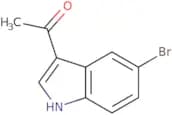
CAS:<p>2-(Piperidin-2-yl)acetic acid hydrochloride is a research chemical that is used in the synthesis of esters, solvents and other organic compounds. It is also used as a solvent in the production of pharmaceuticals. 2-(Piperidin-2-yl)acetic acid hydrochloride can be obtained by chemoenzymatic reactions or by alcoholysis of methyl esters. This compound has been shown to have the ability to act as a lipase inhibitor.</p>Formula:C7H14ClNO2Purity:Min. 95%Molecular weight:179.6 g/mol1-(5-Bromo-1H-indol-3-yl)ethanone
CAS:Controlled Product<p>Versatile small molecule scaffold</p>Formula:C10H8BrNOPurity:Min. 95%Molecular weight:238.08 g/mol2-Acetyl-2-azatricyclo[6.3.1.0,4,12]dodeca-1(12),8,10-trien-7-one
CAS:Versatile small molecule scaffoldFormula:C13H13NO2Purity:Min. 95%Molecular weight:215.25 g/molMethyl 2-[(2-methylpropyl)amino]acetate
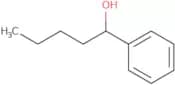
CAS:<p>Versatile small molecule scaffold</p>Formula:C7H15NO2Purity:Min. 95%Molecular weight:145.2 g/mol(1R)-1-Phenylpentan-1-ol
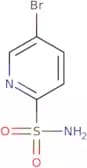
CAS:<p>Versatile small molecule scaffold</p>Formula:C11H16OPurity:Min. 95%Molecular weight:164.24 g/mol5-Bromopyridine-2-sulfonamide
CAS:<p>Versatile small molecule scaffold</p>Formula:C5H5BrN2O2SPurity:Min. 95%Molecular weight:237.08 g/mol

![3-(Trifluoromethyl)thieno[3,2-b]thiophene-2-carboxylic acid](/_next/image/?url=https%3A%2Fstatic.cymitquimica.com%2Fproducts%2F3D%2Fthumb-webp%2FTXB38863.webp&w=3840&q=75)
![2-{[(2-Methylphenyl)(phenyl)methoxy]methyl}oxirane](/_next/image/?url=https%3A%2Fstatic.cymitquimica.com%2Fproducts%2F3D%2Fthumb-webp%2FUAA57483.webp&w=3840&q=75)
![2,7-Dichloro-[1,3]thiazolo[5,4-d]pyrimidine](/_next/image/?url=https%3A%2Fstatic.cymitquimica.com%2Fproducts%2F3D%2Fthumb-webp%2FUAA60261.webp&w=3840&q=75)
![1-bromo-2-[(methylsulfanyl)methyl]benzene](/_next/image/?url=https%3A%2Fstatic.cymitquimica.com%2Fproducts%2F3D%2Fthumb-webp%2FUAA61411.webp&w=3840&q=75)
![2-Acetyl-2-azatricyclo[6.3.1.0,4,12]dodeca-1(12),8,10-trien-7-one](/_next/image/?url=https%3A%2Fstatic.cymitquimica.com%2Fproducts%2F3D%2Fthumb-webp%2FUAA62115.webp&w=3840&q=75)
![Methyl 2-[(2-methylpropyl)amino]acetate](/_next/image/?url=https%3A%2Fstatic.cymitquimica.com%2Fproducts%2F3D%2Fthumb-webp%2FUAA62856.webp&w=3840&q=75)