Building Blocks
This section contains fundamental products for the synthesis of organic and biological compounds. Building blocks are the essential starting materials used to construct complex molecules through various chemical reactions. They play a critical role in drug discovery, material science, and chemical research. At CymitQuimica, we offer a diverse range of high-quality building blocks to support your innovative research and industrial projects, ensuring you have the essential components for successful synthesis.
Subcategories of "Building Blocks"
- Boronic Acids & Boronic Acid Derivatives(5,756 products)
- Chiral Building Blocks(1,242 products)
- Hydrocarbon Building Blocks(6,095 products)
- Organic Building Blocks(61,038 products)
Found 196817 products of "Building Blocks"
Sort by
Purity (%)
0
100
|
0
|
50
|
90
|
95
|
100
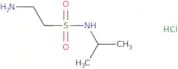
2-Amino-N-(propan-2-yl)ethane-1-sulfonamide hydrochloride
CAS:<p>Versatile small molecule scaffold</p>Formula:C5H15ClN2O2SPurity:Min. 95%Molecular weight:202.7 g/molPerfluorophenyl methanesulfonate
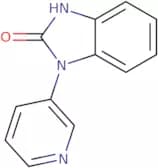
CAS:<p>Perfluorophenyl methanesulfonate is an organic solvent. It is a colorless liquid that is soluble in water and in most organic solvents. The chemical formula for perfluorophenyl methanesulfonate is C6F5OCH3SO3Cl. This compound has the structural formula of CH2=C(O)CH2-CF3SO3Cl. Perfluorophenyl methanesulfonate can be used as a formylating agent to convert alcohols, amines, or carboxylic acids into their corresponding formates, amides, or acid chlorides. It can also be used as an additive to petroleum products to increase the boiling point of hydrocarbons by adding a formyl group to the hydrocarbon chain. Other uses include as a divalent hydrocarbon in alkynyl groups and alkoxycarbonyl groups and as a skeleton for phosphoryl groups.</p>Formula:C7H3F5O3SPurity:Min. 95%Molecular weight:262.15 g/mol1-(Pyridin-3-yl)-2,3-dihydro-1H-1,3-benzodiazol-2-one
CAS:<p>Versatile small molecule scaffold</p>Formula:C12H9N3OPurity:Min. 95%Molecular weight:211.22 g/mol4-[2-(tert-Butoxy)-2-oxoethoxy]benzoic acid
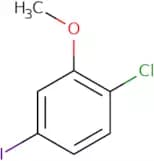
CAS:<p>Versatile small molecule scaffold</p>Formula:C13H16O5Purity:Min. 95%Molecular weight:252.26 g/mol2-Chloro-5-iodoanisole
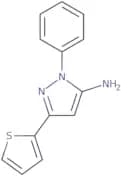
CAS:<p>Versatile small molecule scaffold</p>Formula:C7H6ClIOPurity:Min. 95%Molecular weight:268.48 g/mol1-Phenyl-3-(thiophen-2-yl)-1H-pyrazol-5-amine
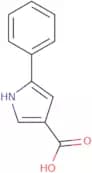
CAS:<p>Versatile small molecule scaffold</p>Formula:C13H11N3SPurity:Min. 95%Molecular weight:241.31 g/mol5-Phenyl-1H-pyrrole-3-carboxylic acid
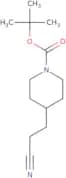
CAS:<p>Versatile small molecule scaffold</p>Formula:C11H9NO2Purity:Min. 95%Molecular weight:187.19 g/molTert-Butyl 4-(2-Cyanoethyl)Piperidine-1-Carboxylate
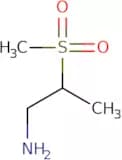
CAS:<p>Versatile small molecule scaffold</p>Formula:C13H22N2O2Purity:Min. 95%Molecular weight:238.33 g/mol2-Methanesulfonylpropan-1-amine
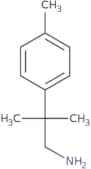
CAS:<p>Versatile small molecule scaffold</p>Formula:C4H11NO2SPurity:Min. 95%Molecular weight:137.2 g/mol2-Methyl-2-p-tolyl-propylamine
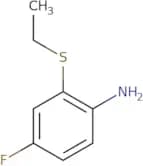
CAS:<p>2-Methyl-2-p-tolyl-propylamine (MPTP) is an aromatic compound that has been shown to have some biologic activity. MPTP was first synthesized in the lab of Dr. K.B. Sharpless and his team at Duke University in 1979, who were attempting to make an inhibitor for monoamine oxidase B (MAO-B). MAO-B is a type of enzyme that breaks down the neurotransmitter dopamine, which is involved in the regulation of movement and emotions. The synthesis of MPTP was abandoned when it was found that the compound was instead metabolized into a neurotoxin called 1-methyl-4-phenylpyridinium (MPP+), which caused Parkinson's disease in mice.<br>MPTP causes cell death by inhibiting mitochondrial complex I, which produces adenosine triphosphate (ATP) needed for cell function, leading to cell death through apoptosis or necrosis</p>Formula:C11H17NPurity:Min. 95%Molecular weight:163.26 g/mol2-(Ethylsulfanyl)-4-fluoroaniline
CAS:<p>Versatile small molecule scaffold</p>Formula:C8H10FNSPurity:Min. 95%Molecular weight:171.24 g/mol2-[(Tetrahydro-2H-pyran-4-yl)amino]ethanol
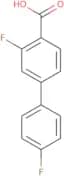
CAS:<p>Versatile small molecule scaffold</p>Formula:C7H15NO2Purity:Min. 95%Molecular weight:145.2 g/moltert-Butyl 2-(4-amino-1H-pyrazol-1-yl)acetate
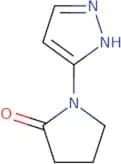
CAS:<p>Versatile small molecule scaffold</p>Formula:C9H15N3O2Purity:Min. 95%Molecular weight:197.23 g/mol4-(4-Fluorophenyl)-2-fluorobenzoic acid
CAS:<p>Versatile small molecule scaffold</p>Formula:C13H8F2O2Purity:Min. 95%Molecular weight:234.2 g/mol1-(1H-Pyrazol-3-yl)pyrrolidin-2-one
CAS:<p>Versatile small molecule scaffold</p>Formula:C7H9N3OPurity:Min. 95%Molecular weight:151.17 g/mol(2E)-3-[4-Methoxy-3-(methylsulfamoyl)phenyl]prop-2-enoic acid
CAS:<p>Versatile small molecule scaffold</p>Formula:C11H13NO5SPurity:Min. 95%Molecular weight:271.29 g/mol(2E)-3-{4-Methoxy-3-[(propan-2-yl)sulfamoyl]phenyl}prop-2-enoic acid
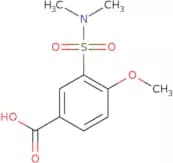
CAS:<p>Versatile small molecule scaffold</p>Formula:C13H17NO5SPurity:Min. 95%Molecular weight:299.34 g/mol3-(Dimethylsulfamoyl)-4-methoxybenzoic acid
CAS:<p>Versatile small molecule scaffold</p>Formula:C10H13NO5SPurity:Min. 95%Molecular weight:259.28 g/mol3-[({[4-(Ethoxycarbonyl)phenyl]carbamoyl}methyl)sulfanyl]propanoic acid
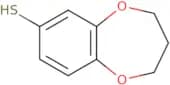
CAS:Controlled Product<p>3-[({[4-(Ethoxycarbonyl)phenyl]carbamoyl}methyl)sulfanyl]propanoic acid is a research tool that is used as an activator of various receptors, ligands, and ion channels. This compound binds to the ligand binding site of the receptor and causes activation by increasing the rate of ligand-receptor interactions. 3-[({[4-(Ethoxycarbonyl)phenyl]carbamoyl}methyl)sulfanyl]propanoic acid has been shown to inhibit protein synthesis in cells by inhibiting peptide bond formation.</p>Formula:C14H17NO5SPurity:Min. 95%Molecular weight:311.36 g/mol3,4-Dihydro-2H-1,5-benzodioxepine-7-thiol
CAS:<p>Versatile small molecule scaffold</p>Formula:C9H10O2SPurity:Min. 95%Molecular weight:182.24 g/mol


![4-[2-(tert-Butoxy)-2-oxoethoxy]benzoic acid](/_next/image/?url=https%3A%2Fstatic.cymitquimica.com%2Fproducts%2F3D%2Fthumb-webp%2FLGA94880.webp&w=3840&q=75)
![2-[(Tetrahydro-2H-pyran-4-yl)amino]ethanol](/_next/image/?url=https%3A%2Fstatic.cymitquimica.com%2Fproducts%2F3D%2Fthumb-webp%2FLGB68400.webp&w=3840&q=75)

![(2E)-3-[4-Methoxy-3-(methylsulfamoyl)phenyl]prop-2-enoic acid](/_next/image/?url=https%3A%2Fstatic.cymitquimica.com%2Fproducts%2F3D%2Fthumb-webp%2FLGB72886.webp&w=3840&q=75)
![(2E)-3-{4-Methoxy-3-[(propan-2-yl)sulfamoyl]phenyl}prop-2-enoic acid](/_next/image/?url=https%3A%2Fstatic.cymitquimica.com%2Fproducts%2F3D%2Fthumb-webp%2FLGB72887.webp&w=3840&q=75)
![3-[({[4-(Ethoxycarbonyl)phenyl]carbamoyl}methyl)sulfanyl]propanoic acid](/_next/image/?url=https%3A%2Fstatic.cymitquimica.com%2Fproducts%2F3D%2Fthumb-webp%2FLGB72890.webp&w=3840&q=75)