Building Blocks
This section contains fundamental products for the synthesis of organic and biological compounds. Building blocks are the essential starting materials used to construct complex molecules through various chemical reactions. They play a critical role in drug discovery, material science, and chemical research. At CymitQuimica, we offer a diverse range of high-quality building blocks to support your innovative research and industrial projects, ensuring you have the essential components for successful synthesis.
Subcategories of "Building Blocks"
- Boronic Acids & Boronic Acid Derivatives(5,756 products)
- Chiral Building Blocks(1,242 products)
- Hydrocarbon Building Blocks(6,095 products)
- Organic Building Blocks(61,038 products)
Found 196817 products of "Building Blocks"
Sort by
Purity (%)
0
100
|
0
|
50
|
90
|
95
|
100
5-[(1,3-Benzothiazol-2-ylsulfanyl)methyl]-4-phenyl-4H-1,2,4-triazole-3-thiol
CAS:<p>Versatile small molecule scaffold</p>Formula:C16H12N4S3Purity:Min. 95%Molecular weight:356.5 g/molN-[4-(Propan-2-yl)phenyl]benzenesulfonamide
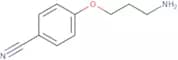
CAS:<p>Versatile small molecule scaffold</p>Formula:C15H17NO2SPurity:Min. 95%Molecular weight:275.4 g/mol4-(3-Aminopropoxy)benzonitrile
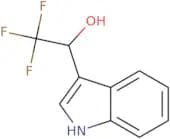
CAS:<p>Versatile small molecule scaffold</p>Formula:C10H12N2OPurity:Min. 95%Molecular weight:176.21 g/mol2,2,2-Trifluoro-1-(1H-indol-3-yl)ethan-1-ol
CAS:<p>Versatile small molecule scaffold</p>Formula:C10H8F3NOPurity:Min. 95%Molecular weight:215.17 g/molN-[2-(Pyrrolidin-1-yl)ethyl]acetamide
CAS:<p>N-[2-(Pyrrolidin-1-yl)ethyl]acetamide is a synthetic, non-narcotic analgesic that is used to treat moderate to severe pain. It has been shown to have affinity for the adenosine A1 receptor and antagonistic properties. N-[2-(Pyrrolidin-1-yl)ethyl]acetamide blocks receptors in the central nervous system by inhibiting the binding of adenosine molecules to their specific receptors. This prevents the formation of cyclic AMP, which is involved in many biological processes including protein synthesis and cell division.</p>Formula:C8H16N2OPurity:Min. 95%Molecular weight:156.23 g/mol5-Chlorofuran-3-carboxylic acid
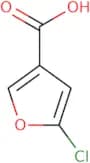
CAS:<p>Versatile small molecule scaffold</p>Formula:C5H3ClO3Purity:Min. 95%Molecular weight:146.53 g/mol1-(1-Trityl-1H-imidazol-4-yl)ethanone
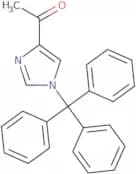
CAS:<p>Versatile small molecule scaffold</p>Formula:C24H20N2OPurity:Min. 95%Molecular weight:352.4 g/mol1-Methyl-4-(pyrrolidine-2-carbonyl)piperazine
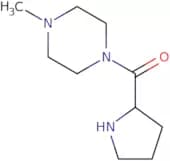
CAS:<p>Versatile small molecule scaffold</p>Formula:C10H19N3OPurity:Min. 95%Molecular weight:197.28 g/mol2-(4-Hydroxypiperidin-1-yl)acetamide
CAS:<p>Versatile small molecule scaffold</p>Formula:C7H14N2O2Purity:Min. 95%Molecular weight:158.2 g/mol4-Hydroxy-1-methyl-1H-pyrazolo[3,4-b]pyridine-5-carbonitrile
CAS:<p>Versatile small molecule scaffold</p>Formula:C8H6N4OPurity:Min. 95%Molecular weight:174.16 g/mol8-Bromoquinolin-5-ol
CAS:<p>Versatile small molecule scaffold</p>Formula:C9H6BrNOPurity:Min. 95%Molecular weight:224.05 g/mol1-Methyl-1H-pyrazolo[3,4-b]pyridine-3-carboxylic acid
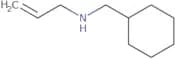
CAS:<p>Versatile small molecule scaffold</p>Formula:C8H7N3O2Purity:Min. 95%Molecular weight:177.16 g/mol(Cyclohexylmethyl)(prop-2-en-1-yl)amine
CAS:<p>Versatile small molecule scaffold</p>Formula:C10H19NPurity:Min. 95%Molecular weight:153.26 g/mol4,4-dimethyl-3,5-dioxa-8-azatricyclo[5.2.1.0²,]decan-9-one
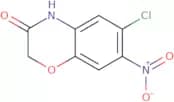
CAS:<p>Versatile small molecule scaffold</p>Formula:C9H13NO3Purity:Min. 95%Molecular weight:183.21 g/mol6-Chloro-7-nitro-2H-1,4-benzoxazin-3(4H)-one
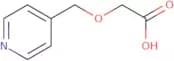
CAS:<p>Versatile small molecule scaffold</p>Formula:C8H5ClN2O4Purity:Min. 95%Molecular weight:228.59 g/mol2-(Pyridin-4-ylmethoxy)acetic acid
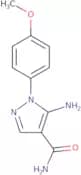
CAS:<p>Versatile small molecule scaffold</p>Formula:C8H9NO3Purity:Min. 95%Molecular weight:167.16 g/mol5-Amino-1-(4-methoxyphenyl)-1H-pyrazole-4-carboxamide
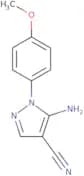
CAS:<p>Versatile small molecule scaffold</p>Formula:C11H12N4O2Purity:Min. 95%Molecular weight:232.24 g/mol5-Amino-1-(4-methoxyphenyl)-1H-pyrazole-4-carbonitrile
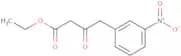
CAS:<p>Versatile small molecule scaffold</p>Formula:C11H10N4OPurity:Min. 95%Molecular weight:214.23 g/molEthyl 4-(3-nitrophenyl)-3-oxobutanoate
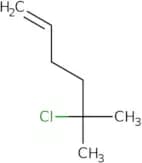
CAS:<p>Versatile small molecule scaffold</p>Formula:C12H13NO5Purity:Min. 95%Molecular weight:251.23 g/mol5-Chloro-5-methylhex-1-ene
CAS:<p>5-Chloro-5-methylhex-1-ene is an odorant that has been used as a probe for olfactory receptors. 5-Chloro-5-methylhex-1-ene activates a g protein coupled receptor (GPCR) and is able to bind to the odorant binding site of the GPCR. The spatial arrangement of the methyl groups on the cyclopentane ring are important in determining which GPCRs it can bind to. 5CMH has been synthesized in a chiral fashion, with enantiomers having different odors. This compound is an enantioselective agonist for some GPCRs, but not others. It also exists as two enantiomers, differing only by the orientation of one chiral center.</p>Formula:C7H13ClPurity:Min. 95%Molecular weight:132.63 g/mol
![5-[(1,3-Benzothiazol-2-ylsulfanyl)methyl]-4-phenyl-4H-1,2,4-triazole-3-thiol](/_next/image/?url=https%3A%2Fstatic.cymitquimica.com%2Fproducts%2F3D%2Fthumb-webp%2FREA71050.webp&w=3840&q=75)

![N-[4-(Propan-2-yl)phenyl]benzenesulfonamide](/_next/image/?url=https%3A%2Fstatic.cymitquimica.com%2Fproducts%2F3D%2Fthumb-webp%2FREA75256.webp&w=3840&q=75)
![N-[2-(Pyrrolidin-1-yl)ethyl]acetamide](/_next/image/?url=https%3A%2Fstatic.cymitquimica.com%2Fproducts%2F3D%2Fthumb-webp%2FREA77381.webp&w=3840&q=75)

![4-Hydroxy-1-methyl-1H-pyrazolo[3,4-b]pyridine-5-carbonitrile](/_next/image/?url=https%3A%2Fstatic.cymitquimica.com%2Fproducts%2F3D%2Fthumb-webp%2FREA83513.webp&w=3840&q=75)

![1-Methyl-1H-pyrazolo[3,4-b]pyridine-3-carboxylic acid](/_next/image/?url=https%3A%2Fstatic.cymitquimica.com%2Fproducts%2F3D%2Fthumb-webp%2FREA85509.webp&w=3840&q=75)
![4,4-dimethyl-3,5-dioxa-8-azatricyclo[5.2.1.0²,]decan-9-one](/_next/image/?url=https%3A%2Fstatic.cymitquimica.com%2Fproducts%2F3D%2Fthumb-webp%2FREA85649.webp&w=3840&q=75)