Building Blocks
This section contains fundamental products for the synthesis of organic and biological compounds. Building blocks are the essential starting materials used to construct complex molecules through various chemical reactions. They play a critical role in drug discovery, material science, and chemical research. At CymitQuimica, we offer a diverse range of high-quality building blocks to support your innovative research and industrial projects, ensuring you have the essential components for successful synthesis.
Subcategories of "Building Blocks"
- Boronic Acids & Boronic Acid Derivatives(5,756 products)
- Chiral Building Blocks(1,242 products)
- Hydrocarbon Building Blocks(6,095 products)
- Organic Building Blocks(61,055 products)
Found 199650 products of "Building Blocks"
Sort by
Purity (%)
0
100
|
0
|
50
|
90
|
95
|
100
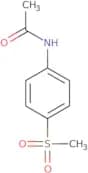
4'-(Methylsulfonyl)acetanilide
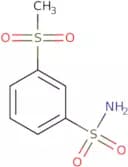
CAS:<p>4'-(Methylsulfonyl)acetanilide is an organic compound that has been shown to have antibacterial and antiviral activity. It targets the benzene nucleus, and inhibits the synthesis of nucleic acids by inhibiting the enzyme ribonucleotide reductase. 4'-(Methylsulfonyl)acetanilide also inhibits viral replication, by binding to the active site of a viral protein (a DNA polymerase), which blocks the incorporation of nucleotides into the virus's DNA. In addition, 4'-(methylsulfonyl)acetanilide is an anti-helminthic agent, as it can inhibit worm motility and kill larvae in vitro. The structure-activity relationships between this molecule and other benzimidazole derivatives were analysed in order to identify new potential drugs for treating diseases caused by viruses or parasites.</p>Formula:C9H11NO3SPurity:Min. 95%Molecular weight:213.26 g/mol3-Methanesulfonylbenzene-1-sulfonamide
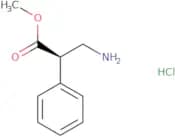
CAS:<p>Versatile small molecule scaffold</p>Formula:C7H9NO4S2Purity:Min. 95%Molecular weight:235.3 g/molMethyl (3R)-3-amino-3-phenylpropanoate hydrochloride
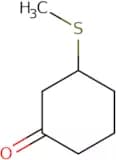
CAS:Versatile small molecule scaffoldFormula:C10H13NO2·HClPurity:Min. 95%Molecular weight:215.68 g/mol3-(Methylsulfanyl)cyclohexan-1-one
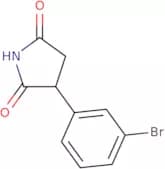
CAS:<p>Versatile small molecule scaffold</p>Formula:C7H12OSPurity:Min. 95%Molecular weight:144.24 g/mol3-(3-Bromophenyl)pyrrolidine-2,5-dione
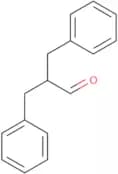
CAS:<p>3-(3-Bromophenyl)pyrrolidine-2,5-dione is a targetable iontophoretic drug that binds to the skin. It is used for the treatment of inflammatory and neuropathic pain. 3-(3-Bromophenyl)pyrrolidine-2,5-dione has been shown to be effective in both hydrophobic and hydrophilic environments, meaning it can be used in both diluents and in water. The drug is insoluble in water and has an activity index of 0.9. 3-(3-Bromophenyl)pyrrolidine-2,5-dione has a molecular electrostatic potential of -1.7eV, which makes it a good candidate for use with iontophoresis devices (devices that deliver drugs through the skin by passing a current across the skin). The drug is also targeted to specific cells or tissues because of its high concentration.</p>Formula:C10H8BrNO2Purity:Min. 95%Molecular weight:254.08 g/mol2-Benzyl-3-phenylpropanal
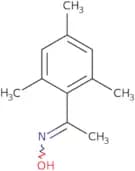
CAS:<p>Versatile small molecule scaffold</p>Formula:C16H16OPurity:Min. 95%Molecular weight:224.3 g/molEthanone, 1-(2,4,6-trimethylphenyl)-, oxime
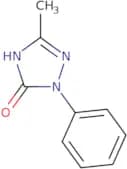
CAS:<p>Ethanone, 1-(2,4,6-trimethylphenyl)-, oxime (1) is an electron-rich oxime with a geometry of C(3)h. It has a dihedral angle of 194.5° and a rotational constant of 3.037 cm-1. The major substituents on the benzene ring are methyl groups at positions 2 and 6, which have constants of 0.898 and 1.922 Å respectively. The molecule has a crystal structure with space group P21/n with unit cell dimensions of a = 12.738 Å, b = 12.738 Å, c = 13.096 Å and β = 102°</p>Formula:C11H15NOPurity:Min. 95%Molecular weight:177.24 g/mol3-Methyl-1-phenyl-4,5-dihydro-1H-1,2,4-triazol-5-one
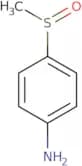
CAS:Versatile small molecule scaffoldFormula:C9H9N3OPurity:Min. 95%Molecular weight:175.19 g/mol4-Methanesulfinylaniline
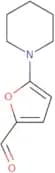
CAS:<p>4-Methanesulfinylaniline is a chemical compound that has been used as an inhibitor of cyclooxygenase-2 (COX-2) and COX-1. This drug has been shown to be effective in animal models of inflammation and hyperalgesia. 4-Methanesulfinylaniline is a regioisomeric inhibitor of COX, which means that it binds to the enzyme at a different location from other drugs. The pharmacological effects of this drug are due to its ability to inhibit the production of prostaglandins, leading to anti-inflammatory effects.</p>Formula:C7H9NOSPurity:Min. 95%Molecular weight:155.22 g/mol5-Piperidin-1-yl-furan-2-carbaldehyde
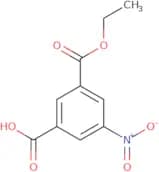
CAS:<p>5-Piperidin-1-yl-furan-2-carbaldehyde is a compound that was first isolated from tobacco. It is an organic chemical that can be used as a solvent and in the manufacture of other chemicals. The analytical method for 5-Piperidin-1-yl-furan-2-carbaldehyde includes gas chromatography/mass spectrometry. This technique separates the compound by its different boiling points, which are then analyzed by mass spectrometry to determine the identity and quantity of each component.</p>Formula:C10H13NO2Purity:Min. 95%Molecular weight:179.22 g/mol5-Nitroisophthalic acid monoethyl ester
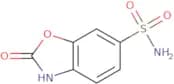
CAS:<p>5-Nitroisophthalic acid monoethyl ester is an organic compound that belongs to the group of nitro compounds. It has a molecular weight of 188.1 g/mol and the chemical formula C6H4(NO2)2OCH2CH3. The crystallographic data were collected in two different crystallization experiments and show a monoclinic crystal structure with space group P21/n, lattice constants a = 8.852(3) Å, b = 7.959(3) Å, c = 11.411(4) Å, β = 98.532(10)°, and Z = 4. The molecular structure was determined by X-ray diffraction analysis with Bruker D8 Advanced Diffractometer at 100 Kv using CuKα radiation (λ=0.1542 nm). This compound is an isotropic solid that is soluble in benzene and methanol, but</p>Formula:C10H9NO6Purity:Min. 95%Molecular weight:239.18 g/mol2-Oxo-2,3-dihydro-1,3-benzoxazole-6-sulfonamide
CAS:<p>Versatile small molecule scaffold</p>Formula:C7H6N2O4SPurity:Min. 95%Molecular weight:214.2 g/mol2-[(p-chlorobenzyl)amino]-pyridine
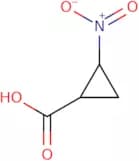
CAS:<p>2-[(p-chlorobenzyl)amino]-pyridine is a chemical compound that belongs to the group of aliphatic alcohols. It can be prepared by reacting 2-aminopyridine with sodium borohydride and an inorganic acid. This reaction yields a mixture of 2-[(p-chlorobenzyl)amino]-pyridine, hydroxylamine hydrochloride, and sodium chloride. Hydroxylamine hydrochloride can be removed from the mixture by azeotropic distillation. The product is used as a reducing agent for reductive amination reactions or as a catalyst for aliphatic hydrocarbon reductions.</p>Formula:C12H11ClN2Purity:Min. 95%Molecular weight:218.68 g/mol(1S,2S)-2-Nitrocyclopropanecarboxylic acid
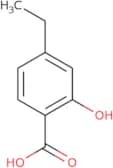
CAS:<p>(1S,2S)-2-Nitrocyclopropanecarboxylic acid is a β-unsaturated carboxylic acid that catalyzes the cyclopropanation of 1,3-dienes. It is used as a catalyst to produce synlett products by asymmetric addition to α,β-unsaturated carbonyls with thiourea. (1S,2S)-2-Nitrocyclopropanecarboxylic acid has been shown to be an effective organocatalyst for asymmetric synthesis of chiral compounds.</p>Formula:C4H5NO4Purity:Min. 95%Molecular weight:131.09 g/mol4-Ethyl-2-hydroxybenzoic acid
CAS:<p>4-Ethyl-2-hydroxybenzoic acid is a molecule that has been shown to inhibit the growth of tumor cells by binding to tubulin and preventing polymerization. 4-Ethyl-2-hydroxybenzoic acid also inhibits the formation of colchicine binding sites on tubulin, which prevents colchicine from binding and inhibiting microtubule assembly. This compound has potent antiproliferative activity against a variety of cell lines and may be useful in elucidating the mechanism of action of colchicine.</p>Formula:C9H10O3Purity:Min. 95%Molecular weight:166.17 g/mol2-Chloro-N-[(2-nitrophenyl)methyl]acetamide
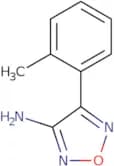
CAS:<p>Versatile small molecule scaffold</p>Formula:C9H9ClN2O3Purity:Min. 95%Molecular weight:228.63 g/mol4-(2-Methylphenyl)-1,2,5-oxadiazol-3-amine
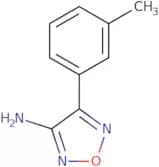
CAS:Versatile small molecule scaffoldFormula:C9H9N3OPurity:Min. 95%Molecular weight:175.19 g/mol4-(3-Methylphenyl)-1,2,5-oxadiazol-3-amine
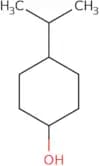
CAS:<p>Versatile small molecule scaffold</p>Formula:C9H9N3OPurity:Min. 95%Molecular weight:175.19 g/mol(1S,4S)-4-(Propan-2-yl)cyclohexan-1-ol
CAS:<p>(1S,4S)-4-(Propan-2-yl)cyclohexan-1-ol is a synthetic compound that has been used in skin care products. It is more potent than cyclohexanol and it has been shown to be stereoselective. In addition, it is hydrolyzed by alcohol dehydrogenases to form hydrochloric acid, which can activate chloride ions. (1S,4S)-4-(Propan-2-yl)cyclohexan-1-ol has also been shown to react with the skin protein ankyrin, leading to a change in the kinetic parameters of the reaction.</p>Formula:C9H18OPurity:Min. 95%Molecular weight:142.24 g/mol2-Deoxy-D-riboside
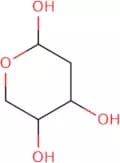
CAS:<p>2-Deoxy-D-riboside is a natural product that is an intermediate in the synthesis of ribose and deoxyribose. It has shown hypotensive and anti-inflammatory effects, as well as being an activator of ribose and galactose metabolism. In addition, it has been shown to inhibit tumor cell growth in culture. 2-Deoxy-D-riboside also inhibits the activity of the enzyme glycosyl transferase, which is involved in the synthesis of glycoproteins from a variety of sugars. It has been shown to inhibit recrystallization in reaction solutions.</p>Formula:C5H10O4Purity:Min. 95%Molecular weight:134.13 g/mol

![2-[(p-chlorobenzyl)amino]-pyridine](/_next/image/?url=https%3A%2Fstatic.cymitquimica.com%2Fproducts%2F3D%2Fthumb-webp%2FXAA88133.webp&w=3840&q=75)
![2-Chloro-N-[(2-nitrophenyl)methyl]acetamide](/_next/image/?url=https%3A%2Fstatic.cymitquimica.com%2Fproducts%2F3D%2Fthumb-webp%2FXAA89607.webp&w=3840&q=75)