Building Blocks
This section contains fundamental products for the synthesis of organic and biological compounds. Building blocks are the essential starting materials used to construct complex molecules through various chemical reactions. They play a critical role in drug discovery, material science, and chemical research. At CymitQuimica, we offer a diverse range of high-quality building blocks to support your innovative research and industrial projects, ensuring you have the essential components for successful synthesis.
Subcategories of "Building Blocks"
- Boronic Acids & Boronic Acid Derivatives(5,778 products)
- Chiral Building Blocks(1,242 products)
- Hydrocarbon Building Blocks(6,098 products)
- Organic Building Blocks(61,092 products)
Found 199296 products of "Building Blocks"
Sort by
Purity (%)
0
100
|
0
|
50
|
90
|
95
|
100
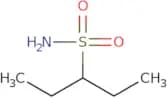
Pentane-3-sulfonamide
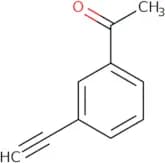
CAS:<p>Versatile small molecule scaffold</p>Formula:C5H13NO2SPurity:Min. 95%Molecular weight:151.23 g/mol1-(3-Ethynylphenyl)ethan-1-one
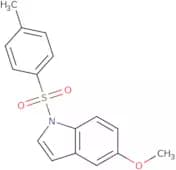
CAS:<p>Versatile small molecule scaffold</p>Formula:C10H8OPurity:Min. 95%Molecular weight:144.17 g/mol5-Methoxy-1-tosyl-1H-indole
CAS:<p>Versatile small molecule scaffold</p>Formula:C16H15NO3SPurity:Min. 95%Molecular weight:301.4 g/mol4-[(1H-Benzimidazol-1-yl)methyl]benzoic acid
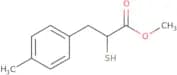
CAS:<p>4-[(1H-Benzimidazol-1-yl)methyl]benzoic acid is an ionic compound. The anion has a focus with a radius of 2.6 Å and the cation has a radius of 1.9 Å. It is stable in aqueous solution and reacts with chloride to form the salt 4-[(1H-Benzimidazol-1-yl)methyl]benzoyl chloride, which is colorless, crystalline, and soluble in water. This compound can be used for analyzing ligands that bind to lanthanide ions (e.g., lanthanum). The analyzes of frameworks have been carried out by single crystal x-ray diffraction methods and fluorescence spectroscopy parameters are given in Table 1.</p>Formula:C15H12N2O2Purity:Min. 95%Molecular weight:252.27 g/molMethyl 3-(4-methylphenyl)-2-sulfanylpropanoate
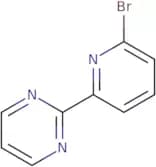
CAS:<p>Versatile small molecule scaffold</p>Formula:C11H14O2SPurity:Min. 95%Molecular weight:210.29 g/mol2-(6-Bromopyridin-2-yl)pyrimidine
CAS:<p>Versatile small molecule scaffold</p>Formula:C9H6BrN3Purity:Min. 95%Molecular weight:236.07 g/mol3-[[[5-(Aminocarbonyl)-1-methyl-3-propyl-1H-pyrazol-4-yl]amino]carbonyl]-4-propoxybenzene
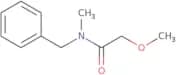
CAS:<p>Versatile small molecule scaffold</p>Formula:C18H24N4O3Purity:Min. 95%Molecular weight:344.41 g/molN-Benzyl-2-methoxy-N-methylacetamide
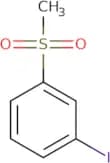
CAS:<p>Versatile small molecule scaffold</p>Formula:C11H15NO2Purity:Min. 95%Molecular weight:193.24 g/mol1-Iodo-3-methanesulfonylbenzene
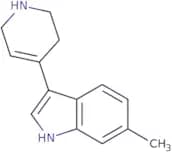
CAS:<p>Versatile small molecule scaffold</p>Formula:C7H7IO2SPurity:Min. 95%Molecular weight:282.1 g/mol6-Methyl-3-(1,2,3,6-tetrahydropyridin-4-yl)-1H-indole
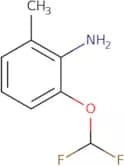
CAS:Versatile small molecule scaffoldFormula:C14H16N2Purity:Min. 95%Molecular weight:212.29 g/mol2-(Difluoromethoxy)-6-methylaniline
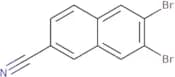
CAS:<p>Versatile small molecule scaffold</p>Formula:C8H9F2NOPurity:Min. 95%Molecular weight:173.16 g/mol6,7-dibromonaphthalene-2-carbonitrile
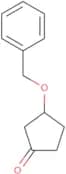
CAS:Versatile small molecule scaffoldFormula:C11H5Br2NPurity:Min. 95%Molecular weight:311 g/mol3-(Benzyloxy)cyclopentan-1-one
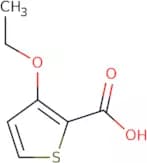
CAS:<p>Versatile small molecule scaffold</p>Formula:C12H14O2Purity:Min. 95%Molecular weight:190.24 g/mol3-Ethoxythiophene-2-carboxylic acid
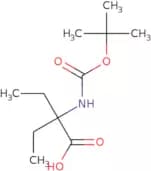
CAS:Versatile small molecule scaffoldFormula:C7H8O3SPurity:Min. 95%Molecular weight:172.2 g/mol2-(Boc-amino)-2-ethyl-butanoic acid
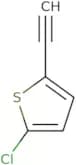
CAS:<p>Versatile small molecule scaffold</p>Formula:C11H21NO4Purity:Min. 95%Molecular weight:231.29 g/mol2-Chloro-5-ethynylthiophene
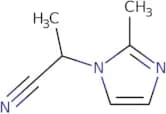
CAS:<p>2-Chloro-5-ethynylthiophene (2CET) is a x-ray crystal structure that exhibits potent adenosine receptor antagonist activity. 2CET binds to the adenosine receptor in a noncompetitive manner and blocks the receptor, preventing the activation of G proteins. The binding of 2CET to the adenosine receptor leads to an increase in adenine nucleotide levels, which may contribute to its antihypertensive properties. 2CET has also been shown to be a potent agonist at A1 and A2A receptors. It was found that 2CET bound with high affinity to both receptors, but only activated A1 receptors. This indicates that 2CET is capable of stimulating cAMP production without activating other G protein coupled receptors such as angiotensin II type 1 or muscarinic acetylcholine receptors.</p>Formula:C6H3ClSPurity:Min. 95%Molecular weight:142.61 g/mol2-(2-Methyl-1H-imidazol-1-yl)propanenitrile
CAS:<p>Versatile small molecule scaffold</p>Formula:C7H9N3Purity:Min. 95%Molecular weight:135.17 g/mol2-(4-Methoxyphenyl)-1H-pyrrolo[2,3-b]pyridine
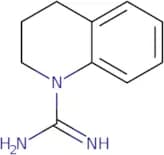
CAS:<p>Versatile small molecule scaffold</p>Formula:C14H12N2OPurity:Min. 95%Molecular weight:224.26 g/mol1,2,3,4-Tetrahydroquinoline-1-carboximidamide
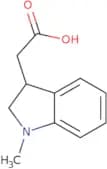
CAS:<p>Versatile small molecule scaffold</p>Formula:C10H13N3Purity:Min. 95%Molecular weight:175.23 g/mol2-(1-Methyl-2,3-dihydro-1H-indol-3-yl)acetic acid
CAS:Versatile small molecule scaffoldFormula:C11H13NO2Purity:Min. 95%Molecular weight:191.23 g/mol

![4-[(1H-Benzimidazol-1-yl)methyl]benzoic acid](/_next/image/?url=https%3A%2Fstatic.cymitquimica.com%2Fproducts%2F3D%2Fthumb-webp%2FPFA74250.webp&w=3840&q=75)
![3-[[[5-(Aminocarbonyl)-1-methyl-3-propyl-1H-pyrazol-4-yl]amino]carbonyl]-4-propoxybenzene](/_next/image/?url=https%3A%2Fstatic.cymitquimica.com%2Fproducts%2F3D%2Fthumb-webp%2FPFA75604.webp&w=3840&q=75)
![2-(4-Methoxyphenyl)-1H-pyrrolo[2,3-b]pyridine](/_next/image/?url=https%3A%2Fstatic.cymitquimica.com%2Fproducts%2F3D%2Fthumb-webp%2FPFA96268.webp&w=3840&q=75)