Building Blocks
This section contains fundamental products for the synthesis of organic and biological compounds. Building blocks are the essential starting materials used to construct complex molecules through various chemical reactions. They play a critical role in drug discovery, material science, and chemical research. At CymitQuimica, we offer a diverse range of high-quality building blocks to support your innovative research and industrial projects, ensuring you have the essential components for successful synthesis.
Subcategories of "Building Blocks"
- Boronic Acids & Boronic Acid Derivatives(5,781 products)
- Chiral Building Blocks(1,242 products)
- Hydrocarbon Building Blocks(6,101 products)
- Organic Building Blocks(61,033 products)
Found 205320 products of "Building Blocks"
Sort by
Purity (%)
0
100
|
0
|
50
|
90
|
95
|
100
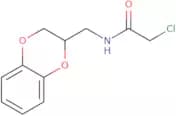
2-Chloro-N-(2,3-dihydro-1,4-benzodioxin-2-ylmethyl)acetamide
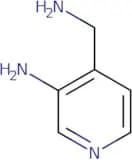
CAS:Versatile small molecule scaffoldFormula:C11H12ClNO3Purity:Min. 95%Molecular weight:241.67 g/mol4-(Aminomethyl)pyridin-3-amine
CAS:Versatile small molecule scaffold
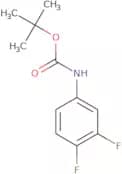
Formula:C6H9N3Purity:Min. 95%Molecular weight:123.16 g/moltert-Butyl N-(3,4-difluorophenyl)carbamate
CAS:Versatile small molecule scaffoldFormula:C11H13F2NO2Purity:Min. 95%Molecular weight:229.22 g/mol2-({3-Oxo-4-phenyl-8-thia-4,6-diazatricyclo[7.4.0.0,2,7]trideca-1(9),2(7),5-trien-5-yl}sulfanyl)acetohydrazide
CAS:Versatile small molecule scaffoldFormula:C18H18N4O2S2Purity:Min. 95%Molecular weight:386.5 g/moltert-Butyl N-methyl-N-[(methylcarbamoyl)methyl]carbamate
CAS:Versatile small molecule scaffoldFormula:C9H18N2O3Purity:Min. 95%Molecular weight:202.25 g/mol(2S)-1-{[(4-Bromophenyl)methoxy]carbonyl}pyrrolidine-2-carboxylic acid
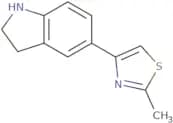
CAS:Versatile small molecule scaffoldFormula:C13H14BrNO4Purity:Min. 95%Molecular weight:328.16 g/mol5-(2-Methyl-1,3-thiazol-4-yl)-2,3-dihydro-1H-indole
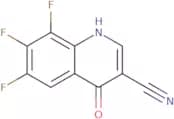
CAS:Versatile small molecule scaffoldFormula:C12H12N2SPurity:Min. 95%Molecular weight:216.3 g/mol6,7,8-Trifluoro-4-oxo-1,4-dihydroquinoline-3-carbonitrile
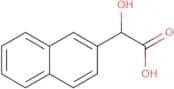
CAS:Versatile small molecule scaffoldFormula:C10H3F3N2OPurity:Min. 95%Molecular weight:224.14 g/mol(2S)-2-Hydroxy-2-(naphthalen-2-yl)acetic acid
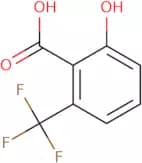
CAS:Versatile small molecule scaffoldFormula:C12H10O3Purity:Min. 95%Molecular weight:202.21 g/mol2-Hydroxy-6-(trifluoromethyl)benzoic acid
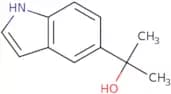
CAS:Versatile small molecule scaffoldFormula:C8H5F3O3Purity:Min. 95%Molecular weight:206.12 g/mol2-(1H-Indol-5-yl)propan-2-ol
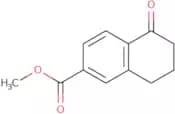
CAS:Versatile small molecule scaffoldFormula:C11H13NOPurity:Min. 95%Molecular weight:175.23 g/molMethyl 5-Oxo-6,7,8-Trihydronaphthalene-2-Carboxylate
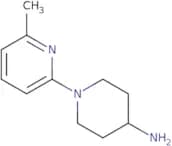
CAS:Versatile small molecule scaffoldFormula:C12H12O3Purity:Min. 95%Molecular weight:204.22 g/mol1-(6-Methylpyridin-2-yl)piperidin-4-amine
CAS:Versatile small molecule scaffoldFormula:C11H17N3Purity:Min. 95%Molecular weight:191.27 g/mol2-[2-(2-Nitrophenoxy)ethoxy]ethan-1-amine
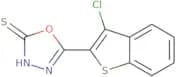
CAS:Versatile small molecule scaffoldFormula:C10H14N2O4Purity:Min. 95%Molecular weight:226.23 g/mol5-(3-Chloro-1-benzothiophen-2-yl)-1,3,4-oxadiazole-2-thiol
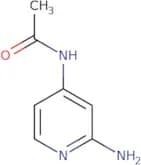
CAS:5-(3-Chloro-1-benzothiophen-2-yl)-1,3,4-oxadiazole-2-thiol is an antibacterial agent that inhibits the growth of bacteria by binding to sulfur. It is a sulfur analog that has been shown to inhibit the growth of certain bacteria. 5-(3-Chloro-1-benzothiophen-2-yl)-1,3,4-oxadiazole-2-thiol binds to the thiol group in cysteine and methionine residues in bacterial proteins and blocks their activity. This leads to cell death by inhibiting protein synthesis.Formula:C10H5ClN2OS2Purity:Min. 95%Molecular weight:268.7 g/molN-(2-Aminopyridin-4-yl)acetamide
CAS:Versatile small molecule scaffold
Formula:C7H9N3OPurity:Min. 95%Molecular weight:151.17 g/mol3-[(tert-Butyldimethylsilyl)oxy]-2,2-dimethylpropanal
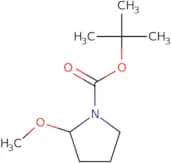
CAS:Versatile small molecule scaffoldFormula:C11H24O2SiPurity:Min. 95%Molecular weight:216.39 g/mol1-Boc-2-Methoxypyrrolidine
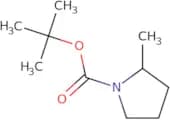
CAS:Versatile small molecule scaffoldFormula:C10H19NO3Purity:Min. 95%Molecular weight:201.27 g/moltert-Butyl 2-methylpyrrolidine-1-carboxylate
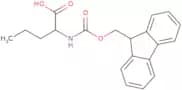
CAS:Versatile small molecule scaffoldFormula:C10H19NO2Purity:Min. 95%Molecular weight:185.26 g/molFmoc-DL-norvaline
CAS:Versatile small molecule scaffoldFormula:C20H21NO4Purity:Min. 95%Molecular weight:339.4 g/mol

![2-({3-Oxo-4-phenyl-8-thia-4,6-diazatricyclo[7.4.0.0,2,7]trideca-1(9),2(7),5-trien-5-yl}sulfanyl)ac…](/_next/image/?url=https%3A%2Fstatic.cymitquimica.com%2Fproducts%2F3D%2Fthumb-webp%2FUFA31616.webp&w=3840&q=75)
![tert-Butyl N-methyl-N-[(methylcarbamoyl)methyl]carbamate](/_next/image/?url=https%3A%2Fstatic.cymitquimica.com%2Fproducts%2F3D%2Fthumb-webp%2FUFA33255.webp&w=3840&q=75)
![(2S)-1-{[(4-Bromophenyl)methoxy]carbonyl}pyrrolidine-2-carboxylic acid](/_next/image/?url=https%3A%2Fstatic.cymitquimica.com%2Fproducts%2F3D%2Fthumb-webp%2FUFA33275.webp&w=3840&q=75)
![2-[2-(2-Nitrophenoxy)ethoxy]ethan-1-amine](/_next/image/?url=https%3A%2Fstatic.cymitquimica.com%2Fproducts%2F3D%2Fthumb-webp%2FUFA58771.webp&w=3840&q=75)
![3-[(tert-Butyldimethylsilyl)oxy]-2,2-dimethylpropanal](/_next/image/?url=https%3A%2Fstatic.cymitquimica.com%2Fproducts%2F3D%2Fthumb-webp%2FUFA68167.webp&w=3840&q=75)