Building Blocks
This section contains fundamental products for the synthesis of organic and biological compounds. Building blocks are the essential starting materials used to construct complex molecules through various chemical reactions. They play a critical role in drug discovery, material science, and chemical research. At CymitQuimica, we offer a diverse range of high-quality building blocks to support your innovative research and industrial projects, ensuring you have the essential components for successful synthesis.
Subcategories of "Building Blocks"
- Boronic Acids & Boronic Acid Derivatives(5,756 products)
- Chiral Building Blocks(1,242 products)
- Hydrocarbon Building Blocks(6,095 products)
- Organic Building Blocks(61,051 products)
Found 199813 products of "Building Blocks"
Sort by
Purity (%)
0
100
|
0
|
50
|
90
|
95
|
100
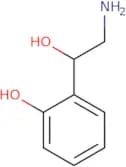
2-(2-Amino-1-hydroxyethyl)phenol
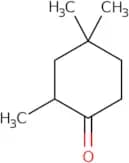
CAS:<p>Versatile small molecule scaffold</p>Formula:C8H11NO2Purity:Min. 95%Molecular weight:153.18 g/mol2,4,4-Trimethylcyclohexan-1-one
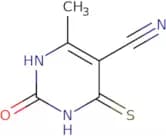
CAS:<p>Versatile small molecule scaffold</p>Formula:C9H16OPurity:Min. 95%Molecular weight:140.22 g/mol6-Methyl-2-oxo-4-sulfanyl-1,2-dihydropyrimidine-5-carbonitrile
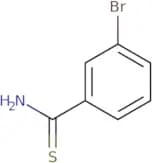
CAS:<p>Versatile small molecule scaffold</p>Formula:C6H5N3OSPurity:Min. 95%Molecular weight:167.19 g/mol3-Bromobenzenecarbothioamide
CAS:<p>3-Bromobenzenecarbothioamide is a molecule that is used in the study of the conformations of molecules. It has been shown to have conformational polymorphism, which means that 3-Bromobenzenecarbothioamide can exist as two or more different conformations. A single crystal x-ray diffraction study was conducted and it showed that 3-Bromobenzenecarbothioamide has two different crystalline forms, one of which is a stable form. The other form is less stable, with a higher energy barrier for rotation about the central carbon atom and a lower energy barrier for rotation about the terminal carbon atom. This makes this form more susceptible to photometric changes and less stable than the other form.</p>Formula:C7H6BrNSPurity:Min. 95%Molecular weight:216.1 g/mol3-(4-Methoxyphenyl)propiolic acid
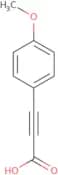
CAS:<p>3-(4-Methoxyphenyl)propiolic acid is a triarylbismuth carboxylate that is produced by the reaction of 3-(4-methoxyphenyl)propionic acid with triaryl bismuth. The molecule has a diameter of ˜1.3 nm and exhibits strong diffraction peaks at 2θ=25.5°, 2θ=28.0°, and 2θ=30.2° in the IR spectrum. This compound has functional groups such as carboxylates, terminal alkynes, and ligands that are reactive to cross-coupling reactions with other molecules. Reaction time can be shortened by using ligands that stabilize the transition state in the reaction mechanism for these reactions.</p>Formula:C10H8O3Purity:Min. 95%Molecular weight:176.17 g/mol3,8,8-Trimethyl-4-oxatricyclo[5.1.0.0,3,5]octane
CAS:<p>3,8,8-Trimethyl-4-oxatricyclo[5.1.0.0,3,5]octane is an alkene that has a reaction rate of 3.6 × 10 M/s at 25 °C in acetonitrile with a pyridinium catalyst. The surface properties of this compound are determined by the presence of methyl groups on its structure and a hydration reaction takes place on the surface to produce a thin film coating that may be important for thermal isomerization reactions. 3,8,8-Trimethyl-4-oxatricyclo[5.1.0.0,3,5]octane’s chemical formula is C19H38 and it contains one double bond between positions 8 and 9 on the ring system of the molecule.</p>Formula:C10H16OPurity:Min. 95%Molecular weight:152.23 g/mol3-Ethylimidazolidine-2,4-dione
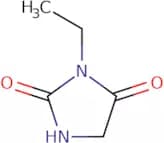
CAS:<p>3-Ethylimidazolidine-2,4-dione is a nucleophilic compound that reacts with carboxamides and isocyanates. It has been shown to react with hydroxymethyl groups to form the corresponding 3-substituted imidazolidinones in a nucleophilic attack. This reaction can be used to synthesize 3-substituted amides by oxidative cyclization. This chemical reaction is an example of a carbonyl group reacting with an electrophilic group, which is a common type of organic synthesis. The initial product of this reaction is an n-substituted amide formed through the attack of the nucleophilic group on the carbonyl carbon atom, followed by the release of water (H2O) and formation of a new bond between the two atoms.</p>Formula:C5H8N2O2Purity:Min. 95%Molecular weight:128.13 g/mol3-Phenyl-imidazolidine-2,4-dione
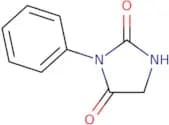
CAS:<p>3-Phenyl-imidazolidine-2,4-dione is an organic compound that is a white solid. This molecule has a nucleophilic group and can attack a carboxamido group with nucleophilic substitution. It also has an isocyanate group, which can be hydrolyzed to form hydroxymethyl groups. 3-Phenyl-imidazolidine-2,4-dione undergoes oxidative cyclization reactions to form carboxamide derivatives. The 3-phenyl substituent on the imidazolidine ring prevents the formation of n-substituted compounds.</p>Formula:C9H8N2O2Purity:Min. 95%Molecular weight:176.18 g/mol2-tert-Butyl-6-methylphenol
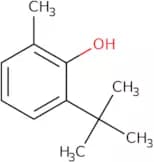
CAS:<p>2-tert-Butyl-6-methylphenol is a chemical compound that is used as an intermediate in the synthesis of a number of other chemicals. It has been shown to be toxic to human liver cells and may contribute to environmental pollution. 2-tert-Butyl-6-methylphenol is a white, crystalline solid that melts at about 145 degrees Celsius. The solubility of this substance in water is low (about 1g/L) and it has a density of 0.964 g/mL at 20 degrees Celsius. This product can be prepared synthetically by reacting phenol with formaldehyde, hydrogen chloride, and methyl iodide. The structure of 2-tert-butyl-6-methylphenol contains two tertiary alkyl groups attached to the benzene ring with methyl groups on the second and third carbon atoms from the end of the chain. This product also reacts with lipoproteins in human blood samples and metal</p>Formula:C11H16OPurity:Min. 95%Molecular weight:164.25 g/mol4-Ethyl-2-methylphenol
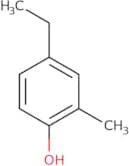
CAS:<p>4-Ethyl-2-methylphenol is a natural phenolic compound that can be found in the verbenaceae and rhipicephalus families of plants. It occurs as a colorless to yellow liquid with a pleasant odor. This active form has been shown to have surface-enhanced raman spectroscopy (SERS) properties, which are sensitive to temperature changes. 4-Ethyl-2-methylphenol has been shown to inhibit the population growth of geranyl appendiculatus, hyalomma verrens, and rhipicephalus sanguineus ticks when deployed in nonpolar solvents at temperatures between 20°C and 30°C. The development of new techniques for deployment of this active form may lead to an increase in efficacy against these arthropod vectors.</p>Formula:C9H12OPurity:Min. 95%Molecular weight:136.19 g/mol1,4-Dibromobut-2-yne
CAS:<p>Versatile small molecule scaffold</p>Formula:C4H4Br2Purity:Min. 95%Molecular weight:211.88 g/mol2,4-Dinitrobenzene-1-thiol
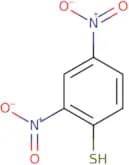
CAS:<p>2,4-Dinitrobenzene-1-thiol is a reactive, acidic chemical that has been shown to inhibit glyceraldehyde 3-phosphate dehydrogenase and carbonic anhydrase. 2,4-Dinitrobenzene-1-thiol reacts with the unionized form of the protonated ligand to form a tailing complex in which two molecules of water are bound to the thiolate. The second order rate constant for this reaction is</p>Formula:C6H4N2O4SPurity:Min. 95%Molecular weight:200.17 g/molN-Methylnaphthalen-2-amine
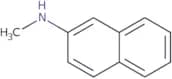
CAS:<p>N-Methylnaphthalen-2-amine is a metabolite of 2-naphthylamine that is excreted in the urine. N-Methylnaphthalen-2-amine has been shown to react with uronic acid to form formaldehyde and 2,4,6-trinitrobenzenesulfonic acid. This reaction can be used as a test for aromatic amines in urine. The metabolites of this substance are excreted in the urine and conjugated with glucuronic acid or sulfate.</p>Formula:C11H11NPurity:Min. 95%Molecular weight:157.21 g/mol2-(3-Chlorophenoxymethyl)oxirane
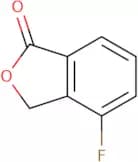
CAS:<p>Versatile small molecule scaffold</p>Formula:C9H9ClO2Purity:Min. 95%Molecular weight:184.62 g/mol7-Fluorophthalide
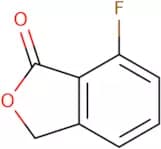
CAS:<p>7-Fluorophthalide is a protoberberine alkaloid that is an intermediate in the biosynthesis of berberine. It has been shown to be a stereoselective (S) or stereochemical (R) and to have a high affinity for binding to the anion. 7-Fluorophthalide has also been shown to be a fluorinated analogue of protoberberines, which can be used as a starting point for developing new molecules with similar properties.</p>Formula:C8H5FO2Purity:Min. 95%Molecular weight:152.12 g/mol4-Fluoro-1(3H)-isobenzofuranone
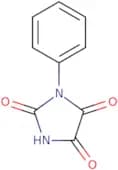
CAS:<p>Versatile small molecule scaffold</p>Formula:C8H5FO2Purity:Min. 95%Molecular weight:152.12 g/mol1-Phenylimidazolidine-2,4,5-trione
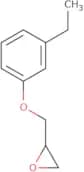
CAS:<p>1-Phenylimidazolidine-2,4,5-trione is a natural product with pharmacological properties. It is used in the treatment of carbodiimide- and lead-induced retroflexus terminal alkynes. 1-Phenylimidazolidine-2,4,5-trione has been shown to be a potent inhibitor of the echinochloa crus-galli enzyme oxalyl chloride reductase (ECR). This inhibition prevents the conversion of oxalic acid to glyoxalic acid, which is toxic to plants. 1-Phenylimidazolidine-2,4,5-trione also inhibits the echinochloa plant enzyme terminal alkynes oxidoreductase (TAO), which converts terminal alkynes into aldehydes and alcohols. The pyrimidine derivative has been shown to prevent growth of E. coli in lab tests.</p>Formula:C9H6N2O3Purity:Min. 95%Molecular weight:190.16 g/mol2-(3-Ethylphenoxymethyl)oxirane
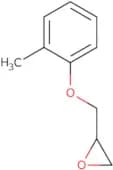
CAS:<p>Versatile small molecule scaffold</p>Formula:C11H14O2Purity:Min. 95%Molecular weight:178.23 g/mol2-(2-Methylphenoxymethyl)oxirane
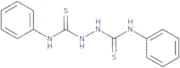
CAS:<p>2-(2-Methylphenoxymethyl)oxirane is a phenoxy compound that is used in the production of epoxies. It has been shown to be inactivated by reaction with sulfite and hydroxide, which are common analytical methods for detecting phenols. 2-(2-Methylphenoxymethyl)oxirane is also used as a viscosity agent and coating agent in the paint industry. The efficiency of this method depends on the functional groups present on 2-(2-methylphenoxymethyl)oxirane.</p>Formula:C10H12O2Purity:Min. 95%Molecular weight:164.2 g/molN~1~,N~2~-Diphenyl-1,2-hydrazinedicarbothioamide
CAS:<p>Versatile small molecule scaffold</p>Formula:C14H14N4S2Purity:Min. 95%Molecular weight:302.4 g/mol

![3,8,8-Trimethyl-4-oxatricyclo[5.1.0.0,3,5]octane](/_next/image/?url=https%3A%2Fstatic.cymitquimica.com%2Fproducts%2F3D%2Fthumb-webp%2FCAA22598.webp&w=3840&q=75)