Building Blocks
Subcategories of "Building Blocks"
- Boronic Acids & Boronic Acid Derivatives(5,778 products)
- Chiral Building Blocks(1,243 products)
- Hydrocarbon Building Blocks(6,098 products)
- Organic Building Blocks(61,036 products)
Found 205240 products of "Building Blocks"
Benzyl[3-(dimethylamino)propyl]amine dihydrochloride
CAS:Versatile small molecule scaffoldFormula:C12H22Cl2N2Purity:Min. 95%Molecular weight:265.22 g/mol2-(Propan-2-yl)but-3-ynoic acid
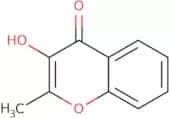
CAS:Versatile small molecule scaffoldFormula:C7H10O2Purity:Min. 95%Molecular weight:126.2 g/mol3-Hydroxy-2-methyl-4H-chromen-4-one
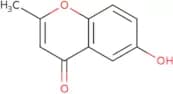
CAS:3-Hydroxy-2-methyl-4H-chromen-4-one is a synthetic compound that has been shown to have potential use as an anticancer agent. It was originally developed for the treatment of cancer, but clinical studies have been limited due to its poor solubility and toxicity. 3-Hydroxy-2-methyl-4H-chromen-4-one has antiangiogenic effects, which means it prevents the formation of new blood vessels that are necessary for tumor growth. This effect may be due to its ability to inhibit the production of substances that stimulate angiogenesis, such as erythropoietin and vascular endothelial growth factor (VEGF). In addition, 3HMMCT inhibits iron homeostasis by binding to ferric iron in the enterocyte lysosome and preventing its absorption from food. This leads to increased excretion of iron in feces and urine.Formula:C10H8O3Purity:Min. 95%Molecular weight:176.17 g/mol6-Hydroxy-2-methyl-4H-chromen-4-one
CAS:Protocetraric acid is a natural product that is found in the bark of Usnea longissima. It can be synthesized by diazotization and oxidation of protocetraric acid with nitrous acid, followed by hydrolysis. Protocetraric acid has been shown to have cytotoxic effects on murine cells and multidimensional structures. The structure of protocetraric acid is similar to that of chromones and flavones, which are also found in Usnea longissima. Protocetraric acid has been shown to inhibit the enzyme catalase, suggesting it may have anti-inflammatory properties.Formula:C10H8O3Purity:Min. 95%Molecular weight:176.17 g/molN-Methyl-N-phenylpyrrolidin-3-amine
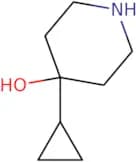
CAS:Versatile small molecule scaffoldFormula:C11H16N2Purity:Min. 95%Molecular weight:176.26 g/mol4-cyclopropylpiperidin-4-ol
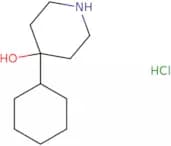
CAS:Versatile small molecule scaffoldFormula:C8H15NOPurity:Min. 95%Molecular weight:141.21 g/mol4-Cyclohexylpiperidin-4-ol hydrochloride
CAS:Versatile small molecule scaffoldFormula:C11H22ClNOPurity:Min. 95%Molecular weight:219.75 g/mol3,5,6-Trichloropicoline
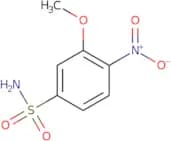
CAS:Versatile small molecule scaffoldFormula:C6H4Cl3NPurity:Min. 95%Molecular weight:196.46 g/mol3-Methoxy-4-nitrobenzene-1-sulfonamide
CAS:Versatile small molecule scaffold
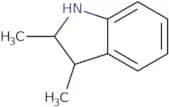
Formula:C7H8N2O5SPurity:Min. 95%Molecular weight:232.22 g/mol2,3-Dimethylindoline
CAS:2,3-Dimethylindoline is a homologous compound that is used in the synthesis of medicines. It has been shown to have selectable properties for the production of Hygromycin B, which is a type of antibiotic. This compound also has the potential to enhance glyceraldehyde-3-phosphate dehydrogenase activity in genetically engineered E. coli strains with this enzyme as a reporter gene. 2,3-Dimethylindoline has been shown to be effective against subcutaneous tissue infections caused by Staphylococcus aureus.
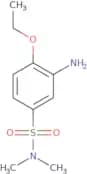
Formula:C10H13NPurity:Min. 95%Molecular weight:147.22 g/mol3-Amino-4-ethoxy-N,N-dimethylbenzene-1-sulfonamide
CAS:Versatile small molecule scaffold
Formula:C10H16N2O3SPurity:Min. 95%Molecular weight:244.31 g/mol2',3'A,4',5',6',7'-Hexahydrospiro[cyclohexane-1,3'-indazole]
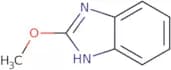
CAS:Versatile small molecule scaffoldFormula:C12H20N2Purity:Min. 95%Molecular weight:192.3 g/mol2-Methoxy-1H-1,3-benzodiazole
CAS:2-Methoxy-1H-1,3-benzodiazole is a small molecule that has been shown to inhibit the activity of the cyclic AMP response element binding protein. This drug can be used in the treatment of hepatitis C, although it is not effective against other viral infections. 2-Methoxy-1H-1,3-benzodiazole is an antihypertensive agent that has been used in clinical trials for the treatment of diabetic patients and patients with insulin resistance. The mechanism by which this drug exerts its effects on blood pressure is not clear. It may act by decreasing vascular resistance or by increasing cardiac output. 2-Methoxy-1H-1,3-benzodiazole also has anticancer activity and inhibits tumor growth in mice with brain infarction. This compound binds to fatty acids and hydroxyl groups to form a reactive intermediate that reacts with DNA bases to form covalent adduct
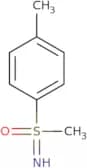
Formula:C8H8N2OPurity:Min. 95%Molecular weight:148.16 g/molS-Methyl-S-(4-methylphenyl)-sulfoximine
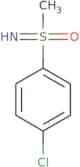
CAS:Versatile small molecule scaffoldFormula:C8H11NOSPurity:Min. 95%Molecular weight:169.25 g/molS-Methyl-S-(4-chlorophenyl) sulfoximine
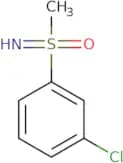
CAS:Versatile small molecule scaffoldFormula:C7H8ClNOSPurity:Min. 95%Molecular weight:189.67 g/molS-(3-Chlorophenyl)-S-methyl-sulfoximine
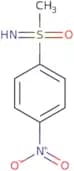
CAS:Versatile small molecule scaffoldFormula:C7H8ClNOSPurity:Min. 95%Molecular weight:189.66 g/molImino(methyl)(4-nitrophenyl)-λ6-sulfanone
CAS:Versatile small molecule scaffoldFormula:C7H8N2O3SPurity:Min. 95%Molecular weight:200.22 g/mol3,5-Dichlorosulfanilamide
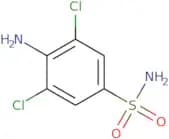
CAS:3,5-Dichlorosulfanilamide is a potent inhibitor of hydrogen peroxide anhydrase. It has been shown to outperform other sulfonamides in the inhibition of anhydrase activity. 3,5-Dichlorosulfanilamide inhibits the enzyme by forming a covalent adduct with the sulfonamide group and carbonic acid. This covalent adduct prevents the enzyme from binding to its substrate, thereby preventing catalysis. 3,5-Dichlorosulfanilamide also shows stereoselective inhibition of anhydrase enzymes. The synthesis of this drug can be efficiently achieved using a synthetic route that features high yields and short reaction times.Formula:C6H6Cl2N2O2SPurity:Min. 95%Molecular weight:241.09 g/mol(R)-2-Hydroxy-3,3-dimethylbutanoic acid
CAS:(R)-2-Hydroxy-3,3-dimethylbutanoic acid is an organic compound that is used as a hypochlorite. It is the stoichiometric reagent for the synthesis of hypochlorous acid and its salts. (R)-2-Hydroxy-3,3-dimethylbutanoic acid can be prepared by the reaction of sodium hypochlorite with chloral or chloroform in alkaline solution. This method yields a high yield of (R)-2-hydroxy-3,3-dimethylbutanoic acid. The optical purity of (R)-2-hydroxydimethylbutanoic acid can be increased by using palladium as a catalyst.Formula:C6H12O3Purity:Min. 95%Molecular weight:132.16 g/mol2-Acetamido-3,3-dimethylbutanoic acid
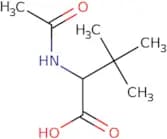
CAS:2-Acetamido-3,3-dimethylbutanoic acid (2ADMBA) is a lipase inhibitor that is structurally related to amides. It is a competitive inhibitor of the enzyme lipase, which catalyzes the hydrolysis of triglycerides. 2ADMBA has been shown to be an efficient and selective inhibitor of this enzyme in both laboratory and industrial tests. The efficacy of 2ADMBA as a lipase inhibitor has also been demonstrated in vivo. In vitro studies have shown that 2ADMBA inhibits the hydrolysis of amino acids, including phenylalanine, tyrosine, and tryptophan, with high potency and selectivity. Cleavage reactions catalyzed by 2ADMBA have also been studied extensively.
Formula:C8H15NO3Purity:Min. 95%Molecular weight:173.21 g/mol
![Benzyl[3-(dimethylamino)propyl]amine dihydrochloride](/_next/image/?url=https%3A%2Fstatic.cymitquimica.com%2Fproducts%2F3D%2Fthumb-webp%2FXAA10229.webp&w=3840&q=75)



![2',3'A,4',5',6',7'-Hexahydrospiro[cyclohexane-1,3'-indazole]](/_next/image/?url=https%3A%2Fstatic.cymitquimica.com%2Fproducts%2F3D%2Fthumb-webp%2FXAA12296.webp&w=3840&q=75)