


Building Blocks
This section contains fundamental products for the synthesis of organic and biological compounds. Building blocks are the essential starting materials used to construct complex molecules through various chemical reactions. They play a critical role in drug discovery, material science, and chemical research. At CymitQuimica, we offer a diverse range of high-quality building blocks to support your innovative research and industrial projects, ensuring you have the essential components for successful synthesis.
Subcategories of "Building Blocks"
- Boronic Acids & Boronic Acid Derivatives(5,778 products)
- Chiral Building Blocks(1,242 products)
- Hydrocarbon Building Blocks(6,098 products)
- Organic Building Blocks(61,034 products)
Found 199601 products of "Building Blocks"
Sort by
Purity (%)
0
100
|
0
|
50
|
90
|
95
|
100
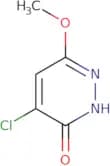
4-Chloro-6-methoxy-2,3-dihydropyridazin-3-one
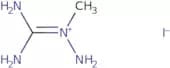
CAS:<p>Versatile small molecule scaffold</p>Formula:C5H5ClN2O2Purity:Min. 95%Molecular weight:160.56 g/mol1-(Diaminomethylidene)-1-methylhydrazinium iodide
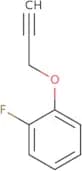
CAS:Versatile small molecule scaffoldFormula:C2H9IN4Purity:Min. 95%Molecular weight:216.02 g/mol1-Fluoro-2-(prop-2-yn-1-yloxy)benzene
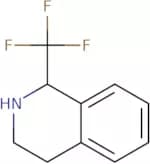
CAS:<p>Versatile small molecule scaffold</p>Formula:C9H7FOPurity:Min. 95%Molecular weight:150.15 g/mol1-(Trifluoromethyl)-1,2,3,4-tetrahydroisoquinoline
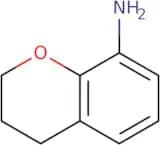
CAS:<p>Versatile small molecule scaffold</p>Formula:C10H10F3NPurity:Min. 95%Molecular weight:201.19 g/mol3,4-Dihydro-2H-1-benzopyran-8-amine
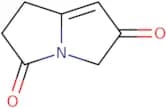
CAS:<p>3,4-Dihydro-2H-1-benzopyran-8-amine is a nitrate derivative that inhibits the activity of mitogen activated protein kinase (MAPK) and has been shown to have an inhibitory effect on the p38 MAPK pathway. It has been demonstrated to have anti-inflammatory and antiproliferative activities in vitro. 3,4-Dihydro-2H-1-benzopyran-8-amine also inhibits the production of tumor necrosis factor α (TNFα) and IL6 in thp1 cells. This compound is an active form of 2,3,4,5,6,-pentahydroxybenzoic acid that can be synthesized from 3-(2'-hydroxyethyl)-2H-pyran by acylation with caprylic acid followed by hydrolysis. The two isomers are called 3,4-(+)-isomer and</p>Formula:C9H11NOPurity:Min. 95%Molecular weight:149.19 g/mol1H-Pyrrolizine-3,6(2H,5H)-dione
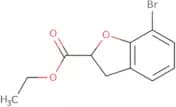
CAS:<p>Versatile small molecule scaffold</p>Formula:C7H7NO2Purity:Min. 95%Molecular weight:137.14 g/molEthyl 7-bromo-2,3-dihydro-benzofuran-2-carboxylate
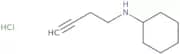
CAS:Versatile small molecule scaffoldFormula:C11H11BrO3Purity:Min. 95%Molecular weight:271.11 g/molN-(But-3-yn-1-yl)cyclohexanamine hydrochloride
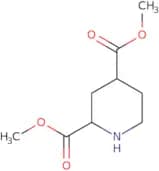
CAS:<p>Versatile small molecule scaffold</p>Formula:C10H18ClNPurity:Min. 95%Molecular weight:187.7 g/mol2,4-Dimethyl piperidine-2,4-dicarboxylate
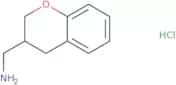
CAS:<p>Versatile small molecule scaffold</p>Formula:C9H15NO4Purity:Min. 95%Molecular weight:201.22 g/mol1-(3,4-Dihydro-2h-chromen-3-yl)methanamine HCl
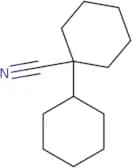
CAS:<p>Versatile small molecule scaffold</p>Formula:C10H13NO·HClPurity:Min. 95%Molecular weight:199.68 g/mol1-Cyclohexylcyclohexane-1-carbonitrile
CAS:<p>1-Cyclohexylcyclohexane-1-carbonitrile is a mesomorphic organic liquid at room temperature and pressure, but becomes a crystalline solid at low temperature. It is soluble in many solvents, including water and alcohols. The crystal phase has been found to be monoclinic and the dipole moment of the molecules is zero. 1-Cyclohexylcyclohexane-1-carbonitrile has been used in simulations to study the structures of DNA molecules. The molecule was found to have an interaction energy with the base pairs of -10.5 kcal/mol and an interaction energy with the bases of -2 kcal/mol. The structural analysis of this molecule revealed that it has two hydrogen bonds with pyrimidine bases and one hydrogen bond with purine bases. The parameters for this molecule are:</p>Formula:C13H21NPurity:Min. 95%Molecular weight:191.31 g/mol2-[2-(Propan-2-yl)-1,3-dioxolan-2-yl]ethan-1-ol
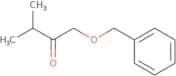
CAS:<p>Versatile small molecule scaffold</p>Formula:C8H16O3Purity:Min. 95%Molecular weight:160.21 g/mol1-(Benzyloxy)-3-methylbutan-2-one
CAS:<p>Versatile small molecule scaffold</p>Formula:C12H16O2Purity:Min. 95%Molecular weight:192.25 g/mol3-Amino-4-cyclohexyl-2-hydroxybutanoic acid hydrochloride
CAS:Versatile small molecule scaffoldFormula:C10H20ClNO3Purity:Min. 95%Molecular weight:237.7 g/mol3-(Prop-2-en-1-yl)pyrrolidin-2-one
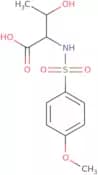
CAS:<p>Versatile small molecule scaffold</p>Formula:C7H11NOPurity:Min. 95%Molecular weight:125.17 g/mol3-Hydroxy-2-(4-methoxybenzenesulfonamido)butanoic acid
CAS:3-Hydroxy-2-(4-methoxybenzenesulfonamido)butanoic acid is a sulfonamide that has geometric properties. It contains chains and hydrogen bonds, which are formed by the torsion of the benzene ring, the coplanarity of the benzene ring, and the 3-hydroxyl group. The sulfonamide group is attached to the carbon atom in the center of this molecule, while a carbonyl group is attached to one end. This molecule also contains two benzene rings that are not directly connected. The other end of this molecule has an amine group with a hydrogen bond to a hydroxyl group from another molecule.Formula:C11H15NO6SPurity:Min. 95%Molecular weight:289.31 g/mol1-(4-Chloro-phenyl)-3,5-dimethyl-1H-pyrazole-4-carboxylic acid
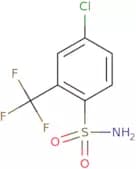
CAS:<p>Versatile small molecule scaffold</p>Formula:C12H11ClN2O2Purity:Min. 95%Molecular weight:250.68 g/mol4-Chloro-2-(trifluoromethyl)benzene sulfonamide
CAS:<p>Versatile small molecule scaffold</p>Formula:C7H5ClF3NO2SPurity:Min. 95%Molecular weight:259.63 g/mol7-Phenoxy-1,2,3,4,9,10-hexahydroacridin-9-one
CAS:Versatile small molecule scaffoldFormula:C19H17NO2Purity:Min. 95%Molecular weight:291.3 g/moltert-Butyl 3-iodo-2-methyl-4H,5H,6H,7H-pyrazolo[1,5-a]pyrazine-5-carboxylate
CAS:<p>Versatile small molecule scaffold</p>Formula:C12H18IN3O2Purity:Min. 95%Molecular weight:363.19 g/mol

![2-[2-(Propan-2-yl)-1,3-dioxolan-2-yl]ethan-1-ol](/_next/image/?url=https%3A%2Fstatic.cymitquimica.com%2Fproducts%2F3D%2Fthumb-webp%2FNEA77866.webp&w=3840&q=75)



![tert-Butyl 3-iodo-2-methyl-4H,5H,6H,7H-pyrazolo[1,5-a]pyrazine-5-carboxylate](/_next/image/?url=https%3A%2Fstatic.cymitquimica.com%2Fproducts%2F3D%2Fthumb-webp%2FNKD12216.webp&w=3840&q=75)