Building Blocks
This section contains fundamental products for the synthesis of organic and biological compounds. Building blocks are the essential starting materials used to construct complex molecules through various chemical reactions. They play a critical role in drug discovery, material science, and chemical research. At CymitQuimica, we offer a diverse range of high-quality building blocks to support your innovative research and industrial projects, ensuring you have the essential components for successful synthesis.
Subcategories of "Building Blocks"
- Boronic Acids & Boronic Acid Derivatives(5,756 products)
- Chiral Building Blocks(1,242 products)
- Hydrocarbon Building Blocks(6,095 products)
- Organic Building Blocks(61,055 products)
Found 199650 products of "Building Blocks"
Sort by
Purity (%)
0
100
|
0
|
50
|
90
|
95
|
100
1-{4-[(4-Methylphenyl)methoxy]phenyl}propan-2-amine hydrochloride
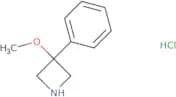
CAS:<p>Versatile small molecule scaffold</p>Formula:C17H22ClNOPurity:Min. 95%Molecular weight:291.8 g/mol3-Methoxy-3-phenylazetidine hydrochloride
CAS:<p>Versatile small molecule scaffold</p>Formula:C10H14ClNOPurity:Min. 95%Molecular weight:199.68 g/mol6-[(Difluoromethyl)sulfanyl]-1,2,3,4-tetrahydronaphthalen-1-one
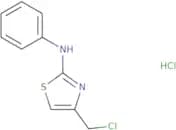
CAS:<p>Versatile small molecule scaffold</p>Formula:C11H10F2OSPurity:Min. 95%Molecular weight:228.26 g/mol4-(Chloromethyl)-N-phenyl-1,3-thiazol-2-amine hydrochloride
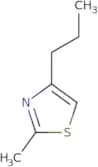
CAS:<p>Versatile small molecule scaffold</p>Formula:C10H9ClN2S·HClPurity:Min. 95%Molecular weight:261.18 g/mol2-Methyl-4-propyl-1,3-thiazole
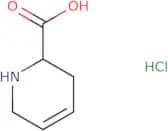
CAS:<p>Versatile small molecule scaffold</p>Formula:C7H11NSPurity:Min. 95%Molecular weight:141.24 g/mol1,2,5,6-Tetrahydropyridine-2-carboxylic acid hydrochloride
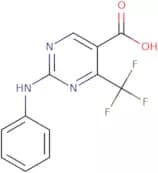
CAS:<p>Versatile small molecule scaffold</p>Formula:C6H10ClNO2Purity:Min. 95%Molecular weight:163.6 g/mol2-(Phenylamino)-4-(trifluoromethyl)pyrimidine-5-carboxylic acid
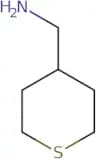
CAS:<p>Versatile small molecule scaffold</p>Formula:C12H8F3N3O2Purity:Min. 95%Molecular weight:283.21 g/molThian-4-ylmethanamine
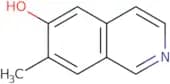
CAS:<p>Versatile small molecule scaffold</p>Formula:C6H13NSPurity:Min. 95%Molecular weight:131.24 g/mol7-Methylisoquinolin-6-ol
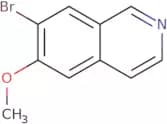
CAS:<p>Versatile small molecule scaffold</p>Formula:C10H9NOPurity:Min. 95%Molecular weight:159.18 g/mol7-Bromo-6-methoxyisoquinoline
CAS:<p>7-Bromo-6-methoxyisoquinoline is a drug that inhibits protein kinases and has been shown to be effective against cancer cells. It is a member of the class of compounds known as isoquinolones. 7-Bromo-6-methoxyisoquinoline is an inhibitor of protein kinases, which are enzymes that regulate the activity of other proteins in cells. Protein kinases are involved in many cellular processes, such as metabolism, cell cycle regulation, and DNA repair. The inhibition of these enzymes by 7-bromo-6-methoxyisoquinoline may result in the death of cancer cells. This compound has been used to explore the biochemical mechanisms underlying tumorigenesis and has been shown to inhibit proliferation in atypical models of breast cancer cells.</p>Formula:C10H8BrNOPurity:Min. 95%Molecular weight:238.08 g/mol2-Methyl-1,6-naphthyridin-3-ol
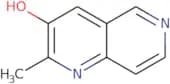
CAS:<p>Versatile small molecule scaffold</p>Formula:C9H8N2OPurity:Min. 95%Molecular weight:160.17 g/molMethyl 3-(2-chloroacetamido)propanoate
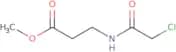
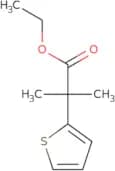
CAS:<p>Versatile small molecule scaffold</p>Formula:C6H10ClNO3Purity:Min. 95%Molecular weight:179.6 g/molEthyl 2-methyl-2-(thiophen-2-yl)propanoate
CAS:<p>Versatile small molecule scaffold</p>Formula:C10H14O2SPurity:Min. 95%Molecular weight:198.28 g/mol6-Bromo-3,4-dihydrospiro[1,4-benzoxazine-2,1'-cyclopropane]
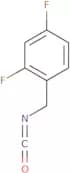
CAS:<p>Versatile small molecule scaffold</p>Formula:C10H10BrNOPurity:Min. 95%Molecular weight:240.1 g/mol2,4-Difluoro-1-(isocyanatomethyl)benzene
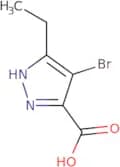
CAS:<p>Versatile small molecule scaffold</p>Formula:C8H5F2NOPurity:Min. 95%Molecular weight:169.13 g/mol4-Bromo-3-ethyl-1H-pyrazole-5-carboxylic acid
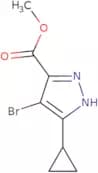
CAS:<p>Versatile small molecule scaffold</p>Formula:C6H7BrN2O2Purity:Min. 95%Molecular weight:219.04 g/molMethyl 4-bromo-5-cyclopropyl-1H-pyrazole-3-carboxylate
CAS:<p>Methyl 4-bromo-5-cyclopropyl-1H-pyrazole-3-carboxylate is a receptor agonist that binds to the 5-membered heteroaryl of the growth factor receptor and can stimulate fibroblast growth. Methyl 4-bromo-5-cyclopropyl-1H-pyrazole-3-carboxylate is also an inhibitor of the growth factor receptor, which may be due to its ability to inhibit the production of fibroblast growth factor. The binding of methyl 4-bromo-5 cyclopropyl 1H pyrazole 3 carboxylate to the s1p1 receptor may lead to inhibition of sphingosine synthesis.</p>Formula:C8H9BrN2O2Purity:Min. 95%Molecular weight:245.07 g/mol2-(Cyclopropylamino)-3-[3-(trifluoromethyl)-1H-pyrazol-1-yl]propanoic acid
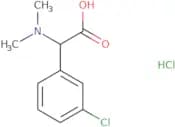
CAS:<p>Versatile small molecule scaffold</p>Formula:C10H12F3N3O2Purity:Min. 95%Molecular weight:263.22 g/mol2-(3-Chlorophenyl)-2-(dimethylamino)acetic acid hydrochloride
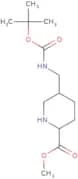
CAS:<p>Versatile small molecule scaffold</p>Formula:C10H13Cl2NO2Purity:Min. 95%Molecular weight:250.12 g/molmethyl 5-(((tert-butoxycarbonyl)amino)methyl)piperidine-2-carboxylate
CAS:<p>Versatile small molecule scaffold</p>Formula:C13H24N2O4Purity:Min. 95%Molecular weight:272.3 g/mol
![1-{4-[(4-Methylphenyl)methoxy]phenyl}propan-2-amine hydrochloride](/_next/image/?url=https%3A%2Fstatic.cymitquimica.com%2Fproducts%2F3D%2Fthumb-webp%2FQZB52844.webp&w=3840&q=75)

![6-[(Difluoromethyl)sulfanyl]-1,2,3,4-tetrahydronaphthalen-1-one](/_next/image/?url=https%3A%2Fstatic.cymitquimica.com%2Fproducts%2F3D%2Fthumb-webp%2FQZB52846.webp&w=3840&q=75)
![6-Bromo-3,4-dihydrospiro[1,4-benzoxazine-2,1'-cyclopropane]](/_next/image/?url=https%3A%2Fstatic.cymitquimica.com%2Fproducts%2F3D%2Fthumb-webp%2FRBC09446.webp&w=3840&q=75)
![2-(Cyclopropylamino)-3-[3-(trifluoromethyl)-1H-pyrazol-1-yl]propanoic acid](/_next/image/?url=https%3A%2Fstatic.cymitquimica.com%2Fproducts%2F3D%2Fthumb-webp%2FRBC28724.webp&w=3840&q=75)