Amines
Amines are a set of molecules containing an amino functional group (derived from ammonia). This category includes amines at any level of substitution : primary, secondary, tertiary, and ammonium salts. Amines are fundamental in organic synthesis and are widely used in pharmaceuticals, agrochemicals, and materials science. At CymitQuimica, we provide a comprehensive selection of amines to meet your research and industrial needs. Our range ensures access to various amines for diverse chemical processes and innovative research.
Subcategories of "Amines"
- Nitrosamines(2,605 products)
- Primary Amines(30,821 products)
- Quaternary Ammonium Cations and Salts(1,099 products)
- Secondary Amines(20,817 products)
- Tertiary Amines(17,117 products)
Found 8778 products of "Amines"
Sort by
Purity (%)
0
100
|
0
|
50
|
90
|
95
|
100
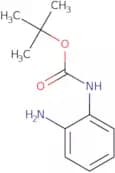
N-Boc-1,2-phenyldiamine
CAS:<p>N-Boc-1,2-phenyldiamine is a histone acetyltransferase (HAT) inhibitor. It is an acetylated molecule that contains two phenyl rings, one of which is substituted with an amine group. This compound was designed to inhibit the activity of HATs, which are enzymes involved in the chemical modification of histones and other proteins. N-Boc-1,2-phenyldiamine inhibits the activities of these enzymes and prevents the acetylation of lysines on histones or other proteins. It has been shown to be efficient in inducing apoptosis in human cancer cells and may also have some antitumor effects.</p>Formula:C11H16N2O2Purity:Min. 95%Color and Shape:PowderMolecular weight:208.26 g/molFencamine
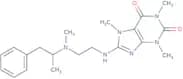
CAS:Controlled Product<p>Fencamine is a substrate molecule that is used in the synthesis of peptide hormones. It can be detected in urine samples and has been shown to be a synthetic cannabinoid. Fencamine can be used for diagnostic purposes. Fencamine has been shown to have matrix effects on the bowel disease, hepatitis, and hepatitis C., as well as exerting control analysis of the metabolite molecule. Fencamine has also been shown to have an effect on inflammatory bowel disease, hepatitis C., and toll-like receptor 2.</p>Formula:C20H28N6O2Purity:Min. 95%Color and Shape:PowderMolecular weight:384.48 g/mol3-Amino-5-tert-butylisoxazole
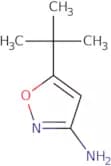
CAS:<p>3-Amino-5-tert-butylisoxazole is a postulated CB2 receptor agonist. It has been shown to inhibit the hydrolysis of L-3,4-dihydroxyphenylalanine (L-DOPA) in rat brain synaptosomes and to reduce pain in rats with diabetic neuropathy. 3-Amino-5-tert-butylisoxazole is a compound class that inhibits the binding of inhibitor compounds to the enzyme tyrosine hydroxylase. 3-(3'-Amino-5'-tert butylisoxazol)-1,2,4(1H,3H)-triazine reacts with amines and acyl halides to form inhibitors that are less reactive than the parent compound. The reaction products have been characterized using kinetic studies and NMR spectroscopy.</p>Formula:C7H12N2OPurity:Min. 95%Molecular weight:140.18 g/mol4-(Diethylamino)butyl amine
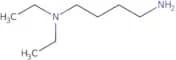
CAS:<p>4-(Diethylamino)butyl amine is a chemical that is used as a radiolabeled probe for the uptake of amines into tumors. It is used to measure tumor uptake and pharmacokinetic properties. This chemical has been found to be stable in both water and organic solvents, which makes it an excellent candidate for use in radiopharmaceuticals. 4-(Diethylamino)butyl amine also has a high affinity for cells, which may make it an ideal choice for therapeutic purposes.</p>Formula:C8H20N2Purity:Min. 95%Molecular weight:144.26 g/molL-2,3-Diaminopropionicacid
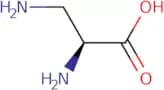
CAS:<p>L-2,3-Diaminopropionic acid is a diamine with an asymmetric carbon atom. It has been used to synthesize antimicrobial peptides and has also shown hemolytic activity in vitro. L-2,3-Diaminopropionic acid is stable when exposed to water vapor, which may make it useful for the treatment of cancer tissues. This molecule has been shown to have significant cytotoxicity against human leukemia cells and is able to inhibit the growth of various bacteria by inhibiting protein synthesis in the ribosome. L-2,3-Diaminopropionic acid also inhibits the enzyme enolase and reduces the production of ATP in cells.</p>Formula:C3H8N2O2Purity:Min. 95%Molecular weight:104.11 g/molN-(3-Dimethylaminopropyl)acrylamide, stabilized with MEHQ
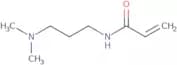
CAS:<p>N-(3-Dimethylaminopropyl)acrylamide is a polymerization initiator that is used in the synthesis of polymers. It is also a model protein, which can be used to study bacterial growth rates and tissue metabolism. N-(3-Dimethylaminopropyl)acrylamide has been shown to have biological properties similar to human serum, as well as to serve as a model for primary cells. The FT-IR spectroscopy of N-(3-Dimethylaminopropyl)acrylamide reveals the presence of chloride ions in its molecular structure. The reaction mechanism for this compound has been determined by deionized water and ionic reactions with chloride ions.</p>Formula:C8H16N2OPurity:Min. 95%Molecular weight:156.23 g/mol4-Amino-6-chloro-1,3-benzenedisulfonamide
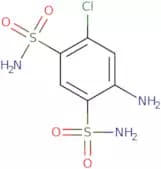
CAS:<p>4-Amino-6-chloro-1,3-benzenedisulfonamide is a natural substance that has been used in Chinese medicine preparations for the treatment of cardiac problems. It belongs to the class of organic compounds called benzenedisulfonamides. 4-Amino-6-chloro-1,3-benzenedisulfonamide is produced by the bacterial enzyme aminase from amino acid and benzoic acid. The adsorption mechanism of 4-Amino-6-chloro-1,3-benzenedisulfonamide is not fully understood, but it is believed that the benzyl groups are key players in this process. The high affinity of 4-Amino-6-chloro1,3 benzenedisulfonamide to proteins may be due to its ability to form hydrogen bonds with protein side chains, such as serine or threonine residues. 4 Amino</p>Formula:C6H8ClN3O4S2Purity:Min. 95%Color and Shape:White To Light Brown SolidMolecular weight:285.73 g/moltrans-1,2-Diaminocyclohexane-N,N,N',N'-tetraacetic acid monohydrate
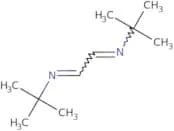
CAS:<p>Trans-1,2-Diaminocyclohexane-N,N,N',N'-tetraacetic acid monohydrate (CDTA) is a chelating agent that has been shown to be effective in the treatment of some cancers. CDTA has been shown to inhibit the growth of tumor cells by binding to lysine residues on histones and DNA and inhibiting their acetylation. CDTA also prevents the genotoxicity induced by irradiation. CDTA can be used as an adjuvant in cancer therapy due to its ability to inhibit histone deacetylase activity. Trans-1,2-Diaminocyclohexane-N,N,N',N'-tetraacetic acid monohydrate is synthesized from two amino acids: lysine and glutamic acid. This molecule is a polymeric compound composed of cyclic molecules linked together through amide bonds. These polymers are linear chains of</p>Formula:C14H22N2O8·H2OColor and Shape:White PowderMolecular weight:364.35 g/molN,N'-Ethane-1,2-diylidenebis(2-methylpropan-2-amine)
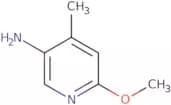
CAS:<p>Please enquire for more information about N,N'-Ethane-1,2-diylidenebis(2-methylpropan-2-amine) including the price, delivery time and more detailed product information at the technical inquiry form on this page</p>Formula:C10H20N2Purity:Min. 95%Color and Shape:PowderMolecular weight:168.28 g/mol5-Amino-2-methoxy-4-methylpyridine
CAS:<p>5-Amino-2-methoxy-4-methylpyridine is a small molecule that inhibits bromodomains. Bromodomains are protein domains that bind to acetylated lysine residues on histones. 5-Amino-2-methoxy-4-methylpyridine binds to the bromodomain, preventing the acetylated lysine residues from binding with other proteins and inhibiting transcription. This drug has been shown to be effective in treating prostate cancer by interacting with the androgen receptor. 5-Amino-2-methoxy-4-methylpyridine also interacts with ATPase, which may lead to increased levels of ATP production, and has been shown to have antitumor effects in vitro.</p>Formula:C7H10N2OPurity:Min. 95%Molecular weight:138.17 g/mol(3R)-3-[(tert-Butoxycarbonyl)amino]-4-(2,4-difluorophenyl)butanoic acid
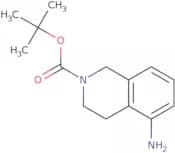
CAS:<p>Please enquire for more information about (3R)-3-[(tert-Butoxycarbonyl)amino]-4-(2,4-difluorophenyl)butanoic acid including the price, delivery time and more detailed product information at the technical inquiry form on this page</p>Formula:C15H19F2NO4Purity:Min. 95%Molecular weight:315.31 g/mol5-Amino-2-tert-butoxycarbonyl-1,2,3,4-tetrahydroisoquinoline
CAS:<p>Please enquire for more information about 5-Amino-2-tert-butoxycarbonyl-1,2,3,4-tetrahydroisoquinoline including the price, delivery time and more detailed product information at the technical inquiry form on this page</p>Formula:C14H20N2O2Purity:Min. 95%Molecular weight:248.32 g/mol(aR)-a-[[[2-(4-Aminophenyl)ethyl]amino]methyl]-benzenemethanol
CAS:<p>Please enquire for more information about (aR)-a-[[[2-(4-Aminophenyl)ethyl]amino]methyl]-benzenemethanol including the price, delivery time and more detailed product information at the technical inquiry form on this page</p>Formula:C16H20N2OPurity:Min. 95%Color and Shape:PowderMolecular weight:256.34 g/mol(Nle 35)-Amyloid b-Protein (1-40) ammonium salt
CAS:<p>Please enquire for more information about (Nle 35)-Amyloid b-Protein (1-40) ammonium salt including the price, delivery time and more detailed product information at the technical inquiry form on this page</p>Formula:C195H297N53O58Purity:Min. 95%Molecular weight:4,311.77 g/molDABCYL-(Asn670,Leu671)-Amyloid b/A4 Protein Precursor770 (667-675)-EDANS ammonium salt
CAS:<p>Please enquire for more information about DABCYL-(Asn670,Leu671)-Amyloid b/A4 Protein Precursor770 (667-675)-EDANS ammonium salt including the price, delivery time and more detailed product information at the technical inquiry form on this page</p>Formula:C71H91N15O21SPurity:Min. 95%Molecular weight:1,522.64 g/mol(S,S)-(-)-Bis(a-methylbenzyl)amine Hcl
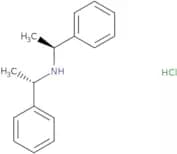
CAS:<p>Please enquire for more information about (S,S)-(-)-Bis(a-methylbenzyl)amine Hcl including the price, delivery time and more detailed product information at the technical inquiry form on this page</p>Formula:C16H19N·HClPurity:Min. 95%Molecular weight:261.79 g/mol4-Amino-N-(4-methylpyrimidin-2-yl)benzenesulfonamide
CAS:<p>4-Amino-N-(4-methylpyrimidin-2-yl)benzenesulfonamide (AMBPS) is a sulfonamide antimicrobial agent that belongs to the group of sulfa drugs. It is a potent inhibitor of tetracycline resistance in bacterial cells, and has been shown to be effective against infectious diseases such as tuberculosis, leprosy and pneumonia. AMBPS has also been used in wastewater treatment and biological studies with high values. This drug binds to sulfamerazine, which inhibits bacterial growth by inhibiting RNA synthesis. The hydrogen bonding interactions between AMBPS and sulfadiazine are thought to be responsible for the effects on congestive heart failure.</p>Formula:C11H12N4O2SPurity:Min. 95%Molecular weight:264.3 g/mol(R)-1-Boc-3-Aminopyrrolidine
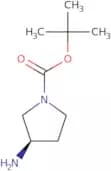
CAS:<p>(R)-1-Boc-3-Aminopyrrolidine is a small molecule that inhibits 3-kinase. It has been shown to bind to the ATP binding site of PI3Kδ and inhibit its activity. This results in the inhibition of phosphoinositide production, which leads to decreased cell proliferation and survival. (R)-1-Boc-3-Aminopyrrolidine has also been shown to have selectivity for isoform α over β, γ, and δ. The drug binds specifically to the ATP binding site on PI3Kδ, but does not disrupt other interactions such as hydrogen bonding or pi stacking interactions with residues in the vicinity of the ATP binding site. The IC50 values for (R)-1-Boc-3-Aminopyrrolidine were determined using siRNA knockdown experiments against human isoform α PI3Kδ.</p>Formula:C9H18N2O2Purity:Min. 95%Molecular weight:186.25 g/mol(Deamino-Cys11,D-2-Nal 14,Cys18)-b-MSH (11-22) amide trifluoroacetate salt
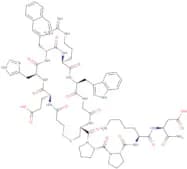
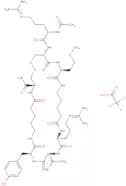
CAS:<p>Please enquire for more information about (Deamino-Cys11,D-2-Nal 14,Cys18)-b-MSH (11-22) amide trifluoroacetate salt including the price, delivery time and more detailed product information at the technical inquiry form on this page</p>Formula:C69H91N19O16S2Purity:Min. 95%Molecular weight:1,506.71 g/molAc-Arg-Cys-Met-5-aminopentanoyl-Arg-Val-Tyr-5-aminopentanoyl-Cys-NH2 trifluoroacetate salt (Disulfide bond)
CAS:<p>Please enquire for more information about Ac-Arg-Cys-Met-5-aminopentanoyl-Arg-Val-Tyr-5-aminopentanoyl-Cys-NH2 trifluoroacetate salt (Disulfide bond) including the price, delivery time and more detailed product information at the technical inquiry form on this page</p>Formula:C49H82N16O11S3Purity:Min. 95%Molecular weight:1,167.47 g/mol


![(3R)-3-[(tert-Butoxycarbonyl)amino]-4-(2,4-difluorophenyl)butanoic acid](/_next/image/?url=https%3A%2Fstatic.cymitquimica.com%2Fproducts%2F3D%2Fthumb-webp%2FFB99243.webp&w=3840&q=75)
![(aR)-a-[[[2-(4-Aminophenyl)ethyl]amino]methyl]-benzenemethanol](/_next/image/?url=https%3A%2Fstatic.cymitquimica.com%2Fproducts%2F3D%2Fthumb-webp%2FFA75045.webp&w=3840&q=75)