Cyano-, Nitrile-
Cyano and nitrile compounds are organic molecules that contain cyano (C≡N) or nitrile groups in their structure, characterized by the presence of nitrogen. These groups play important roles in various chemical reactions and industrial applications. In this category, you will find a wide range of cyano and nitrile compounds, ranging from simple to complex structures. At CymitQuimica, we offer high-quality cyano and nitrile compounds tailored to meet research and industrial needs. Our compounds are suitable for a variety of synthesis and analytical applications.
Found 9618 products of "Cyano-, Nitrile-"
Sort by
Purity (%)
0
100
|
0
|
50
|
90
|
95
|
100
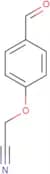
(4-Formylphenoxy)acetonitrile
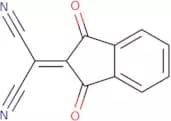
CAS:<p>Please enquire for more information about (4-Formylphenoxy)acetonitrile including the price, delivery time and more detailed product information at the technical inquiry form on this page</p>Formula:C9H7NO2Purity:Min. 95%Molecular weight:161.16 g/mol2-(Dicyanomethylene)indan-1,3-dione
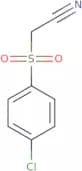
CAS:<p>2-(Dicyanomethylene)indan-1,3-dione is a zwitterion that can be used as an acceptor in organic synthesis. It reacts with nucleophiles (e.g., amines) to form the corresponding adducts and is reversibly hydrolyzed by water or alkali. 2-(Dicyanomethylene)indan-1,3-dione is also known for its ability to undergo nucleophilic attack of the carbonyl group and react with anilines to form the corresponding azine derivatives. This molecule has been shown to be a good candidate for use in uv irradiation due to its high absorption coefficient at 260 nm.</p>Formula:C12H4N2O2Purity:Min. 95%Color and Shape:PowderMolecular weight:208.17 g/mol2-(4-Chlorobenzenesulphonyl)acetonitrile
CAS:<p>2-(4-Chlorobenzenesulphonyl)acetonitrile is a reactive chemical that is synthesized from chloroform and acetonitrile. It can be used to synthesize various medicines such as analgesics, muscle relaxants, and x-ray contrast agents. 2-(4-Chlorobenzenesulphonyl)acetonitrile has minimal effects on the human body and is not known to cause any major health problems. It is metabolized in the liver by oxidation of the methyl group to form 4-chlorobenzene sulfonic acid, which is excreted through urine. The chlorine atom in this molecule has a trigonal bipyramidal geometry with a bond length of 1.82 Å, which can be seen in x-ray crystallography studies.</p>Formula:C8H6ClNO2SPurity:Min. 95%Color and Shape:PowderMolecular weight:215.66 g/molethyl 2-cyano-3-[3-(trifluoromethyl)phenyl]acrylate
CAS:<p>Please enquire for more information about ethyl 2-cyano-3-[3-(trifluoromethyl)phenyl]acrylate including the price, delivery time and more detailed product information at the technical inquiry form on this page</p>Purity:Min. 95%N-(4-Cyanophenyl)-2-chloropropanamide
CAS:<p>Please enquire for more information about N-(4-Cyanophenyl)-2-chloropropanamide including the price, delivery time and more detailed product information at the technical inquiry form on this page</p>Purity:Min. 95%N-(2-Cyanophenyl)-2-chloropropanamide
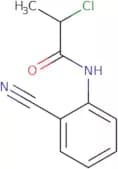
CAS:<p>Please enquire for more information about N-(2-Cyanophenyl)-2-chloropropanamide including the price, delivery time and more detailed product information at the technical inquiry form on this page</p>Purity:Min. 95%2-(Aminomethylene)phenylsulphonyl acetonitrile
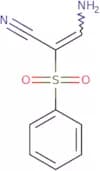
CAS:<p>2-(Aminomethylene)phenylsulphonyl acetonitrile is an allylating agent. It reacts with hydrochloric acid to form allyl isothiocyanate, which can be used for the synthesis of thiazoline derivatives. 2-(Aminomethylene)phenylsulphonyl acetonitrile is a reagent that has been used in multicenter trials to study the effects of allylation on cancerous cells.</p>Formula:C9H8N2O2SPurity:Min. 95%Color and Shape:PowderMolecular weight:208.24 g/mol2-(4-Fluorophenoxy)-Acetonitrile
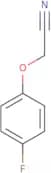
CAS:<p>Please enquire for more information about 2-(4-Fluorophenoxy)-Acetonitrile including the price, delivery time and more detailed product information at the technical inquiry form on this page</p>Formula:C8H6FNOPurity:Min. 95%Molecular weight:151.14 g/molα-Amino-4-(trifluoromethoxy)benzeneacetonitrile Hydrochloride
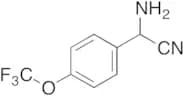
CAS:Controlled ProductFormula:C9H7F3N2OColor and Shape:NeatMolecular weight:216.16(5-Benzyloxyindol-3-yl)acetonitrile
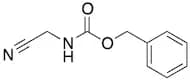
CAS:Controlled ProductFormula:C17H14N2OColor and Shape:NeatMolecular weight:262.306Benzyl Cyanomethylcarbamate
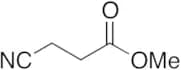
CAS:Controlled Product<p>Applications BENZYL CYANOMETHYLCARBAMATE (cas# 3589-41-1) is a useful research chemical.<br></p>Formula:C10H10N2O2Color and Shape:NeatMolecular weight:190.19Methyl 3-Cyanoropionate
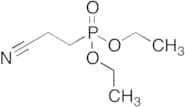
CAS:Controlled Product<p>Applications Methyl 3-Cyanoropionate is used in the preparation of anticancer agents. Also used in the design of the ‘dipeptoid’ analogs of cholecystokinin.<br>References Graham, L. et al.: J. Med. Chem., 55, 7817 (2012); Boden, P. et al.: Eur. J. Med. Chem., 28, 47 (1993);<br></p>Formula:C5H7NO2Color and Shape:NeatMolecular weight:113.11Diethyl (2-cyanoethyl)phosphonate
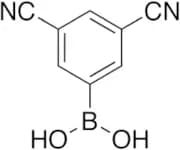
CAS:Controlled Product<p>Applications Diethyl (2-cyanoethyl)phosphonate, is a useful reactant used in various chemical synthesis such as in synthesis of lipophilic oxoamides with activity against phospholipase A2, Triose phosphate isomerase of muscle inhibitors, and also in base-catalyzed stereospecific anti-Markovnikov addition.<br></p>Formula:C7H14NO3PColor and Shape:NeatMolecular weight:191.163,5-Dicyanophenylboronic Acid
CAS:Controlled ProductFormula:C8H5BN2O2Color and Shape:NeatMolecular weight:171.9483-Cyanobenzoic Acid
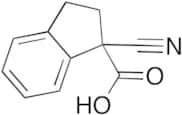
CAS:Controlled Product<p>Applications 3-Cyanobenzoic Acid, is a building block used for the synthesis of a variety of 3,5-disubstituted 1,2,4-oxadiazoles from carboxylic acids, that can be used for the synthesis of a metabotropic glutamate subtype 5 (mGlu5) receptor antagonist.<br>References Ramu, T., et al.: Chem. Lett., 42, 722 (2013);<br></p>Formula:C8H5NO2Color and Shape:NeatMolecular weight:147.131-Cyano-2,3-dihydro-1H-indene-1-carboxylic Acid
CAS:Controlled ProductFormula:C11H9NO2Color and Shape:NeatMolecular weight:187.19(2-Isocyanoethyl)-benzene
CAS:<p>Applications (2-Isocyanoethyl)-benzene is a useful synthetic intermediate. It is a reagent used in Ugi reactions to synthesize various compounds such as tetrazole and bisamide.<br>References Zhao, T., et al.: Org. Lett., 15, 639 (2013); Brockmeyer, F., et al.: Helv. Chim. Acta., 95, 1857 (2012)<br></p>Formula:C9H9NColor and Shape:NeatMolecular weight:131.1745Diethyl Cyanomethylphosphonate
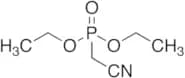
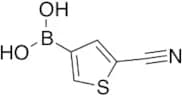
CAS:Controlled Product<p>Applications A Wittig reagent.<br>References Laine, D., et al.: J. Med. Chem., 52, 5241 (2009), Nakao, A., et al.: Bioorg. Med. Chem. Lett., 19, 4607 (2009), Arakawa, Y., et al.: Chem. Pharm. Bull., 57, 167 (2009),<br></p>Formula:C6H12NO3PColor and Shape:NeatMolecular weight:177.14(5-Cyanothiophen-3-yl)boronic Acid
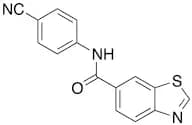
CAS:Controlled ProductFormula:C5H4BNO2SColor and Shape:NeatMolecular weight:152.967N-(4-Cyanophenyl)-6-benzothiazolecarboxamide
CAS:Controlled Product<p>Applications N-(4-Cyanophenyl)-6-benzothiazolecarboxamide is a compound used in the synthesis of piperazines presenting neuro and psychotropic agent with low toxicity.<br></p>Formula:C15H9N3OSColor and Shape:NeatMolecular weight:279.317

![ethyl 2-cyano-3-[3-(trifluoromethyl)phenyl]acrylate](/_next/image/?url=https%3A%2Fstatic.cymitquimica.com%2Fproducts%2F3D%2Fthumb-webp%2FFE168860.webp&w=3840&q=75)