Ethers
Ethers are organic compounds containing an ether functional group, characterized by an oxygen atom bonded to two hydrocarbon radicals. These compounds are valuable in synthesis and serve as solvents in various chemical reactions. At CymitQuimica, we offer a selection of high-quality ethers to support your research and industrial applications, ensuring reliable and effective results. Our range of ethers meets diverse laboratory requirements, from routine experiments to advanced research.
Found 40712 products of "Ethers"
Sort by
Purity (%)
0
100
|
0
|
50
|
90
|
95
|
100
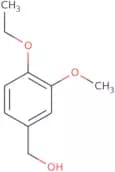
4-Ethoxy-3-methoxybenzyl alcohol
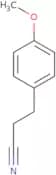
CAS:<p>4-Ethoxy-3-methoxybenzyl alcohol is a metabolite of the drug benzocaine. It is formed by hydrolysis of the ester linkages in benzocaine and is then further metabolized to form 4-hydroxy-3-methoxybenzyl alcohol. 4-Ethoxy-3-methoxybenzyl alcohol has been shown to have antinociceptive effects in rats, which may be due to its ability to inhibit pain signals from the peripheral nerves.</p>Formula:C10H14O3Purity:Min. 95%Color and Shape:PowderMolecular weight:182.22 g/molβ-(p-Methoxyphenyl)propionitrile
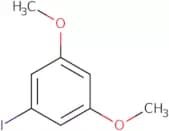
CAS:<p>The synthesis of beta-(p-methoxyphenyl)propionitrile is a sustainable process that can be carried out in the laboratory. The reaction requires no catalysts or solvents and can be completed within an hour, with yields of up to 99%. This compound can be used as a precursor for other organic compounds, such as pharmaceuticals.</p>Formula:C10H11NOPurity:Min. 95%Color and Shape:Clear LiquidMolecular weight:161.2 g/mol3,5-Dimethoxyiodobenzene
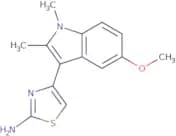
CAS:<p>3,5-Dimethoxyiodobenzene is an organic molecule that is structurally similar to biphenyl. It has been shown to inhibit the growth of cancer cells by flipping the mcf-7 protein and cross-coupling with pterostilbene. 3,5-Dimethoxyiodobenzene can be used as a substitute for biphenyl in some reactions because it has a similar structure but does not have halogen groups. 3,5-Dimethoxyiodobenzene also inhibits the production of chloride ions in bacteria and causes accumulation of phosphane, which is an enzyme inhibitor. This compound has also been shown to act as a stereoselective inhibitor of enzymes that catalyze the synthesis of phytoalexins, which are plant secondary metabolites produced under biotic stress conditions (e.g., bacterial infection).</p>Formula:C8H9IO2Purity:Min. 95%Color and Shape:Light Brown To Brown SolidMolecular weight:264.06 g/mol4-(5-Methoxy-1,2-dimethyl-1H-indol-3-yl)-1,3-thiazol-2-amine
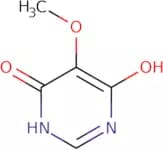
CAS:<p>Please enquire for more information about 4-(5-Methoxy-1,2-dimethyl-1H-indol-3-yl)-1,3-thiazol-2-amine including the price, delivery time and more detailed product information at the technical inquiry form on this page</p>Formula:C14H15N3OSPurity:Min. 95%Color and Shape:PowderMolecular weight:273.35 g/mol4,6-Dihydroxy-5-methoxypyrimidine
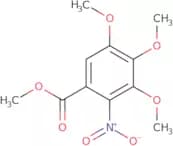
CAS:<p>4,6-Dihydroxy-5-methoxypyrimidine is a white crystalline solid. It is soluble in alkali, acid ethyl, and alcohol. This compound can be used as a solvent for organic substances and has been shown to methylate phosphorus oxychloride. 4,6-Dihydroxy-5-methoxypyrimidine is also used in the synthesis of nucleosides.</p>Formula:C5H6N2O3Purity:Min. 95%Molecular weight:142.11 g/mol2-Nitro-3,4,5-trimethoxybenzoic acid methyl ester
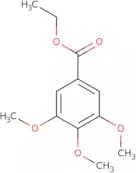
CAS:<p>2-Nitro-3,4,5-trimethoxybenzoic acid methyl ester is a potential anticancer agent. It has been shown to inhibit the growth of cancer cells in vitro and demonstrates anticancer activity against human tumor xenografts in mice. This compound binds to the epidermal growth factor receptor (EGFR) and inhibits its activity. This binding causes downstream signalling pathways to be suppressed, which ultimately prevents tumor cells from proliferating. 2-Nitro-3,4,5-trimethoxybenzoic acid methyl ester also has directional properties that may allow for selective targeting of cancerous cells.<br>2-Nitro-3,4,5-trimethoxybenzoic acid methyl ester is a white crystalline powder with an orthorhombic crystal system and an amine group on each end of the molecule.</p>Formula:C11H13NO7Purity:Min. 95%Color and Shape:PowderMolecular weight:271.22 g/molEthyl 3,4,5-trimethoxybenzoate
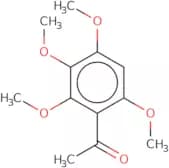
CAS:<p>Ethyl 3,4,5-trimethoxybenzoate is a synthetic chemical that is used as a precursor in the synthesis of quinoxalines. Ethyl 3,4,5-trimethoxybenzoate has been shown to have antiviral properties against human immunodeficiency virus and leishmania. It also has potent inhibitory activity against heterocyclic amines and t. rubrum.</p>Formula:C12H16O5Purity:Min. 95%Color and Shape:White To Grey SolidMolecular weight:240.25 g/mol2,4,5,6-Tetramethoxyacetophenone
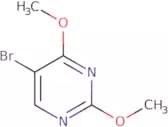
CAS:<p>2,4,5,6-Tetramethoxyacetophenone is a versatile building block that can be used as an intermediate in the production of complex compounds and speciality chemicals. This compound is a useful scaffold for research chemicals and reaction components. It has CAS No. 7508-05-6 and a high quality.</p>Formula:C12H16O5Purity:Min. 95%Molecular weight:240.25 g/mol5-Bromo-2,4-dimethoxypyrimidine
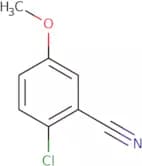
CAS:<p>5-Bromo-2,4-dimethoxypyrimidine is a compound that functions as a potent inhibitor of L-glutamic acid amidohydrolase. This enzyme is essential for the synthesis of gamma-amino butyric acid (GABA) and glutamine, which are neurotransmitters in the central nervous system. 5-Bromo-2,4-dimethoxypyrimidine inhibits the formylation of l-glutamic acid to glutamate by inhibiting the enzyme L-glutamate formate lyase. It also inhibits herpes simplex virus type 1 (HSV1) replication by preventing viral DNA polymerization. 5-Bromo-2,4-dimethoxypyrimidine has been shown to be an effective inhibitor of chloride ion transport in some bacteria. The compound also shows photochromism when exposed to ultraviolet light or visible light under certain conditions. 5BROMO 2, 4 -DIM</p>Formula:C6H7BrN2O2Purity:Min. 95%Color and Shape:PowderMolecular weight:219.04 g/mol2-Chloro-5-methoxybenzonitrile
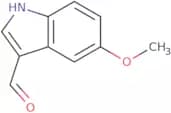
CAS:<p>2-Chloro-5-methoxybenzonitrile is an organic compound that has a chlorinated methoxy group and a cyano group. It is synthesized by the reaction of 2-chloro-5-hydroxybenzonitrile with sulfuryl chloride in the presence of potassium carbonate. The yield of this reaction can be increased by adding a chlorinated solvent such as dichloromethane or chloroform. 2-Chloro-5-methoxybenzonitrile is used in the synthesis of various drugs and other organic compounds, such as amides and benzene ring compounds.</p>Formula:C8H6ClNOColor and Shape:PowderMolecular weight:167.59 g/mol5-Methoxyindole-3-carboxaldehyde
CAS:<p>5-Methoxyindole-3-carboxaldehyde is a molecule that belongs to the genus of indolequinones. It has been shown to have potent inhibitory activity against prostate cancer cells, and also has anti-cancer properties. 5-Methoxyindole-3-carboxaldehyde inhibits the proliferation of cancer cells by inducing apoptosis in prostate cancer cells. 5-Methoxyindole-3-carboxaldehyde also suppresses the growth of cervical cancer cells and breast cancer cells. This molecule binds to the hydrogen bond sites on DNA, which may be one reason for its anti-cancer properties. The molecule is fluorescent and can be used as a marker for detecting cancers or other diseases in living tissue.</p>Formula:C10H9NO2Purity:Min. 95%Color and Shape:PowderMolecular weight:175.18 g/mol5-Methoxy-2-[[(4-methoxy-3,5-dimethyl-2-pyridinyl)methyl]thio]-1H-benzimidazole N-oxide
CAS:<p>5-Methoxy-2-[[(4-methoxy-3,5-dimethyl-2-pyridinyl)methyl]thio]-1H-benzimidazole N-oxide is a sulfoxide that belongs to the family of medicines called proton pump inhibitors. It is a stereoselective proton pump inhibitor due to its cyclic nature and has been used as a pharmaceutical preparation for the treatment of gastroesophageal reflux disease. 5-Methoxy-2-[(4-methoxy-3,5-dimethylpyridinium) methylthio]-1H benzimidazole N oxide has been shown to be an enantiomerically pure salt form with magnesium chloride.</p>Formula:C17H19N3O3SPurity:Min. 95%Color and Shape:White to off-white solid.Molecular weight:345.42 g/mol5-Chloro-2-methoxyacetophenone
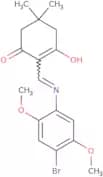
CAS:<p>5-Chloro-2-methoxyacetophenone is a byproduct of the synthesis of 2-hydroxybenzofuran. It is also used in the synthesis of tetracyclic benzopyrans, which are known to be potent analgesics and have been found to have anti-inflammatory properties. 5-Chloro-2-methoxyacetophenone can be obtained by decarbonylation (loss of carbon) or elimination reactions.</p>Formula:C9H9ClO2Purity:Min. 95%Color and Shape:Clear LiquidMolecular weight:184.62 g/mol2-(((4-Bromo-2,5-dimethoxyphenyl)amino)methylene)-5,5-dimethylcyclohexane-1,3-dione
CAS:<p>Please enquire for more information about 2-(((4-Bromo-2,5-dimethoxyphenyl)amino)methylene)-5,5-dimethylcyclohexane-1,3-dione including the price, delivery time and more detailed product information at the technical inquiry form on this page</p>Formula:C17H20BrNO4Purity:Min. 95%Molecular weight:382.25 g/molN-[2-(2,3-Dimethoxyphenyl)ethyl]-2-chlorobenzamide
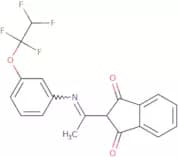
CAS:Controlled Product<p>N-[2-(2,3-Dimethoxyphenyl)ethyl]-2-chlorobenzamide is a versatile building block that can be used as a reaction component and reagent. It is an intermediate in the synthesis of pharmaceuticals and fine chemicals and has been shown to be useful in the synthesis of complex compounds. This compound reacts with nucleophiles, such as amines and alcohols, by replacing the chloride group with a variety of functional groups. The product is then hydrolyzed to release the original reactant. N-[2-(2,3-Dimethoxyphenyl)ethyl]-2-chlorobenzamide has a CAS number of 320576-19-0 and can be found at ChemDiv.com.</p>Formula:C17H18ClNO3Purity:Min. 95%Molecular weight:319.78 g/mol2-(2-Aza-1-methyl-2-(3-(1,1,2,2-tetrafluoroethoxy)phenyl)vinyl)indane-1,3-dione
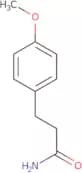
CAS:<p>Please enquire for more information about 2-(2-Aza-1-methyl-2-(3-(1,1,2,2-tetrafluoroethoxy)phenyl)vinyl)indane-1,3-dione including the price, delivery time and more detailed product information at the technical inquiry form on this page</p>Formula:C19H13F4NO3Purity:Min. 95%Color and Shape:PowderMolecular weight:379.3 g/mol3-(4-Methoxyphenyl)propionamide
CAS:<p>3-(4-Methoxyphenyl)propionamide is a compound that belongs to the group of benzene amides. It is synthesized by reacting an excess of 3-bromopropionaldehyde with an amine in the presence of sodium hydroxide. This reaction produces a mixture of products, which are separated by chromatography. The yields for this reaction are approximately 90%. 3-(4-Methoxyphenyl)propionamide has been used as a biomolecular building block, and its traceless nature makes it useful in organic synthesis.<br>3-(4-Methoxyphenyl)propionamide can be used to synthesize alkanesulfonamides and spirolactams, which are important intermediates in chemical synthesis. 3-(4-Methoxyphenyl)propionamide also reacts with phenanthridone to produce chloride derivatives and with arenes to produce linkers.</p>Formula:C10H13NO2Purity:Min. 95%Color and Shape:PowderMolecular weight:179.22 g/mol2-Cyano-N-[2-(3,4-dimethoxyphenyl)ethyl]acetamide
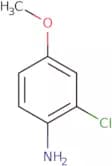
CAS:<p>Please enquire for more information about 2-Cyano-N-[2-(3,4-dimethoxyphenyl)ethyl]acetamide including the price, delivery time and more detailed product information at the technical inquiry form on this page</p>Formula:C13H16N2O3Purity:Min. 95%Molecular weight:248.28 g/mol2-Chloro-4-methoxyaniline
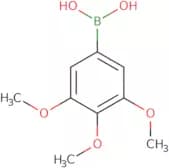
CAS:<p>2-Chloro-4-methoxyaniline is a primary amine that has been used in the synthesis of polychlorinated and chlorinated amines. It is an important precursor for the manufacture of herbicides, insecticides, and pharmaceuticals. 2-Chloro-4-methoxyaniline reacts with hydrogen chloride to form chloroacetanilide, which can be hydrolysed to aniline. This reaction proceeds at room temperature and does not require catalysts. The reactivity of this compound is due to its nucleophilic substitutions in the presence of ketocarboxylic acids or vinyl ethers. 2-Chloro-4-methoxyaniline has also been used as a dehydrating reagent in organic synthesis reactions.br>br><br>2-Chloro-4-methoxyaniline is highly reactive because it contains two primary amines (NH2) that</p>Formula:C7H8ClNOPurity:Min. 95%Molecular weight:157.6 g/mol(3,4,5-Trimethoxyphenyl)boronic acid
CAS:<p>(3,4,5-Trimethoxyphenyl)boronic acid is an active analogue of 3,4,5-trimethoxybenzoic acid. It has potent anti-inflammatory properties and inhibits cancer cell proliferation. (3,4,5-Trimethoxyphenyl)boronic acid has been shown to inhibit the growth of cancer cells in vitro by binding to the gyrase enzyme. This drug also has biological properties that may be useful for treating human liver diseases such as hepatic steatosis or nonalcoholic fatty liver disease (NAFLD).</p>Formula:C9H13BO5Purity:Min. 95 Area-%Color and Shape:PowderMolecular weight:212.01 g/mol

![5-Methoxy-2-[[(4-methoxy-3,5-dimethyl-2-pyridinyl)methyl]thio]-1H-benzimidazole N-oxide](/_next/image/?url=https%3A%2Fstatic.cymitquimica.com%2Fproducts%2F3D%2Fthumb-webp%2FFM63432.webp&w=3840&q=75)

![N-[2-(2,3-Dimethoxyphenyl)ethyl]-2-chlorobenzamide](/_next/image/?url=https%3A%2Fstatic.cymitquimica.com%2Fproducts%2F3D%2Fthumb-webp%2FFD66108.webp&w=3840&q=75)
![2-Cyano-N-[2-(3,4-dimethoxyphenyl)ethyl]acetamide](/_next/image/?url=https%3A%2Fstatic.cymitquimica.com%2Fproducts%2F3D%2Fthumb-webp%2FFC131318.webp&w=3840&q=75)