Ethers
Ethers are organic compounds containing an ether functional group, characterized by an oxygen atom bonded to two hydrocarbon radicals. These compounds are valuable in synthesis and serve as solvents in various chemical reactions. At CymitQuimica, we offer a selection of high-quality ethers to support your research and industrial applications, ensuring reliable and effective results. Our range of ethers meets diverse laboratory requirements, from routine experiments to advanced research.
Found 40902 products of "Ethers"
Sort by
Purity (%)
0
100
|
0
|
50
|
90
|
95
|
100
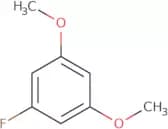
1-Fluoro-3,5-dimethoxybenzene
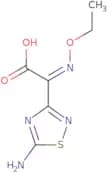
CAS:<p>1-Fluoro-3,5-dimethoxybenzene has been shown to be a ferroelectric material with a dielectric constant of approximately 3000. It is soluble in organic solvents and can be isolated as an oil or solid. The crystalline form of 1-fluoro-3,5-dimethoxybenzene is obtained by sublimation at −20 °C. The compound has a molecular weight of 204.17 and melting point of 155 °C. This compound is used as a starting material for the synthesis of fluorotriphenylmethane analogs that are potential CB2 receptor agonists and other organic compounds, including tetrahydrocannabinol (THC) and its analogues. 1-Fluoro-3,5-dimethoxybenzene also reacts with chloride to form difluorobenzene (DFB). DFB's ability to bind aluminium ions allows it to cataly</p>Formula:C8H9FO2Purity:Min. 98 Area-%Color and Shape:Clear LiquidMolecular weight:156.15 g/mol(Z)-2-(5-Amino-1,2,4-thiadiazol-3-yl)-2-(ethoxyimino)acetic acid
CAS:<p>(Z)-2-(5-Amino-1,2,4-thiadiazol-3-yl)-2-(ethoxyimino)acetic acid is a synthetic compound that can be used as an antibiotic. It is synthesized from acetonitrile and phosphorus oxychloride in the presence of hydroxyl groups. This reaction yields a mixture of amides and cyanoacetamide derivatives. The amides are then converted to their respective alkyl chlorides with methyl iodide, which are then reacted with dimethyl acetylenedicarboxylate to form the desired product. The final step is to hydrolyze the ester group with hydrochloric acid to yield (Z)-2-(5-amino-1,2,4-thiadiazol-3-yl)-2-(ethoxyimino)acetic acid. This chemical has been shown to have antibacterial properties against some strains of bacteria such as</p>Formula:C6H8N4O3SPurity:Min. 95%Color and Shape:PowderMolecular weight:216.22 g/mol5-Methoxy-1-methyl-1H-indole-3-carbaldehyde
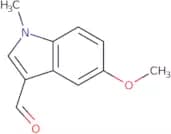
CAS:<p>5-Methoxy-1-methyl-1H-indole-3-carbaldehyde is a synthetic compound that has been shown to inhibit the growth of human tumour cells in vitro. This compound is a regioisomeric mixture of two enantiomers, with the (S) isomer being the more potent inhibitor. The (R) isomer was found to be less active against human tumour cells and may have an antimicrobial activity. 5-Methoxy-1-methyl-1H-indole-3-carbaldehyde has been shown to be bioreductive towards electron donors such as NADPH and glutathione. It also inhibits dt diaphorase and aerobic metabolism in human tumour cells.</p>Formula:C11H11NO2Purity:Min. 95%Color and Shape:Off-White PowderMolecular weight:189.21 g/mol3,4-Diethoxyphenylacetone
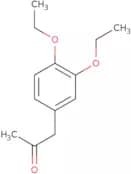
CAS:<p>3,4-Diethoxyphenylacetone is a chemical compound that is used as a building block for research and as an intermediate in the synthesis of other chemicals. This compound is also used as a reagent. 3,4-Diethoxyphenylacetone has CAS number 93635-48-4.</p>Formula:C13H18O3Purity:Min. 95%Molecular weight:222.28 g/mol2-Methoxy-2-phenylethanol
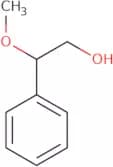
CAS:<p>2-Methoxy-2-phenylethanol is a molecule that has been found to be a good catalyst for the ring-opening of epoxides. It is also used as a solid catalyst in kinetic studies and as an additive in organic syntheses. 2-Methoxy-2-phenylethanol is soluble in water and reacts with fatty acids to form acetylated products. This molecule has been shown to have an inhibitory effect on human liver alcohol dehydrogenase, which may be due to it's ability to bind to the enzyme's active site.</p>Formula:C9H12O2Purity:Min. 95%Color and Shape:Colorless Clear LiquidMolecular weight:152.19 g/mol4',2-Dihydroxy-3-methoxychalcone
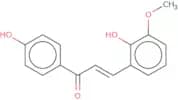
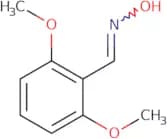
CAS:<p>4,2-Dihydroxy-3-methoxychalcone is a fine chemical that is useful in the synthesis of various pharmaceuticals and other chemicals. It is a versatile building block that can be used as a reaction component or intermediate in the synthesis of complex compounds. 4,2-Dihydroxy-3-methoxychalcone has been shown to be a high quality reagent for use in the synthesis of speciality chemicals and research chemicals. This compound is also useful as a scaffold for the development of new drugs.</p>Formula:C16H14O4Purity:Min. 95%Molecular weight:270.28 g/mol2,6-Dimethoxybenzaldoxime
CAS:<p>2,6-Dimethoxybenzaldoxime is a phenylhydrazone that can be used in the catalytic system for oxidation of carbonyl compounds. The reaction proceeds through the periodate-mediated oxidation of the hydrazone to form the corresponding hydroxamic acid. This compound has been shown to be efficient and selective for the oxidation of a wide range of carbonyl compounds, including porphyrins. 2,6-Dimethoxybenzaldoxime is also used as a precursor for other syntheses, such as tetraphenylporphyrin.</p>Formula:C9H11NO3Purity:Min. 95%Molecular weight:181.19 g/molPoly[2-methoxy-5-(2-ethylhexyloxy)-1,4-phenylenevinylene] - M.W. average 10,000-100,000
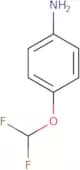
CAS:<p>Poly[2-methoxy-5-(2-ethylhexyloxy)-1,4-phenylenevinylene] (MEH-PPV) is a polymer that has been extensively studied in the past. It has an average molecular weight of 10,000 to 100,000 and exhibits semiconducting properties. MEH-PPV can be synthesized by chemical sulfonation of MEH-PPV with sulfuric acid followed by addition of potassium hydroxide. This process yields a polymer that is soluble in organic solvents. The degree of sulfonation can be controlled by adjusting the ratio of sulfuric acid to MEH-PPV. MEH-PPV can also be synthesized from vinyl alcohol and vinylene monomers by free radical polymerization or copolymerization reactions. In this process, vinyl alcohol and vinylene are copolymerized to form polymers with alternating ethylene glycol and phenylethynyl moieties.</p>Formula:(C17H24O2)nPurity:Min. 95%Color and Shape:Red Powder4-Difluoromethoxyaniline
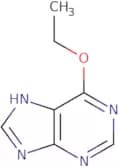
CAS:<p>4-Difluoromethoxyaniline is an allosteric modulator for glutamate receptors. It is a chemical compound that can be used to modify glutamate receptors to act as either metabotropic or ionotropic. 4-Difluoromethoxyaniline is used in the treatment of Parkinson's disease and other movement disorders, such as dyskinesia. It has been shown that 4-difluoromethoxyaniline increases the activity of activated glutamate receptors, which leads to increased levels of the neurotransmitter dopamine in the brain. This drug may also inhibit nitric oxide production and corticotropin-releasing hormone (CRH) synthesis.</p>Formula:C7H7F2NOPurity:Min. 95%Molecular weight:159.13 g/mol6-Ethoxypurine
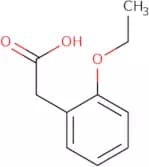
CAS:<p>6-Ethoxypurine is a nucleoside analog that inhibits the enzyme ribonucleotide reductase, which converts ribonucleotides to deoxyribonucleotides. It is used in cell culture to measure the effects of radiation and hydrochloric acid on the production of ATP. 6-Ethoxypurine has been shown to inhibit influenza virus replication with an IC50 of 10 μM. This compound has reactive hydroxyl groups that allow it to participate in hydrogen bonding, which can be beneficial for interactions with other molecules. 6-Ethoxypurine also exhibits nucleophilic properties, which allows it to react with other chemical species and can be useful for generating new chemical compounds.</p>Formula:C7H8N4OPurity:Min. 95%Color and Shape:PowderMolecular weight:164.16 g/mol2-Ethoxyphenylacetic acid
CAS:<p>2-Ethoxyphenylacetic acid (2EPA) is a drug that has been used in the treatment of cancer. It is a hydrophobic molecule that can inhibit the activity of various enzymes, such as sildenafil and triazolone. 2EPA has shown to be an antagonist at the active site of quinazolinone, which is a molecule involved in erectile dysfunction. The physicochemical properties of 2EPA have been studied using molecular dynamics simulations and quantum mechanical computations. This drug is able to form hydrophobic interactions with the active site of quinazolinone, which may account for its antagonistic activity.</p>Formula:C10H12O3Purity:90%Color and Shape:PowderMolecular weight:180.2 g/mol5-Methoxy-3-(1,2,5,6-tetrahydro-4-pyridinyl)-1H-indole hemisuccinate
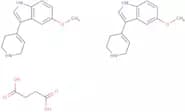
CAS:<p>5-Methoxy-3-(1,2,5,6-tetrahydro-4-pyridinyl)-1H-indole hemisuccinate is a serotonin receptor agonist that has been shown to stimulate the 5HT1A receptor. It stimulates insulin secretion and glucose uptake in rats and inhibits feeding behavior in mice. It has also been shown to have antihypertensive effects on rats by blocking the 5HT2 receptors. In addition, it stimulates regeneration of injured nerve cells. This drug has potential uses as a treatment for neurological diseases such as Parkinson's disease and depression.</p>Formula:C14H16N2O•(C4H6O4)0Purity:Min. 95%Color and Shape:Yellow solid.Molecular weight:287.33 g/mol5-Ethoxy-2(5H)-furanone
CAS:<p>5-Ethoxy-2(5H)-furanone is an oxidation product of 5-ethoxy-2(5H)-furanone. It has an isomeric, stereospecific, regiospecifically, and a tautomeric relationship with furfural. 5-Ethoxy-2(5H)-furanone can be produced by the oxidation of furfural with boron trifluoride etherate in the presence of iodosobenzene. The reaction mechanism involves the addition of hydrogen peroxide to the boron trifluoride etherate to form hydroperoxydiborane. This compound then reacts with iodosobenzene to produce 5-ethoxy-2(5H)-furanone and 2,5-dihydroxybenzaldehyde. The reaction produces a mixture of diastereomers that contain different numbers of carbon atoms due to the regiospecific</p>Formula:C6H8O3Purity:Min. 95%Color and Shape:PowderMolecular weight:128.13 g/mol3-Bromo-5-methoxybenzoic acid
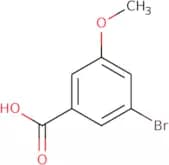
CAS:<p>3-Bromo-5-methoxybenzoic acid is a cytotoxic agent that inhibits the activity of acid transporter, which is involved in the transport of organic acids from the cell to the blood. It is used as an antineoplastic agent for animal studies and has been shown to have a safety profile similar to benzbromarone. 3-Bromo-5-methoxybenzoic acid also inhibits uricosuric activity in mouse hepatocytes and metabolic activation in mice. This compound has inhibitory effects on mouse liver cells and can be used for the treatment of liver cancer.</p>Formula:C8H7BrO3Purity:Min. 95%Molecular weight:231.04 g/molEthyl 2-(3,4-dimethoxyphenyl)acetate - 90%
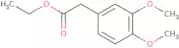
CAS:<p>Ethyl 2-(3,4-dimethoxyphenyl)acetate is a synthetic molecule that has been observed in the gas phase. It has been shown to have antibacterial activity and significant antifungal activity. Ethyl 2-(3,4-dimethoxyphenyl)acetate was also found to be resistant to amines, which are organic compounds that can be found in many types of bacteria. The antibacterial properties of ethyl 2-(3,4-dimethoxyphenyl)acetate may be due to its ability to cleave bonds with chloride ions and its conformational studies.</p>Formula:C12H16O4Purity:Min. 95%Color and Shape:PowderMolecular weight:224.25 g/mol3-Chloro-4-methoxybenzylamine hydrochloride
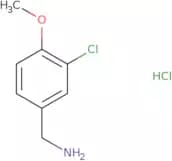
CAS:<p>3-Chloro-4-methoxybenzylamine hydrochloride is a quinoline derivative that inhibits the activity of phosphodiesterase 5, an enzyme that breaks down cGMP in the brain. This drug has been shown to increase levels of cGMP and decrease levels of low energy (i.e., low ATP) in synaptosomes. 3-Chloro-4-methoxybenzylamine hydrochloride may be useful for the treatment of Alzheimer's disease, as it has been shown to improve cognitive function and memory in animal models. The mechanism of action is not fully understood but may involve inhibition of cholinergic neurotransmission or activation of nitric oxide synthase.</p>Formula:C8H10ClNO•HClPurity:Min. 95%Color and Shape:PowderMolecular weight:208.08 g/mol3,3'-Dimethoxyazoxybenzene
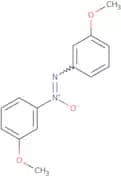
CAS:<p>3,3'-Dimethoxyazoxybenzene is a nitroarene that has electron-donating properties. It reacts with primary amines to form azoxy groups in the presence of alkoxide. 3,3'-Dimethoxyazoxybenzene can be used for the synthesis of nitrophenyl and aniline derivatives by reaction with nitroarenes, alcohols, or amines. It can also serve as a photoreduced molecule in mechanistic studies.</p>Formula:C14H14N2O3Purity:Min. 95%Molecular weight:258.27 g/mol2-[(Acetyloxy)methoxy]ethyl acetate
CAS:<p>2-[(Acetyloxy)methoxy]ethyl acetate is a drug that inhibits the enzyme orotidine 5′-monophosphate decarboxylase, which is responsible for the conversion of uridine to orotic acid. This inhibition prevents the synthesis of RNA and DNA and leads to cell death by inhibiting protein synthesis. 2-[(Acetyloxy)methoxy]ethyl acetate has shown tuberculostatic activity in leukemic mice, with an inhibition constant of 3.2 × 10 M. The compound also inhibits diphenolase activity, which is important in the production of uridine phosphorylase, an enzyme that produces uridine from orotic acid. 2-[(Acetyloxy)methoxy]ethyl acetate has been tested for its ability to inhibit herpes simplex virus (HSV) in vitro and in vivo and has been shown to be effective against HSV type 1 and HSV</p>Formula:C7H12O5Purity:Min. 95%Color and Shape:Colorless Clear LiquidMolecular weight:176.17 g/mol3,6-Dimethoxyterephthaldicarboxaldehyde
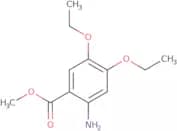
<p>3,6-Dimethoxyterephthaldicarboxaldehyde is a chemical compound that can be used in the synthesis of complex compounds. It has been shown to be an effective reagent for the synthesis of heterocycles and has also been used as a building block in the synthesis of pharmaceuticals and other organic compounds. 3,6-Dimethoxyterephthaldicarboxaldehyde is a versatile building block with many potential uses. It has also been identified as a useful scaffold for drug design and development.</p>Purity:Min. 95%2-Amino-4,5-diethoxy-benzoic acid methyl ester
CAS:<p>2-Amino-4,5-diethoxy-benzoic acid methyl ester is a fine chemical that is used as a building block in the synthesis of complex compounds. It is a versatile building block with many possible reactions and can be used as a reagent or speciality chemical. 2-Amino-4,5-diethoxy-benzoic acid methyl ester can be used in the synthesis of diverse scaffolds for use in research chemicals, pharmaceuticals and agrochemicals.</p>Formula:C12H17NO4Purity:Min. 95%Molecular weight:239.27 g/mol

![Poly[2-methoxy-5-(2-ethylhexyloxy)-1,4-phenylenevinylene] - M.W. average 10,000-100,000](/_next/image/?url=https%3A%2Fstatic.cymitquimica.com%2Fproducts%2F3D%2Fthumb-webp%2FFP165854.webp&w=3840&q=75)

![2-[(Acetyloxy)methoxy]ethyl acetate](/_next/image/?url=https%3A%2Fstatic.cymitquimica.com%2Fproducts%2F3D%2Fthumb-webp%2FFA64791.webp&w=3840&q=75)