Amides
Amides are a wide range of chemical compounds that contain at least one heterocyclic ring, which has atoms of at least two different elements in the ring structure, and at least one amide group (-CONH2). These compounds are crucial in the synthesis of pharmaceuticals, polymers, and agrochemicals. Amides exhibit unique properties and reactivity, making them valuable intermediates in organic synthesis. At CymitQuimica, we offer a comprehensive selection of high-quality amides to support your research and industrial needs.
Found 16393 products of "Amides"
Sort by
Purity (%)
0
100
|
0
|
50
|
90
|
95
|
100
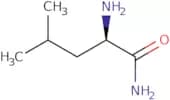
D-Leucine amide
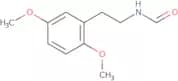
CAS:<p>D-Leucine amide is a hydrophobic, carboxyamide amino acid that is found in the fungus Ochrobactrum anthropi. D-Leucine amide has been shown to catalyze the formation of tripeptides, such as d-alanine and d-tryptophan, from their monomers. The presence of this compound enhances the expression of genes encoding proteins involved in the synthesis of these amino acids. This compound also has been shown to enhance gene analysis by increasing the stability of DNA and RNA molecules.</p>Formula:C6H14N2OPurity:Min. 95%Molecular weight:130.19 g/mol2-(2,5-Dimethoxyphenyl)ethylformamide
CAS:Controlled Product<p>Please enquire for more information about 2-(2,5-Dimethoxyphenyl)ethylformamide including the price, delivery time and more detailed product information at the technical inquiry form on this page</p>Formula:C11H15NO3Purity:Min. 95%Molecular weight:209.24 g/molN-[4-(1-Allyl-3-butyl-2,6-dioxo-2,3,6,7-tetrahydro-1H-purin-8-ylmethyl)phenyl]acetamide
CAS:Controlled Product<p>N-[4-(1-Allyl-3-butyl-2,6-dioxo-2,3,6,7-tetrahydro-1H-purin-8-ylmethyl)phenyl]acetamide (NUAA) is an antiinfective agent that has been shown to be effective against typhimurium. It inhibits bacterial growth by binding to the light chain of the monoclonal antibodies. NUAA is also able to inhibit uptake of iron in E. coli K12 and human cells. The mechanism for this inhibition is not well understood but may be related to its ability to bind iron homeostasis proteins or its oxidation catalyst activity.</p>Formula:C21H25N5O3Purity:Min. 95%Molecular weight:395.46 g/molβ-Alanine amide HCl
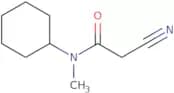
CAS:<p>Beta-alanine amide HCl is a research chemical that belongs to the class of beta-amino acid derivatives. Beta-alanine amide HCl is an activator of nucleophiles and can be used in analytical chemistry as an indicator for chloride ions. It has been shown to react with asparagine, yielding beta-alanine and ammonia. The reaction system can be analysed by measuring the elimination of a hydrogen chloride ion from the beta-alanine amide HCl molecule and the subsequent increase in pH. The analytical method has also been used to measure concentrations of deamination reactions and redox potentials at high concentrations.</p>Formula:C3H8N2O·HClPurity:Min. 95%Color and Shape:White PowderMolecular weight:124.57 g/mol2-Cyano-N-cyclohexyl-N-methylacetamide
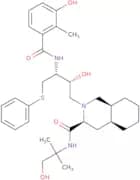
CAS:<p>Please enquire for more information about 2-Cyano-N-cyclohexyl-N-methylacetamide including the price, delivery time and more detailed product information at the technical inquiry form on this page</p>Formula:C10H16N2OPurity:Min. 95%Molecular weight:180.25 g/molNelfinavir hydroxy-tert-butylamide
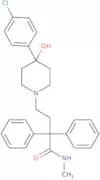
CAS:<p>Nelfinavir is an antiviral agent that is used to treat HIV/AIDS. It is a protease inhibitor that inhibits the action of the virus in cells by binding to specific enzymes, thus preventing the destruction of human cells by the virus. Nelfinavir also prevents cancer cell growth and has shown anticancer activity in animal models and humans. This drug binds to fatty acids, making it more difficult for the body to eliminate this substance. The half-life of nelfinavir is prolonged in patients with hepatic failure or renal failure. Nelfinavir can be used as a chemotherapeutic agent in infants because it does not cross the blood-brain barrier.</p>Formula:C32H45N3O5SPurity:Min. 95%Molecular weight:583.78 g/molN-Desmethyl loperamide
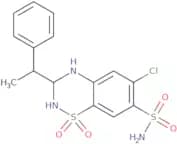
CAS:<p>N-Desmethyl loperamide is a prodrug of loperamide, which is a peripherally acting μ-opioid receptor agonist. It has been shown to be effective in reducing the uptake of radiation in wild-type mice. This drug also inhibits p-glycoprotein (p-gp), and has been shown to reduce the uptake of pyridinium ions and amide substrates. N-Desmethyl loperamide has been shown to have anticancer properties, including resistance to radiation, inhibition of tumor growth and metastasis, and induction of apoptosis, which may be due to its ability to inhibit cellular proliferation and induce cell death. The mechanism by which this drug functions is not yet clear but it may involve inhibition of the expression or function of p-gp or other efflux pumps in cells that are sensitive to these drugs.</p>Formula:C28H31ClN2O2Purity:Min. 95%Molecular weight:463.01 g/mol6-Chloro-3,4-dihydro-3-(a-methylbenzyl)-2H-1,2,4-benzothiadiazine-7-sulfonamide 1,1-dioxide
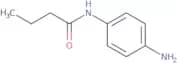
CAS:<p>6-Chloro-3,4-dihydro-3-(a-methylbenzyl)-2H-1,2,4-benzothiadiazine-7-sulfonamide 1,1-dioxide is an active metabolite of the drug benzbromarone. It is primarily administered as a diuretic to treat high blood pressure and congestive heart failure. The pharmacodynamics of this drug are related to its ability to inhibit the activity of sodium channels in vascular smooth muscle cells and thereby reduce the force of contraction and relax the vessel wall. 6CBDMTD has shown an increase in glomerular filtration rate in patients with congestive heart failure. This drug also decreases the plasma concentration of fatty acids by inhibiting the formation of lipoprotein particles. 6CBDMTD has been shown to be effective at lowering diastolic and systolic blood pressure levels in patients with hypertension.</p>Formula:C15H16ClN3O4S2Purity:Min. 95%Molecular weight:401.89 g/molN-(4-Aminophenyl)butanamide
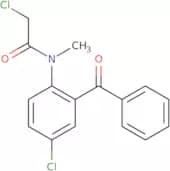
CAS:<p>Please enquire for more information about N-(4-Aminophenyl)butanamide including the price, delivery time and more detailed product information at the technical inquiry form on this page</p>Formula:C10H14N2OPurity:Min. 95%Molecular weight:178.23 g/molN-(2-Benzoyl-4-chlorophenyl)-2-chloro-N-methylacetamide
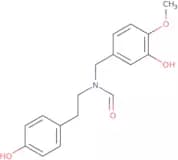
CAS:<p>Please enquire for more information about N-(2-Benzoyl-4-chlorophenyl)-2-chloro-N-methylacetamide including the price, delivery time and more detailed product information at the technical inquiry form on this page</p>Formula:C16H13Cl2NO2Purity:Min. 95%Molecular weight:322.19 g/molN-(p-Hydroxyphenethyl)-N-(3-hydroxy-4-methoxybenzyl)formamide
CAS:Controlled Product<p>Please enquire for more information about N-(p-Hydroxyphenethyl)-N-(3-hydroxy-4-methoxybenzyl)formamide including the price, delivery time and more detailed product information at the technical inquiry form on this page</p>Formula:C17H19NO4Purity:Min. 95%Molecular weight:301.34 g/molWAY 316606
CAS:<p>WAY 316606 is a potent, orally administered small molecule that inhibits the Wnt signaling pathway by blocking the action of β-catenin. It has been shown to have potential for treating eye disorders, including age-related macular degeneration. This drug also has potential for treatment of cell and nervous system diseases such as Alzheimer's disease and Huntington's disease. WAY 316606 inhibits the transcriptional activity of the β-catenin/Tcf4 complex by binding to it and preventing its translocation into the nucleus. In addition, WAY 316606 prevents downstream activation of genes regulated by β-catenin signaling, including c-myc and cyclin D1. This drug also blocks growth factor receptor tyrosine kinases and monoclonal antibodies that activate these receptors.</p>Formula:C18H19F3N2O4S2Purity:Min. 95%Molecular weight:448.48 g/mol2-[(Diphenylmethyl)sulfinyl]-N-hydroxyacetamide
CAS:Controlled Product<p>Adrafinil is a prodrug. It is primarily metabolized in vivo to modafinil, resulting in very similar pharmacological effects.</p>Formula:C15H15NO3SPurity:Min. 98 Area-%Molecular weight:289.35 g/molN-(4-Chloro-5-iodo-7H-pyrrolo[2,3-d]pyrimidin-2-yl)pivalamide
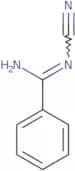
CAS:<p>Please enquire for more information about N-(4-Chloro-5-iodo-7H-pyrrolo[2,3-d]pyrimidin-2-yl)pivalamide including the price, delivery time and more detailed product information at the technical inquiry form on this page</p>Formula:C11H12ClIN4OPurity:Min. 95%Molecular weight:378.6 g/molN'-Cyanobenzenecarboximidamide hydrochloride
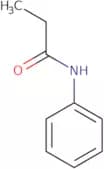
CAS:<p>N-Cyanobenzenecarboximidamide hydrochloride (NCBCH) is an intermediate for the synthesis of azomethine dyes. It can be used to produce azo dyes with a methoxy group at the 3 position and a hydrogen atom at the 4 position. NCBCH is also an excellent substrate for chemical reactions involving fragmentation, extraction, or elimination. NCBCH can be synthesized from methyl ether and benzonitrile in the presence of benzamidine. The product is then treated with methanol to give a tautomeric mixture of benzyl and methyl ether.</p>Formula:C8H7N3Purity:Min. 95%Molecular weight:145.16 g/molN-Phenylpropanamide
CAS:<p>N-Phenylpropanamide is a chemical inhibitor that has been shown to have a protective effect against the light-induced degradation of drugs in urine samples. The compound also inhibits the hydrolysis of amides by hydrochloric acid and hydrogen bonds with the receptor binding site on human liver cells. N-Phenylpropanamide has been shown to affect cardiac function, as well as growth factor production.</p>Formula:C9H11NOPurity:Min. 95%Molecular weight:149.19 g/mol2-(4-Aminophenoxy)acetamide
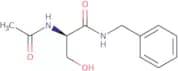
CAS:<p>2-(4-Aminophenoxy)acetamide is a chemical compound that belongs to the class of acetamides. It is used in the production of polyester fibers and dyes. 2-(4-Aminophenoxy)acetamide is a colorless, crystalline solid that has not been identified in nature.</p>Formula:C8H10N2O2Purity:Min. 95%Molecular weight:166.18 g/molDesmethyl lacosamide
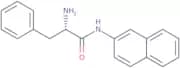
CAS:<p>Lacosamide is an antiepileptic drug that has been shown to be bioequivalent to the reference product, Gabapentin. Lacosamide binds to voltage-gated sodium channels and is thought to have a similar clinical profile as Gabapentin. It is used in the treatment of partial seizures (with or without secondary generalization) and adjunctive therapy for generalized seizures in adults and children aged 2 years or older. Lacosamide can interact with other drugs, such as gabapentin, by increasing their serum concentrations. This interaction may lead to adverse effects such as dizziness and confusion. Lacosamide plasma concentrations are measured using LC-MS/MS methods after a two-way crossover study in healthy human volunteers. This study also showed that lacosamide is excreted unchanged in urine samples at a rate of about 50% over 24 hours, indicating that it does not undergo extensive metabolism in humans.</p>Formula:C12H16N2O3Purity:Min. 95%Color and Shape:White Off-White PowderMolecular weight:236.27 g/molL-Phenylalanine b-naphthylamide
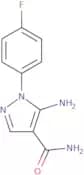
CAS:<p>L-Phenylalanine b-naphthylamide is a phenylalanine derivative that can be used as an indicator for the detection of Clostridium, 2-naphthylamine, and other anaerobes. This compound is a chromogenic substrate that reacts with amino groups in amino acids and amides in peptides to form a variety of color products. The condensation of phenylalanine with 2-naphthylamine is catalyzed by enzymes found in clostridia. When L-phenylalanine b-naphthylamide is incubated with tissue from animals or humans, it produces a pink coloration that indicates the presence of clostridia. The aerobic conditions necessary for this reaction are also found in the environment and within the body.</p>Formula:C19H18N2OPurity:Min. 95%Molecular weight:290.36 g/mol5-Amino-1-(4-Fluorophenyl)-1H-Pyrazole-4-Carboxamide
CAS:<p>Please enquire for more information about 5-Amino-1-(4-Fluorophenyl)-1H-Pyrazole-4-Carboxamide including the price, delivery time and more detailed product information at the technical inquiry form on this page</p>Formula:C10H9FN4OPurity:Min. 95%Molecular weight:220.2 g/mol

![N-[4-(1-Allyl-3-butyl-2,6-dioxo-2,3,6,7-tetrahydro-1H-purin-8-ylmethyl)phenyl]acetamide](/_next/image/?url=https%3A%2Fstatic.cymitquimica.com%2Fproducts%2F3D%2Fthumb-webp%2FFA17305.webp&w=3840&q=75)


![2-[(Diphenylmethyl)sulfinyl]-N-hydroxyacetamide](/_next/image/?url=https%3A%2Fstatic.cymitquimica.com%2Fproducts%2F3D%2Fthumb-webp%2FW-104904.webp&w=3840&q=75)
![N-(4-Chloro-5-iodo-7H-pyrrolo[2,3-d]pyrimidin-2-yl)pivalamide](/_next/image/?url=https%3A%2Fstatic.cymitquimica.com%2Fproducts%2F3D%2Fthumb-webp%2FFC138201.webp&w=3840&q=75)