Amides
Amides are a wide range of chemical compounds that contain at least one heterocyclic ring, which has atoms of at least two different elements in the ring structure, and at least one amide group (-CONH2). These compounds are crucial in the synthesis of pharmaceuticals, polymers, and agrochemicals. Amides exhibit unique properties and reactivity, making them valuable intermediates in organic synthesis. At CymitQuimica, we offer a comprehensive selection of high-quality amides to support your research and industrial needs.
Found 16485 products of "Amides"
Sort by
Purity (%)
0
100
|
0
|
50
|
90
|
95
|
100
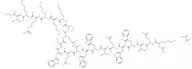
pTH-Related Protein (7-34) amide (human, mouse, rat) trifluoroacetate salt
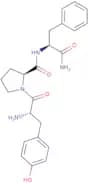
CAS:<p>Please enquire for more information about pTH-Related Protein (7-34) amide (human, mouse, rat) trifluoroacetate salt including the price, delivery time and more detailed product information at the technical inquiry form on this page</p>Formula:C153H247N49O37Purity:Min. 95%Molecular weight:3,364.91 g/molBeta-Casomorphin (1-3) amide acetate salt
CAS:<p>Beta-casomorphin (1-3) amide acetate salt (BCMA) is a peptide that belongs to the class of opioid compounds. It is an amino acid and has been shown to be a potent agonist at opioid receptors. BCMA is used in vivo as a tritiated ligand for mapping the distribution of opioid receptors in rat brain. The affinity of BCMA for opioid receptors increases with dose, and its antinociceptive effects are dose-dependent. Beta-casomorphin (1-3) amide acetate salt has also been shown to have affinity for enkephalins, which are naturally occurring peptides that bind to opioid receptors.</p>Formula:C23H28N4O4Purity:Min. 95%Molecular weight:424.49 g/molN-[4-(2-Bromoacetyl)phenyl]methanesulfonamide
CAS:<p>N-[4-(2-Bromoacetyl)phenyl]methanesulfonamide is a chiral biocatalytic agent, which is synthesized by chemoenzymatic or enzymatic reactions. It has been used in enantioselective synthesis of 4-aminoacetophenone and as an antiarrhythmic agent. This compound is not active against bacterial infections.</p>Formula:C9H10BrNO3SPurity:Min. 95%Molecular weight:292.15 g/molPep-1-cysteamide trifluoroacetate salt
CAS:Please enquire for more information about Pep-1-cysteamide trifluoroacetate salt including the price, delivery time and more detailed product information at the technical inquiry form on this pageFormula:C140H202N36O33SPurity:Min. 95%Molecular weight:2,949.39 g/molPhenylacetyl-(D-Arg2·28,p-chloro-Phe6, Homoarg 9·29,Tyr(Me)10, Abu 15, Nle 27)-GRF (1-29) amide (human)
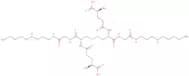
CAS:<p>Please enquire for more information about Phenylacetyl-(D-Arg2·28,p-chloro-Phe6, Homoarg 9·29,Tyr(Me)10, Abu 15, Nle 27)-GRF (1-29) amide (human) including the price, delivery time and more detailed product information at the technical inquiry form on this page</p>Formula:C172H284ClN53O41Purity:Min. 95%Molecular weight:3,785.88 g/molN1-Glutathionyl-spermidine disulfide [
CAS:<p>N1-Glutathionyl-spermidine disulfide (N1-GS) is a molecule that has been shown to have clinical use in the treatment of chronic hepatitis C infection. The N1-GS molecule is composed of a glutathione (GSH) scaffold with two sulfhydryl groups and an amino acid side chain. N1-GS has a hydrophobic nature, which allows it to penetrate the cellular membrane and enter cells. It is also able to form hydrogen bonds and act as a catalyst for reactions. Fluorescence analysis revealed that this molecule is selective for disulfides over thiols, amines, or alcohols. Disulfides are very important in biological systems since they can be found in enzymes, proteins, and cellular membranes. The insolubility of the N1-GS molecule makes it difficult to analyze its structure using traditional methods such as gas chromatography or nuclear magnetic resonance spectroscopy. However, fluorescence</p>Formula:C34H66N12O10S2Purity:Min. 95%Molecular weight:867.09 g/molOsteostatin (1-5) amide (human, bovine, dog, horse, mouse, rabbit, rat) trifluoroacetate salt
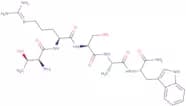
CAS:<p>Please enquire for more information about Osteostatin (1-5) amide (human, bovine, dog, horse, mouse, rabbit, rat) trifluoroacetate salt including the price, delivery time and more detailed product information at the technical inquiry form on this page</p>Formula:C27H42N10O7Purity:Min. 95%Molecular weight:618.69 g/molCys(NPys)-Antennapedia Homeobox (43-58) amide trifluoroacetate salt
CAS:<p>Please enquire for more information about Cys(NPys)-Antennapedia Homeobox (43-58) amide trifluoroacetate salt including the price, delivery time and more detailed product information at the technical inquiry form on this page</p>Formula:C112H176N38O22S3Purity:Min. 95%Molecular weight:2,503.04 g/mol2-Chloroacetamide
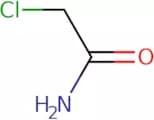
CAS:<p>2-Chloroacetamide is a quaternary ammonium compound that is used as an intermediate in the synthesis of other organic compounds. It has been reported to have anticancer activity and has been studied for use as a herbicide in agriculture. The vibrational, turbidimetric method, amide, and sample preparation are all instrumental in determining the reaction mechanism of 2-chloroacetamide. This molecule has also been studied using FT-IR spectroscopy and molecular modelling techniques. The hydrogen bond is integral to its optical properties and can be determined by nmr spectra.</p>Formula:C2H4ClNOPurity:Min. 98%Color and Shape:White PowderMolecular weight:93.51 g/mol(Phe1-psi(CH2NH)Gly2)-Nociceptin (1-13) amide
<p>Please enquire for more information about (Phe1-psi(CH2NH)Gly2)-Nociceptin (1-13) amide including the price, delivery time and more detailed product information at the technical inquiry form on this page</p>Formula:C61H102N22O14Purity:Min. 95%Molecular weight:1,367.6 g/molN-(4-Chlorophenyl)-2-cyanoacetamide
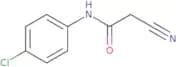
CAS:<p>N-(4-Chlorophenyl)-2-cyanoacetamide is a pyridine compound that can be synthesized from chloroacetonitrile and acetamide. It has been shown to react with an active methylene group in benzene or pyridine to produce a heterocycle. This reaction is reversible and can be used as a preparative method for the synthesis of heterocycles. The 1,3-dipolar cycloaddition of N-(4-chlorophenyl)-2-cyanoacetamide with nitro groups in nitrobenzene produces the corresponding 2-nitropyridines, which are important intermediates in the synthesis of other heterocycles. N-(4-Chlorophenyl)-2-cyanoacetamide has been used as an efficient method for the preparation of nitrogen nucleophiles that are useful for catalysis.</p>Formula:C9H7ClN2OPurity:Min. 95%Molecular weight:194.62 g/mol4-Chloro-3-nitrobenzenesulfonamide
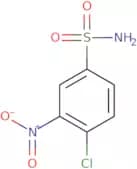
CAS:<p>4-Chloro-3-nitrobenzenesulfonamide is a fluorogenic probe that can be used in the diagnosis of cancer. It inhibits the activity of MCL-1, which is an antiapoptotic protein. The skeleton of 4-Chloro-3-nitrobenzenesulfonamide has been shown to have carbonic and fluorescence properties. This chemical compound is also metabolized by azobenzene to form a fluorescent derivative that can be used for optical imaging in vivo.</p>Formula:C6H5ClN2O4SPurity:Min. 95%Molecular weight:236.63 g/molGlycinamide hydrochloride
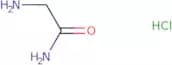
CAS:<p>Glycinamide hydrochloride is an inhibitor that binds to the glycine-binding site of the protein synthetase and inhibits the formation of glycinamide ribonucleotide. It has been shown to inhibit human glycinamide ribonucleotide synthetase in vitro. Glycinamide hydrochloride is also a glycinamide amide, which was synthesized by linking two molecules of glycine with an amide bond. This molecule is cross-linked with a macrogel, forming a hydrogel. The hydrogel can be used in biomedical applications, such as tissue engineering and drug delivery systems.</p>Formula:C2H7ClN2OColor and Shape:White PowderMolecular weight:110.54 g/mol(Deamino-Cys3, Nle 4,Arg5,D-2-Nal 7,Cys11)-a-MSH (3-11) amide trifluoroacetate salt
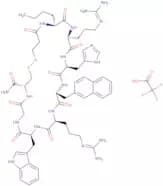
CAS:<p>Please enquire for more information about (Deamino-Cys3, Nle 4,Arg5,D-2-Nal 7,Cys11)-a-MSH (3-11) amide trifluoroacetate salt including the price, delivery time and more detailed product information at the technical inquiry form on this page</p>Formula:C56H76N18O9S2Purity:Min. 95%Molecular weight:1,209.45 g/molAmyloid P Component (27-38) amide trifluoroacetate salt
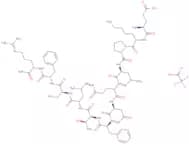
CAS:<p>Please enquire for more information about Amyloid P Component (27-38) amide trifluoroacetate salt including the price, delivery time and more detailed product information at the technical inquiry form on this page</p>Formula:C68H107N19O17SPurity:Min. 95%Molecular weight:1,494.76 g/mol4-Biphenylac-Cys(Me)-D-Arg-Phe-(2-phenylethyl)amide
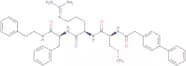
CAS:<p>4-Biphenylac-Cys(Me)-D-Arg-Phe-(2-phenylethyl)amide is a tetrapeptide that has been shown to have antihypertensive properties. This drug binds to the regulatory proteins of the renin angiotensin system and blocks the production of angiotensin II, which decreases blood pressure. 4-Biphenylac-Cys(Me)-D-Arg-Phe-(2-phenylethyl)amide has also shown to be an effective treatment for skin care products, especially those used for inflammatory skin diseases. 4-Biphenylac-Cys(Me)-D-Arg-Phe-(2-phenylethyl)amide has been shown to be a potent inhibitor of serine proteases and can inhibit cellular proliferation and induce apoptosis in cancer cells.</p>Formula:C41H49N7O4SPurity:Min. 95%Molecular weight:735.94 g/molPAR-2 (1-6) amide (human) trifluoroacetate salt
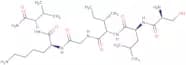
CAS:<p>PAR-2 (1-6) amide (human) trifluoroacetate salt H-Ser-Leu-Ile-Gly-Lys-Val-NH2 trifluoroacetate salt is a protease inhibitor that inhibits the activity of PAR2, a protein receptor. PAR2 is implicated in cancer and inflammation. It has been shown to inhibit growth factor signaling, as well as activate toll-like receptor 4 and other inflammatory pathways. PAR2 inhibition has also been studied in vivo and found to be effective in treating wild type mice with melanoma cells. In vitro studies have shown that PAR2 inhibition by PAR 2 (1-6) amide (human) trifluoroacetate salt H-Ser-Leu-Ile-Gly-Lys-Val NH2 trifluoroacetate salt blocks the production of tumour necrosis factor alpha and interleukin 6.</p>Formula:C28H54N8O7Purity:Min. 95%Molecular weight:614.78 g/molN,N'-Bis(2-mercaptoethyl)isophthalamide
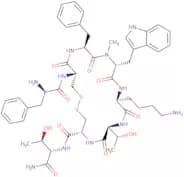
CAS:N,N'-Bis(2-mercaptoethyl)isophthalamide is a peptide hormone that belongs to the group of imines. It is the active substance in fulminant hepatitis and has been used as a diagnostic agent. It has been shown to increase serum alanine levels and decrease intracellular glutathione levels in the brain. N,N'-Bis(2-mercaptoethyl)isophthalamide has also been used as a pharmaceutical formulation for treatment of liver disease. The dosage ranges from 10 mg/kg to 20 mg/kg body weight per day.Formula:C12H16N2O2S2Purity:Min. 95%Molecular weight:284.4 g/mol(D-Phe5,Cys6·11,N-Me-D-Trp8)-Somatostatin-14 (5-12) amide
CAS:<p>Please enquire for more information about (D-Phe5,Cys6·11,N-Me-D-Trp8)-Somatostatin-14 (5-12) amide including the price, delivery time and more detailed product information at the technical inquiry form on this page</p>Formula:C50H67N11O10S2Purity:Min. 95%Molecular weight:1,046.27 g/molAmyloid P Component (33-38) amide trifluoroacetate salt
CAS:<p>Please enquire for more information about Amyloid P Component (33-38) amide trifluoroacetate salt including the price, delivery time and more detailed product information at the technical inquiry form on this page</p>Formula:C37H56N10O7SPurity:Min. 95%Molecular weight:784.97 g/mol


![N-[4-(2-Bromoacetyl)phenyl]methanesulfonamide](/_next/image/?url=https%3A%2Fstatic.cymitquimica.com%2Fproducts%2F3D%2Fthumb-webp%2FFB19192.webp&w=3840&q=75)