Amides
Amides are a wide range of chemical compounds that contain at least one heterocyclic ring, which has atoms of at least two different elements in the ring structure, and at least one amide group (-CONH2). These compounds are crucial in the synthesis of pharmaceuticals, polymers, and agrochemicals. Amides exhibit unique properties and reactivity, making them valuable intermediates in organic synthesis. At CymitQuimica, we offer a comprehensive selection of high-quality amides to support your research and industrial needs.
Found 16393 products of "Amides"
Sort by
Purity (%)
0
100
|
0
|
50
|
90
|
95
|
100
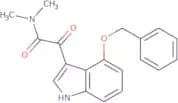
4-(Benzyloxy)-N,N-dimethyl-indole-3-glyoxylamide
CAS:<p>Please enquire for more information about 4-(Benzyloxy)-N,N-dimethyl-indole-3-glyoxylamide including the price, delivery time and more detailed product information at the technical inquiry form on this page</p>Formula:C19H18N2O3Purity:Min. 95%Molecular weight:322.36 g/molAcetyl-(Pro18,Asp21)-Amyloid b-Protein (17-21) amide
CAS:<p>Acetyl-(Pro18,Asp21)-Amyloid b-Protein (17-21) amide is a peptide that was generated by incubating β-amyloid with the protease papain. This peptide has been shown to induce population and biochemical changes in cells, including focusing of β-amyloid aggregates. It also induces reactive oxygen species and promotes extracellular protofibril formation. Acetyl-(Pro18,Asp21)-Amyloid b-Protein (17-21) amide is a conjugate of acetylated lysine residues and amyloid β-protein that can be used as an anti-amyloid therapeutic. The peptide is characterized by dichroism spectroscopy, which has revealed its specific binding to the fibrils' surface.</p>Formula:C35H46N6O8Purity:Min. 95%Molecular weight:678.78 g/molAmyloid β-Protein (25-35) amide trifluoroacetate salt
CAS:<p>Please enquire for more information about Amyloid beta-Protein (25-35) amide trifluoroacetate salt including the price, delivery time and more detailed product information at the technical inquiry form on this page</p>Formula:C45H82N14O13SPurity:Min. 95%Molecular weight:1,059.29 g/mol3-Nitro-4-[[(tetrahydropyran-4-yl)methyl]amino]benzenesulfonamide
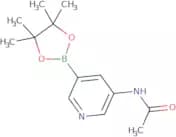
CAS:<p>Please enquire for more information about 3-Nitro-4-[[(tetrahydropyran-4-yl)methyl]amino]benzenesulfonamide including the price, delivery time and more detailed product information at the technical inquiry form on this page</p>Formula:C12H17N3O5SPurity:Min. 95%Molecular weight:315.35 g/molN-(5-(4,4,5,5-Tetramethyl-1,3,2-dioxaborolan-2-yl)pyridin-3-yl)acetamide
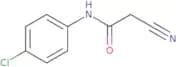
CAS:<p>Please enquire for more information about N-(5-(4,4,5,5-Tetramethyl-1,3,2-dioxaborolan-2-yl)pyridin-3-yl)acetamide including the price, delivery time and more detailed product information at the technical inquiry form on this page</p>Formula:C13H19BN2O3Purity:Min. 95%Molecular weight:262.11 g/molN-(4-Chlorophenyl)-2-cyanoacetamide
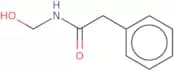
CAS:<p>N-(4-Chlorophenyl)-2-cyanoacetamide is a pyridine compound that can be synthesized from chloroacetonitrile and acetamide. It has been shown to react with an active methylene group in benzene or pyridine to produce a heterocycle. This reaction is reversible and can be used as a preparative method for the synthesis of heterocycles. The 1,3-dipolar cycloaddition of N-(4-chlorophenyl)-2-cyanoacetamide with nitro groups in nitrobenzene produces the corresponding 2-nitropyridines, which are important intermediates in the synthesis of other heterocycles. N-(4-Chlorophenyl)-2-cyanoacetamide has been used as an efficient method for the preparation of nitrogen nucleophiles that are useful for catalysis.</p>Formula:C9H7ClN2OPurity:Min. 95%Molecular weight:194.62 g/molN-(Hydroxymethyl)-phenylacetamide
CAS:<p>N-(Hydroxymethyl)-phenylacetamide is an organic solvent that is used in the synthesis of certain antibiotics. It is a synthetic compound and can be obtained by reacting toluene with benzene, using a strong acid catalyst such as sulfuric acid. N-(Hydroxymethyl)-phenylacetamide has been used in the synthesis of isoquinolones, which are also antibiotics. This organic solvent can also be used for recrystallization, which is a process that helps purify solids from liquids or liquids from solids. The yield of this reaction is high, making it an efficient way to synthesize these compounds.</p>Formula:C9H11NO2Purity:Min. 95%Molecular weight:165.19 g/molN,N-Dimethylformamide dibenzyl acetal
CAS:<p>N,N-Dimethylformamide dibenzyl acetal is an organic solvent that has a low volatility and high solubility in water. It is used as a cosolvent for reactions involving carboxylic acids, formamides, and epoxides. N,N-Dimethylformamide dibenzyl acetal can be used to produce peroxide as a reagent for oxidation reactions. Hydrogen peroxide can be produced from this compound by treatment with thionyl chloride or alkanoic acid. This chemical is also derivatized by the mesoporous method to provide mesoporous silica nanoparticles with enhanced surface area.</p>Purity:Min. 95%Syndyphalin SD-33
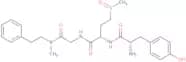
CAS:<p>Please enquire for more information about Syndyphalin SD-33 including the price, delivery time and more detailed product information at the technical inquiry form on this page</p>Formula:C25H34N4O5SPurity:Min. 95%Molecular weight:502.63 g/molGastric Inhibitory Polypeptide (6-30) amide (human) trifluoroacetate salt
CAS:<p>Please enquire for more information about Gastric Inhibitory Polypeptide (6-30) amide (human) trifluoroacetate salt including the price, delivery time and more detailed product information at the technical inquiry form on this page</p>Formula:C139H209N35O38SPurity:Min. 95%Molecular weight:3,010.43 g/mol2-Phenylacetamide
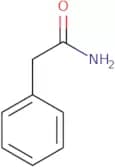
CAS:Controlled Product<p>2-Phenylacetamide is a nitro, acetate extract that has been shown to have antimicrobial activity. It can inhibit HIV infection and has been investigated as an antiviral drug. 2-Phenylacetamide binds to the 2-adrenergic receptor, which is found in high concentrations in the brain and inhibits the release of neurotransmitters. It also binds to κ-opioid receptors and sodium carbonate, which are found on cells throughout the body. The biological properties of this substance have not been fully elucidated but some studies suggest that it may be able to inhibit microbial metabolism or stimulate monoamine neurotransmitters.</p>Formula:C8H9NOPurity:Min. 95%Color and Shape:White PowderMolecular weight:135.16 g/molN-Benzoyl-L-leucine-β-naphthylamide
CAS:<p>N-Benzoyl-L-leucine-beta-naphthylamide is a chromogenic substrate for transpeptidase. It is hydrolyzed to L-phenylalanine and 2-naphthylamine, which react with the chromogen to produce a color change. The reaction occurs in both spermatozoa and epithelial cells, but can be inhibited by aminopeptidase and peptidase. This substrate is used as a marker for spermatozoa in semen analysis.</p>Formula:C23H24N2O2Purity:Min. 95%Color and Shape:PowderMolecular weight:360.45 g/mol(D-Trp6)-LHR
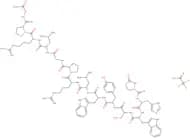
<p>Please enquire for more information about (D-Trp6)-LHR including the price, delivery time and more detailed product information at the technical inquiry form on this page</p>Formula:C83H115N25O17Purity:Min. 95%Molecular weight:1,734.96 g/molMca-(Asn670,Leu671)-Amyloid β/A4 Protein Precursor770 (667-676)-Lys(Dnp)-Arg-Arg amide trifluoroacetate salt
CAS:<p>Please enquire for more information about Mca-(Asn670,Leu671)-Amyloid beta/A4 Protein Precursor770 (667-676)-Lys(Dnp)-Arg-Arg amide trifluoroacetate salt including the price, delivery time and more detailed product information at the technical inquiry form on this page</p>Formula:C86H125N27O29Purity:Min. 95%Molecular weight:2,001.08 g/molpTH-Related Protein (67-86) amide (human, bovine, dog, mouse, ovine, rat) trifluoroacetate salt
CAS:<p>Please enquire for more information about pTH-Related Protein (67-86) amide (human, bovine, dog, mouse, ovine, rat) trifluoroacetate salt including the price, delivery time and more detailed product information at the technical inquiry form on this page</p>Formula:C108H173N27O35Purity:Min. 95%Molecular weight:2,409.69 g/mol(D-Ala2)-Leu-Enkephalin amide
CAS:<p>Hyaluronic acid is a natural component of connective tissue and synovial fluid in animals. It is a linear, unbranched polysaccharide consisting of alternating D-glucuronic acid and N-acetyl-D-glucosamine. Hyaluronic acid has been shown to be useful in the treatment of long-term diseases such as heart disease or skin conditions like eczema. It is important for the efficient production of vaccines, which are used to prevent infectious diseases such as streptococcal infections. Hyaluronic acid can also be used as a microcontroller for minimally invasive procedures. This molecule can be used as an additive in the production of metallocene catalysts to increase the efficiency of these reactions, while reducing impurities during the process. The use of hyaluronic acid has been studied extensively, with many techniques employed to study its properties and functions. Genetic factors have also been found to play a role in</p>Formula:C29H40N6O6Purity:Min. 95%Molecular weight:568.66 g/mol2-Aminoethanesulphonamide monohydrochloride
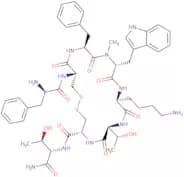
CAS:<p>2-Aminoethanesulphonamide monohydrochloride is a perovskite with a hexagonal shape. It has been shown to interact with the pharmacophore of the enzyme cytochrome P450, and it has been optimized for the reaction by altering its structure. This product is soluble in gaseous form, but can also be used as a solid. 2-Aminoethanesulphonamide monohydrochloride has an absorption maximum at 325 nm and emits fluorescence at 420 nm. It is used in devices that detect ionizing radiation.</p>Formula:C2H8N2O2S•HClPurity:Min. 95%Color and Shape:PowderMolecular weight:160.62 g/mol(D-Phe5,Cys6·11,N-Me-D-Trp8)-Somatostatin-14 (5-12) amide
CAS:<p>Please enquire for more information about (D-Phe5,Cys6·11,N-Me-D-Trp8)-Somatostatin-14 (5-12) amide including the price, delivery time and more detailed product information at the technical inquiry form on this page</p>Formula:C50H67N11O10S2Purity:Min. 95%Molecular weight:1,046.27 g/mol(Pro3)-Dynorphin A (1-11) amide trifluoroacetate salt
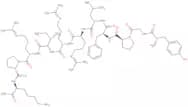
CAS:<p>Please enquire for more information about (Pro3)-Dynorphin A (1-11) amide trifluoroacetate salt including the price, delivery time and more detailed product information at the technical inquiry form on this page</p>Formula:C66H108N22O12Purity:Min. 95%Molecular weight:1,401.7 g/molN-(2-Hydroxypropyl)benzenesulfonamide
CAS:<p>N-(2-Hydroxypropyl)benzenesulfonamide is a sulfonamide that is used as a plasticizer in thermoplastics. It is the sodium salt of 2-hydroxypropyl benzenesulfonic acid and has been shown to be effective as an antimicrobial agent in plastics. N-(2-Hydroxypropyl)benzenesulfonamide may be used for the prevention of bacterial growth and may inhibit the growth of fungi and algae, although more studies are needed to determine its effectiveness.</p>Formula:C9H13NO3SPurity:Min. 95%Molecular weight:215.27 g/mol


![3-Nitro-4-[[(tetrahydropyran-4-yl)methyl]amino]benzenesulfonamide](/_next/image/?url=https%3A%2Fstatic.cymitquimica.com%2Fproducts%2F3D%2Fthumb-webp%2FFN145631.webp&w=3840&q=75)