Amides
Amides are a wide range of chemical compounds that contain at least one heterocyclic ring, which has atoms of at least two different elements in the ring structure, and at least one amide group (-CONH2). These compounds are crucial in the synthesis of pharmaceuticals, polymers, and agrochemicals. Amides exhibit unique properties and reactivity, making them valuable intermediates in organic synthesis. At CymitQuimica, we offer a comprehensive selection of high-quality amides to support your research and industrial needs.
Found 16401 products of "Amides"
Sort by
Purity (%)
0
100
|
0
|
50
|
90
|
95
|
100
5-Fmoc-amino-10,11-dihydro-5H-dibenzo[a,d]-cycloheptenyl-2-oxyacetyl-DL-Nle-4- methyl-benzhydrylamide resin
<p>Please enquire for more information about 5-Fmoc-amino-10,11-dihydro-5H-dibenzo[a,d]-cycloheptenyl-2-oxyacetyl-DL-Nle-4- methyl-benzhydrylamide resin including the price, delivery time and more detailed product information at the technical inquiry form on this page</p>Purity:Min. 95%PAR-2 (1-6) amide (human) trifluoroacetate salt
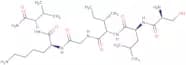
CAS:<p>PAR-2 (1-6) amide (human) trifluoroacetate salt H-Ser-Leu-Ile-Gly-Lys-Val-NH2 trifluoroacetate salt is a protease inhibitor that inhibits the activity of PAR2, a protein receptor. PAR2 is implicated in cancer and inflammation. It has been shown to inhibit growth factor signaling, as well as activate toll-like receptor 4 and other inflammatory pathways. PAR2 inhibition has also been studied in vivo and found to be effective in treating wild type mice with melanoma cells. In vitro studies have shown that PAR2 inhibition by PAR 2 (1-6) amide (human) trifluoroacetate salt H-Ser-Leu-Ile-Gly-Lys-Val NH2 trifluoroacetate salt blocks the production of tumour necrosis factor alpha and interleukin 6.</p>Formula:C28H54N8O7Purity:Min. 95%Molecular weight:614.78 g/mol2-Methyl-N-phenyl-5,6-dihydro-1,4-oxathiine-3-carboxamide
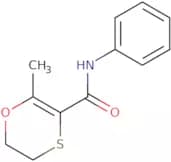
CAS:<p>2-Methyl-N-phenyl-5,6-dihydro-1,4-oxathiine-3-carboxamide is a signal molecule that has antimicrobial activity. It inhibits the proliferation of cells and is used as an antifungal agent. 2,5,6-Trimethyloxathiinium ion has been shown to induce apoptosis in human leukemia cells and inhibit the growth of erythrocytes infected with Plasmodium falciparum. This compound also inhibits wild type strains of bacteria and fungi and can be used as a natural fungicide. 2,5,6-Trimethyloxathiinium ion has been found to be effective in treating autoimmune diseases such as diabetes mellitus type II, which may be due to its ability to regulate glucose metabolism and suppress inflammatory responses.</p>Formula:C12H13NO2SPurity:Min. 95%Molecular weight:235.3 g/mol6-Aminopicolinamide
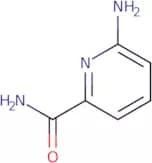
CAS:<p>6-Aminopicolinamide is a metabolite of nicotinamide, which can be found in the urine of humans and animals. 6-Aminopicolinamide has been shown to have anti-leukemic activity against experimental leukemias in animals. The mechanism of action is not well understood but may involve inhibition of nucleotide synthesis or the inhibition of dehydrogenase activity. Clinical trials are underway to determine its efficacy as an anti-tumor agent.</p>Formula:C6H7N3OPurity:Min. 95%Molecular weight:137.14 g/molGLP-1 (1-36) amide (human, bovine, guinea pig, mouse, rat) trifluoroacetate salt
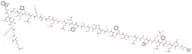
CAS:<p>Please enquire for more information about GLP-1 (1-36) amide (human, bovine, guinea pig, mouse, rat) trifluoroacetate salt including the price, delivery time and more detailed product information at the technical inquiry form on this page</p>Formula:C184H273N51O57Purity:Min. 95%Molecular weight:4,111.45 g/molN-(2-Hydroxypropyl)benzenesulfonamide
CAS:<p>N-(2-Hydroxypropyl)benzenesulfonamide is a sulfonamide that is used as a plasticizer in thermoplastics. It is the sodium salt of 2-hydroxypropyl benzenesulfonic acid and has been shown to be effective as an antimicrobial agent in plastics. N-(2-Hydroxypropyl)benzenesulfonamide may be used for the prevention of bacterial growth and may inhibit the growth of fungi and algae, although more studies are needed to determine its effectiveness.</p>Formula:C9H13NO3SPurity:Min. 95%Molecular weight:215.27 g/molAbz-Amyloid beta/A4 Protein Precursor770 (708-715)-Lys(Dnp)-D-Arg-D-Arg-D-Arg amide trifluoroacetate salt
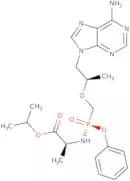
CAS:<p>Please enquire for more information about Abz-Amyloid beta/A4 Protein Precursor770 (708-715)-Lys(Dnp)-D-Arg-D-Arg-D-Arg amide trifluoroacetate salt including the price, delivery time and more detailed product information at the technical inquiry form on this page</p>Formula:C69H114N26O18Purity:Min. 95%Molecular weight:1,595.81 g/molTenofovir alafenamide (free base)
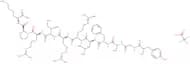
CAS:<p>Tenofovir alafenamide (free base) is a prodrug of tenofovir with action on viral reverse transcriptase to block replication and is used for treating HIV/AIDS and chronic hepatitis B with improved safety profile.</p>Formula:C21H29N6O5PPurity:Min. 97 Area-%Color and Shape:PowderMolecular weight:476.47 g/mol(Deamino-Cys3, Nle 4,Arg5,D-2-Nal 7,Cys11)-a-MSH (3-11) amide trifluoroacetate salt
CAS:<p>Please enquire for more information about (Deamino-Cys3, Nle 4,Arg5,D-2-Nal 7,Cys11)-a-MSH (3-11) amide trifluoroacetate salt including the price, delivery time and more detailed product information at the technical inquiry form on this page</p>Formula:C56H76N18O9S2Purity:Min. 95%Molecular weight:1,209.45 g/molN-Allyl-n-(2-chloro-5-cyanophenyl)acetamide
CAS:<p>N-Allyl-n-(2-chloro-5-cyanophenyl)acetamide is a fine chemical that is used as a building block in the synthesis of other compounds. It is also used in research and as a reagent or speciality chemical. N-Allyl-n-(2-chloro-5-cyanophenyl)acetamide has been shown to be an excellent intermediate for complex organic reactions, such as coupling reactions with amines, alcohols, and thiols. In addition, this compound can be used to form new scaffolds for biological studies.</p>Formula:C12H11ClN2OPurity:Min. 95%Color and Shape:PowderMolecular weight:234.68 g/mol(Phe4)-Dermorphin (1-4) amide
CAS:<p>Dermorphin is a peptide that is derived from the proenkephalin gene. It is an opioid analgesic and has been shown to be effective in the treatment of hernias. Dermorphin has also been shown to inhibit platelet aggregation and blood coagulation, making it an antithrombotic therapy. The structure of dermorphin has been determined using a hydroxy group as the reactive site for synthesis and molecular modelling techniques. Dermorphin has also been shown to have an active oxygen species selectivity index (a measure of antioxidant activity) higher than those of other drugs in its class, which makes it suitable for use as a sealant in abdominal surgery.</p>Formula:C30H35N5O5Purity:Min. 95%Molecular weight:545.63 g/molN-Me-Abz-Amyloid beta/A4 Protein Precursor770 (708-715)-Lys(Dnp)-D-Arg-D-Arg-D-Arg amide trifluoroacetate salt
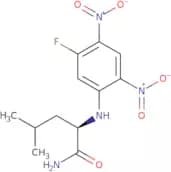
CAS:<p>Please enquire for more information about N-Me-Abz-Amyloid beta/A4 Protein Precursor770 (708-715)-Lys(Dnp)-D-Arg-D-Arg-D-Arg amide trifluoroacetate salt including the price, delivery time and more detailed product information at the technical inquiry form on this page</p>Formula:C70H116N26O18Purity:Min. 95%Molecular weight:1,609.83 g/molNalpha-(5-fluoro-2,4-dinitrophenyl)-D-leucinamide
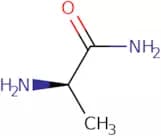
CAS:<p>Nalpha-(5-fluoro-2,4-dinitrophenyl)-D-leucinamide is a chemical compound that inhibits the activity of proteases. It has been shown to inhibit leukemia cells and actinomycetes. This chemical binds to the active site of proteases, inhibiting the hydrolysis of peptides by blocking the access of water molecules to the reactive site. In addition, Nalpha-(5-fluoro-2,4-dinitrophenyl)-D-leucinamide can also be used as a fluorescent probe for protease activity in analytical methods. The product research on this compound has shown that it is a potent inhibitor of cyclic peptide synthetases and can be used as an anti-inflammatory agent.</p>Formula:C12H15FN4O5Purity:Min. 95%Color and Shape:Off-White To Yellow SolidMolecular weight:314.27 g/mol(2R)-2-Aminopropanamide
CAS:<p>(2R)-2-Aminopropanamide is a chemical compound that is classified as an amide. It has been shown to inhibit bacterial growth and induce apoptosis in mammalian cells, but not in bacteria. This drug has a number of hydrogen bonding interactions with the carbonyl group and amide functional groups and can bind to affinity ligands with hydrogen bonding interactions. (2R)-2-Aminopropanamide inhibits the activity of enzymes that are involved in the synthesis of d-alanine, which is a precursor for protein synthesis. It also inhibits the enzyme glutamine synthase, which plays a key role in building up nitrogen reserves in bacteria. The drug binds to DNA by forming hydrogen bonds with the phosphate backbone and intercalates into double-stranded DNA by forming van der Waals interactions with base pairs.</p>Formula:C3H8N2OPurity:Min. 95%Molecular weight:88.11 g/mol3-Nitro-4-[[(tetrahydropyran-4-yl)methyl]amino]benzenesulfonamide
CAS:<p>Please enquire for more information about 3-Nitro-4-[[(tetrahydropyran-4-yl)methyl]amino]benzenesulfonamide including the price, delivery time and more detailed product information at the technical inquiry form on this page</p>Formula:C12H17N3O5SPurity:Min. 95%Molecular weight:315.35 g/mol(D-Ala3)-Dynorphin A (1-11) amide trifluoroacetate salt
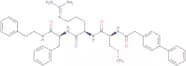
CAS:<p>Please enquire for more information about (D-Ala3)-Dynorphin A (1-11) amide trifluoroacetate salt including the price, delivery time and more detailed product information at the technical inquiry form on this page</p>Formula:C64H106N22O12Purity:Min. 95%Molecular weight:1,375.67 g/mol4-Biphenylac-Cys(Me)-D-Arg-Phe-(2-phenylethyl)amide
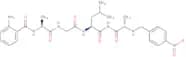
CAS:<p>4-Biphenylac-Cys(Me)-D-Arg-Phe-(2-phenylethyl)amide is a tetrapeptide that has been shown to have antihypertensive properties. This drug binds to the regulatory proteins of the renin angiotensin system and blocks the production of angiotensin II, which decreases blood pressure. 4-Biphenylac-Cys(Me)-D-Arg-Phe-(2-phenylethyl)amide has also shown to be an effective treatment for skin care products, especially those used for inflammatory skin diseases. 4-Biphenylac-Cys(Me)-D-Arg-Phe-(2-phenylethyl)amide has been shown to be a potent inhibitor of serine proteases and can inhibit cellular proliferation and induce apoptosis in cancer cells.</p>Formula:C41H49N7O4SPurity:Min. 95%Molecular weight:735.94 g/molAbz-Ala-Gly-Leu-Ala-p-nitrobenzylamide
CAS:<p>Benzamidine is a benzamidase inhibitor that competitively binds to bacterial enzymes such as metalloendopeptidases and matrix metalloproteinases. It inhibits the degradation of collagen, resulting in a higher concentration of soluble extract. This drug also has an effect on spermatozoa, which may be due to its ability to inhibit bacterial enzymes that are involved with uptake and preload. Benzamidine has been shown to have a pH optimum of 8-9 and is most active at this pH range.</p>Formula:C28H37N7O7Purity:Min. 95%Molecular weight:583.64 g/molGlibenclamide
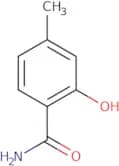
CAS:<p>ATP-sensitive K+ channel blocker</p>Formula:C23H28ClN3O5SPurity:Min. 98 Area-%Color and Shape:White PowderMolecular weight:494 g/mol4-Methylsalicylamide
CAS:<p>4-Methylsalicylamide is a chemical compound that belongs to the class of isonicotinic amides. It is a potent anti-inflammatory agent with minimal inhibitory concentration (MIC) values of 4 µg/mL for gram-positive bacteria and 8 µg/mL for gram-negative bacteria. This compound has been shown to be effective against methicillin-resistant Staphylococcus aureus (MRSA) and Clostridium perfringens, although is not active against acid-fast bacteria such as Mycobacterium tuberculosis or Mycobacterium avium complex. 4-Methylsalicylamide has been shown to have an inhibitory effect on ring-opening, which may be due to its ability to acetylate mitochondrial membranes, altering the membrane potential. The molecular modeling studies also showed that 4MSAM binds at the same site as antibiotics such as penicillin and erythromycin in bacterial ribos</p>Formula:C8H9NO2Purity:Min. 95%Color and Shape:PowderMolecular weight:151.16 g/mol
![5-Fmoc-amino-10,11-dihydro-5H-dibenzo[a,d]-cycloheptenyl-2-oxyacetyl-DL-Nle-4- methyl-benzhydrylam…](/_next/image/?url=https%3A%2Fstatic.cymitquimica.com%2Fproducts%2F3D%2Fthumb-webp%2FFT111711.webp&w=3840&q=75)




![3-Nitro-4-[[(tetrahydropyran-4-yl)methyl]amino]benzenesulfonamide](/_next/image/?url=https%3A%2Fstatic.cymitquimica.com%2Fproducts%2F3D%2Fthumb-webp%2FFN145631.webp&w=3840&q=75)