


Amides
Amides are a wide range of chemical compounds that contain at least one heterocyclic ring, which has atoms of at least two different elements in the ring structure, and at least one amide group (-CONH2). These compounds are crucial in the synthesis of pharmaceuticals, polymers, and agrochemicals. Amides exhibit unique properties and reactivity, making them valuable intermediates in organic synthesis. At CymitQuimica, we offer a comprehensive selection of high-quality amides to support your research and industrial needs.
Found 16399 products of "Amides"
Sort by
Purity (%)
0
100
|
0
|
50
|
90
|
95
|
100
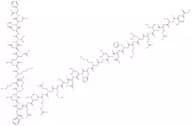
Galanin Message Associated Peptide (25-41) amide
CAS:<p>Please enquire for more information about Galanin Message Associated Peptide (25-41) amide including the price, delivery time and more detailed product information at the technical inquiry form on this page</p>Formula:C90H143N21O22SPurity:Min. 95%Molecular weight:1,903.29 g/mol2-Chloro-N-[2-(diethylamino)ethyl]-4-quinolinecarboxamide
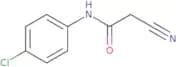
CAS:<p>2-Chloro-N-[2-(diethylamino)ethyl]-4-quinolinecarboxamide is a carboxamide analog of dibucaine. It is synthesized from chloroacetyl chloride and isatin in the presence of sodium hydroxide. The synthesis has been scaled to an industrial level. 2-Chloro-N-[2-(diethylamino)ethyl]-4-quinolinecarboxamide has been shown to have analgesic properties, similar to those of dibucaine. Radiolysis of this compound gives a carboxylic acid and a heterocyclic ring product.</p>Formula:C16H20ClN3OPurity:95%MinColor and Shape:PowderMolecular weight:305.8 g/molN-(4-Chlorophenyl)-2-cyanoacetamide
CAS:<p>N-(4-Chlorophenyl)-2-cyanoacetamide is a pyridine compound that can be synthesized from chloroacetonitrile and acetamide. It has been shown to react with an active methylene group in benzene or pyridine to produce a heterocycle. This reaction is reversible and can be used as a preparative method for the synthesis of heterocycles. The 1,3-dipolar cycloaddition of N-(4-chlorophenyl)-2-cyanoacetamide with nitro groups in nitrobenzene produces the corresponding 2-nitropyridines, which are important intermediates in the synthesis of other heterocycles. N-(4-Chlorophenyl)-2-cyanoacetamide has been used as an efficient method for the preparation of nitrogen nucleophiles that are useful for catalysis.</p>Formula:C9H7ClN2OPurity:Min. 95%Molecular weight:194.62 g/molPAR-4 (1-6) amide (mouse) trifluoroacetate salt
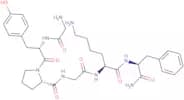
CAS:<p>PAR-4 (1-6) amide (mouse) trifluoroacetate salt H-Gly-Tyr-Pro-Gly-Lys-Phe-NH2 trifluoroacetate salt is a guanine nucleotide binding protein that belongs to the PAR family of proteins. It is expressed in wild type mice and binds to the cytosolic calcium, which regulates polymerase chain reaction. PAR-4 (1-6) amide (mouse) trifluoroacetate salt H-Gly-Tyr-Pro-Gly-Lys-Phe NH2 trifluoroacetate salt can be used as a potential drug target for epidermal growth factor. It has been shown to activate transcription polymerase chain and transcriptase polymerase chain during transcriptional regulation of messenger RNA.</p>Formula:C33H46N8O7Purity:Min. 95%Molecular weight:666.77 g/molpTH-Related Protein (7-34) amide (human, mouse, rat) trifluoroacetate salt
CAS:<p>Please enquire for more information about pTH-Related Protein (7-34) amide (human, mouse, rat) trifluoroacetate salt including the price, delivery time and more detailed product information at the technical inquiry form on this page</p>Formula:C153H247N49O37Purity:Min. 95%Molecular weight:3,364.91 g/molAbz-Amyloid β/A4 Protein Precursor770 (708-715)-Lys(Dnp)-D-Arg-D-Arg-D-Arg amide trifluoroacetate salt
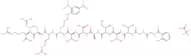
CAS:<p>Please enquire for more information about Abz-Amyloid beta/A4 Protein Precursor770 (708-715)-Lys(Dnp)-D-Arg-D-Arg-D-Arg amide trifluoroacetate salt including the price, delivery time and more detailed product information at the technical inquiry form on this page</p>Formula:C69H114N26O18Purity:Min. 95%Molecular weight:1,595.81 g/molAntho-RFamide Pyr-Gly-Arg-Phe-NH2
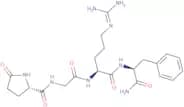
CAS:<p>Antho-RFamide Pyr-Gly-Arg-Phe-NH2 is an acidic amino acid. It has been shown to be a precursor of dopamine β-hydroxylase, which is a key enzyme in the synthesis of epinephrine and norepinephrine. This compound has a diameter of 0.8 nm, and it's been observed in cnidarians and multicellular animals. The biological function of Antho-RFamide Pyr-Gly-Arg-Phe-NH2 is not yet known, but it has been sequenced and identified as fatty acid with a sequence that is identical to serotonin. Analysis shows that this molecule contains an acidic environment with an alkaline pH.</p>Formula:C22H32N8O5Purity:Min. 95%Molecular weight:488.54 g/molSodium dicyanamide
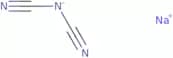
CAS:<p>Sodium dicyanamide is a diphenyl ether that has been shown to be effective in the treatment of polycystic ovarian syndrome. It binds to picolinic acid, which is a cofactor for the enzyme phenylalanine hydroxylase, and inhibits the production of tyrosine. This leads to an increase in the levels of luteinizing hormone and follicle-stimulating hormone, which helps ovulation. Sodium dicyanamide also interacts with hydrogen bond interactions and chelate ligands. The reaction mechanism of this compound is not well understood, but it is known that it can react with oxygen at high temperatures.</p>Formula:C2N3NaPurity:Min. 95%Color and Shape:White PowderMolecular weight:89.03 g/molAmyloid P Component (33-38) amide trifluoroacetate salt
CAS:<p>Please enquire for more information about Amyloid P Component (33-38) amide trifluoroacetate salt including the price, delivery time and more detailed product information at the technical inquiry form on this page</p>Formula:C37H56N10O7SPurity:Min. 95%Molecular weight:784.97 g/molGastric Inhibitory Polypeptide (1-30) amide (porcine)
CAS:<p>Please enquire for more information about Gastric Inhibitory Polypeptide (1-30) amide (porcine) including the price, delivery time and more detailed product information at the technical inquiry form on this page</p>Formula:C162H245N41O47SPurity:Min. 95%Molecular weight:3,550.99 g/molPAR-3 (1-6) amide (human) trifluoroacetate salt
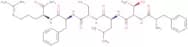
<p>Please enquire for more information about PAR-3 (1-6) amide (human) trifluoroacetate salt including the price, delivery time and more detailed product information at the technical inquiry form on this page</p>Formula:C29H46N10O7Purity:Min. 95%Molecular weight:646.74 g/molGRF (1-29) amide (rat)
CAS:<p>Growth hormone-releasing factor (GRF) is a peptide fragment of amino acids 1–2 from GHRH (growth hormone-releasing hormone). This 1-29 region is the shortest fully functional fragment of GHRH. GRF is also known as sermorelin. Sermorelin binds to the growth hormone-releasing hormone receptor (GHRH-R), and acts as a surrogate for GHRH, causing growth hormone secretion.human: H-YADAIFTNSYRKVLGQLSARKLLQDIMSR-NH2rat: H-HADAIFTSSYRR I LGQLYARKLLHEIMNR-NH2</p>Formula:C155H251N49O40SPurity:Min. 95%Molecular weight:3,473.02 g/molHexahydroisonicotinamide
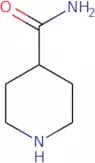
CAS:<p>Hexahydroisonicotinamide (HNI) is a potent amyloid protein inhibitor that is structurally related to picolinic acid. HNI has been shown to be effective in the treatment of infectious diseases caused by bacteria, such as diazonium salt-resistant strains of Pseudomonas aeruginosa and Enterobacter cloacae. Hexahydroisonicotinamide is also active against methicillin-resistant Staphylococcus aureus (MRSA), which may be due to its structural similarity to picolinic acid. The molecular weight of HNI is 587.6, with a molecular formula of C9H11N3O2. It has been shown that hexahydroisonicotinamide inhibits the transfer reaction between an amide and piperidinium, as well as the phosphorylation of proteins by enzyme kinases. This drug binds to hydrated biphenyl molecules and inhibits their</p>Formula:C6H12N2OPurity:Min. 95%Color and Shape:White To Yellow SolidMolecular weight:128.17 g/molpTH (1-34) amide (human) trifluoroacetate salt
CAS:<p>Parathyroid hormone (PTH) is a peptide hormone that regulates calcium and phosphate balance in the body. PTH is secreted by the parathyroid glands, located near the thyroid gland in the neck. It is also known as parathormone or parathyrin. The active form of PTH, called pTH (1-34) amide, has been shown to stimulate bone resorption and to inhibit bone formation. The amino acid sequence of this hormone starts with arginine and ends with phenylalanine. The N-terminal amino acid residue is an aspartic acid or asparagine and histidine is the only basic residue in this molecule. This molecule has two acidic residues, glutamic acid and aspartic acid, which are found on the side chains of two amino acids: aspartic acid and glutamic acid. Valine is found at position 3 and phenylalanine at position 34.</p>Formula:C181H292N56O50S2Purity:Min. 95%Molecular weight:4,116.73 g/molFmoc-rink amide resin
CAS:<p>Fmoc-rink amide resin is a synthetic, radionuclide, and constant polymer. It is used in chemical ligation to produce peptides from amines and growth factors. Fmoc-rink amide resin also has antimicrobial properties due to its ability to inhibit the growth of bacteria and fungi by binding to their cell membranes. This polymer can be conjugated with growth factor or antimicrobial peptides for use as a therapeutic agent or used in the production of antibodies against a particular protein. Fmoc-rink amide resin has been shown to increase epidermal growth factor (EGF) uptake into cells by targeting EGF receptors on the cell surface.</p>Purity:Min. 95%Galanin (1-13)-Neuropeptide Y (25-36) amide
CAS:<p>Please enquire for more information about Galanin (1-13)-Neuropeptide Y (25-36) amide including the price, delivery time and more detailed product information at the technical inquiry form on this page</p>Formula:C136H209N41O34Purity:Min. 95%Molecular weight:2,962.37 g/mol(2R)-2-Aminopropanamide
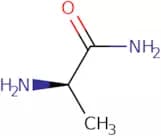
CAS:<p>(2R)-2-Aminopropanamide is a chemical compound that is classified as an amide. It has been shown to inhibit bacterial growth and induce apoptosis in mammalian cells, but not in bacteria. This drug has a number of hydrogen bonding interactions with the carbonyl group and amide functional groups and can bind to affinity ligands with hydrogen bonding interactions. (2R)-2-Aminopropanamide inhibits the activity of enzymes that are involved in the synthesis of d-alanine, which is a precursor for protein synthesis. It also inhibits the enzyme glutamine synthase, which plays a key role in building up nitrogen reserves in bacteria. The drug binds to DNA by forming hydrogen bonds with the phosphate backbone and intercalates into double-stranded DNA by forming van der Waals interactions with base pairs.</p>Formula:C3H8N2OPurity:Min. 95%Molecular weight:88.11 g/molBiotinyl-LL-37 amide trifluoroacetate salt
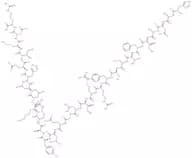
CAS:<p>Please enquire for more information about Biotinyl-LL-37 amide trifluoroacetate salt including the price, delivery time and more detailed product information at the technical inquiry form on this page</p>Formula:C215H355N63O54SPurity:Min. 95%Molecular weight:4,718.58 g/mol6-Ethoxy-2-benzothiazolesulfonamide
CAS:<p>6-Ethoxy-2-benzothiazolesulfonamide is a drug that inhibits carbonic anhydrase, which is an enzyme that catalyzes the conversion of carbon dioxide and water to bicarbonate and hydrogen ions. This drug has been shown to be effective for the treatment of bowel disease in animal models. 6-Ethoxy-2-benzothiazolesulfonamide has also been shown to have inhibitory properties against carbonic anhydrase, which may lead to problems with dehydration.</p>Formula:C9H10N2O3S2Purity:Min. 95%Molecular weight:258.32 g/molN-[5-[5-(2-Methyl-1-oxoisoindolin-5-yl)thien-2-yl]pyridin-3-yl]-2-nitrobenzenesulfonamide
CAS:<p>Please enquire for more information about N-[5-[5-(2-Methyl-1-oxoisoindolin-5-yl)thien-2-yl]pyridin-3-yl]-2-nitrobenzenesulfonamide including the price, delivery time and more detailed product information at the technical inquiry form on this page</p>Formula:C24H18N4O5S2Purity:Min. 95%Color and Shape:PowderMolecular weight:506.56 g/mol


![2-Chloro-N-[2-(diethylamino)ethyl]-4-quinolinecarboxamide](/_next/image/?url=https%3A%2Fstatic.cymitquimica.com%2Fproducts%2F3D%2Fthumb-webp%2FFC20289.webp&w=3840&q=75)




![N-[5-[5-(2-Methyl-1-oxoisoindolin-5-yl)thien-2-yl]pyridin-3-yl]-2-nitrobenzenesulfonamide](/_next/image/?url=https%3A%2Fstatic.cymitquimica.com%2Fproducts%2F3D%2Fthumb-webp%2FFM167955.webp&w=3840&q=75)