Amides
Amides are a wide range of chemical compounds that contain at least one heterocyclic ring, which has atoms of at least two different elements in the ring structure, and at least one amide group (-CONH2). These compounds are crucial in the synthesis of pharmaceuticals, polymers, and agrochemicals. Amides exhibit unique properties and reactivity, making them valuable intermediates in organic synthesis. At CymitQuimica, we offer a comprehensive selection of high-quality amides to support your research and industrial needs.
Found 16399 products of "Amides"
Sort by
Purity (%)
0
100
|
0
|
50
|
90
|
95
|
100
2-Methyl-N-phenyl-5,6-dihydro-1,4-oxathiine-3-carboxamide
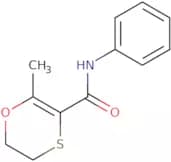
CAS:<p>2-Methyl-N-phenyl-5,6-dihydro-1,4-oxathiine-3-carboxamide is a signal molecule that has antimicrobial activity. It inhibits the proliferation of cells and is used as an antifungal agent. 2,5,6-Trimethyloxathiinium ion has been shown to induce apoptosis in human leukemia cells and inhibit the growth of erythrocytes infected with Plasmodium falciparum. This compound also inhibits wild type strains of bacteria and fungi and can be used as a natural fungicide. 2,5,6-Trimethyloxathiinium ion has been found to be effective in treating autoimmune diseases such as diabetes mellitus type II, which may be due to its ability to regulate glucose metabolism and suppress inflammatory responses.</p>Formula:C12H13NO2SPurity:Min. 95%Molecular weight:235.3 g/mol(2R)-2-Aminopropanamide
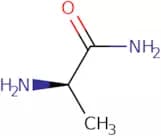
CAS:<p>(2R)-2-Aminopropanamide is a chemical compound that is classified as an amide. It has been shown to inhibit bacterial growth and induce apoptosis in mammalian cells, but not in bacteria. This drug has a number of hydrogen bonding interactions with the carbonyl group and amide functional groups and can bind to affinity ligands with hydrogen bonding interactions. (2R)-2-Aminopropanamide inhibits the activity of enzymes that are involved in the synthesis of d-alanine, which is a precursor for protein synthesis. It also inhibits the enzyme glutamine synthase, which plays a key role in building up nitrogen reserves in bacteria. The drug binds to DNA by forming hydrogen bonds with the phosphate backbone and intercalates into double-stranded DNA by forming van der Waals interactions with base pairs.</p>Formula:C3H8N2OPurity:Min. 95%Molecular weight:88.11 g/molAcetyl-(Pro18,Asp21)-Amyloid b-Protein (17-21) amide
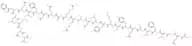
CAS:<p>Acetyl-(Pro18,Asp21)-Amyloid b-Protein (17-21) amide is a peptide that was generated by incubating β-amyloid with the protease papain. This peptide has been shown to induce population and biochemical changes in cells, including focusing of β-amyloid aggregates. It also induces reactive oxygen species and promotes extracellular protofibril formation. Acetyl-(Pro18,Asp21)-Amyloid b-Protein (17-21) amide is a conjugate of acetylated lysine residues and amyloid β-protein that can be used as an anti-amyloid therapeutic. The peptide is characterized by dichroism spectroscopy, which has revealed its specific binding to the fibrils' surface.</p>Formula:C35H46N6O8Purity:Min. 95%Molecular weight:678.78 g/molN-[2-[(2-Bromo-4,6-dinitrophenyl)azo]-5-(diethylamino)phenyl]acetamide
CAS:N-2-[(2-bromo-4,6-dinitrophenyl)azo]-5-(diethylamino)phenyl]acetamide (NBDPA) is a yellowish solid that is soluble in water. It has a molecular weight of 308.3 and chemical formula C14H21BrN2O4. NBDPA is used as an analytical reagent for the kinetic data of liver cells and in wastewater treatment. This compound has been shown to exhibit carcinogenic potential in rats, causing genetic damage to the DNA of liver cells and kidney tissue. NBDPA has also been shown to be toxic to fish embryos and larvae, with significant effects on the development of larvae at high concentrations.Formula:C18H19BrN6O5Purity:90%MinMolecular weight:479.28 g/mol(Tyr36)-pTH-Related Protein (1-36) amide (chicken)
CAS:<p>Please enquire for more information about (Tyr36)-pTH-Related Protein (1-36) amide (chicken) including the price, delivery time and more detailed product information at the technical inquiry form on this page</p>Formula:C184H301N57O55Purity:Min. 95%Molecular weight:4,191.71 g/molGastric Inhibitory Polypeptide (6-30) amide (human) trifluoroacetate salt
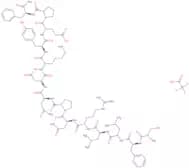
CAS:<p>Please enquire for more information about Gastric Inhibitory Polypeptide (6-30) amide (human) trifluoroacetate salt including the price, delivery time and more detailed product information at the technical inquiry form on this page</p>Formula:C139H209N35O38SPurity:Min. 95%Molecular weight:3,010.43 g/molTRAP-6 amide trifluoroacetate salt
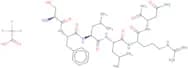
CAS:<p>Protease-activated receptor 1 (PAR-1) selective activating peptide, TFA salt. 98%.</p>Formula:C34H57N11O8Purity:Min. 95%Color and Shape:PowderMolecular weight:747.89 g/molChorionic Gonadotropin-β (109-119) amide (human)
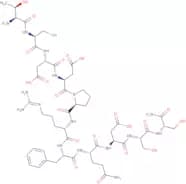
CAS:<p>Please enquire for more information about Chorionic Gonadotropin-beta (109-119) amide (human) including the price, delivery time and more detailed product information at the technical inquiry form on this page</p>Formula:C50H76N16O21SPurity:Min. 95%Molecular weight:1,269.3 g/mol2-Aminoethanesulphonamide monohydrochloride
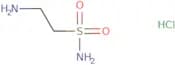
CAS:<p>2-Aminoethanesulphonamide monohydrochloride is a perovskite with a hexagonal shape. It has been shown to interact with the pharmacophore of the enzyme cytochrome P450, and it has been optimized for the reaction by altering its structure. This product is soluble in gaseous form, but can also be used as a solid. 2-Aminoethanesulphonamide monohydrochloride has an absorption maximum at 325 nm and emits fluorescence at 420 nm. It is used in devices that detect ionizing radiation.</p>Formula:C2H8N2O2S•HClPurity:Min. 95%Color and Shape:PowderMolecular weight:160.62 g/mol2-Chloro-N-[2-(diethylamino)ethyl]-4-quinolinecarboxamide
CAS:<p>2-Chloro-N-[2-(diethylamino)ethyl]-4-quinolinecarboxamide is a carboxamide analog of dibucaine. It is synthesized from chloroacetyl chloride and isatin in the presence of sodium hydroxide. The synthesis has been scaled to an industrial level. 2-Chloro-N-[2-(diethylamino)ethyl]-4-quinolinecarboxamide has been shown to have analgesic properties, similar to those of dibucaine. Radiolysis of this compound gives a carboxylic acid and a heterocyclic ring product.</p>Formula:C16H20ClN3OPurity:95%MinColor and Shape:PowderMolecular weight:305.8 g/molTRAP-14 amide trifluoroacetate salt
CAS:<p>Please enquire for more information about TRAP-14 amide trifluoroacetate salt including the price, delivery time and more detailed product information at the technical inquiry form on this page</p>Formula:C81H119N21O22Purity:Min. 95%Molecular weight:1,738.94 g/mol(Deamino-Cys11,D-2-Nal 14,Cys18)-b-MSH (11-22) amide trifluoroacetate salt
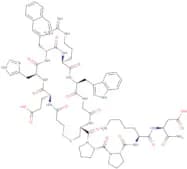
CAS:<p>Please enquire for more information about (Deamino-Cys11,D-2-Nal 14,Cys18)-b-MSH (11-22) amide trifluoroacetate salt including the price, delivery time and more detailed product information at the technical inquiry form on this page</p>Formula:C69H91N19O16S2Purity:Min. 95%Molecular weight:1,506.71 g/molN-(Hydroxymethyl)-phenylacetamide
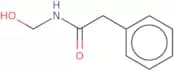
CAS:<p>N-(Hydroxymethyl)-phenylacetamide is an organic solvent that is used in the synthesis of certain antibiotics. It is a synthetic compound and can be obtained by reacting toluene with benzene, using a strong acid catalyst such as sulfuric acid. N-(Hydroxymethyl)-phenylacetamide has been used in the synthesis of isoquinolones, which are also antibiotics. This organic solvent can also be used for recrystallization, which is a process that helps purify solids from liquids or liquids from solids. The yield of this reaction is high, making it an efficient way to synthesize these compounds.</p>Formula:C9H11NO2Purity:Min. 95%Molecular weight:165.19 g/molN-Benzoyl-L-leucine-β-naphthylamide
CAS:<p>N-Benzoyl-L-leucine-beta-naphthylamide is a chromogenic substrate for transpeptidase. It is hydrolyzed to L-phenylalanine and 2-naphthylamine, which react with the chromogen to produce a color change. The reaction occurs in both spermatozoa and epithelial cells, but can be inhibited by aminopeptidase and peptidase. This substrate is used as a marker for spermatozoa in semen analysis.</p>Formula:C23H24N2O2Purity:Min. 95%Color and Shape:PowderMolecular weight:360.45 g/mol(Phe1-psi(CH2NH)Gly2)-Nociceptin (1-13) amide
<p>Please enquire for more information about (Phe1-psi(CH2NH)Gly2)-Nociceptin (1-13) amide including the price, delivery time and more detailed product information at the technical inquiry form on this page</p>Formula:C61H102N22O14Purity:Min. 95%Molecular weight:1,367.6 g/mol1-Methyl-4-nitro-1H-pyrazole-3-carboxamide
CAS:<p>Please enquire for more information about 1-Methyl-4-nitro-1H-pyrazole-3-carboxamide including the price, delivery time and more detailed product information at the technical inquiry form on this page</p>Purity:Min. 95%(Des-His1,Glu9)-Glucagon (1-29) amide (human, rat, porcine)
CAS:<p>Please enquire for more information about (Des-His1,Glu9)-Glucagon (1-29) amide (human, rat, porcine) including the price, delivery time and more detailed product information at the technical inquiry form on this page</p>Formula:C148H221N41O47SPurity:Min. 95%Molecular weight:3,358.65 g/mol(D-Trp12,Tyr34)-pTH (7-34) amide (bovine) trifluoroacetate salt
CAS:<p>Please enquire for more information about (D-Trp12,Tyr34)-pTH (7-34) amide (bovine) trifluoroacetate salt including the price, delivery time and more detailed product information at the technical inquiry form on this page</p>Formula:C165H251N49O40S2Purity:Min. 95%Molecular weight:3,625.2 g/moltert-Butylsulfinamide
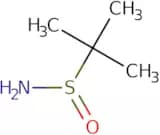
CAS:<p>tert-Butylsulfinamide is a model system for the synthesis of enantiopure amines and esters. The synthesis of tert-butylsulfinamide starts with the reaction of an allyl bromide with a sulfinic acid chloride to form an allyl sulfonate, which is then hydrolyzed to produce tert-butylsulfinamide. The yield for this type of reaction is usually low, but tert-butylsulfinamide can be isolated in good yields if it is prepared in a stereoselective manner. Tert-butylsulfinamide has been shown to inhibit the growth of human hair follicles in cell culture experiments, which may be due to its ability to inhibit the formation of hydrogen peroxide by inhibiting an enzyme called tyrosine hydroxylase.</p>Formula:C4H11NOSPurity:Min. 95%Color and Shape:White PowderMolecular weight:121.2 g/mol6-Ethoxy-2-benzothiazolesulfonamide
CAS:<p>6-Ethoxy-2-benzothiazolesulfonamide is a drug that inhibits carbonic anhydrase, which is an enzyme that catalyzes the conversion of carbon dioxide and water to bicarbonate and hydrogen ions. This drug has been shown to be effective for the treatment of bowel disease in animal models. 6-Ethoxy-2-benzothiazolesulfonamide has also been shown to have inhibitory properties against carbonic anhydrase, which may lead to problems with dehydration.</p>Formula:C9H10N2O3S2Purity:Min. 95%Molecular weight:258.32 g/mol


![N-[2-[(2-Bromo-4,6-dinitrophenyl)azo]-5-(diethylamino)phenyl]acetamide](/_next/image/?url=https%3A%2Fstatic.cymitquimica.com%2Fproducts%2F3D%2Fthumb-webp%2FFB151321.webp&w=3840&q=75)

![2-Chloro-N-[2-(diethylamino)ethyl]-4-quinolinecarboxamide](/_next/image/?url=https%3A%2Fstatic.cymitquimica.com%2Fproducts%2F3D%2Fthumb-webp%2FFC20289.webp&w=3840&q=75)