Amides
Found 16485 products of "Amides"
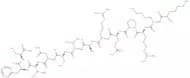
Kemptamide trifluoroacetate salt
CAS:Kemptamide is a peptide that has been shown to have cytotoxic and anti-proliferative effects on renal cancer cells. It is a synthetic analogue of an endogenous peptide, Lys-Lys-Arg-Pro-Gln-Arg-Ala-Thr-Ser-Asn-Val-Phe, that is found in porcine kidney. Kemptamide’s cytotoxic activity may be due to its ability to inhibit the activity of phosphatases. Kemptamide also has regulatory properties and can modulate the expression of genes that are involved in cell growth and apoptosis. This peptide has been shown to be reactive with kidney cells, which may lead to its therapeutic effect on renal cancer.
Formula:C65H112N24O18Purity:Min. 95%Molecular weight:1,517.74 g/molRef: 3D-FK110967
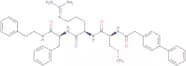
Discontinued product4-Biphenylac-Cys(Me)-D-Arg-Phe-(2-phenylethyl)amide
CAS:4-Biphenylac-Cys(Me)-D-Arg-Phe-(2-phenylethyl)amide is a tetrapeptide that has been shown to have antihypertensive properties. This drug binds to the regulatory proteins of the renin angiotensin system and blocks the production of angiotensin II, which decreases blood pressure. 4-Biphenylac-Cys(Me)-D-Arg-Phe-(2-phenylethyl)amide has also shown to be an effective treatment for skin care products, especially those used for inflammatory skin diseases. 4-Biphenylac-Cys(Me)-D-Arg-Phe-(2-phenylethyl)amide has been shown to be a potent inhibitor of serine proteases and can inhibit cellular proliferation and induce apoptosis in cancer cells.
Formula:C41H49N7O4SPurity:Min. 95%Molecular weight:735.94 g/molRef: 3D-FB111103
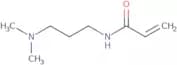
Discontinued productN-(3-Dimethylaminopropyl)acrylamide, stabilized with MEHQ
CAS:N-(3-Dimethylaminopropyl)acrylamide is a polymerization initiator that is used in the synthesis of polymers. It is also a model protein, which can be used to study bacterial growth rates and tissue metabolism. N-(3-Dimethylaminopropyl)acrylamide has been shown to have biological properties similar to human serum, as well as to serve as a model for primary cells. The FT-IR spectroscopy of N-(3-Dimethylaminopropyl)acrylamide reveals the presence of chloride ions in its molecular structure. The reaction mechanism for this compound has been determined by deionized water and ionic reactions with chloride ions.
Formula:C8H16N2OPurity:Min. 95%Molecular weight:156.23 g/molN,N-Bis(2-hydroxyethyl)dodecanamide
CAS:N,N-Bis(2-hydroxyethyl)dodecanamide is a surfactant that is used in the treatment of wastewater. It has been shown to be effective at removing p-hydroxybenzoic acid from water and at reducing the concentration of this compound in the environment. N,N-Bis(2-hydroxyethyl)dodecanamide also has antimicrobial properties and synergizes with other antimicrobial agents to provide a more potent effect than when it is used alone. This surfactant has been shown to have an effect on congestive heart failure by blocking the action of angiotensin II receptors.
Formula:C16H33NO3Color and Shape:Clear LiquidMolecular weight:287.44 g/molDithiooxamide
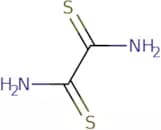
CAS:Dithiooxamide is a chemical compound that contains two sulfur atoms, one oxygen atom, and one nitrogen atom. It has been shown to be an effective treatment for wastewater by removing nitrogen and phosphorus. Dithiooxamide binds to metal ions such as copper and iron in the water, forming a complex. This process prevents the metal ions from being available as catalysts in the oxidation of organic pollutants. The binding of dithiooxamide with these metals also removes them from wastewater, preventing them from being taken up by plants or animals. Dithiooxamide can be used to remove malonic acid (a carcinogen) and p-nitrophenyl phosphate (a liver toxin) from blood samples for analysis using electrochemical impedance spectroscopy, which relies on the ability of dithiooxamide to bind to these chemicals. Dithiooxamide is also used as a surfactant in analytical chemistry methods such as gas chromatography or liquid chromatography because it
Formula:C2H4N2S2Purity:Min. 95%Color and Shape:PowderMolecular weight:120.2 g/mol