Carboxylic Acids
Carboxylic acids are organic molecules characterized by having a carboxyl-type functional group (-COOH). These acids are fundamental in various chemical reactions, including esterification, amidation, and decarboxylation. Carboxylic acids are widely used in the production of pharmaceuticals, polymers, and agrochemicals. In this section, you can find a large number of carboxylic acids ready to be used. At CymitQuimica, we provide a broad range of high-quality carboxylic acids to support your research and industrial applications.
Found 12453 products of "Carboxylic Acids"
Sort by
Purity (%)
0
100
|
0
|
50
|
90
|
95
|
100
HCV NS4A Protein (22-33) (FDA strain) trifluoroacetate salt
CAS:<p>Please enquire for more information about HCV NS4A Protein (22-33) (FDA strain) trifluoroacetate salt including the price, delivery time and more detailed product information at the technical inquiry form on this page</p>Formula:C54H99N15O14SPurity:Min. 95%Molecular weight:1,214.52 g/molpTH (2-38) (human) acetate salt
CAS:<p>Please enquire for more information about pTH (2-38) (human) acetate salt including the price, delivery time and more detailed product information at the technical inquiry form on this page</p>Formula:C194H314N58O53S2Purity:Min. 95%Molecular weight:4,371.06 g/molIL-1β (163-171) (human) trifluoroacetate salt
CAS:<p>Interleukin-1 beta (IL-1β) is a cytokine that is produced by activated macrophages and T cells. It is an important regulator of immune function, inducing fever, activating the inflammatory response, and increasing vascular permeability. IL-1β is a 163-amino acid polypeptide with a molecular weight of 18.7 kDa. The trifluoroacetate salt of IL-1β has been shown to be active in vitro against human leukemic cells and to have an interferon-gamma activity in vitro.</p>Formula:C39H64N12O19Purity:Min. 95%Molecular weight:1,004.99 g/mol1-Butanesulfonic acid sodium
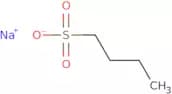
CAS:<p>1-Butanesulfonic acid sodium salt is a perfluorinated compound that inhibits the activity of various enzymes in the body, such as kinases and phosphatases. It has been used to study the effects of these enzymes on chemical reactions. 1-Butanesulfonic acid sodium salt is also used to detect the presence of selenium compounds in urine samples. The inhibition of an enzyme by this compound results in a decreased rate of reaction and a change in kinetic behavior. This can be observed by measuring the time it takes for the reaction to reach half its maximum value. Sodium taurocholate, chloride, and trifluoroacetic acid are all reagents that are commonly used with this compound when performing kinetic studies. 1-Butanesulfonic acid sodium salt has been shown to inhibit cholesterol synthesis in many animal models. In addition, this compound has been shown to bind to and inhibit plasma mass spectrometry by chromatography on silica gel from human plasma</p>Formula:C4H10O3S•NaPurity:Min. 95%Color and Shape:PowderMolecular weight:161.18 g/mol(Tyr0)-BNP-32 (human) trifluoroacetate salt
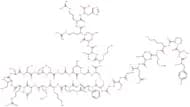
CAS:<p>Please enquire for more information about (Tyr0)-BNP-32 (human) trifluoroacetate salt including the price, delivery time and more detailed product information at the technical inquiry form on this page</p>Formula:C152H253N51O44S4Purity:Min. 95%Molecular weight:3,627.22 g/molVesicular Stomatitis Virus Nucleoprotein (52-59) trifluoroacetate salt
CAS:<p>Please enquire for more information about Vesicular Stomatitis Virus Nucleoprotein (52-59) trifluoroacetate salt including the price, delivery time and more detailed product information at the technical inquiry form on this page</p>Formula:C44H66N12O12Purity:Min. 95%Molecular weight:955.07 g/molH-Lys-Phe-Gly-Lys-OH acetate salt
CAS:<p>Please enquire for more information about H-Lys-Phe-Gly-Lys-OH acetate salt including the price, delivery time and more detailed product information at the technical inquiry form on this page</p>Formula:C23H38N6O5Purity:Min. 95%Molecular weight:478.59 g/mol2-Hydroxy-4-(methylthio)butyric acid calcium salt
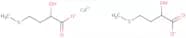
CAS:<p>2-Hydroxy-4-(methylthio)butyric acid calcium salt (2HMBAC) is a fatty acid that is found in malic acid. It is an important industrial chemical used for the preparation of other chemicals such as acetic anhydride, adipic acid, and butyric acid. 2HMBAC has been shown to have various biological functions including the inhibition of protein synthesis and the reduction of chloride ion transport. The dietary administration of 2HMBAC has been shown to relieve diarrhoea in rats.</p>Formula:C10H18CaO6S2Purity:Min. 95%Molecular weight:338.46 g/molPAR-4 (1-6) amide (mouse) trifluoroacetate salt
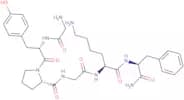
CAS:<p>PAR-4 (1-6) amide (mouse) trifluoroacetate salt H-Gly-Tyr-Pro-Gly-Lys-Phe-NH2 trifluoroacetate salt is a guanine nucleotide binding protein that belongs to the PAR family of proteins. It is expressed in wild type mice and binds to the cytosolic calcium, which regulates polymerase chain reaction. PAR-4 (1-6) amide (mouse) trifluoroacetate salt H-Gly-Tyr-Pro-Gly-Lys-Phe NH2 trifluoroacetate salt can be used as a potential drug target for epidermal growth factor. It has been shown to activate transcription polymerase chain and transcriptase polymerase chain during transcriptional regulation of messenger RNA.</p>Formula:C33H46N8O7Purity:Min. 95%Molecular weight:666.77 g/molH-Arg-Ser-OH acetate salt
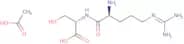
CAS:Controlled Product<p>Please enquire for more information about H-Arg-Ser-OH acetate salt including the price, delivery time and more detailed product information at the technical inquiry form on this page</p>Formula:C9H19N5O4Purity:Min. 95%Molecular weight:261.28 g/molNeuromedin U-8 (porcine) trifluoroacetate salt
CAS:<p>Neuromedin U-8 (porcine) trifluoroacetate salt H-Tyr-Phe-Leu-Phe-Arg-Pro-Arg-Asn-NH2 trifluoroacetate salt is a molecule that inhibits the action of vasoactive intestinal peptide. It is a peptide hormone that has been shown to be involved in the regulation of bowel function and blood pressure. Neuromedin U-8 (porcine) trifluoroacetate salt H-Tyr-Phe-Leu-Phe-Arg-Pro-Arg-Asn NH2 trifluoroacetate salt has also been shown to inhibit cell proliferation, cancer, and inflammatory bowel disease. Neuromedin U 8 (porcine) trifluoroacetate salt H Tyr Phe Leu Phe Arg Pro Arg Asn NH2 trifluoroacetate salt binds to the receptor for</p>Formula:C54H78N16O10Purity:Min. 95%Molecular weight:1,111.3 g/moltrans-4-[(2,5-Dihydro-2,5-dioxo-1H-pyrrol-1-yl)methyl]cyclohexanecarboxylic acid
CAS:<p>4-Maleimidomethylcyclohexanecaroboxylic acid (4MAMC) is a bifunctional molecule that is conjugated to a polymer, which has the ability to bind with cellular antigens and target tissue. It is used in clinical chemistry because it can be detected at low concentrations. 4MAMC has been shown to reduce cirrhosis caused by chronic liver injury. 4MAMC also increases the uptake of coagulation factors and decreases the expression of prothrombin, which leads to an increase in clotting time. The localization of 4MAMC is determined by the type of polymer conjugate it is bound with; for example, when it binds with human serum albumin, it localizes on the surface of cells.</p>Formula:C12H15NO4Purity:Min. 95%Color and Shape:White PowderMolecular weight:237.25 g/molFormyl-LHRH (2-10) trifluoroacetate salt
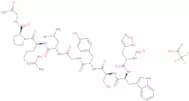
CAS:<p>Please enquire for more information about Formyl-LHRH (2-10) trifluoroacetate salt including the price, delivery time and more detailed product information at the technical inquiry form on this page</p>Formula:C51H70N16O12Purity:Min. 95%Molecular weight:1,099.2 g/molDABCYL-Glu-Arg-Nle-Phe-Leu-Ser-Phe-Pro-EDANS trifluoroacetate salt
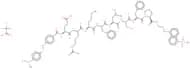
CAS:<p>Please enquire for more information about DABCYL-Glu-Arg-Nle-Phe-Leu-Ser-Phe-Pro-EDANS trifluoroacetate salt including the price, delivery time and more detailed product information at the technical inquiry form on this page</p>Formula:C76H98N16O15SPurity:Min. 95%Molecular weight:1,507.76 g/molGastric Inhibitory Polypeptide (porcine) trifluoroacetate salt
CAS:<p>Please enquire for more information about Gastric Inhibitory Polypeptide (porcine) trifluoroacetate salt including the price, delivery time and more detailed product information at the technical inquiry form on this page</p>Formula:C225H342N60O66SPurity:Min. 95%Molecular weight:4,975.55 g/molWRW4
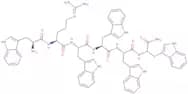
CAS:<p>Please enquire for more information about WRW4 including the price, delivery time and more detailed product information at the technical inquiry form on this page</p>Formula:C61H65N15O6Purity:Min. 95%Molecular weight:1,104.27 g/molH-Arg-Pro-pNA trifluoroacetate salt
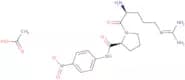
CAS:Controlled Product<p>Please enquire for more information about H-Arg-Pro-pNA trifluoroacetate salt including the price, delivery time and more detailed product information at the technical inquiry form on this page</p>Formula:C17H25N7O4Purity:Min. 95%Molecular weight:391.43 g/mol(Asp371)-Tyrosinase (369-377) (human) trifluoroacetate salt
CAS:<p>Trifluoroacetate salt</p>Formula:C42H66N10O16S2Purity:Min. 95%Molecular weight:1,031.16 g/molH-Gly-Arg-Ala-Asp-Ser-Pro-Lys-OH acetate salt
CAS:<p>Glycine-arginine-aspartate (GAA) is a mimic of the endothelium-derived vasoactive peptide, nitric oxide (NO). It has been shown to attenuate the inflammatory response by decreasing leukocyte adhesion and migration. GAA is also a potent inhibitor of vascular permeability and can attenuate edema in animal models. Studies have shown that GAA prevents microvascular damage following brain infarction. The mechanism of action for GAA is not fully understood, but it may be due to its ability to inhibit fibronectin breakdown, which leads to cerebral edema. GAA's activity on the endothelium may be due to its ability to mimic NO or inhibit sulfate synthesis.</p>Formula:C29H51N11O11Purity:Min. 95%Molecular weight:729.78 g/molBis-ACV trifluoroacetate salt
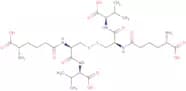
CAS:<p>Bis-ACV trifluoroacetate salt is a regulatory compound that belongs to the class of bis-acids. It is a cytosolic calcium ionophore that binds to the cytosolic calcium ion channel and regulates its activity. Bis-ACV trifluoroacetate salt also has nucleophilic attack on phosphate groups, which are essential for biosynthesis. The enzyme activity of this compound has been studied in various strains of bacteria such as E. coli and S. cerevisiae, and it was found to be involved in the synthesis of oligosaccharides and polysaccharides. This compound can be solubilized by the addition of sodium bicarbonate or urea, which facilitates its use in synthetic reactions. The synthase gene for this compound has been identified from various strains of bacteria such as E. coli and S. cerevisiae, but not from mammalian cells or plants.</p>Formula:C28H48N6O12S2Purity:Min. 95%Molecular weight:724.85 g/mol




![trans-4-[(2,5-Dihydro-2,5-dioxo-1H-pyrrol-1-yl)methyl]cyclohexanecarboxylic acid](/_next/image/?url=https%3A%2Fstatic.cymitquimica.com%2Fproducts%2F3D%2Fthumb-webp%2FFM54570.webp&w=3840&q=75)