


Carboxylic Acids
Carboxylic acids are organic molecules characterized by having a carboxyl-type functional group (-COOH). These acids are fundamental in various chemical reactions, including esterification, amidation, and decarboxylation. Carboxylic acids are widely used in the production of pharmaceuticals, polymers, and agrochemicals. In this section, you can find a large number of carboxylic acids ready to be used. At CymitQuimica, we provide a broad range of high-quality carboxylic acids to support your research and industrial applications.
Found 12453 products of "Carboxylic Acids"
Sort by
Purity (%)
0
100
|
0
|
50
|
90
|
95
|
100
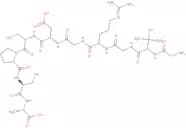
H-Gly-Pen-Gly-Arg-Gly-Asp-Ser-Pro-Cys-Ala-OH trifluoroacetate salt (Disulfide bond between Pen2 and Cys9)
CAS:<p>Gly-Pen-Gly-Arg-Gly-Asp-Ser-Pro-Cys (GPEG) is a peptide that modulates the function of muscle cells and is present in collagen. GPEG has been shown to improve oxidative damage, which occurs during exercise. The effect of GPEG on muscle cells is dependent on the dose. Low doses of GPEG activate proteins that are involved in transcription and increases the synthesis of oxidative enzymes, while high doses inhibit these proteins. GPEG also modulates integrin receptor expression and decreases fibronectin production by vascular smooth muscle cells.</p>Formula:C35H57N13O14S2Purity:Min. 95%Molecular weight:948.04 g/mol2-Iodo-5-methoxybenzoic acid
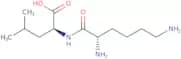
CAS:<p>2-Iodo-5-methoxybenzoic acid is a macrocyclic compound that has been synthesized in the Wittig reaction. It was first prepared by catalyzed intramolecular aryl demethylation of 2-iodo-5-nitrobenzoic acid, followed by coupling with methyl vinyl ketone. The cytotoxic activity of this compound is due to its ability to inhibit the synthesis of protein and DNA and induce apoptosis. This molecule has been shown to be effective against liverworts and ethers.</p>Formula:C8H7IO3Purity:Min. 95%Color and Shape:PowderMolecular weight:278.04 g/molH-Lys-Leu-OH acetate salt
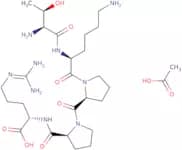
CAS:<p>H-Lys-Leu-OH acetate salt is a derivatized amino acid ester that is used for the detection of lysine and leucine. It is used as an analyte in microextraction, with a sensitivity of 0.25 ng/mL, which can be increased to 0.5 ng/mL by derivatization. H-Lys-Leu-OH acetate salt has been used in the detection of acids and bases, particularly carboxylic acids and basic amino acids, respectively.</p>Formula:C12H25N3O3·C2H4O2Purity:Min. 95%Molecular weight:319.4 g/molH-Thr-Lys-Pro-Pro-Arg-OH acetate salt
CAS:Controlled Product<p>Please enquire for more information about H-Thr-Lys-Pro-Pro-Arg-OH acetate salt including the price, delivery time and more detailed product information at the technical inquiry form on this page</p>Formula:C26H47N9O7Purity:Min. 95%Molecular weight:597.71 g/molCell-permeable Caspase-3 Inhibitor I trifluoroacetate salt
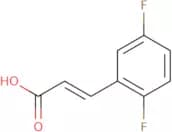
CAS:<p>Please enquire for more information about Cell-permeable Caspase-3 Inhibitor I trifluoroacetate salt including the price, delivery time and more detailed product information at the technical inquiry form on this page</p>Formula:C94H158N20O27Purity:Min. 95%Molecular weight:2,000.38 g/moltrans-2,5-Difluorocinnamic acid
CAS:<p>Trans-2,5-difluorocinnamic acid is a monomer that belongs to the group of organic acids. It is used as a solvent and in analytical methods. Trans-2,5-difluorocinnamic acid is also used to transport other substances and can be used in reactions with other molecules. Trans-2,5-difluorocinnamic acid has been shown to be neuropathic and has been tested for its ability to cause cataracts, but has not shown any evidence of mutagenicity.</p>Formula:C9H6F2O2Purity:Min. 95%Color and Shape:PowderMolecular weight:184.14 g/molpTH (1-37) (human) trifluoroacetate salt
CAS:<p>Please enquire for more information about pTH (1-37) (human) trifluoroacetate salt including the price, delivery time and more detailed product information at the technical inquiry form on this page</p>Formula:C195H316N58O54S2Purity:Min. 95%Molecular weight:4,401.09 g/molNeurotensin acetate salt Pyr-Leu-Tyr-Glu-Asn-Lys-Pro-Arg-Arg-Pro-Tyr-Ile-Leu-OH acetate salt
CAS:<p>Neurotensin is a peptide hormone that regulates the release of other hormones and neurotransmitters, such as dopamine. It has been shown to be able to regulate appetite and bowel disease in animal models. Neurotensin acetate salt Pyr-Leu-Tyr-Glu-Asn-Lys-Pro-Arg-Arg-Pro-Tyr-Ile-Leu-OH acetate salt is a neurotensin molecule with an acetate group attached to it. This molecule is completely soluble in water and has been shown to have no effect on energy metabolism or polymerase chain reactions.</p>Formula:C78H121N21O20Purity:Min. 95%Molecular weight:1,672.92 g/molCRAMP-18 (mouse) trifluoroacetate salt
CAS:<p>Please enquire for more information about CRAMP-18 (mouse) trifluoroacetate salt including the price, delivery time and more detailed product information at the technical inquiry form on this page</p>Formula:C101H171N27O24Purity:Min. 95%Molecular weight:2,147.61 g/mol3-(4-Methoxybenzoyl)acrylic acid
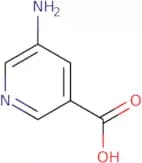
CAS:<p>Please enquire for more information about 3-(4-Methoxybenzoyl)acrylic acid including the price, delivery time and more detailed product information at the technical inquiry form on this page</p>Formula:C11H10O4Purity:Min. 95%Color and Shape:PowderMolecular weight:206.19 g/mol5-Aminopyridine-3-carboxylic acid
CAS:<p>5-Aminopyridine-3-carboxylic acid (5APC) is a structural analog of nicotinic acid that has been shown to have anti-inflammatory effects. 5APC inhibits the production of inflammatory cytokines, such as IL-10 and IL-17, by inhibiting the activation of NFκB and MAPK pathways. This drug also has significant inhibitory activities against dextran sulfate sodium (DSS)-induced acute colitis in experimental models. 5APC is thought to act by interrupting the assembly of p38 mitogen activated protein kinase (MAPK) and nuclear factor kappa B (NFκB) signaling complexes.</p>Formula:C6H6N2O2Purity:Min. 95%Molecular weight:138.12 g/molAmyloid β/A4 Protein Precursor770 (740-770) trifluoroacetate salt
CAS:<p>Please enquire for more information about Amyloid beta/A4 Protein Precursor770 (740-770) trifluoroacetate salt including the price, delivery time and more detailed product information at the technical inquiry form on this page</p>Formula:C162H243N45O52S2Purity:Min. 95%Molecular weight:3,717.07 g/molPresenilin-1 (331-349)-Cys (human, mouse) trifluoroacetate salt
CAS:<p>Please enquire for more information about Presenilin-1 (331-349)-Cys (human, mouse) trifluoroacetate salt including the price, delivery time and more detailed product information at the technical inquiry form on this page</p>Formula:C92H130N28O37SPurity:Min. 95%Molecular weight:2,252.25 g/molAminocaproic acid
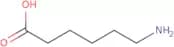
CAS:<p>Aminocaproic acid is a non-specific lysing agent that is used in the treatment of acute blood clots. Aminocaproic acid has minimal toxicity and low-dose effects, and can be used for the treatment of thrombotic disorders. It also has biological properties that are different from those of aminocaproate, which can lead to a more rapid dissolution of the clot. Aminocaproic acid is an organic compound that belongs to the class of dicarboxylic acids. It is synthesized from two molecules of aminoacetic acid by the enzyme aminocaproic acid synthetase. The synthesis occurs in a two-step process: first, caprylic acid reacts with ATP to form aminopropyl-adenylate (APA), followed by hydrolysis by APA lyase to form aminocaproic acid.</p>Formula:C6H13NO2Color and Shape:PowderMolecular weight:131.17 g/molVinylboronic acid MIDA ester
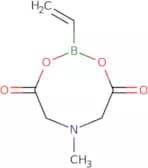
CAS:<p>Vinylboronic acid MIDA ester is a boronic ester that can be used as an additive to control weeds. It is a mixture of two diastereomers, with the vinyl group on one end of the molecule and the boron atom on the other. Vinylboronic acid MIDA ester has been shown to be more effective than methoxy for weed control, with yields of up to 100%. The addition of this compound to herbicides increases their activity against weeds, which may be due to its ability to increase the solubility of active ingredients.</p>Formula:C7H10BNO4Purity:Min. 95%Molecular weight:182.97 g/molN-α-Fmoc-Nβ-allyloxycarbonyl-L-2,3-diaminopropionic acid
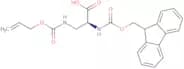
CAS:<p>Please enquire for more information about N-alpha-Fmoc-Nbeta-allyloxycarbonyl-L-2,3-diaminopropionic acid including the price, delivery time and more detailed product information at the technical inquiry form on this page</p>Formula:C22H22N2O6Purity:Min. 95%Molecular weight:410.53 g/mol2-Amino-a-(methoxyimino)-4-thiazoleacetic acid
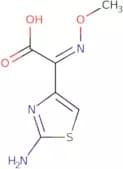
CAS:<p>2-Amino-a-(methoxyimino)-4-thiazoleacetic acid is a reaction product of cefotaxime and n-dimethyl formamide. It has been shown to be an effective agent for the treatment of wastewater with a high organic content. 2-Amino-a-(methoxyimino)-4-thiazoleacetic acid also reacts with chloride ions to form cleavage products that are soluble in water, making it an ideal choice for wastewater treatment. This compound is not toxic and can be used as a drug to treat patients with infections caused by bacteria resistant to other antibiotics. 2-Amino-a-(methoxyimino)-4-thiazoleacetic acid binds to mismatched base pairs in DNA, inhibiting DNA synthesis and causing cell death by apoptosis.</p>Formula:C6H7N3O3SPurity:Min. 95%Molecular weight:201.2 g/molErythropoietin Mimetic Peptide Sequence 20 trifluoroacetate salt
CAS:<p>Please enquire for more information about Erythropoietin Mimetic Peptide Sequence 20 trifluoroacetate salt including the price, delivery time and more detailed product information at the technical inquiry form on this page</p>Formula:C72H99N17O17S2Purity:Min. 95%Molecular weight:1,538.79 g/molNeuronostatin-19 (mouse, rat) trifluoroacetate salt
<p>Please enquire for more information about Neuronostatin-19 (mouse, rat) trifluoroacetate salt including the price, delivery time and more detailed product information at the technical inquiry form on this page</p>Formula:C91H153N29O26Purity:Min. 95%Molecular weight:2,069.37 g/mol5'-Chloro-2'-hydroxy-3'-nitro-[1,1'-biphenyl]-3-carboxylic acid
CAS:<p>Please enquire for more information about 5'-Chloro-2'-hydroxy-3'-nitro-[1,1'-biphenyl]-3-carboxylic acid including the price, delivery time and more detailed product information at the technical inquiry form on this page</p>Formula:C13H8ClNO5Purity:Min. 95%Molecular weight:293.66 g/mol







![5'-Chloro-2'-hydroxy-3'-nitro-[1,1'-biphenyl]-3-carboxylic acid](/_next/image/?url=https%3A%2Fstatic.cymitquimica.com%2Fproducts%2F3D%2Fthumb-webp%2FFC159731.webp&w=3840&q=75)