Carboxylic Acids
Carboxylic acids are organic molecules characterized by having a carboxyl-type functional group (-COOH). These acids are fundamental in various chemical reactions, including esterification, amidation, and decarboxylation. Carboxylic acids are widely used in the production of pharmaceuticals, polymers, and agrochemicals. In this section, you can find a large number of carboxylic acids ready to be used. At CymitQuimica, we provide a broad range of high-quality carboxylic acids to support your research and industrial applications.
Found 12453 products of "Carboxylic Acids"
Sort by
Purity (%)
0
100
|
0
|
50
|
90
|
95
|
100
Hexanoyl-(Ala19,Lys27·28)-VIP (free acid) trifluoroacetate salt
<p>Please enquire for more information about Hexanoyl-(Ala19,Lys27·28)-VIP (free acid) trifluoroacetate salt including the price, delivery time and more detailed product information at the technical inquiry form on this page</p>Formula:C153H250N44O43SPurity:Min. 95%Molecular weight:3,425.96 g/molDefensin HNP-1 (human) trifluoroacetate salt
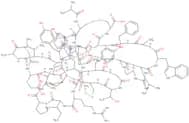
CAS:<p>Defensin HNP-1 is a trifluoroacetate salt of human defensin HNP-1. It has antimicrobial activity against Gram-negative and Gram-positive bacteria, including Mycobacterium tuberculosis, Staphylococcus aureus, Mycoplasma pneumoniae, Streptococcus pneumoniae, Haemophilus influenzae and Enterococcus faecalis. The purified protein also has broad-spectrum activity against cancer cells. Defensin HNP-1 is most active in neutrophils from humans with active cystic fibrosis. The protein binds to the bacterial cell membrane and causes the release of lysosomal enzymes that kill the bacteria. Defensin HNP-1 is also able to inhibit the growth of tumor cells as it can be internalized into these cells by endocytosis.</p>Formula:C150H222N44O38S6Purity:Min. 95%Molecular weight:3,442.04 g/molε-Maleimidocaproic acid-(2-nitro-4-sulfo)-phenyl ester·sodium salt
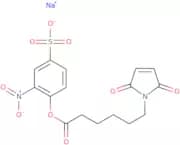
CAS:<p>Epsilon-Maleimidocaproic acid-(2-nitro-4-sulfo)-phenyl ester·sodium salt (EMAP) is a crosslinker that belongs to the group of heterobifunctional reagents. It has been used to conjugate monoclonal antibodies with other molecules, such as toxins. EMAP is activated by the dianion generated by protonation of the nitro groups on the phenyl ring and reacts with free amines or thiols in proteins. EMAP can be used for labeling immunotoxins for diagnostic use, maximizing detection sensitivity, and crosslinking DNA molecules for use in molecular cloning experiments.</p>Formula:C16H15N2NaO9SPurity:Min. 95%Molecular weight:434.35 g/molpTH (1-84) (rat) trifluoroacetate salt
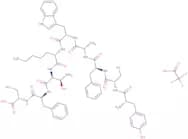
<p>Please enquire for more information about pTH (1-84) (rat) trifluoroacetate salt including the price, delivery time and more detailed product information at the technical inquiry form on this page</p>Formula:C406H670N122O126S3Purity:Min. 95%Molecular weight:9,372.61 g/molH-Tyr-Cys-Phe-Ala-Trp-Lys-Thr-Phe-Cys-OH trifluoroacetate salt (Disulfide bond)
CAS:<p>Please enquire for more information about H-Tyr-Cys-Phe-Ala-Trp-Lys-Thr-Phe-Cys-OH trifluoroacetate salt (Disulfide bond) including the price, delivery time and more detailed product information at the technical inquiry form on this page</p>Formula:C57H71N11O12S2Purity:Min. 95%Molecular weight:1,166.37 g/molMaxadilan trifluoroacetate salt
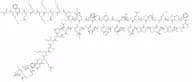
CAS:<p>Maxadilan trifluoroacetate salt is a low-potency drug that binds to the GABA receptor and affects the central nervous system. Maxadilan trifluoroacetate salt is structurally related to leishmaniasis, an infectious disease caused by protozoa of the genus Leishmania. Maxadilan trifluoroacetate salt has been shown to prevent the development of autoimmune diseases in mice, including systemic lupus erythematosus, experimental autoimmune encephalomyelitis, and collagen-induced arthritis. Maxadilan trifluoroacetate salt has also been shown to be effective against cutaneous lesions in mice infected with Leishmania major. The mechanism of action is not yet known but may be due to its ability to influence mitochondrial membrane potential or fatty acid metabolism.</p>Formula:C291H466N86O94S6Purity:Min. 95%Molecular weight:6,865.73 g/molCRAMP (mouse) trifluoroacetate salt
CAS:<p>Please enquire for more information about CRAMP (mouse) trifluoroacetate salt including the price, delivery time and more detailed product information at the technical inquiry form on this page</p>Formula:C178H302N50O46Purity:Min. 95%Molecular weight:3,878.61 g/molPhenyl pyruvic acid
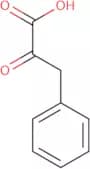
CAS:<p>Phenyl pyruvic acid is a sodium salt of phenylpyruvic acid that can be synthesized from phenylalanine, an amino acid. It has been shown to have antioxidant and anti-inflammatory properties. Phenyl pyruvic acid was found to inhibit oxidative injury caused by sodium nitroprusside in the rat brain, liver, and heart. Phenyl pyruvic acid also increased the activity of 3t3-l1 preadipocytes and improved energy metabolism in these cells. The synthesis of phenylpyruvate is catalyzed by a decarboxylase enzyme and it can be converted into insulin or phenylalanine.</p>Formula:C9H8O3Purity:Min. 95%Color and Shape:PowderMolecular weight:164.16 g/mol4-Nitrobenzaldiacetate
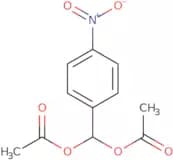
CAS:<p>4-Nitrobenzaldiacetate is a crystalline solid that can be obtained by two-dimensional experimental methods. It has been shown to have high reactivity in the presence of ozone and sulfuric acid. The reaction product is the corresponding sulfate salt. The filtration technique is used to separate the desired product from the reaction mixture. This product can also be crystallized with catalytic amounts of sulfuric acid and 4-nitrobenzoic acid. The catalytic oxidation of 4-nitrobenzoic acid to form 4-nitrobenzaldaicetic acid, as well as its subsequent conversion to 4-nitrobenzaldiacetate, are both feasible reactions for this compound.</p>Formula:C11H11NO6Purity:Min. 95%Color and Shape:PowderMolecular weight:253.21 g/molNeuromedin U-25 (human) trifluoroacetate salt
CAS:<p>Please enquire for more information about Neuromedin U-25 (human) trifluoroacetate salt including the price, delivery time and more detailed product information at the technical inquiry form on this page</p>Formula:C141H203N41O38Purity:Min. 95%Molecular weight:3,080.37 g/molEthyl diphenylacetate
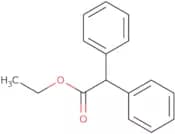
CAS:<p>Ethyl diphenylacetate is a trifluoromethyl group that has the potential for use as a fungicide. The hydrochloride salt of this compound exhibits high activity against various fungi, such as Rhizoctonia solani, Sclerotium rolfsii, and Botrytis cinerea. Ethyl diphenylacetate has also been shown to be an effective herbicide in plants, as it inhibits the enzyme acetolactate synthase and prevents the formation of branched-chain amino acids. It can also inhibit germination of seeds.</p>Formula:C16H16O2Purity:Min. 95%Molecular weight:240.3 g/molAmylin (free acid) (human) trifluoroacetate salt
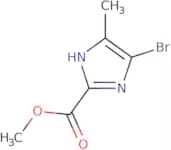
CAS:<p>Please enquire for more information about Amylin (free acid) (human) trifluoroacetate salt including the price, delivery time and more detailed product information at the technical inquiry form on this page</p>Formula:C165H260N50O56S2Purity:Min. 95%Molecular weight:3,904.27 g/molMethyl 4- bromo- 5- methyl- 1H- imidazole- 2- carboxylate
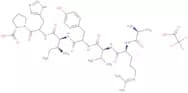
CAS:<p>Please enquire for more information about Methyl 4- bromo- 5- methyl- 1H- imidazole- 2- carboxylate including the price, delivery time and more detailed product information at the technical inquiry form on this page</p>Purity:Min. 95%Angiotensin A (1-7) trifluoroacetate
CAS:<p>Endogenous heptapetide which causes vasodilation and has anti-hypertensive properties.</p>Formula:C40H62N12O9•(C2HF3O2)xPurity:Min. 95%Color and Shape:PowderMolecular weight:855 g/molThymopentin acetate salt
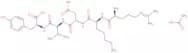
CAS:Controlled Product<p>Thymopentin acetate salt H-Arg-Lys-Asp-Val-Tyr-OH acetate salt is an experimental model system that has been shown to replicate the physiological effects of thymopoietin in vitro. It has also been shown to inhibit the growth of Candida glabrata, a fungus that causes infection in patients with HIV or AIDS. Thymopentin acetate salt H-Arg-Lys-Asp-Val-Tyr-OH acetate salt has been shown to activate both toll like receptor and IL2 receptor, which may be due to its ability to stimulate polyamine synthesis.</p>Formula:C30H49N9O9Purity:Min. 95%Molecular weight:679.77 g/molIsopropyl 2-amino-4-hydroxy-5,8-dihydropyrido[3,4-d]pyrimidine-7(6H)-carboxylate
CAS:<p>Please enquire for more information about Isopropyl 2-amino-4-hydroxy-5,8-dihydropyrido[3,4-d]pyrimidine-7(6H)-carboxylate including the price, delivery time and more detailed product information at the technical inquiry form on this page</p>Formula:C11H16N4O3Purity:Min. 95%Molecular weight:252.27 g/molN-(2-Pyridyl)oxamic acid
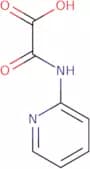
CAS:<p>N-(2-Pyridyl)oxamic acid is a non-steroidal anti-inflammatory drug that belongs to the group of piroxicam. It was found to be a competitive inhibitor of the reaction between singlet oxygen and certain organic compounds. The reaction rate of N-(2-pyridyl)oxamic acid is dependent on the concentration of solvent, which affects the solvation of the reactants and products. The tautomerization equilibrium constant for N-(2-pyridyl)oxamic acid has been determined as 1.3 × 10 at 25°C in acetonitrile, with an apparent molecular weight of 251.6 g/mol. The singlet oxygen constant (Ks) for this compound is 2.8 × 10 at 25°C in acetonitrile, with a maximum absorbance wavelength at 295 nm and a half life time of 0.27 seconds at 298 K in pure water.</p>Formula:C7H6N2O3Purity:Min. 95%Color and Shape:PowderMolecular weight:166.13 g/mol4-Acetylamino-5-bromo-2-methoxy-benzoic acid methylester
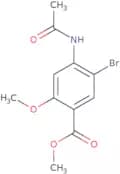
CAS:<p>Please enquire for more information about 4-Acetylamino-5-bromo-2-methoxy-benzoic acid methylester including the price, delivery time and more detailed product information at the technical inquiry form on this page</p>Formula:C11H12BrNO4Purity:Min. 95%Color and Shape:PowderMolecular weight:302.12 g/molTES
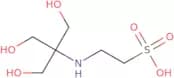
CAS:<p>TES, also known as N-Tris(hydroxymethyl)methyl-2-aminoethanesulfonic acid, is a buffering agent that is used in protein assays and forms complexes with DNA and copper ions. The optimal pH range of this zwitterionic buffer is 6.8-8.2 and its pKa is 7.4.</p>Formula:C6H15NO6SPurity:Min. 95%Color and Shape:PowderMolecular weight:229.25 g/molGlycodehydrocholic acid
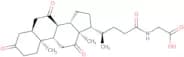
CAS:Controlled Product<p>Glycodehydrocholic acid is a bile acid that is synthesized from cholesterol by the liver and intestine. It is used for the diagnosis of cancer and other medical conditions, such as obesity. Glycodehydrocholic acid inhibits the growth of adipose tissue cells, which may be due to its ability to increase the expression of genes related to lipid metabolism. This drug has also been shown to have an inhibitory effect on mitochondria and tumor cells in human serum. Glycodehydrocholic acid can be measured using chromatographic methods with a sample preparation before analysis. This drug can also be detected in urine samples by gas-liquid chromatography or mass spectrometry. The metabolic profiles of women differ from men, so it is important to take this into account when performing analytical chemistry procedures on this compound.</p>Formula:C26H37NO6Purity:Min. 95%Color and Shape:White/Off-White SolidMolecular weight:459.58 g/mol

![Isopropyl 2-amino-4-hydroxy-5,8-dihydropyrido[3,4-d]pyrimidine-7(6H)-carboxylate](/_next/image/?url=https%3A%2Fstatic.cymitquimica.com%2Fproducts%2F3D%2Fthumb-webp%2FFI135088.webp&w=3840&q=75)