Carboxylic Acids
Carboxylic acids are organic molecules characterized by having a carboxyl-type functional group (-COOH). These acids are fundamental in various chemical reactions, including esterification, amidation, and decarboxylation. Carboxylic acids are widely used in the production of pharmaceuticals, polymers, and agrochemicals. In this section, you can find a large number of carboxylic acids ready to be used. At CymitQuimica, we provide a broad range of high-quality carboxylic acids to support your research and industrial applications.
Found 12453 products of "Carboxylic Acids"
Sort by
Purity (%)
0
100
|
0
|
50
|
90
|
95
|
100
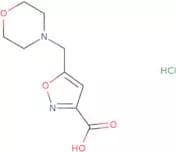
5-(Morpholin-4-ylmethyl)isoxazole-3-carboxylic acid hydrochloride
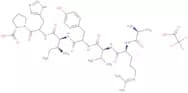
CAS:<p>Please enquire for more information about 5-(Morpholin-4-ylmethyl)isoxazole-3-carboxylic acid hydrochloride including the price, delivery time and more detailed product information at the technical inquiry form on this page</p>Formula:C9H12N2O4•HClPurity:Min. 95%Molecular weight:248.66 g/molAngiotensin A (1-7) trifluoroacetate
CAS:<p>Endogenous heptapetide which causes vasodilation and has anti-hypertensive properties.</p>Formula:C40H62N12O9•(C2HF3O2)xPurity:Min. 95%Color and Shape:PowderMolecular weight:855 g/mol4-[2-[[(1S)-1-(2-Aminophenyl)-3-methylbutyl]amino]-2-oxoethyl]-2-ethoxybenzoic acid
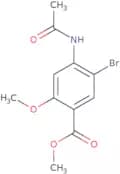
CAS:<p>Bosentan is a potent inhibitor of the uptake of organic anions. It is used in the treatment of pulmonary arterial hypertension and has been shown to be effective against pravastatin-resistant HIV protease inhibitors, such as saquinavir, quinidine, and rosuvastatin. Bosentan inhibits uptake by binding to the transporter protein at a site that does not overlap with the binding site for organic anion substrates. This leads to a change in kinetic parameters for substrates, such as pravastatin and saquinavir. The binding site on bosentan may also be elucidated through monolayer experiments with efflux transporters.</p>Formula:C22H28N2O4Purity:Min. 95%Molecular weight:384.47 g/mol4-Acetylamino-5-bromo-2-methoxy-benzoic acid methylester
CAS:<p>Please enquire for more information about 4-Acetylamino-5-bromo-2-methoxy-benzoic acid methylester including the price, delivery time and more detailed product information at the technical inquiry form on this page</p>Formula:C11H12BrNO4Purity:Min. 95%Color and Shape:PowderMolecular weight:302.12 g/mol5,7-Docosadiynoic acid
CAS:<p>5,7-Docosadiynoic acid is a fluorescent molecule that has been found to have low molecular weight, which makes it ideal for use in a variety of strategies. This compound can be used as a fluorescent probe for the detection of membrane interactions and also has many potential applications in polymerized optical devices. 5,7-Docosadiynoic acid is able to fluoresce when irradiated with light at wavelengths above 500 nm and has been shown to be excited by UV light. The chemical properties of 5,7-docosadiynoic acid make it an excellent candidate for use in sensors and optical devices.</p>Formula:C22H36O2Purity:Min. 95%Molecular weight:332.52 g/mol2-Bromopropionic acid benzyl ester
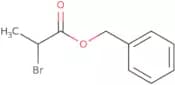
CAS:<p>2-Bromopropionic acid benzyl ester is a synthetic compound with a molecular weight of 220.24 g/mol. It is soluble in organic solvents and has a hydroxyl group at its alpha position. 2-Bromopropionic acid benzyl ester is used in the synthesis of beta-cyclodextrin, which is an important biomaterial for drug delivery as well as other applications. 2-Bromopropionic acid benzyl ester also has antioxidant properties and can be used to treat leukemia cells by inhibiting the production of reactive oxygen species (ROS).</p>Formula:C10H11BrO2Purity:Min. 95%Molecular weight:243.1 g/molMethyl 4- bromo- 5- methyl- 1H- imidazole- 2- carboxylate
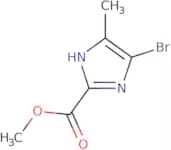
CAS:<p>Please enquire for more information about Methyl 4- bromo- 5- methyl- 1H- imidazole- 2- carboxylate including the price, delivery time and more detailed product information at the technical inquiry form on this page</p>Purity:Min. 95%tert-Butyl (2R,3S)-(-)-6-oxo-2,3-diphenyl-4-morpholinecarboxylate
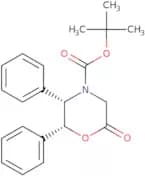
CAS:<p>tert-Butyl (2R,3S)-(-)-6-oxo-2,3-diphenyl-4-morpholinecarboxylate is a chiral compound that contains two stereogenic centers. It is a racemate of enantiomers. The enantiomeric purity can be determined by the preparative method. This compound is soluble in water and is stable in neutral or acidic conditions. It has been shown to act as an α-amino acid and to inhibit glycine uptake by neurons.</p>Formula:C21H23NO4Purity:Min. 95%Color and Shape:SolidMolecular weight:353.41 g/molN,N-Bis(carboxymethyl)-L-glutamic acid
CAS:<p>N,N-bis(Carboxymethyl)-L-glutamic acid is a synthetic compound that functions as a disinfectant. It has been shown to be effective against bacteria and fungi in vitro, with an efficacy of over 90%. N,N-bis(Carboxymethyl)-L-glutamic acid is used as a treatment for tumors due to its ability to penetrate the tumor cells and inhibit fatty acid uptake. This compound also prevents the formation of new blood vessels by inhibiting the synthesis of DNA and RNA. N,N-bis(Carboxymethyl)-L-glutamic acid can be used in coatings for metals or metal surfaces that are exposed to water or air because it is biodegradable and noncorrosive.</p>Formula:C9H13NO8Purity:Min. 95%Color and Shape:Clear LiquidMolecular weight:263.2 g/mol(S)-(-)-6,7-Dimethoxy-1,2,3,4-tetrahydroisoquinoline-3-carboxylic acid hydrochloride
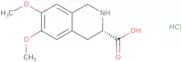
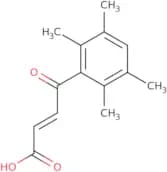
CAS:<p>(S)-(-)-6,7-Dimethoxy-1,2,3,4-tetrahydroisoquinoline-3-carboxylic acid hydrochloride is a synthetic chiral compound that is used to study the role of glyoxylate in biochemical reactions. This drug is an enolate and alkylating agent that can react with nucleophiles such as amines and thiols. It has been shown to be effective against perchlorates by hydrolyzing them into chlorine and oxygen gas. This drug has also been shown to inhibit the growth of Rhodobacter sphaeroides by inhibiting glyoxylate metabolism.</p>Formula:C12H15NO4·HClPurity:Min. 95%Color and Shape:White PowderMolecular weight:273.71 g/mol3-(2,3,5,6-Tetramethylbenzoyl)-acrylic acid
CAS:<p>3-(2,3,5,6-Tetramethylbenzoyl)-acrylic acid is a versatile building block for the synthesis of complex compounds. It is used as a reagent to make other chemicals and has been used in the synthesis of research chemicals. 3-(2,3,5,6-Tetramethylbenzoyl)-acrylic acid is also useful as an intermediate or scaffold compound in organic chemistry. This product has high purity and quality.</p>Formula:C14H16O3Purity:Min. 95%Molecular weight:232.28 g/mol2-[(2,3-Dimethylphenyl)amino]nicotinic acid
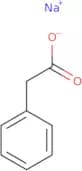
CAS:<p>2-[(2,3-Dimethylphenyl)amino]nicotinic acid is an arylpropionic acid that has been designed for the treatment of cancer. It is a neutral compound that can be crystallized or sterilized and then injected or implanted into tissues. The compound can be used as a diagnostic tool to target specific tissues in the body by using iontophoresis or organic solvents. 2-[(2,3-Dimethylphenyl)amino]nicotinic acid interacts with chlorine ions to form a chloride derivative, which is then transported through the tissue. This process can be reversed by adding an acid solution to the tissue, which will cause the chloride ions to break down into hydrogen and chloride ions.</p>Formula:C14H14N2O2Purity:Min. 95%Molecular weight:242.27 g/molSodium phenylacetate
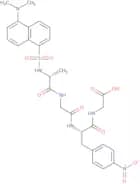
CAS:Controlled Product<p>Sodium phenylacetate is a chemical compound that is used as an antifungal agent in vitro. It has also been shown to have anti-proliferative and cytotoxic effects on neuroblastoma cells. The physiological function of sodium phenylacetate is not well understood, but it may act as a neurotransmitter by inhibiting the release of acetylcholine or by regulating cell signaling pathways. Sodium phenylacetate may also inhibit angiogenesis, which would limit the growth of cancerous tumors.</p>Formula:C8H7NaO2Purity:Min. 95%Color and Shape:PowderMolecular weight:158.13 g/molDansyl-D-Ala-Gly-4-nitro-Phe-Gly-OH trifluoroacetate salt
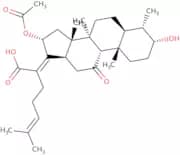
CAS:<p>Dansyl-D-Ala-Gly-4-nitro-Phe-Gly-OH trifluoroacetate salt is a fluorescent marker that can be used in immunohistochemical staining. It binds to endogenous vasoactive intestinal peptide, calcitonin and other proteins in tissues and can be detected using immunostaining. Dansyl-D-Ala-Gly-4-nitro-Phe-Gly-OH trifluoroacetate salt is optimised for use as a substrate for neutral endopeptidase and metalloendopeptidase enzymes, which are responsible for the degradation of vasoactive intestinal peptide.</p>Formula:C28H32N6O9S·C2HF3O2Purity:Min. 95%Color and Shape:SolidMolecular weight:742.68 g/mol11-Keto fusidic acid
CAS:<p>Fusidic acid is a hydrophilic antibiotic that is structurally related to penicillin. It has a cavity that interacts with γ-cyclodextrin, which can be used for its monitoring and stoichiometry. Fusidic acid has hydroxyl groups that are located on the 7th and 8th positions of the fusidate ring. This antibiotic has been shown to have stability constants in a range of 10-10 M. Fusidic acid also has two electrophoretically distinct forms, depending on the pH of the solution. The form at pH 10 is called fusidane, while the form at pH 5 is called fusidate.</p>Formula:C31H46O6Purity:Min. 95%Molecular weight:514.69 g/molD-(-)-3-Phosphoglyceric acid disodium
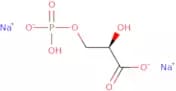
CAS:<p>D-(-)-3-Phosphoglyceric acid disodium is a homologue of D-glyceric acid and is used in the synthesis of phosphatidylcholine. It binds to the active site of phosphatases and prevents them from hydrolyzing phosphate groups, which are critical for the production of adenosine triphosphate (ATP). The chemical stability and the availability make this compound an excellent candidate for biochemical studies. D-(-)-3-Phosphoglyceric acid disodium has been shown to be essential in biological function, as it functions as a substrate for many metabolic pathways such as glycolysis, gluconeogenesis, pentose phosphate pathway, and fatty acid biosynthesis. The molecule is also involved in a number of biochemical reactions that are catalyzed by enzymes. Mutational studies have shown that organisms without this compound will not survive.</p>Formula:C3H5O7PNa2Purity:Min. 93%Color and Shape:White PowderMolecular weight:230.02 g/molN,N'-Bis(2,6-diisopropylphenyl)-3,4,9,10-perylenetetracarboxylic diimide
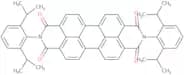
CAS:<p>N,N'-Bis(2,6-diisopropylphenyl)-3,4,9,10-perylenetetracarboxylic diimide is a molecule that has an optimum concentration of 0.5 M. It has a hydrogen bond donor and acceptor and is optically active. This molecule displays fluorescence properties and is inorganic with a chloride acceptor group. N,N'-Bis(2,6-diisopropylphenyl)-3,4,9,10-perylenetetracarboxylic diimide has been shown to have high photostability and to be enhanced by light emission from a diode. This molecule also has carbonyl groups that are electron donors for the fluorescence process.</p>Formula:C49H50N6O4Purity:Min. 95 Area-%Color and Shape:PowderMolecular weight:786.96 g/molCromoglicic acid D5
CAS:<p>Please enquire for more information about Cromoglicic acid D5 including the price, delivery time and more detailed product information at the technical inquiry form on this page</p>Formula:C6D5BrPurity:Min. 95%Color and Shape:PowderMolecular weight:473.40 g/mol3-[2-Amino-3-(2-tert-butoxycarbonyl-ethoxy)-2-(2-tert-butoxycarbonyl-ethoxymethyl)-propoxy]-propionic acid tert-butyl ester
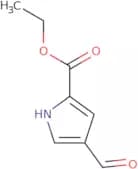
CAS:<p>Please enquire for more information about 3-[2-Amino-3-(2-tert-butoxycarbonyl-ethoxy)-2-(2-tert-butoxycarbonyl-ethoxymethyl)-propoxy]-propionic acid tert-butyl ester including the price, delivery time and more detailed product information at the technical inquiry form on this page</p>Formula:C25H47NO9Purity:Min. 95%Molecular weight:505.64 g/molEthyl 4-formylpyrrole-2-carboxylate
CAS:<p>Ethyl 4-formylpyrrole-2-carboxylate is a chemical compound that is used as an intermediate in organic synthesis. The compound has been reported to have spectra at m/z (M+1) of 168, 156 and 140. It also has been reported to have yields of about 98% when synthesized from ethyl azidoacetate and ethyl bromoacetate. The mass spectra show the molecular ion peak at m/z of 168, 156 and 140 corresponding to the structure of ethyl 4-formylpyrrole-2-carboxylate. Furan, n-substituted furan, thiophene, acetamide and cyclization are other possible structures for this molecule.</p>Formula:C8H9NO3Purity:Min. 95%Molecular weight:167.16 g/mol

![4-[2-[[(1S)-1-(2-Aminophenyl)-3-methylbutyl]amino]-2-oxoethyl]-2-ethoxybenzoic acid](/_next/image/?url=https%3A%2Fstatic.cymitquimica.com%2Fproducts%2F3D%2Fthumb-webp%2FFD21379.webp&w=3840&q=75)


![2-[(2,3-Dimethylphenyl)amino]nicotinic acid](/_next/image/?url=https%3A%2Fstatic.cymitquimica.com%2Fproducts%2F3D%2Fthumb-webp%2FFD136106.webp&w=3840&q=75)

![3-[2-Amino-3-(2-tert-butoxycarbonyl-ethoxy)-2-(2-tert-butoxycarbonyl-ethoxymethyl)-propoxy]-propio…](/_next/image/?url=https%3A%2Fstatic.cymitquimica.com%2Fproducts%2F3D%2Fthumb-webp%2FFA163774.webp&w=3840&q=75)