


Pharmaceutical Standards
Pharmaceutical standards are a comprehensive set of reference materials essential for ensuring the safety, efficacy, and quality of pharmaceutical products. This category includes standards for active pharmaceutical ingredients (APIs), which are the core components responsible for therapeutic effects. Additionally, it covers compounds and metabolites relevant to both the pharmaceutical and veterinary industries, providing benchmarks for the accurate measurement and analysis of these substances. Nitrosamine control standards are crucial for detecting and mitigating potentially harmful nitrosamines in drug formulations. Toxicology standards help assess the safety and potential adverse effects of pharmaceutical compounds. Furthermore, enzyme activators and inhibitors standards are vital for research and development, enabling precise studies of biochemical pathways and drug mechanisms. These pharmaceutical standards are indispensable tools for regulatory compliance, quality control, and research, ensuring that pharmaceutical products meet stringent safety and effectiveness criteria.
Subcategories of "Pharmaceutical Standards"
- APIs for research and impurities(273,474 products)
- Enzyme Activators and Inhibitors(2,827 products)
- Nitrosamines(2,603 products)
- Pharmaceutical and Veterinary Compounds and Metabolites(2,602 products)
- Toxicology(13,653 products)
Found 7836 products of "Pharmaceutical Standards"
Sort by
Purity (%)
0
100
|
0
|
50
|
90
|
95
|
100
2-(4-Nitrophenoxy)-3-chloro-5-trifluoromethyl pyridine
CAS:<p>Please enquire for more information about 2-(4-Nitrophenoxy)-3-chloro-5-trifluoromethyl pyridine including the price, delivery time and more detailed product information at the technical inquiry form on this page</p>Purity:Min. 95%1-(3-Acetylphenyl)-3-phenylurea
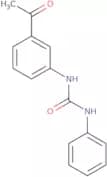
CAS:<p>Please enquire for more information about 1-(3-Acetylphenyl)-3-phenylurea including the price, delivery time and more detailed product information at the technical inquiry form on this page</p>Formula:C15H14N2O2Purity:Min. 95%Color and Shape:PowderMolecular weight:254.28 g/mol1-(3-Chlorophenyl) thiourea
CAS:<p>1-(3-Chlorophenyl) thiourea is a curcumin analog that has been shown to inhibit the epidermal growth factor (EGF) receptor. It is synthesized from 1,2-dichlorobenzene and urea in a two-step process. The anhydrous potassium carbonate is first converted to the potassium salt with an acid chloride. The second step is the reaction of this salt with urea in the presence of excess anhydrous potassium carbonate. This product has been shown to be effective against cancer cells and may be used as a potential anticancer agent for treatment of skin cancer. 1-(3-Chlorophenyl) thiourea inhibits EGF receptor by binding to it and preventing its activation, which prevents cell proliferation and reduces tumor size.</p>Purity:Min. 95%N-(2-(3,4-dimethoxyphenyl)ethyl)(2-nitrophenyl)formamide
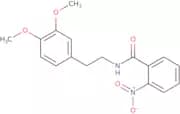
CAS:Controlled Product<p>Please enquire for more information about N-(2-(3,4-dimethoxyphenyl)ethyl)(2-nitrophenyl)formamide including the price, delivery time and more detailed product information at the technical inquiry form on this page</p>Purity:Min. 95%(4-Fluorophenyl)urea
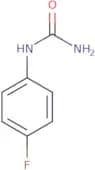
CAS:<p>The descriptors for (4-Fluorophenyl)urea are correlating with the parameters, coefficients, and constants of the regression equation. The topological optimality is obtained by using the values of the coefficients and constants. The hydrolysis of (4-Fluorophenyl)urea is correlated with the phenylureas and molecular structures. The pesticides have a correlation with both (4-Fluorophenyl)urea and phenylureas. This product can be used as an insecticide or herbicide.</p>Formula:C7H7FN2OPurity:Min. 95%Color and Shape:PowderMolecular weight:154.14 g/mol2-(1-Naphthyloxy)acetohydrazide
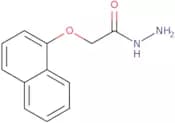
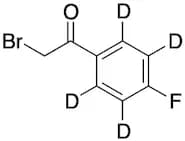
CAS:<p>2-(1-Naphthyloxy)acetohydrazide is a lipoxygenase inhibitor that has been shown to inhibit the activity of dihdroxygenases in the nanomolar range. These enzymes catalyze the initial step in lipid metabolism and are involved in the synthesis of prostaglandins and leukotrienes, which play a role in inflammatory diseases. 2-(1-Naphthyloxy)acetohydrazide is a potent inhibitor of lipoxygenases, with an IC50 value of 0.5 μM, and has been shown to be effective at inhibiting the release of arachidonic acid from cell membranes. This drug also inhibits cyclooxygenase-2 (COX-2), which is involved in inflammation, pain, fever and other conditions. The inhibition of COX-2 by 2-(1-naphthyloxy)acetohydrazide may be due to its ability to bind competitively with</p>Formula:C12H12N2O2Purity:Min. 95%Color and Shape:PowderMolecular weight:216.24 g/mol2-Bromo-4'-fluoroacetophenone-2',3',5',6'-d4
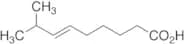
CAS:Controlled Product<p>Applications 2-Bromo-4'-fluoroacetophenone-2',3',5',6'-d4 (CAS# 1219803-30-1) is a useful isotopically labeled research compound.<br></p>Formula:C8H2D4BrFOColor and Shape:NeatMolecular weight:221.06(6E)-8-Methyl-6-nonenoic Acid
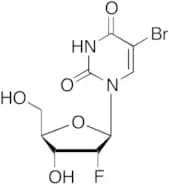
CAS:Controlled Product<p>Applications A compund from thermal decomposition of Capsaicin, as a possible carcinogen. E/Z = 4.4/1 (by NMR).<br>References Fusco, B., et al.: Drugs, 53, 909 (1997), Buisman, G., et al.: Biotechnol. Lett., 20, 131 (1998), Kobata, K., et al.: Bios. Biotechnol. Biochem., 66, 319 (2002), Aluru, M., et al.: J. Exp. Bot., 54, 1655 (2003),<br></p>Formula:C10H18O2Color and Shape:NeatMolecular weight:170.255-Bromo-2'-deoxy-2'-fluorouridine
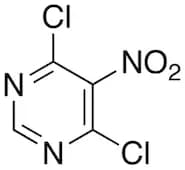
CAS:Controlled ProductFormula:C9H10BrFN2O5Color and Shape:NeatMolecular weight:325.094,6-Dichloro-5-nitropyrimidine
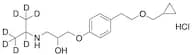
CAS:Controlled Product<p>Applications 4,6-Dichloro-5-nitropyrimidine (cas# 4316-93-2) is a compound useful in organic synthesis.<br></p>Formula:C4HCl2N3O2Color and Shape:NeatMolecular weight:193.98(±)-Betaxolol-d7 HCl (iso-propyl-d7)
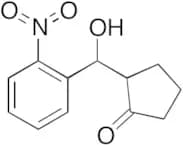
CAS:Controlled Product<p>Applications (±)-Betaxolol-d7 HCl (iso-propyl-d7) (CAS# 1219802-92-2) is a useful isotopically labeled research compound.<br></p>Formula:C18H23D7ClNO3Color and Shape:NeatMolecular weight:350.932-(Hydroxy-(2-nitrophenyl)methyl)cyclopentanone
CAS:Controlled ProductFormula:C12H13NO4Color and Shape:NeatMolecular weight:235.236[1,1'-Binaphthalene]-2,2'-dicarboxylic Acid
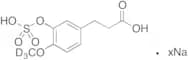
CAS:Controlled ProductFormula:C22H14O4Color and Shape:NeatMolecular weight:342.35Dihydro Isoferulic Acid-d3 3-O-Sulfate Sodium Salt
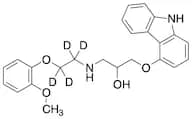
CAS:Controlled Product<p>Applications Labelled Dihydroisoferulic Acid 3-O-Sulfate, the sulfate conjugate of Dihydroisoferulic Acid (H946365). Dihydroisoferulic Acid 3-O-Sulfate is a minor circulating metabolite in human plasma after coffee consumption.<br>References Fumeaux, R. et al.: Org. Biomol. Chem., 8, 5199 (2010); Redeuil, K. et al.: J. Chrom. A, 1218, 4678 (2011);<br></p>Formula:C10H9D3O7S·xNaColor and Shape:NeatMolecular weight:279.28(±)-Carvedilol-d4 (ethyl-d4)
CAS:Controlled Product<p>Applications (±)-Carvedilol-d4 (ethyl-d4) (CAS# 1133705-56-2) is a useful isotopically labeled research compound.<br></p>Formula:C24H22D4N2O4Color and Shape:NeatMolecular weight:410.512,4-Hexadecadienoic acid
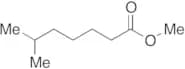
CAS:Controlled Product<p>Applications 2,4-Hexadecadienoic acid has been used as a compound for the study of Langmuir’s monolayer behaviour in an air/water interface.<br>References Lee, K.J., et al.: Macromolecular Reports, A30, 101-9 (1993)<br></p>Formula:C16H28O2Color and Shape:NeatMolecular weight:252.3926-Methylheptanoic Acid Methyl Ester
CAS:Controlled ProductFormula:C9H18O2Color and Shape:NeatMolecular weight:158.238Dapoxetine-d6 Hydrochloride
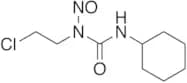
CAS:Controlled Product<p>Applications Labelled Dapoxetine (D185700). Selective serotonin reuptake inhibitor (SSRI).<br>References Feret, B., et al.: Formulary, 40, 227 (2005),<br></p>Formula:C21H18D6ClNOColor and Shape:NeatMolecular weight:347.91Lomustine
CAS:Controlled Product<p>Applications Chloroethylnitrosourea derivative with antitumor activity. Similar to carmustine, chlorozotocin, nimustine, ranimustine. Antineoplastic.<br> Not a dangerous good if item is equal to or less than 1g/ml and there is less than 100g/ml in the package<br>References Johnston, T.P., et al.: J. Med. Chem., 9, 892 (1966), Oliverio, V.T., et al.: Cancer Res., 30, 1330 (1970), Thompson, G.R., et al.: Toxicol. Appl. Pharmacol., 21, 405 (1972), Al-Shammary, F.J., et al.: Anal. Profiles Drug Subs., 19, 315 (1990),<br></p>Formula:C9H16ClN3O2Color and Shape:NeatMolecular weight:233.706-Chloro-2-(4-chlorophenyl)imidazo[1,2-a]pyridine-3-acetamide
CAS:Controlled Product<p>Applications A metabolite of Alpidem.<br>References Padovani, P., et al.: Eur. J. Drug Metab. Pharmacokinetics, 12, 295 (1987).<br></p>Formula:C15H11Cl2N3OColor and Shape:NeatMolecular weight:320.17




![[1,1'-Binaphthalene]-2,2'-dicarboxylic Acid](/_next/image/?url=https%3A%2Fstatic.cymitquimica.com%2Fproducts%2FTR%2Fthumb-webp%2FB387080.webp&w=3840&q=75)


![6-Chloro-2-(4-chlorophenyl)imidazo[1,2-a]pyridine-3-acetamide](/_next/image/?url=https%3A%2Fstatic.cymitquimica.com%2Fproducts%2FTR%2Fthumb-webp%2FC365610.webp&w=3840&q=75)