Glycoscience
Glycoscience is the study of carbohydrates and their derivatives, as well as the interactions and biological functions they participate in. This field of research is crucial for understanding a wide variety of biological processes, including cell recognition, signaling, immune response, and disease development. Glycoscience has important applications in biotechnology, medicine, and the development of new drugs and therapies. At CymitQuimica, we offer a wide selection of high-quality, high-purity products for glycoscience research. Our catalog includes monosaccharides, oligosaccharides, polysaccharides, glycoconjugates, and specific reagents, designed to support researchers in their studies on the structure, function, and applications of carbohydrates in biological systems. These resources are intended to facilitate scientific discoveries and practical applications in various areas of bioscience and medicine.
Subcategories of "Glycoscience"
- Aminosugars(108 products)
- Glyco-Related Antibodies(282 products)
- Glycolipids(46 products)
- Glycosaminoglycans (GAGs)(55 products)
- Glycosides(419 products)
- Monosaccharides(6,622 products)
- Oligosaccharides(3,682 products)
- Polysaccharides(503 products)
Found 11041 products of "Glycoscience"
Sort by
Purity (%)
0
100
|
0
|
50
|
90
|
95
|
100
(3R, 4R, 5R) -3, 4- Dihydroxy- 5- (hydroxymethyl) - L- proline
CAS:<p>The chemical compound (3R, 4R, 5R) -3, 4- Dihydroxy-5-(hydroxymethyl)-L-proline is a synthetic amino acid that contains a methyl group at the C4 position. It has been shown to have antiinflammatory and analgesic effects in animal models. The synthesis of this compound has been reported in the journal Tetrahedron. This compound is also an intermediate for the synthesis of other compounds that contain fluorine atoms.</p>Purity:Min. 95%3,4,6-Tri-O-acetyl-2-deoxy-2-fluoro-D-mannopyranosyl fluoride
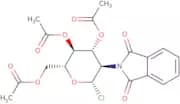
CAS:<p>3,4,6-Tri-O-acetyl-2-deoxy-2-fluoro-D-mannopyranosyl fluoride is an Oligosaccharide that can be used for Glycosylation. It's a sugar that is Synthetic and Fluorinated. This product has Custom synthesis and Methylation. It is a Monosaccharide and Polysaccharide. It is a saccharide that has been Click modified and it has a high purity of 99%. 3,4,6-Tri-O-acetyl-2-deoxy-2-fluoro-D-mannopyranosyl fluoride is CAS No. 29209981.</p>Formula:C12H16F2O7Purity:Min. 95%Color and Shape:PowderMolecular weight:310.25 g/molEthyl 2,3-di-O-benzyl-4,6-O-benzylidene-a-D-thiomannopyranoside
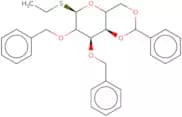
CAS:<p>Ethyl 2,3-di-O-benzyl-4,6-O-benzylidene-a-D-thiomannopyranoside is a custom synthesis of an oligosaccharide with a complex carbohydrate structure. It can be modified to suit customer specifications. This product has been fluorinated and is available in high purity. Ethyl 2,3-di-O-benzyl-4,6-O-benzylidene-a-D-thiomannopyranoside is a sugar that can be used for the synthesis of polysaccharides and saccharides. It has been synthesized by methylation and Click modification.</p>Formula:C29H32O5SPurity:Min. 95%Molecular weight:492.63 g/mol5-Alkynyl-L-fucose
CAS:<p>Inhibits GDP-4-keto-6-deoxymannose 3,5-epimerase-4-reductase (FX), which is required for the synthesis of GDP-Fuc. 5-alkynylfucose is also incorporated into the core glycan structures of the antibody. Thus, reduced concentration of endogenous substrates of fucosyltransferase 8 (FUT8) leads to reduced fucosylation of antibodies and increased therapeutic efficacy.</p>Formula:C7H10O5Purity:Min. 95%Color and Shape:PowderMolecular weight:174.15 g/molCMP-Neu5Ac sodium salt
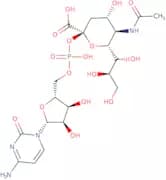
CAS:<p>CMP-Neu5Ac sodium salt (CMP-sialic acid) is a compound of the monosaccharide N-acetylneuraminic acid (Neu5Ac) O-linked with the nucleotide cytidine-5’-monophosphate (CMP). CMP-sialic acid is a substrate for sialyltransferases, which attach sialic acid to a growing oligosaccharide chain. This sugar nucleotide is produced in cytoplasm and then transported into Golgi lumen by a nucleotide-sugar transporter, where it is used in sialylation reactions on glycoproteins and glycolipids.</p>Formula:C20H30NaN4O16PPurity:(%) Min. 85.0%Color and Shape:White Off-White PowderMolecular weight:636.43 g/mol1-Deoxy-1-nitro-L-iditol hemihydrate
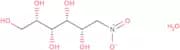
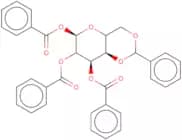
CAS:<p>1-Deoxy-1-nitro-L-iditol hemihydrate is a carbohydrate that has been modified with fluorination and methylation. It is used in the synthesis of oligosaccharides and sugars, as well as in the modification of complex carbohydrates. This product is also used for custom synthesis, glycosylation, and click chemistry. The purity of this product ranges from 98% to 100%.</p>Formula:C6H13NO7H2OPurity:Min. 95%Molecular weight:220.18 g/mol1,2,3-Tri-O-benzoyl-4,6-O-benzylidene-a-D-mannopyranose
<p>1,2,3-Tri-O-benzoyl-4,6-O-benzylidene-a-D-mannopyranose is a synthetic carbohydrate that has been modified with fluorine. It is a complex carbohydrate that has been designed to have high purity and custom synthesis. This product also contains methylation and glycosylation modifications. 1,2,3-Tri-O-benzoyl-4,6-O-benzylidene-a-D -mannopyranose can be used in the synthesis of oligosaccharides and polysaccharides for research purposes.</p>Formula:C34H28O9Purity:Min. 95%Molecular weight:580.58 g/mol2,5-Anhydro-3-deoxy-6-O-methyl-4-O-tert.butyldimethylsilyl-L-arabino-hexonic acid methyl ester
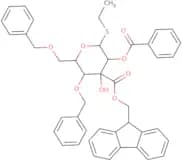
<p>2,5-Anhydro-3-deoxy-6-O-methyl-4-O-tert.butyldimethylsilyl-L-arabinohexonic acid methyl ester (2,5Anh3DMA) is a custom synthesis that is used as an intermediate for the preparation of oligosaccharides and polysaccharides. This compound has a CAS number of 51357-61-1 and is soluble in water. 2,5Anh3DMA can be modified with different groups such as methylation, glycosylation, or fluorination to produce desired products. It can be synthesized by the click reaction between an acetaldehyde and a silyl enolate.</p>Purity:Min. 95%Ethyl 2-O-benzoyl-4,6-di-O-benzyl-3-Fmoc-b-D-thiogalactopyranoside
CAS:<p>Ethyl 2-O-benzoyl-4,6-di-O-benzyl-3-Fmoc-b-D-thiogalactopyranoside is a synthetic monosaccharide with a benzoyl protecting group. It belongs to the class of saccharides and is used in the synthesis of oligosaccharides, which are carbohydrates consisting of two or more simple sugars. The chemical name for this compound is 3-(2'-benzoyloxy)-2'-deoxygalactose. This product can be custom ordered in high purity and has been modified with methylation and glycosylation.</p>Purity:Min. 95%trans,trans-3,4-Dihydroxy-D-proline
<p>Trans,trans-3,4-Dihydroxy-D-proline is a custom synthesis that has been fluorinated and methylated. It is a polysaccharide with a sugar backbone of an oligosaccharide or saccharide. The carbons in the backbone are connected by glycosylation to form a complex carbohydrate. This product has CAS No.</p>Purity:Min. 95%5,6-O-Isopropylidene-L-ascorbic acid
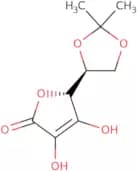
CAS:<p>5,6-O-Isopropylidene-L-ascorbic acid is an access to the vitamin C molecule. It can be synthesized from L-ascorbic acid by reacting with isopropyl iodide and hydrochloric acid. Cryo-electron microscopy has been used to identify the location of 5,6-O-Isopropylidene-L-ascorbic acid in human ganglion cells. This compound has a number of physiological activities and is one of the most powerful antioxidants found in humans. 5,6-O-Isopropylidene-L-ascorbic acid is a precursor to retinoic acid and hydrogen chloride, which are important for erythropoietin production in the kidneys. Dehydroascorbate (DHA) is formed when 5,6-O-Isopropylidene-L-ascorbic acid reacts with hydrogen chloride. D</p>Formula:C9H12O6Purity:Min. 95%Molecular weight:216.19 g/mol1,2,3,4,6-Penta-O-acetyl-5-thio-D-galactose
<p>1,2,3,4,6-Penta-O-acetyl-5-thio-D-galactose is a fluorinated monosaccharide that is synthesized by the reaction of 1,2,3,4,6-penta-O-acetyl-D-galactose with sodium hypochlorite in the presence of sodium bicarbonate. This compound has been shown to be an excellent substrate for glycosylation reactions and can be used as a sugar donor in polysaccharide synthesis. 1,2,3,4,6 penta O acetyl 5 thio D galactose can also be methylated with dimethylsulfoxide and trimethylsilyl chloride to form the corresponding methylated derivative. This product is available at high purity levels and CAS No. 68713-89-1.END></p>Formula:C16H22O10SPurity:Min. 95%Molecular weight:406.41 g/moliminosugar 1
<p>Iminosugar 1 is a fluorinated saccharide that belongs to the group of carbohydrates. It is synthesized by the modification of glucose with a fluorine atom. This modification prevents crystallization and increases solubility in water. Iminosugar 1 has been modified by methylation and glycosylation to increase its stability. This product is available as a custom synthesis, and has high purity.</p>Purity:Min. 95%2,3,4,6-Tetra-O-acetyl-D-mannopyranosyl fluoride
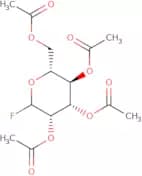
CAS:<p>2,3,4,6-Tetra-O-acetyl-D-mannopyranosyl fluoride is a methylated, fluorinated oligosaccharide. It is a custom synthesis and can be used as a monosaccharide to modify polysaccharides or saccharides. The modification of the sugar with 2,3,4,6-Tetra-O-acetyl-D-mannopyranosyl fluoride increases the water solubility of the complex carbohydrate and its ability to be synthesized into other compounds. This product is high purity and has been modified with fluorine for better stability.</p>Formula:C14H19FO9Purity:Min. 95%Molecular weight:350.29 g/molMethyl 3-O-benzyl-D-glucopyranoside
CAS:<p>Methyl 3-O-benzyl-D-glucopyranoside is a custom synthesis. It is a complex carbohydrate that is an oligosaccharide, polysaccharide, and modified saccharide. Methyl 3-O-benzyl-D-glucopyranoside can be synthesized from glucose with the use of methylation, glycosylation, or carbonylation reactions. The product has been fluorinated to yield a high purity product. This product can be used for click modifications or sugar chemistry experiments.</p>Purity:Min. 95%D-Glucuronic acid methyl ester
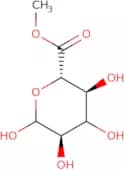
CAS:<p>D-Glucuronic acid methyl ester is an acidic, carbohydrate-binding molecule. It has been shown to bind to sugar residues in proteins and form covalent linkages with ester linkages. D-Glucuronic acid methyl ester has also been shown to be effective for the treatment of pentosan polysulfate sodium (PPS) induced inflammation in animal models. D-Glucuronic acid methyl ester binds to the monoclonal antibodies that are used for structural analysis of glycosidic bonds and oligosaccharides. The hydroxyl group on the molecule can form hydrogen bonds with other molecules, which may explain its usefulness as a magnetic resonance spectroscopy probe.</p>Formula:C7H12O7Purity:Min. 90 Area-%Color and Shape:Yellow PowderMolecular weight:208.17 g/mol4-Iodophenyl 2-acetamido-3,4,6-tri-O-acetyl-2-deoxy-b-D-glucopyranoside
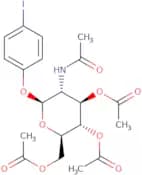
CAS:<p>4-Iodophenyl 2-acetamido-3,4,6-tri-O-acetyl-2-deoxy-b-D-glucopyranoside is a white crystalline powder. It is a glycosylation product of 4-(iodophenyl)-2-(acetamido)-3,4,6,-triacetylaminohexose. This compound can be used for the synthesis of complex carbohydrates and saccharides. This compound is also used in the modification of polysaccharides and oligosaccharides. The purity of this compound is greater than 98%.</p>Formula:C20H24INO9Purity:Min. 95%Color and Shape:PowderMolecular weight:549.31 g/molN-[2-(4'-Methoxyphenyl)-1-cyano-3-butene)-2,3,4,6-tetra-O-pivaloyl-D-glucopyranoside
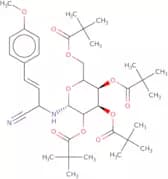
<p>N-[2-(4'-Methoxyphenyl)-1-cyano-3-butene)-2,3,4,6-tetra-O-pivaloyl-D-glucopyranoside is a modification of a complex carbohydrate. It has a CAS No. and is made synthetically with high purity. It is also a monosaccharide that has been methylated and glycosylated. This product is fluorinated and saccharide.</p>Formula:C37H54N2O10Purity:Min. 95%Molecular weight:686.83 g/molNeoagarotetraose
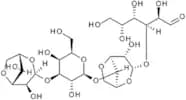
CAS:<p>Agarose is a polysaccharide found in red algae, typically Gelidium and Gracilaria. It is a strictly alternating polysaccharide of α-1,3 linked D-galactose and β-1,4 linked L-3,6 anhydrogalactose with occasional sulfation at position 6 of the anhydrogalactose residue. Agaro-oligosaccharides result from cleavage at galactose residues and neoagaro-oligosaccharides from cleavage at 3,6-anhydro residues. Neoagarotetraose is reported to have potential for novel cosmeceuticals.</p>Formula:C24H38O19Purity:Min. 98 Area-%Color and Shape:White PowderMolecular weight:630.55 g/mol1, 4:3, 6- Dianhydro-D- iditol
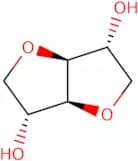
CAS:<p>1,4:3,6-Dianhydro-D-iditol is an organic compound. It is the L-enantiomer of 1,4:3,6-dianhydro-L-iditol. This compound can be used as a substrate for the cytochrome P450 system and soluble guanylate cyclase. 1,4:3,6-Dianhydro-D-iditol has been shown to have an inhibitory effect on both tissues and guanylate cyclase in vitro. This compound also inhibits the production of reactive oxygen species by oxidases.</p>Formula:C6H10O4Purity:Min. 95%Molecular weight:146.14 g/mol