Glycoscience
Glycoscience is the study of carbohydrates and their derivatives, as well as the interactions and biological functions they participate in. This field of research is crucial for understanding a wide variety of biological processes, including cell recognition, signaling, immune response, and disease development. Glycoscience has important applications in biotechnology, medicine, and the development of new drugs and therapies. At CymitQuimica, we offer a wide selection of high-quality, high-purity products for glycoscience research. Our catalog includes monosaccharides, oligosaccharides, polysaccharides, glycoconjugates, and specific reagents, designed to support researchers in their studies on the structure, function, and applications of carbohydrates in biological systems. These resources are intended to facilitate scientific discoveries and practical applications in various areas of bioscience and medicine.
Subcategories of "Glycoscience"
- Aminosugars(108 products)
- Glyco-Related Antibodies(282 products)
- Glycolipids(46 products)
- Glycosaminoglycans (GAGs)(55 products)
- Glycosides(419 products)
- Monosaccharides(6,622 products)
- Oligosaccharides(3,682 products)
- Polysaccharides(503 products)
Found 11041 products of "Glycoscience"
Sort by
Purity (%)
0
100
|
0
|
50
|
90
|
95
|
100
Man6GlcNAc(II)
<p>High mannose oligosaccharide found in urine of mannosidosis patients</p>Formula:C44H75NO36Purity:Min. 95%Color and Shape:PowderMolecular weight:1,194.05 g/mol3'-(D-[UL-13C6]Galactosyl)lactose
CAS:<p>Galactosyllactose attenuated NF-κB inflammatory signaling in human intestinal epithelial cells and in human immature intestine. Thus, galactosyllactoses are strong anti-inflammatory agents in human colostrum and early milk, contributing to innate immune modulation. This product has a 13C heavy-label and so can be used in applications such as metabolic tracing and quantitative mass spectrometry.</p>Formula:C6C12H32O16Purity:Min. 90 Area-%Color and Shape:PowderMolecular weight:510.46 g/mol1,2,3,5-Tetra-O-acetyl-β-D-ribofuranose
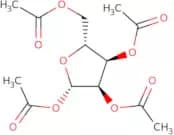
CAS:<p>Important resource for RNA- and DNA-related syntheses including ribosylation</p>Formula:C13H18O9Purity:Min. 95%Color and Shape:White PowderMolecular weight:318.28 g/molb-Chloralose
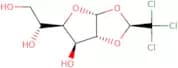
CAS:<p>b-Chloralose is a general anesthetic that is used to induce and maintain anesthesia. It has been shown to decrease the heart rate, respiratory rate, and blood pressure in patients. It also causes a reduction of the glomerular filtration rate and delays the recovery of consciousness. Although b-chloralose has been shown to have negative effects on the cardiovascular system, it can be administered safely in combination with other anesthetics because it does not alter their effects. The use of b-chloralose is limited by its short duration of action and by adverse reactions such as nausea, vomiting, and convulsions.</p>Formula:C8H11Cl3O6Purity:Min. 95%Color and Shape:PowderMolecular weight:309.53 g/mol1,2-Di-O-acetyl-3,4,6-tri-O-benzyl-b-D-galactopyranoside
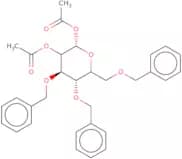
CAS:<p>1,2-Di-O-acetyl-3,4,6-tri-O-benzyl-b-D-galactopyranoside is a synthetic glycosylate sugar. It is a high purity material that can be custom synthesized to meet your needs. This product has been modified with a fluorine atom at the 3' position of the sugar. It is an Oligosaccharide that is useful in the synthesis of complex carbohydrates. It is also used in Click chemistry and can be methylated or acetylated.</p>Formula:C31H34O8Purity:Min. 95%Color and Shape:White PowderMolecular weight:534.6 g/molN-[2-(4'-Fluorobenzylacetonitrile)]-2,3,4,6-tetra-O-pivaloyl-b-D-glucopyranoside
<p>This product is a custom synthesis. It is a complex carbohydrate with a CAS No., Polysaccharide, Modification, saccharide, Methylation, Glycosylation, Click modification and Carbohydrate. It is a sugar with high purity and Fluorination. The product has been synthetically made.</p>Formula:C34H49FN2O9Purity:Min. 95%Molecular weight:648.76 g/mol2,3,4,6-Tetra-O-benzyl-D-galactopyranose
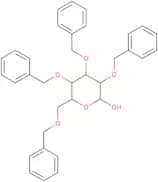
CAS:<p>2,3,4,6-Tetra-O-benzyl-D-galactopyranose is a building block which can be used as both a galactosyl donor and acceptor in the synthesis of saccharides. The benzyl protecting groups can be readily and selectively cleaved but are stable to a variety of reaction conditions allowing chemical manipulations to be carried out on the rest of the saccharide. 2,3,4,6-Tetra-O-benzyl-D-galactopyranose has been used in the synthesis of potential cholera toxin inhibitors, analogues of α-galactosyl ceramide (iNKT agonist) and more recently in the synthesis of Scleropentaside A.</p>Formula:C34H36O6Purity:Min. 98 Area-%Color and Shape:White PowderMolecular weight:540.65 g/mol2-Acetamido-2-deoxy-6-O-(a-L-fucopyranosyl)-D-glucopyranose
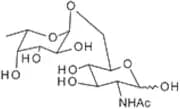
CAS:<p>Adhesion molecule in eukaryotic-bacterial cell interactions</p>Formula:C14H25NO10Purity:Min. 95%Color and Shape:White PowderMolecular weight:367.35 g/mol5-O-Benzyl-D-ribose
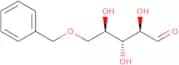
CAS:<p>5-O-Benzyl-D-ribose is an enantiomer of D-ribose. It has been used as an antiperspirant, although it does not stop the formation of sweat, but rather reduces the amount of perspiration. 5-O-Benzyl-D-ribose is also used in the synthesis of deodorants and enantiomers for optically active pharmaceuticals. The configurations are determined by the configuration of the substituents on the benzene ring and can be either R or S. The configurations can be separated into two groups:</p>Formula:C12H16O5Purity:Min. 95%Color and Shape:PowderMolecular weight:240.25 g/molHyaluronate rhodamine - Molecular Weight - 50kDa
<p>Hyaluronate Rhodamine is a molecule that has been modified with a fluorescent dye. Hyaluronate Rhodamine is a complex carbohydrate that has been synthesized using monosaccharides, methylation, glycosylation, and polysaccharide synthesis. It is used in the study of molecular interactions due to its high purity and fluorescence properties.</p>Purity:Min. 95%L-Arabonic acid-1,4-lactone
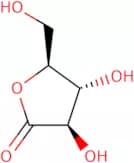
CAS:<p>L-Arabonic acid-1,4-lactone (LL) is the product of the reaction between L-arabinose and trifluoroacetic acid. LL is an enantiomer of D-arabinose and has a pK a of 6.5, which makes it a weak base. This compound has been shown to be a hydroxyl group donor in human liver and is also used as a chaperone for protein folding.</p>Formula:C5H8O5Purity:Min. 95%Color and Shape:White PowderMolecular weight:148.11 g/mol1,2,3,4-Tetra-O-acetyl-6-O-trityl-b-D-galactopyranose
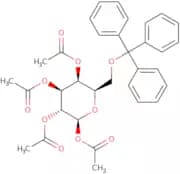
CAS:<p>1,2,3,4-Tetra-O-acetyl-6-O-trityl-b-D-galactopyranose is a high purity glycosylation product. It has been custom synthesized and modified with Methylation, Click modification, Polysaccharide and Fluorination. The CAS number of this compound is 124648-92-6.</p>Formula:C33H34O10Purity:Min. 95%Molecular weight:590.62 g/molKojitriose
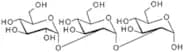
CAS:<p>Kojitriose is a disaccharide composed of two glucose molecules. It has been shown to have insulin-sensitizing effects in animals and humans. Kojitriose binds to the surface of Streptococcus faecalis and prevents the growth of this bacteria. Kojitriose also has an inhibitory effect on mesenteroides, which are a type of bacterium found in the human gut. This disaccharide is enzymatically hydrolyzed to produce hydrogen fluoride, which inhibits the growth of Streptococcus faecalis and mesenteroides. The enzyme trehalase is responsible for this hydrolysis reaction, while hydroxyl groups act as nucleophiles that react with chloride ions to form hydrogen fluoride.</p>Formula:C18H32O16Purity:Min. 95%Color and Shape:PowderMolecular weight:504.44 g/molα-Chloralose
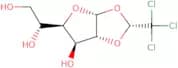
CAS:<p>Anesthetic used in laboratory animal studies; pesticide</p>Formula:C8H11Cl3O6Purity:Min. 95%Color and Shape:PowderMolecular weight:309.53 g/molk-Carrahexaitol trisulfate trisodium salt
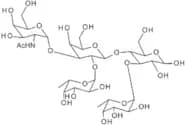
<p>k-carrageenan derived hexasaccharide alcohol trisulfate+(3-6 anhydrogalactose)</p>Formula:C36H55O37S3Na3Purity:Min. 95%Molecular weight:1,244.97 g/molBlood Group A pentasaccharide
CAS:<p>Core antigen fragment in ABO blood group system</p>Formula:C32H55NO24Purity:Min. 95%Color and Shape:White PowderMolecular weight:837.77 g/mol1,2-O-IIsopropylidene -b- L- idofuranuronic acid g- lactone
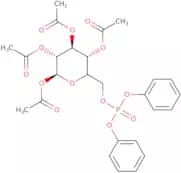
<p>1,2-O-IIsopropylidene -b- L- idofuranuronic acid g- lactone is a fluorinated monosaccharide that is synthesized from the glycosylation of erythritol and glycerol. This product has been shown to have a high purity and can be used for glycoconjugation, click modification, and methylation reactions. It has a CAS number of 638984-63-7.</p>Purity:Min. 95%1,2,3,4-Tetra-O-acetyl-6-diphenylphosphoryl-b-D-mannopyranose
CAS:<p>This product is custom synthesized. The synthesis of this product was accomplished by modification, fluorination, methylation and monosaccharide synthesis. It is a synthetic oligosaccharide that has been modified with click chemistry. This product is made up of saccharides in a glycosylation configuration. It is a complex carbohydrate that contains sugar units in various configurations. This product has high purity and can be used as an intermediate for the synthesis of other products.</p>Formula:C26H29O13PPurity:Min. 95%Color and Shape:White PowderMolecular weight:580.47 g/molD-Glucosamine-6-O-sulphate
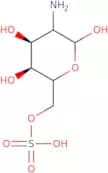
CAS:<p>D-Glucosamine-6-O-sulphate is a disaccharide that is a component of heparin. The molecular docking analysis of this drug with the target proteins, d-glucosamine 6-O-sulphate and l-iduronic acid, has been performed using the protein data sets from proteomics. D-Glucosamine-6-O-sulphate has been found to be related to psoriasis patients in urine samples. The macroscopic and microscopic structure of this drug was also studied and characterized by liquid chromatography.</p>Formula:C6H13NO8SPurity:Min. 95 Area-%Color and Shape:White PowderMolecular weight:259.23 g/mol1,3:4,6-Di-O-benzylidene-D-mannitol
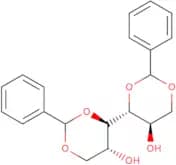
CAS:<p>1,3:4,6-Di-O-benzylidene-D-mannitol is a chiral sugar that is synthesized from d-mannitol. It is used for the preparation of polymers with acrylonitrile and phosphine. 1,3:4,6-Di-O-benzylidene-D-mannitol can be obtained by copolymerizing the monomers d-mannitol and acrylonitrile in an enantioselective manner. The yield of this compound depends on the analytical methods used to determine the composition of the polymer. The product is also used as a ligand in metal hydrides and simplifies the synthesis of chiral methyl esters.</p>Formula:C20H22O6Purity:Min. 95%Color and Shape:PowderMolecular weight:358.39 g/mol
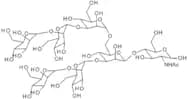

![3'-(D-[UL-13C6]Galactosyl)lactose](/_next/image/?url=https%3A%2Fstatic.cymitquimica.com%2Fproducts%2F3D%2Fthumb-webp%2FOG15068.webp&w=3840&q=75)
![N-[2-(4'-Fluorobenzylacetonitrile)]-2,3,4,6-tetra-O-pivaloyl-b-D-glucopyranoside](/_next/image/?url=https%3A%2Fstatic.cymitquimica.com%2Fproducts%2F3D%2Fthumb-webp%2FMF08491.webp&w=3840&q=75)