Glycoscience
Glycoscience is the study of carbohydrates and their derivatives, as well as the interactions and biological functions they participate in. This field of research is crucial for understanding a wide variety of biological processes, including cell recognition, signaling, immune response, and disease development. Glycoscience has important applications in biotechnology, medicine, and the development of new drugs and therapies. At CymitQuimica, we offer a wide selection of high-quality, high-purity products for glycoscience research. Our catalog includes monosaccharides, oligosaccharides, polysaccharides, glycoconjugates, and specific reagents, designed to support researchers in their studies on the structure, function, and applications of carbohydrates in biological systems. These resources are intended to facilitate scientific discoveries and practical applications in various areas of bioscience and medicine.
Subcategories of "Glycoscience"
- Aminosugars(108 products)
- Glyco-Related Antibodies(282 products)
- Glycolipids(46 products)
- Glycosaminoglycans (GAGs)(55 products)
- Glycosides(419 products)
- Monosaccharides(6,622 products)
- Oligosaccharides(3,682 products)
- Polysaccharides(503 products)
Found 11041 products of "Glycoscience"
Sort by
Purity (%)
0
100
|
0
|
50
|
90
|
95
|
100
m-Methoxytopolin-9-glucoside
CAS:<p>M-methoxytopolin-9-glucoside is a synthetic oligosaccharide that has been modified with fluorination and methylation. It is an important intermediate for the synthesis of complex carbohydrates. M-methoxytopolin-9-glucoside can be used in the production of glycosylated polysaccharides, including glycoproteins, proteoglycans, and mucopolysaccharides. This product is offered at a purity level of > 98% and can be used for custom synthesis.</p>Formula:C19H23N5O6Purity:Min. 95%Molecular weight:417.42 g/mol2-Acetamido-3,4,6-tri-O-acetyl-2-deoxy-a-D-galactopyranosyl-(N-Fmoc)-L-serine pentafluorophenyl ester
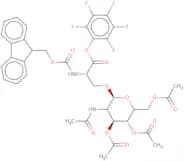
CAS:<p>The 2-acetamido-3,4,6-tri-O-acetyl-2-deoxy-a-D-galactopyranosyl-(N-Fmoc)-L-serine pentafluorophenyl ester is a synthetic sugar that has been modified using the Click chemistry. It is a complex carbohydrate that can be used in the synthesis of oligosaccharides and polysaccharides. This product is custom synthesized to order and has high purity. The 2AA3TA2DO6TFA2DGA2DGAPFPE2SAR2LSE5 is an oligosaccharide with a monosaccharide at the reducing end and methylated at the nonreducing end. The 2AA3TA2DO6TFA2DGA2DGAPFPE2SAR2LSE5 has been fluorinated at the saccharide position on the nonreducing end</p>Formula:C38F5H35N2O13Purity:Min. 95%Molecular weight:822.69 g/mola-Tetrasaccharide-APE-KLH
<p>a-Tetrasaccharide-APE-KLH is a modification of the original tetrasaccharide APE-KLH conjugate. This modified conjugate has increased stability and higher binding affinity to the Fc receptor, which is required for antibody therapy. It is synthesized by custom synthesis and has high purity, with a CAS number of 674797-36-5. The monosaccharides in this conjugate are methylated and glycosylated, with a molecular weight of 1254. The saccharides are fluorinated and saccharide with a molecular weight of 1354.</p>Purity:Min. 95%N-Glycolyl GM1 ganglioside
<p>N-Glycolyl GM1 ganglioside has a core tetrasaccharide structure (Galβ1,3GalNAcβ1,4Galβ1,4Glc) with N-glycolyl sialic acid linked α2,3 to the central galactose residu,e and ceramide linked β to position 1 on the reducing terminal glucose residue (Ledeen, 2009). SV40, Py, and the human BK viruses are unusual among viruses in that they use glycolipids as their major cell surface receptors. SV40 uses the N-glycolylneuraminic acid (NeuGc) analog of the ganglioside GM1 [GM1(Gc)] as the cell surface receptor and it gave markedly stronger binding signals than the NeuAc analog [GM1(Ac)] (Campanero-Rhodes, 2007).</p>Purity:Min. 95%Gemfibrozil b-D-glucuronide-D6
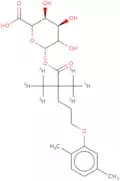
Controlled Product<p>Gemfibrozil b-D-glucuronide-D6 is a methylated, saccharide, Polysaccharide. It is a custom synthesis of the synthetic and fluorinated gemfibrozil b-D-glucuronide. The product is purified by HPLC to >98% purity and supplied as a white powder.</p>Formula:C21H24D6O9Purity:Min. 95%Color and Shape:White to off-white solid.Molecular weight:432.49 g/molMethyl 4-azido-3-O-benzyl-4,6-dideoxy-2-O-methyl-a-D-glucopyranoside
CAS:<p>Methyl 4-azido-3-O-benzyl-4,6-dideoxy-2-O-methyl-a-D-glucopyranoside is a synthetic sugar that has been modified with azide and fluoride. It may be used in the synthesis of saccharides as a monosaccharide or oligosaccharide. This compound can be used to prepare glycosylation derivatives, which are complex carbohydrates that are important for cell recognition and immune system function.</p>Formula:C15H21N3O4Purity:Min. 95%Molecular weight:307.35 g/molEthyl 4-O-allyl-3,6-di-O-benzyl-2-O-levulinoyl-b-D-thioglucopyranoside
<p>Ethyl 4-O-allyl-3,6-di-O-benzyl-2-O-levulinoyl-b-D-thioglucopyranoside is a carbonylated sugar. It is used as an intermediate in the synthesis of glycosides and saccharides. This chemical can be custom synthesized to meet your requirements. Ethyl 4-O-allyl-3,6-di-O-benzyl 2,5,6 trideoxygalactoside can be methylated, glycosylated, or fluorinated to produce different derivatives.</p>Purity:Min. 95%D-Galactosamine-2-N-sulfate sodium
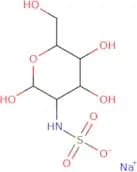
CAS:<p>D-Galactosamine-2-N-sulfate sodium is a chemical compound with potential applications in cancer treatment. It has been shown to enhance the cytotoxic effects of certain drugs, such as Tolvaptan and Luliconazole, in human cancer cells. Additionally, D-Galactosamine-2-N-sulfate sodium has been reported to inhibit kinase activity in Staphylococcus aureus and induce apoptosis in cancer cells. This compound may also have potential as an inhibitor of betamethasone-induced apoptosis and as an analog of cytisine and gossypol. Further research is needed to fully understand the potential therapeutic benefits of D-Galactosamine-2-N-sulfate sodium for cancer treatment.</p>Formula:C6H12NNaO8SPurity:Min. 95%Molecular weight:281.22 g/molL-[2-13C]Xylose
CAS:<p>Please enquire for more information about L-[2-13C]Xylose including the price, delivery time and more detailed product information at the technical inquiry form on this page</p>Formula:C5H10O5Purity:Min. 95%Molecular weight:151.12 g/molR-Phenyleprine-3-D-glucuronide
<p>R-Phenyleprine-3-D-glucuronide is a synthetic compound that is used for the modification of saccharides. It has fluoro groups and has been shown to be active in glycosylation reactions. R-Phenyleprine-3-D-glucuronide can also be used as a methylating agent, or as an intermediate in the synthesis of oligosaccharides and monosaccharides. The molecular weight of this compound is 594.</p>Purity:Min. 95%Hyaluronate fluorescein - Molecular Weight - 2500kDa
<p>Hyaluronate fluorescein is a polymer of hyaluronic acid that has been modified with fluorescein. It is synthesized by the methylation and saccharide coupling of an oligosaccharide, followed by Click modification and the addition of a fluorescent dye. Hyaluronate fluorescein has a molecular weight of 2500kDa. It is highly purified and can be custom-synthesized to suit specific needs.</p>Purity:Min. 95%Color and Shape:PowderMethyl N-trifluoroacetyldaunosaminide
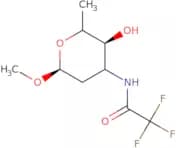
CAS:<p>Methyl N-trifluoroacetyldaunosaminide is a naturally occurring amino sugar that has been shown to have biological relevance. It has been shown to inhibit the activity of bacterial enzymes, such as daunosamine reductase and daunosamine kinase, which are involved in the biosynthesis of anthracyclines in bacteria. The structural analogues of methyl N-trifluoroacetyldaunosaminide have been shown to be effective against a range of Gram-positive and Gram-negative bacteria including Staphylococcus aureus, Mycobacterium tuberculosis, Mycobacterium avium complex and Pseudomonas aeruginosa.</p>Formula:C9H14F3NO4Purity:Min. 95%Molecular weight:257.21 g/molHyaluronate fluorescein - Molecular Weight - 1500kDa
<p>Hyaluronate fluorescein is a synthetic, high purity complex carbohydrate with a molecular weight of 1500kDa. It is a modification of the naturally occurring polysaccharide hyaluronan. It is composed of repeating units of the monosaccharide D-glucuronic acid and the disaccharide N-acetyl-D-glucosamine. Hyaluronate fluorescein is synthesized by methylation and glycosylation of D-glucuronic acid, followed by fluorination to produce the fluorinated saccharide hexafluoro-D-glucuronic acid, which reacts with N-acetyl-D-glucosamine in an amidation reaction. The product can then be modified to produce hyaluronate fluorescein.</p>Purity:Min. 95%2,4-Dideoxy-2,4-difluoro-D-galactose
<p>2,4-Dideoxy-2,4-difluoro-D-galactose is a high purity custom synthetic monosaccharide that is modified with fluorine. It has been synthesized by the methylation of 2,4-dideoxy-2,4-difluoroglucose followed by the click modification of the methyl group. This compound is a complex carbohydrate and an oligosaccharide. It can be used as an intermediate in the synthesis of polysaccharides and saccharides. 2,4-Dideoxy-2,4-difluoro D galactose has CAS No.: 157099-27-1.</p>Purity:Min. 95%2-Acetamido-2-deoxy-b-D-glucopyranosyl serine
<p>2-Acetamido-2-deoxy-b-D-glucopyranosyl serine is a carbohydrate that can be modified in many ways. It can be synthesized from D-glucose and acetamide, which are its only starting materials. The synthesis of 2-acetamido-2-deoxy-b -D -glucopyranosyl serine involves the use of fluoride as a reagent to introduce fluorine atoms at specific positions on the sugar molecule. This modification is used to create oligosaccharides or complex carbohydrates with unique chemical and biological properties. Click chemistry allows for the modification of 2-acetamido-2-deoxy-b -D -glucopyranosyl serine with methyl groups at specific positions on the sugar molecule. With this process, glycosylation reactions can be carried out with ease. 2 acetamido 2 deoxy b D glucopyranosyl serine has</p>Purity:Min. 95%Isopropyl-β-D-thioglucopyranoside
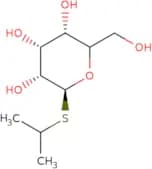
CAS:<p>Isopropyl-beta-D-thioglucopyranoside is a carbohydrate derivative that has the same chemical formula as glucose but with a different spatial arrangement. It is also known as beta-D-thioglucose or thioisopropylglucose, and it is an intermolecular hydrogen bond donor and acceptor. Isopropyl-beta-D-thioglucopyranoside absorbs light at wavelengths of 265 nm, 280 nm, and 320 nm. Carbohydrates are compounds containing carbon, hydrogen and oxygen atoms in a ratio of 1:2:1 by weight, with the general formula CHON. They consist of many isomers that differ from each other in the configurations of their carbonyl group and hydroxyl group. The molecular system for isopropyl-beta-D-thioglucopyranoside consists of one molecule with two hydrogen bonds to two other molecules.</p>Formula:C9H18O5SMolecular weight:238.3 g/mol2,3-O-Isopropylidene-1,5-di-O-toluoyl-b-D-ribofuranose
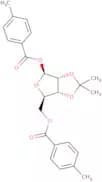
CAS:<p>2,3-O-Isopropylidene-1,5-di-O-toluoyl-b-D-ribofuranose (IPDT) is a saccharide that is modified with a methyl group at the 2' position of the ribose. This modification can be used to control the rate of glycosylation reactions, or to synthesize oligosaccharides and complex carbohydrates. IPDT is also an important precursor for click chemistry reactions, which are used in the synthesis of polymers and other organic compounds.</p>Formula:C24H26NO7Purity:Min. 95%Molecular weight:440.47 g/molMethyl 2,3,4-tri-O-acetyl-b-D-thiogalacturonide methyl ester
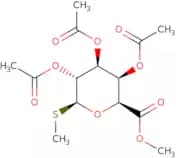
CAS:<p>Methyl 2,3,4-tri-O-acetyl-b-D-thiogalacturonide methyl ester is a modified carbohydrate that has been synthesized for use as a building block in the synthesis of complex carbohydrates. The compound is readily available and can be custom synthesized to meet your specifications. It is also available as a fluorinated form. This product is manufactured by a process called Click chemistry and it has been shown to have high purity, making it suitable for use in pharmaceuticals and other applications.</p>Formula:C14H20O9SPurity:Min. 95%Molecular weight:364.37 g/molMethyl 5,7,8,9-tetra-O-acetyl-4-acylamino-2,6-anhydro-3,4-dideoxy-D-glycero-D-galacto-2-enonate
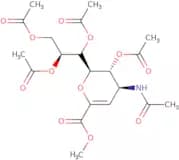
CAS:<p>Methyl 5,7,8,9-tetra-O-acetyl-4-acylamino-2,6-anhydro-3,4-dideoxy-D-glycero-D-galacto-2-enonate is a synthetic sugar that is used as a building block for the synthesis of polysaccharides. This compound can be modified with click chemistry and fluorination to create an array of possible saccharide structures. Methylated sugar derivatives are also used in custom synthesis applications.</p>Formula:C20H27NO12Purity:Min. 95%Molecular weight:473.43 g/mol


![L-[2-13C]Xylose](/_next/image/?url=https%3A%2Fstatic.cymitquimica.com%2Fproducts%2F3D%2Fthumb-webp%2FDUA50663.webp&w=3840&q=75)