Glycoscience
Glycoscience is the study of carbohydrates and their derivatives, as well as the interactions and biological functions they participate in. This field of research is crucial for understanding a wide variety of biological processes, including cell recognition, signaling, immune response, and disease development. Glycoscience has important applications in biotechnology, medicine, and the development of new drugs and therapies. At CymitQuimica, we offer a wide selection of high-quality, high-purity products for glycoscience research. Our catalog includes monosaccharides, oligosaccharides, polysaccharides, glycoconjugates, and specific reagents, designed to support researchers in their studies on the structure, function, and applications of carbohydrates in biological systems. These resources are intended to facilitate scientific discoveries and practical applications in various areas of bioscience and medicine.
Subcategories of "Glycoscience"
- Aminosugars(108 products)
- Glyco-Related Antibodies(282 products)
- Glycolipids(46 products)
- Glycosaminoglycans (GAGs)(55 products)
- Glycosides(419 products)
- Monosaccharides(6,622 products)
- Oligosaccharides(3,682 products)
- Polysaccharides(503 products)
Found 11041 products of "Glycoscience"
Sort by
Purity (%)
0
100
|
0
|
50
|
90
|
95
|
100
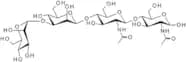
Man-2b N-Glycan
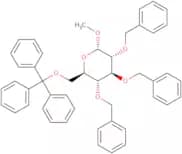
CAS:<p>Man-2b N-glycan is an acidic glycoprotein that is synthesized in the endoplasmic reticulum of mammalian cells. It is a precursor to the oligosaccharide terminal sugar, which connects the glycan to protein. Man-2b N-glycan plays an important role in metabolic disorders such as renal proximal tubule dysfunction and metabolic acidosis by regulating protein synthesis. The Man-2b N-glycan mutation has been shown to lead to changes in cell surface proteins and metabolism, which can be modeled using a glycosylation mutant strain of yeast.</p>Formula:C28H48N2O21Purity:Min. 95%Molecular weight:748.68 g/molMethyl 2,3,4-tri-O-benzyl-6-O-trityl-a-D-glucopyranoside
CAS:<p>Methyl 2,3,4-tri-O-benzyl-6-O-trityl-a-D-glucopyranoside is a modification of the sugar molecule. This modification process is completed by reacting the sugar with a derivative of benzyl alcohol. The result is an increase in the number of functional groups on the sugar molecule and a change in its physical properties. Methyl 2,3,4-tri-O-benzyl-6-O-trityl-a -D glucopyranoside has been used in the synthesis of oligosaccharides and polysaccharides.<br>Methyl 2,3,4 -tri -O -benzyl -6 -O -trityl--a D glucopyranoside is an organic compound that belongs to the class of carbohydrates. It is a white powder that contains water solubility and has a melting point of about 145°C. Methyl</p>Formula:C47H46O6Purity:Min. 95%Molecular weight:706.89 g/molMethylglycol chitosan
CAS:<p>Methylglycol chitosan is a cationic surfactant that has been shown to have the ability to bind with zirconium oxide and polymannuronic acid. It is used in the treatment of infectious diseases, autoimmune diseases, and histological analysis. Methylglycol chitosan has been shown to inhibit the toll-like receptor 4 (TLR4) from binding with lipopolysaccharides and other molecules that are implicated in autoimmune diseases. This binding also prevents TLR4 from activating other cells involved in inflammatory responses. The surface of methylglycol chitosan particles also have a patterning effect on bacteria by preventing them from adhering to the surface of the particle, reducing their virulence.</p>Purity:Min. 95%Azo-Xyloglucan
<p>Dyed and soluble azo-xyloglucan (tamarind) is used for the measurement of enzyme activity, research, biochemical enzyme assays and in vitro diagnostic analysis. It is a soluble chromogenic substrate for the assaying of endo-cellulase.</p>Purity:Min. 95%a1,6-Mannobiose-BSA
<p>a1,6-Mannobiose-BSA is a fluorinated monosaccharide that has been synthesized from mannose. It is a synthetic oligosaccharide that is used in glycosylation and polysaccharide modification. The compound has been modified with methyl groups and has undergone click chemistry to produce a reactive site on the sugar ring. This product has been synthesized using high purity reagents and has CAS No. 73978-99-2.</p>Purity:Min. 95%Neu5Acα(2-6)Galβ(1-4)GlcNAc-β-ethylamine
CAS:<p>Neu5Acα(2-6)Galβ(1-4)GlcNAc-β-ethylamine is a glycosylation agent that is used to modify complex carbohydrates, such as polysaccharides and oligosaccharides. This product is a custom synthesis, which may be modified according to customer specifications. These modifications include methylation, click modification, fluorination, and saccharide modification. The desired purity of this product can be determined by the level of fluorescence in the solution.</p>Formula:C27H47N3O19•NaPurity:Min. 95%Molecular weight:740.66 g/molLewis A tetrasaccharide-BSA
<p>Lewis A tetrasaccharide-BSA is a synthetic oligosaccharide complex carbohydrate. It is a high purity custom synthesis that has been modified with click chemistry, methylation, and fluorination. Lewis A tetrasaccharide-BSA is a glycosylated polysaccharide that has been shown to have antiviral activity against human cytomegalovirus. This product can be used in research as a model for studying the structure of glycoproteins, including their interactions with other molecules in biological systems.</p>Color and Shape:White Powder6-Chloro-6-deoxy-D-allitol
<p>6-Chloro-6-deoxy-D-allitol is a custom synthesis, complex carbohydrate that belongs to the group of oligosaccharides. It is an Oligosaccharide, which is a type of polymer containing a small number of monomer units. This product can be found in CAS No., Polysaccharide, Modification, saccharide, Methylation, Glycosylation, Click modification and Carbohydrate. This product has been modified using fluorination and it’s high purity with a purity greater than 95%.</p>Formula:C6H13ClO5Purity:Min. 95%Molecular weight:200.62 g/molMethyl 2,4-di-O-acetyl-b-D-xylopyranoside
CAS:<p>Methyl 2,4-di-O-acetyl-b-D-xylopyranoside (MDX) is an epoxide that has been found to stimulate the growth of Schizophyllum commune and other fungi. It is structurally related to vicinal diols, which are known to inhibit esterases and hydrolyze acetyl groups. The acetyl groups on MDX can be reduced by hydride reduction or by hydrolysis with acetylated esters. MDX inhibits bacterial growth by inhibiting protein synthesis through its structural similarity to deoxyribose phosphate, a component of DNA.</p>Formula:C10H16O7Purity:Min. 95%Molecular weight:248.2 g/mol1,3,4,5,6-Penta-O-acetyl-2-keto-D-fructose
CAS:<p>1,3,4,5,6-Penta-O-acetyl-2-keto-D-fructose is a custom synthesis of monosaccharide. It has been modified by fluorination and methylation. The CAS number for 1,3,4,5,6-Penta-O-acetyl-2-keto-D-fructose is 494828–55–6. This product is a saccharide that is a sugar with a complex carbohydrate structure.</p>Formula:C16H22O11Purity:Min. 95%Molecular weight:390.34 g/molTetradecasaccharide dp14
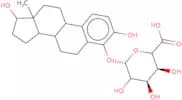
<p>Tetradecasaccharide dp14 is a custom-synthesized, fluorinated, methylated, and modified saccharide. Tetradecasaccharide dp14 has been shown to have a variety of biological activities that are dependent on the type of modification. For example, this compound inhibits the enzyme alpha-glucosidase in vitro and in vivo. This enzyme is responsible for breaking down complex carbohydrates into simple sugars. Tetradecasaccharide dp14 also has anti-inflammatory properties and can be used as an antifungal agent against Candida albicans.</p>Formula:C84H217N35O133S21Purity:Min. 95%Molecular weight:4,519.16 g/mol4-Hydroxyestradiol-4-O-b-D-glucuronide
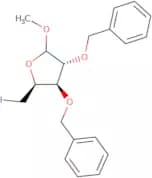
CAS:<p>4-Hydroxyestradiol-4-O-b-D-glucuronide is a custom synthesis of a sugar, Click modification, fluorination, glycosylation, synthetic, methylation, modification and oligosaccharide. It has CAS No. 90746-95-5. 4-Hydroxyestradiol-4-O-b-D-glucuronide is a saccharide with a complex carbohydrate structure.</p>Formula:C24H32O9Purity:Min. 95%Molecular weight:464.51 g/molMethyl 2,3-di-O-benzyl-5-deoxy-5-iodo-D-xylofuranoside
CAS:<p>Methyl 2,3-di-O-benzyl-5-deoxy-5-iodo-D-xylofuranoside is a sugar derivative that is a glycosylation product of the sugar xylose. It has been methylated and fluorinated to generate a complex carbohydrate. This product has been modified with click chemistry, which is a reaction that generates an alkyne on the C2 position of the xylose. The oligosaccharides were synthesized using custom synthesis and high purity was confirmed by HPLC analysis.</p>Purity:Min. 95%Man-3-Xyl-Fuc N-Glycan
<p>Man-3-Xyl-Fuc N-Glycan is a custom synthesis of mannose that has been modified with fucose and glycosylated with a conjugated xylose. This complex carbohydrate can be used in the manufacturing of pharmaceuticals, as well as in research for the production of biofuels.</p>Formula:C45H76N2O34Purity:Min. 95%Molecular weight:1,189.08 g/molXyloglucan
CAS:<p>Xyloglucans are members of a group of polysaccharides typically refered to as hemicelluloses. Hemicelluloses are plant cell wall polysaccharides that are not solubilized by water but are solubilized by aqueous alkali (e.g. 1 and 4M KOH). Other hemicellulosic polysaccharides include xylan, glucuronoxylan, arabinoxylan, mannan, glucomannan and galactoglucomannan. Hemicelluloses have a backbone of 1,4-linked β-D-pyranosyl residues in which O4 is in the equatorial orientation (e.g. Glc, Man, and Xyl). Xyloglucan is the predominant hemicellulose in the primary walls of dicots and non-graminaceous monocots and may account for up to 20% of the dry weight of the primary wall. Xyloglucan has a backbone composed of 1,4-linked β-D-Glcp residues. Up to 75% of these residues are substituted at O6 with mono-, di-, or triglycosyl side chains.</p>Purity:(Dry Basis) Min. 95%Color and Shape:PowderMaltododecaose
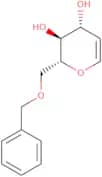
CAS:<p>α-1,4-glucododecasaccharide derived from starch by hydrolysis and chromatography</p>Formula:C72H122O61Purity:Min. 95%Color and Shape:Clear Liquid PowderMolecular weight:1,962 g/mol6-O-Benzyl-D-glucal
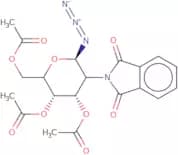
CAS:<p>6-O-Benzyl-D-glucal is an Oligosaccharide, Carbohydrate, complex carbohydrate. It is a custom synthesis of 6-O-benzylated D-glucal. This product is synthesized by the methylation and glycosylation of D-glucose. The molecular weight of this product ranges from 300 to 500 Da. It is also a synthetic compound that can be used in the modification of oligosaccharides and polysaccharides. 6-O-Benzyl-D-glucal has high purity, which can be confirmed by analyzing its melting point and IR spectrum. The CAS number for this product is 1655248566. It reacts with fluoride to produce fluorinated saccharide products that are soluble in water or organic solvents.</p>Formula:C13H16O4Purity:Min. 95%Molecular weight:236.26 g/mol3,4,6-Tri-O-acetyl-2-deoxy-2-phthalimido-b-D-glucopyranosyl azide
CAS:<p>3,4,6-Tri-O-acetyl-2-deoxy-2-phthalimido-b-D-glucopyranosyl azide is a carbohydrate that has been modified by acetylation and fluorination. Carbohydrates are saccharides and oligosaccharides that have the general formula (CH2O)n. 3,4,6-Tri-O-acetyl-2-deoxy-2-phthalimido b -D -glucopyranosyl azide is an example of a high purity custom synthesis glycosylation product. This modification is a methylation reaction in which the hydroxymethyl group of the sugar alcohol reacts with methanol to produce methyl alcohol. The methyl group then reacts with an organic acid to yield the desired product.</p>Formula:C20H20N4O9Purity:Min. 95%Molecular weight:460.39 g/molTri-fucosyl-Lewis Y-heptasaccharide-APE, HSA
<p>Tri-fucosyl-Lewis Y-heptasaccharide-APE, HSA is a complex carbohydrate that has been custom synthesized and glycosylated. It was modified with methylation and fluorination to create a high purity product. This complex carbohydrate has a CAS number of 107386-00-6 and is composed of sugar molecules. It is a polysaccharide with the following structure:</p>Purity:Min. 95%1D-1-O-Butyryl-4,6-O-dibenzoyl-myo-inositol
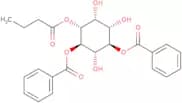
CAS:<p>1D-1-O-Butyryl-4,6-O-dibenzoyl-myo-inositol is an oligosaccharide that has been modified with fluoride. It is a custom synthesis of a complex carbohydrate and its CAS number is 153265-90-8. 1D-1-O-Butyryl-4,6-O-dibenzoyl-myo-inositol is used in the synthesis of saccharides and polysaccharides.</p>Formula:C24H26O9Purity:Min. 95%Molecular weight:458.46 g/mol