Glycoscience
Glycoscience is the study of carbohydrates and their derivatives, as well as the interactions and biological functions they participate in. This field of research is crucial for understanding a wide variety of biological processes, including cell recognition, signaling, immune response, and disease development. Glycoscience has important applications in biotechnology, medicine, and the development of new drugs and therapies. At CymitQuimica, we offer a wide selection of high-quality, high-purity products for glycoscience research. Our catalog includes monosaccharides, oligosaccharides, polysaccharides, glycoconjugates, and specific reagents, designed to support researchers in their studies on the structure, function, and applications of carbohydrates in biological systems. These resources are intended to facilitate scientific discoveries and practical applications in various areas of bioscience and medicine.
Subcategories of "Glycoscience"
- Aminosugars(108 products)
- Glyco-Related Antibodies(282 products)
- Glycolipids(46 products)
- Glycosaminoglycans (GAGs)(55 products)
- Glycosides(419 products)
- Monosaccharides(6,622 products)
- Oligosaccharides(3,682 products)
- Polysaccharides(503 products)
Found 11041 products of "Glycoscience"
Sort by
Purity (%)
0
100
|
0
|
50
|
90
|
95
|
100
Methyl 3,6-dideoxy-a-D-arabino-hexopyranoside
CAS:<p>Methyl 3,6-dideoxy-a-D-arabino-hexopyranoside is a fluorinated sugar analog. It is a monosaccharide that has been synthesized and modified to include an amine group for the purpose of glycosylation. Methyl 3,6-dideoxy-a-D-arabino-hexopyranoside has CAS number 6154-71-8 and can be found in the Polysaccharides category. The compound is soluble in water, ethanol, methanol, acetone, ethyl acetate and chloroform. Methyl 3,6-dideoxy-a-D-arabino-hexopyranoside has a molecular weight of 392.5 grams per mole and a density of 1.3 grams per cubic centimeter. Methyl 3,6 -dideoxy -a -D -arabino -hexopyranoside is</p>Formula:C7H14O4Purity:Min. 95%Molecular weight:162.19 g/molMethyl 3,4-O-isopropylidene-a-D-galactopyranoside
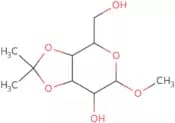
CAS:<p>Methyl 3,4-O-isopropylidene-a-D-galactopyranoside is a white crystalline powder that is soluble in water. This product is used in the synthesis of complex carbohydrate and glycosylation. It has CAS No. 40269-01-0 and can be custom synthesized to meet your requirements. The purity of this product is over 99%.</p>Formula:C10H18O6Purity:Min. 95%Molecular weight:234.25 g/molPhenyl 6-azido-6-deoxy-2,3,4-tri-O-benzyl-b-D-thioglucopyranoside
CAS:<p>Phenyl 6-azido-6-deoxy-2,3,4-tri-O-benzyl-b-D-thioglucopyranoside is a methylated saccharide that can be modified with click chemistry. It is a synthetic compound that is used in the synthesis of oligosaccharides and glycosylations. The chemical formula for this compound is C12H19N5O7.</p>Formula:C33H36N3O4SPurity:Min. 95%Molecular weight:570.72 g/mol1,2:5,6-Di-O-isopropylidene-3,4-di-O-benzyl-D-myo-inositol
CAS:<p>1,2:5,6-Di-O-isopropylidene-3,4-di-O-benzyl-D-myo-inositol is a synthetic compound that is used as a building block for the synthesis of oligosaccharides. It is a monosaccharide and can be methylated to form a glycosylation. 1,2:5,6-Di-O-isopropylidene-3,4-di-O-benzyl-D myo inositol can also be fluorinated to form a saccharide.</p>Formula:C26H32O6Purity:Min. 95%Molecular weight:440.53 g/mol2,5-Dideoxystreptamine dihydrochloride
CAS:<p>2,5-Dideoxystreptamine dihydrochloride is a compound that has been investigated as an antibiotic. This chemical inhibits the growth of microorganisms by inhibiting their protein synthesis, which is required for cell division. 2,5-Dideoxystreptamine dihydrochloride was first isolated from Streptomyces griseus and has been shown to have high levels of activity against Bacillus subtilis and Micrococcus lysodeikticus.</p>Purity:Min. 95%b-D-Fructofuranosyl-a-D-galactopyranoside
CAS:<p>The b-D-Fructofuranosyl-a-D-galactopyranoside is a sugar molecule that is a carbohydrate. It contains sugar phosphates and an aldehyde group. The hydroxyl groups on the molecule can be found on the hydroxyl, ketone, and alcohols that are present. This carbohydrate also has hemiketal and sugar alcohol groups. These molecules have six carbon atoms in their molecular structure with one oxygen atom and one hydrogen atom attached to each of them. The deoxy form of this molecule is not active for DNA synthesis or protein synthesis but it can be used as an intermediate in the production of other sugars such as maltose, cellobiose, and sucrose.</p>Formula:C12H22O11Purity:Min. 95%Molecular weight:342.3 g/molAlphadolone 21-b-D-glucuronide
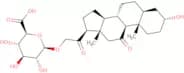
CAS:<p>Alphadolone 21-b-D-glucuronide (ADG) is a synthetic compound that belongs to the group of carbohydrates. ADG is a sugar that has been modified with fluorination and methylation. It is also glycosylated and click modified. This product is custom synthesized for research purposes only.</p>Formula:C27H40O10Purity:Min. 95%Molecular weight:524.6 g/mol1,2,3,4-Tetra-O-acetyl-L-arabinopyranose
CAS:<p>1,2,3,4-Tetra-O-acetyl-L-arabinopyranose is a custom synthesis that has been modified with fluorination and methylation. The monosaccharide is synthesized by using a Click modification and the oligosaccharides and polysaccharides are glycosylated. This compound has CAS No. 123163-97-3 and is a complex carbohydrate.</p>Purity:Min. 95%Methyl 3,6-dideoxychloroacetamido-a-D-mannopyranoside
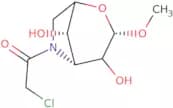
CAS:<p>Methyl 3,6-dideoxychloroacetamido-a-D-mannopyranoside is a complex carbohydrate that has been modified by fluorination and methylation. It is an important building block in the synthesis of oligosaccharides and polysaccharides. This product is also used in click chemistry, where it can be reacted with a variety of thiols to form new linkages. Methyl 3,6-dideoxychloroacetamido-a-D-mannopyranoside can also be used to modify saccharides or sugars by click chemistry. This compound is highly pure and custom synthesized to customer specifications.</p>Formula:C9H14ClNO5Purity:Min. 95%Molecular weight:251.66 g/mol3-Hydroxystanozolol glucuronide
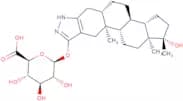
CAS:<p>3-Hydroxystanozolol glucuronide is a metabolite of stanozolol that has been found in human urine. 3-Hydroxystanozolol glucuronide is formed as an intermediate during the metabolic conversion of stanozolol to its active form, which then is hydrolyzed by erythrocyte esterases or glucuronidases to form 3-hydroxystanozolol. This metabolite has been validated as an analytical marker for monitoring the use of stanozolol in sport and population studies.</p>Formula:C26H38N2O8·C2H6Purity:Min. 95%Molecular weight:536.66 g/molMethyl 6-O-(a-D-mannopyranosyl)-a-D-mannopyranoside
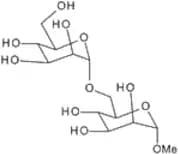
CAS:<p>Methyl 6-O-(a-D-mannopyranosyl)-a-D-mannopyranoside is a complex carbohydrate that belongs to the group of carbohydrates. Methyl 6-O-(a-D-mannopyranosyl)-a-D-mannopyranoside is a modification of the monosaccharides, which are vital for cellular metabolism. Methyl 6-O-(a-D-mannopyranosyl)-a-D-mannopyranoside is used in the synthesis of oligosaccharides, polysaccharides and glycolipids. This product has been shown to be an effective inhibitor of bacterial growth in vitro and has also been shown to have antiinflammatory properties.<br>Methyl 6-O-(a-D-mannopyranosyl)-a-D-mannopyranoside is a white crystalline powder with a melting point range from 120°C to 130°C. It</p>Formula:C13H24O11Purity:Min. 95%Color and Shape:SolidMolecular weight:356.32 g/mol6-Deoxy-3-C-methyl-D-gulose
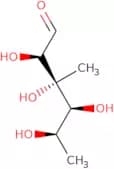
CAS:<p>6-Deoxy-3-C-methyl-D-gulose is an enantiomer of 3,6-dideoxy-D-gluconic acid. This compound has been shown to be a virulent factor in mastitis caused by the mutant strain of Escherichia coli (MT1) and to be expressed at a higher level in mastitic milk than in normal milk. 6DMG has also been shown to induce monoclonal antibody production and stimulate specific immune responses. It is thought that 6DMG damages cells, which leads to the release of intracellular components that trigger an antibody response. The biological function of 6DMG is not known, but it may play a role in the infection process by stimulating an antibody response against infectious agents.</p>Purity:Min. 95%b-L-Rhamnopyranosyl nitromethane
CAS:<p>b-L-Rhamnopyranosyl nitromethane is a synthetic oligosaccharide that has been custom synthesized and modified with methyl groups. This compound is an important building block for the synthesis of complex carbohydrates and glycosides, as well as for the modification of saccharides. Click chemistry is used to modify this product, which employs copper(II) acetate and azide salts to form a single covalent bond between two molecules.</p>Formula:C7H13NO6Purity:Min. 95%Molecular weight:207.18 g/molIvermectin b1 monosaccharide
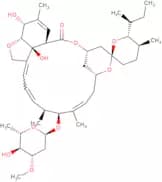
CAS:<p>Ivermectin is a derivative of avermectin that is used for the treatment of parasitic infections. Ivermectin b1 monosaccharide is an analog of the parent molecule, which lacks a carbon atom at position 1 and has a spiroketal group at position 2. It is known to be more potent than ivermectin in animal studies.</p>Formula:C41H62O11Purity:Min. 95%Color and Shape:PowderMolecular weight:730.92 g/molO-[2-Acetamido-4,6-O-benzylidene-2-deoxy-3-O-(2,3,4,6-tetra-O-acetyl-b-D-galactopyranosyl)-a-D-galactopyranosyl]-N-Fmoc-L-threonine allyl ester
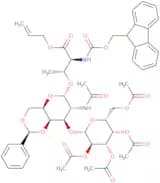
CAS:<p>O-[2-Acetamido-4,6-O-benzylidene-2-deoxy-3-O-(2,3,4,6-tetra-O-acetyl-b-D-galactopyranosyl)-a-D-galactopyranosyl]-N -Fmoc--L--threonine allyl ester is a carbohydrate that can be custom synthesized. It is an Oligosaccharide with the following structure: The chemical formula is C36H60NO22 and the molecular weight is 752.8 g/mol. It has a CAS number of 384346–85–4 and it's Chemical Abstract Service (CAS) name is O-[2-(acetamido)-4,6-[O-(2,3,4,6 tetra‑O‑acetyl‑β‑D‑galactopyranosyl)‑α‑</p>Formula:C51H58N2O19Purity:Min. 95%Molecular weight:1,003.01 g/molHesperetin 3'-O-β-D-glucuronide
CAS:<p>Hesperetin 3'-O-beta-D-glucuronide is a glycosylate that is obtained by the glycosylation of hesperidin. Hesperetin 3'-O-beta-D-glucuronide is a sugar with a glycosylation site at the C3 position of the aglycone. It has shown to be an efficient inhibitor of Triglyceride Synthetase, which reduces triglycerides in the body. Hesperetin 3'-O-beta-D-glucuronide also has been shown to inhibit insulin release and increase insulin sensitivity in vitro.</p>Formula:C22H22O12Purity:Min. 95%Molecular weight:478.4 g/mol4,5,7-Tri-O-acetyl-2,6-anhydro-3-deoxy-D-lyxo-hept-2-enonamide
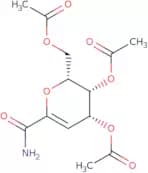
CAS:<p>4,5,7-Tri-O-acetyl-2,6-anhydro-3-deoxy-D-lyxo-hept-2-enonamide is a carbohydrate that belongs to the group of oligosaccharides. It is a synthetic compound that has been modified with fluorination and methylation. This compound has been synthesized with high purity and custom synthesis. The modification process includes glycosylation and click chemistry.</p>Formula:C13H17NO8Purity:Min. 95%Molecular weight:315.28 g/molEtoposide-d4
CAS:Controlled Product<p>Etoposide is a cytotoxic drug used in cancer chemotherapy. It inhibits DNA replication through inhibition of DNA topoisomerase II, thus catalysing cell cycle arrest and apoptosis. This compoud, Etoposide-d4, is a deuterated form of the drug.</p>Formula:C29H32O13Purity:Min. 95%2,4,7,8,9-Penta-O-acetyl-N-acetylneuraminic acid methyl ester
CAS:<p>2,4,7,8,9-Penta-O-acetyl-N-acetylneuraminic acid methyl ester (2,4,7,8,9-PNT) is a fluorescent analogue of sialic acid. It is a sensor for the presence of glycopyranoses and its derivative 2-(3'-hydroxyphenyl)-2H-benzotriazole (HPBT) has been used to detect carboxylic groups in proteins. 2,4,7,8,9-PNT has also been used as an affinity label for lysine residues on proteins and to study protein interactions with carbohydrates. The high yield in this synthesis allows for the use of techniques such as crystallography or fluorescence.</p>Formula:C22H31NO14Purity:Min. 95%Color and Shape:PowderMolecular weight:533.48 g/mol