


Glycoscience
Glycoscience is the study of carbohydrates and their derivatives, as well as the interactions and biological functions they participate in. This field of research is crucial for understanding a wide variety of biological processes, including cell recognition, signaling, immune response, and disease development. Glycoscience has important applications in biotechnology, medicine, and the development of new drugs and therapies. At CymitQuimica, we offer a wide selection of high-quality, high-purity products for glycoscience research. Our catalog includes monosaccharides, oligosaccharides, polysaccharides, glycoconjugates, and specific reagents, designed to support researchers in their studies on the structure, function, and applications of carbohydrates in biological systems. These resources are intended to facilitate scientific discoveries and practical applications in various areas of bioscience and medicine.
Subcategories of "Glycoscience"
- Aminosugars(108 products)
- Glyco-Related Antibodies(282 products)
- Glycolipids(46 products)
- Glycosaminoglycans (GAGs)(55 products)
- Glycosides(419 products)
- Monosaccharides(6,622 products)
- Oligosaccharides(3,682 products)
- Polysaccharides(503 products)
Found 11041 products of "Glycoscience"
Sort by
Purity (%)
0
100
|
0
|
50
|
90
|
95
|
100
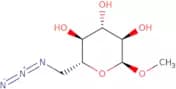
Methyl 6-azido-6-deoxy-a-D-glucopyranoside
CAS:<p>Methyl 6-azido-6-deoxy-a-D-glucopyranoside is a synthetic, fluorinated, complex carbohydrate that can be used as a building block for the synthesis of saccharides and oligosaccharides. It has been shown to inhibit the glycosylation of proteins and is a useful reagent in click chemistry. Methyl 6-azido-6-deoxy-a-D-glucopyranoside is a nonionic monosaccharide that has been modified with an azido group at C2 and a deoxy group at C3. The compound has been shown to have antiviral activity against HIV and influenza A virus.<br>Methyl 6-azido-6-deoxy--a--D--glucopyranoside is not soluble in water and is best stored at -20°C.</p>Formula:C7H13N3O5Purity:Min. 95%Molecular weight:219.2 g/molD-Glycero-D-gulo-heptonic acid γ-lactone
CAS:<p>Please enquire for more information about D-Glycero-D-gulo-heptonic acid γ-lactone including the price, delivery time and more detailed product information at the technical inquiry form on this page</p>Formula:C7H12O7Molecular weight:208.17 g/mol3-O-Acetyl-1,2:5,6-di-O-isopropylidene-a-D-galactofuranose
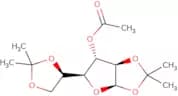
CAS:<p>3-O-Acetyl-1,2:5,6-di-O-isopropylidene-a-D-galactofuranose is a synthetic modified oligosaccharide with a molecular weight of 591.3 g/mol. It has been shown to inhibit the growth of various bacterial strains in the lab and can be used as an antibiotic for bacterial infections. 3-O-Acetyl-1,2:5,6-di-O-isopropylidene galactofuranose is a monosaccharide composed of two acetyl groups and one isopropylidene group. Its glycosylation and methylation patterns are also known.</p>Formula:C14H22O7Purity:Min. 95%Molecular weight:302.32 g/mol1-O-Propargyl 2, 3, 4, 6- tetra-O-acetyl- D- fructofuranose
<p>1-O-Propargyl 2, 3, 4, 6- tetra-O-acetyl-D-fructofuranose is a monosaccharide that is modified with an acetyl, propargyl and fluorine. It can be used as a glycosylation agent, as well as a methylating and click modification agent. 1-O-Propargyl 2, 3, 4, 6- tetra-O-acetyl -D -fructofuranose has been shown to have antiinflammatory properties in addition to its ability to inhibit the growth of bacteria and fungi. This compound can also be used for the synthesis of polysaccharides and oligosaccharides.</p>Purity:Min. 95%2-C-(2,3,4,6-Tetra-O-benzyl-a-D-glucopyranosyl) ethyne
CAS:<p>2-C-(2,3,4,6-Tetra-O-benzyl-a-D-glucopyranosyl) ethyne is a glycosylated oligosaccharide. It can be synthesized by reacting an aryl glycoside with 2,3,4,6-tetra-O-benzyl alpha D glucose in the presence of a fluoride ion. This product has been shown to have anticancer activity against human colon cancer cells in vitro and has been modified with fluorination or click chemistry. The synthesis of 2-C-(2,3,4,6-Tetra-O-benzyl-a-D glucopyranosyl) ethyne is custom and can be made for research purposes only.</p>Formula:C29H30O5Purity:Min. 95%Molecular weight:458.55 g/molBromoxynil 2,3,4-tri-O-acetyl-D-glucuronide methyl ester
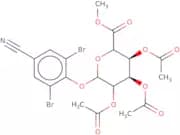
<p>Bromoxynil 2,3,4-tri-O-acetyl-D-glucuronide methyl ester is a custom synthesis of a polysaccharide. It is a modification of the natural saccharides with an acetyl group at the 3’ position on glucose and a methyl group at the 4’ position. Bromoxynil 2,3,4-tri-O-acetyl-D-glucuronide methyl ester is synthesized by glycosylation and then fluorination to form the desired product. The compound has high purity and is stable in water solution.</p>Formula:C20H19Br2NO10Purity:Min. 95%Molecular weight:593.17 g/molmyo-Inositol 1,2,3,4,6-pentakisphosphate
CAS:<p>Myo-inositol 1,2,3,4,6-pentakisphosphate is a compound that belongs to the group of myo-inositols. It can be isolated from rice bran or synthesized by reacting inositol with phosphoric acid. Myo-Inositol 1,2,3,4,6-pentakisphosphate has been shown to be an analog of myo-inositol and has a similar chromatographic profile. This compound also has the ability to dephosphorylate diacylglycerol (DAG) and reduce its levels in cells.<br>Myo-inositol 1,2,3,4,6-pentakisphosphate can be quantified by reversed phase high performance liquid chromatography (RP-HPLC). The result can then be used to calculate the concentration of DAG in cells based on the standard curve obtained from the quantification of DAG in</p>Formula:C6H17O21P5Purity:Min. 95%Molecular weight:580.06 g/mol4-Methylphenyl b-D-thioglucuronide methyl ester
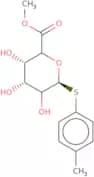
<p>4-Methylphenyl b-D-thioglucuronide methyl ester is a Carbohydrate, Modification, saccharide, Oligosaccharide, sugar. It is a synthetic monosaccharide that has been modified with fluorination and methylation. This chemical is typically used as a reagent in glycosylation reactions to synthesize complex carbohydrates.</p>Formula:C14H18O6SPurity:Min. 95%Molecular weight:314.36 g/mol1,2,4,6-Tetra-O-acetyl-3-deoxy-3-N-(4-nitrobenzamido)-D-galactopyranose
CAS:<p>1,2,4,6-Tetra-O-acetyl-3-deoxy-3-N-(4-nitrobenzamido)-D-galactopyranose is a sugar that has been modified with methylation, click modification, and fluorination. This sugar is a carbohydrate that consists of a monosaccharide unit of galactose. It is synthesized from D-galactopyranose in the presence of methyl iodide and 4-nitrobenzamido anhydride. The synthesis follows an acetal formation reaction between 3,4-diacetoxybenzoic acid and D-galactopyranose. 1,2,4,6-Tetra-O-acetyl 3DGPA reacts with methyl iodide to form the corresponding 2-(methylthio)acetate (MTAA). The MTAA reacts with 4 nitrobenzamido anhyd</p>Formula:C21H24N2O12Purity:Min. 95%Molecular weight:496.42 g/mol1,2,3,6-Tetra-O-benzyl-b-D-galactopyranoside
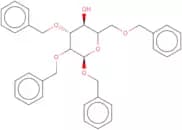
CAS:<p>The chemical structure of 1,2,3,6-Tetra-O-benzyl-b-D-galactopyranoside is the product of a custom synthesis. It is a synthetic oligosaccharide with a high purity and high degree of methylation. The chemical modification includes fluorination and glycosylation. This compound has been shown to have potent anti-tuberculosis activity in vitro and in vivo.</p>Formula:C34H36O6Purity:Min. 95%Molecular weight:540.65 g/molEthyl 2,4,6-tri-O-acetyl-a-D-thiomannopyranoside
CAS:<p>Ethyl 2,4,6-tri-O-acetyl-a-D-thiomannopyranoside is a custom synthesized compound that is a complex carbohydrate. It is an oligosaccharide that has been modified with methylation and glycosylation. This compound is also a polysaccharide and it has been modified with fluorination. Ethyl 2,4,6-tri-O-acetyl-a-D-thiomannopyranoside can be used as a sweetener for food products or as an additive for pharmaceuticals to increase their sweetness. The CAS number for this compound is 1637783-63-1.</p>Formula:C14H22O8SPurity:Min. 95%Molecular weight:350.39 g/mol1,3,6-Tri-O-acetyl-2,4-di-O-benzyl-a-D-glucopyranose
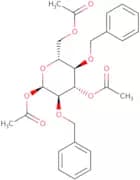
CAS:<p>Glycosylation is a process by which glucose molecules are covalently attached to other molecules, such as proteins or lipids. This process can be accomplished through the addition of a phosphate group to the glucose molecule. The Methylation, Click modification, and Polysaccharide reactions are all methods of modifying glycosides. Glycosylation is an important part of many biological processes such as cell growth and repair, the immune response, and blood clotting. Fluorination is a chemical reaction between fluorine and another element or compound in which one or more atoms of fluorine replace hydrogen atoms on the other element or compound. This process has been used for the synthesis of carbohydrates with specific properties that may not be found in nature. The CAS number for 1,3,6-Tri-O-acetyl-2,4-di-O-benzyl-a-D-glucopyranose is 79414-66-7. This product</p>Formula:C26H30O9Purity:Min. 95%Molecular weight:486.51 g/mol1-Bromo-2,4,6-tri-O-acetyl-3-O-(2,3,4,6-tetra-O-acetyl-b-D-glucopyranosyl)-a-D-glucopyranoside
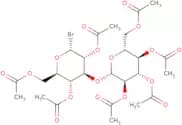
CAS:<p>This is a Glycosylation, Oligosaccharide, sugar, Synthetic, Fluorination, Custom synthesis, Methylation, Monosaccharide, Polysaccharide, saccharide. This product is custom synthesized for your needs. It is a complex carbohydrate with high purity and modification. There are no CAS numbers on this product.</p>Formula:C26H35BrO17Purity:Min. 95%Molecular weight:699.45 g/molD-Galactose-BSA
<p>D-Galactose-BSA is a modified carbohydrate that is synthesized by the selective substitution of the hydroxyl group on the beta-carbon of D-galactose. This modification enhances the binding affinity of D-galactose to bovine serum albumin (BSA), which is used as a carrier protein for many biological assays. The fluorination step in this synthesis creates reactive sites on the molecule, which are then available for chemical modifications such as methylation or glycosylation. D-Galactose-BSA can be custom synthesized to meet your specifications for purity, stability, and activity.</p>Color and Shape:White Powder4-Methoxyphenyl 2,3,4,6-tetra-O-acetyl-β-D-glucopyranoside
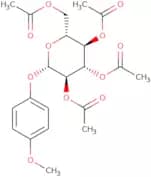
CAS:<p>4-Methoxyphenyl 2,3,4,6-tetra-O-acetyl-b-D-glucopyranoside is a membrane stabilizer that prevents the mesenchymal transition of cells. This compound inhibits the growth of human tumor cells in vitro and has been shown to be an anti-tumor agent. 4-Methoxyphenyl 2,3,4,6-tetra-O-acetyl-b-D-glucopyranoside binds to DNA and RNA and blocks translation or transcription. It also prevents the formation of ternary complex by interfering with the binding between aminoacyl tRNA synthetases and their cognate tRNAs. The compound is activated by intestinal enzymes and is metabolized in human liver microsomes to a more reactive form that can bind to cellular macromolecules such as proteins.</p>Formula:C21H26O11Purity:Min. 95%Color and Shape:PowderMolecular weight:454.42 g/mol2-Acetamido-2-deoxy-6-a-O-sialyl-D-galactopyranose
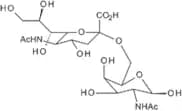
CAS:<p>2-Acetamido-2-deoxy-6-a-O-sialyl-D-galactopyranose is a monosaccharide that is synthesized from D-galactose and acetamide. It has a molecular weight of 388.13 and an empirical formula of C8H14N2O4. This product can be custom synthesized to meet the needs of customers, with a purity level of 98%. 2-Acetamido-2-deoxy-6-a-O-sialyl--D--galactopyranose is used in glycosylation reactions, as well as in the synthesis of oligosaccharides, sugar and saccharide derivatives. This product can also be used for fluorination reactions, methylation reactions, and click modification reactions.</p>Formula:C19H32N2O14Purity:Min. 95%Molecular weight:512.46 g/mol6-O-Triisopropylsilyl-D-galactal
CAS:<p>6-O-Triisopropylsilyl-D-galactal is a thioether that can be used to modify the octane number of petroleum. It can also be used as an analytical reagent for sulfur compounds and as a catalyst in desulfurization reactions. 6-O-Triisopropylsilyl-D-galactal is synthesized by reacting 6,6'-dithiodipyridine with glycerol in the presence of triisopropylsilyl chloride. The reaction is synchronous and the interaction energy between the two molecules is high. The orientation of the components (i.e., sulfoxide and sulfide) are octane and oriented, respectively.</p>Formula:C15H30O4SiPurity:Min. 95%Molecular weight:302.48 g/molBenzyl 2-acetamido-3-O-(2,3,4,6-tetra-O-acetyl-b-D-galactopyranosyl)-2-deoxy-4,6-O-isopropylidene-D-galactopyranose
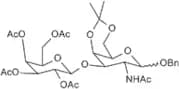
<p>This is a custom synthesized, high purity and complex carbohydrate. The synthesis process involves the following steps: 1) Acetylation of a monosaccharide, 2) Fluorination, 3) Methylation, 4) Oligosaccharide formation, 5) Polysaccharide formation with glycosylation and 6) Click modification. <br>Benzyl 2-acetamido-3-O-(2,3,4,6-tetra-O-acetyl-b-D-galactopyranosyl)-2-deoxy-4,6-O-isopropylidene-D-galactopyranose is an oligosaccharide that has been modified by methylation and click chemistry. It has CAS No. 77562-20-0 and can be used as a sugar in various applications.</p>Formula:C32H43NO15Purity:Min. 95%Molecular weight:681.7 g/molL-Daunosamine
CAS:<p>L-Daunosamine is a natural amino sugar that is synthesized from D-glucose by the enzyme daunosamine synthetase. L-Daunosamine is a nucleophilic compound that can form an enolate intermediate as well as an amide, which are reactive intermediates in organic synthesis. This compound is also able to undergo stereoselective reactions. The product of this reaction can be used to produce methyl glycosides, which have been shown to have anticancer properties. L-Daunosamine has been shown to be a substrate for the formation of enolates and amides, which are reactive compounds in organic synthesis. This compound has also been shown to undergo stereoselective reactions. The product of this reaction can be used to produce methyl glycosides, which have been shown to have anticancer properties.</p>Formula:C6H11NO3Purity:Min. 95%Molecular weight:145.16 g/mol1,2-Dideoxy-2'-dimethylamino-a-D-glucopyranoso-[2,1-d]-2'-thiazoline
CAS:<p>1,2-Dideoxy-2'-dimethylamino-a-D-glucopyranoso-[2,1-d]-2'-thiazoline is a synthetic sugar that is used in the synthesis of complex carbohydrates. It can be used to modify polysaccharides and glycosyls with methyl groups. This product has high purity and custom synthesis.</p>Formula:C9H16N2O4SPurity:Min. 95%Molecular weight:248.3 g/mol









![1,2-Dideoxy-2'-dimethylamino-a-D-glucopyranoso-[2,1-d]-2'-thiazoline](/_next/image/?url=https%3A%2Fstatic.cymitquimica.com%2Fproducts%2F3D%2Fthumb-webp%2FMD15731.webp&w=3840&q=75)