Glycoscience
Glycoscience is the study of carbohydrates and their derivatives, as well as the interactions and biological functions they participate in. This field of research is crucial for understanding a wide variety of biological processes, including cell recognition, signaling, immune response, and disease development. Glycoscience has important applications in biotechnology, medicine, and the development of new drugs and therapies. At CymitQuimica, we offer a wide selection of high-quality, high-purity products for glycoscience research. Our catalog includes monosaccharides, oligosaccharides, polysaccharides, glycoconjugates, and specific reagents, designed to support researchers in their studies on the structure, function, and applications of carbohydrates in biological systems. These resources are intended to facilitate scientific discoveries and practical applications in various areas of bioscience and medicine.
Subcategories of "Glycoscience"
- Aminosugars(108 products)
- Glyco-Related Antibodies(282 products)
- Glycolipids(46 products)
- Glycosaminoglycans (GAGs)(55 products)
- Glycosides(419 products)
- Monosaccharides(6,621 products)
- Oligosaccharides(3,681 products)
- Polysaccharides(503 products)
Found 11041 products of "Glycoscience"
Sort by
Purity (%)
0
100
|
0
|
50
|
90
|
95
|
100
N-Acetyl-D-[UL-13C6,15N]glucosamine
CAS:<p>N-Acetyl-D-[U-13C6,15N]glucosamine is a custom synthesis of an oligosaccharide. It is a methylated form of glucosamine and has been modified with 13C 6, 15N atoms. N-Acetyl-D-[U-13C6,15N]glucosamine is used in the study of complex carbohydrate structures and can be used for the production of polysaccharides. This chemical contains a single monosaccharide sugar that can be easily modified with fluorine to produce complex carbohydrates for research purposes. The purity level of this chemical is greater than 99%.</p>Purity:Min. 95%D-glucosyl--1,1' N-oleoyl-D-erythro-sphingosine
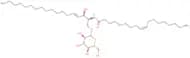
CAS:<p>D-glucosyl--1,1' N-oleoyl-D-erythro-sphingosine is a synthetic oligosaccharide with a fluorinated alpha-hydroxy group and a methylated nitrogen atom. It is also a complex carbohydrate that has been modified by glycosylation and polysaccharide modification. D-glucosyl--1,1' N-oleoyl-D-erythro-sphingosine can be used in custom synthesis, click modification, methylation, and sugar modification. This product has high purity and can be used in the synthesis of drugs or other chemical compounds.</p>Formula:C42H79NO8Purity:Min. 95%Molecular weight:726.08 g/molLauryl glucoside
CAS:<p>Lauryl glucoside is a cationic surfactant that has been used in pharmaceutical preparations for the treatment of bacterial vaginosis. Lauryl glucoside is a non-irritating, low-toxicity compound that is effective against most Gram-positive and Gram-negative bacteria. It has been shown to be an effective antimicrobial agent with an adsorption mechanism based on hydrogen bonding. This agent also has been shown to have skin cancer prevention properties, as it is able to inhibit the proliferation of human skin cells. Lauryl glucoside can also cause allergic reactions or sensitization in some individuals, while diamine tetraacetic acid (DTA) may be used as a stabilizer in products containing lauryl glucoside.</p>Purity:Min. 95%Heparin disaccharide I-H trisodium salt
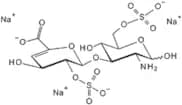
CAS:<p>Heparin disaccharide I-H trisodium salt is a high purity, custom synthesis, methylated, glycosylated, fluorinated, complex carbohydrate with a CAS number of 136098-04-9. It has been modified by the addition of a saccharide group and can be used for research purposes.</p>Formula:C12H16NNa3O16S2Purity:Min. 95 Area-%Color and Shape:PowderMolecular weight:563.35 g/molDextran 20, MW: 17,000 to 23,000
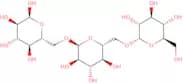
CAS:<p>Complex glucan (a 1-6) from Leuconostoc spp.; extender in blood transfusions</p>Color and Shape:Powder2,4-O-Benzylidene-L-xylose
CAS:<p>2,4-O-Benzylidene-L-xylose is a white crystalline powder with a melting point of about 125°C. It is an acetate salt that can be used in the synthesis of many natural products. It has been shown to inhibit HMG-CoA reductase and is used in the treatment of hypercholesterolemia. The reaction mechanism for this compound is not well understood, but it is believed to involve an acid catalyst and an organic solvent. The yield for this compound is low and it requires a long reaction time due to its high reactivity.</p>Formula:C12H14O5Purity:Min. 95%Molecular weight:238.24 g/mol5-(Galactosylhydroxy)-L-lysine
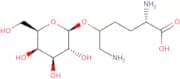
CAS:<p>5-(Galactosylhydroxy)-L-lysine is a metabolite that is found in human urine and serum. It is a basic compound with a hydroxyl group, which can be used as a biomarker for metabolic disorders and pharmacological treatments. 5-(Galactosylhydroxy)-L-lysine has been shown to have the potential to be used as a treatment for protein synthesis disorders. The mechanism of this reaction is still unknown, but it has been found that the optimum pH for this reaction is between 7 and 8.</p>Formula:C12H24N2O8Purity:Min. 95%Color and Shape:Off-White To Light Brown SolidMolecular weight:324.33 g/molMethyl 2,3,6-tri-O-benzyl-α-D-galactopyranoside
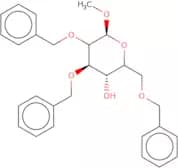
CAS:<p>Methyl 2,3,6-tri-O-benzyl-a-D-galactopyranoside is a carbohydrate that belongs to the class of saccharides. It is a sugar with a glycosidic linkage that has been fluorinated at the 3 position. Methyl 2,3,6-tri-O-benzyl-a-D-galactopyranoside is a synthetic chemical created by modification of an existing carbohydrate using methylation and glycosylation reactions. It's CAS number is 5569749 and it has been synthesized for use in research. Methyl 2,3,6-tri-O-benzyl-a-D-galactopyranoside is not approved for use in food applications and should be handled with caution.</p>Formula:C28H32O6Purity:Min. 95%Molecular weight:464.55 g/molGalactomannan, from soybean
CAS:<p>A polysaccharide consisting of a mannose backbone with galactose side chains. Galactomannan is a component of the cell wall of the mold Aspergillus and is released during growth. Detection of galactomannan in blood is used to diagnose invasive aspergillosis infections in humans.</p>Purity:Min. 95%Color and Shape:PowderFulvestrant 17-b-D-glucuronide
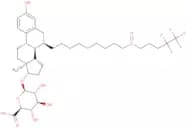
CAS:<p>Fulvestrant 17-b-D-glucuronide is a synthetic, high purity, custom synthesis of fulvestrant. It is modified with click chemistry and contains saccharides and oligosaccharides. Fulvestrant 17-b-D-glucuronide is used in the treatment of hormone receptor positive breast cancer in postmenopausal women who have been previously treated with an aromatase inhibitor.</p>Formula:C38H55F5O9SPurity:Min. 95%Molecular weight:782.9 g/molEthyl 2-acetamido-3,4,6-tri-O-acetyl-2-deoxy-a-D-thioglucopyranoside
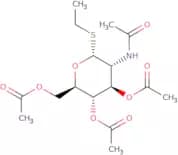
CAS:<p>Ethyl 2-acetamido-3,4,6-tri-O-acetyl-2-deoxy-a-D-thioglucopyranoside is a sugar derived from the condensation of two molecules of acetamide with three molecules of glucose. It is a synthetic compound that has been modified by fluorination, methylation, and monosaccharide synthesis. This product has been shown to be effective against bacteria and fungi in laboratory studies.</p>Formula:C16H25NO8SPurity:Min. 95%Color and Shape:White To Off-White SolidMolecular weight:391.44 g/molGum cassia tora
CAS:<p>Cassia gum is obtained from the ground purified endosperm of the seeds of Cassia tora and Cassia obtusifolia (Fam. Leguminosae) containing less than 0.05% of Cassia occidentalis. It consists mainly of high molecular weight (approximately 200,000-300,000) <br>The polysaccharide is composed of galactomannans with a mannose:galactose ratio of about 5:1. The seeds are dehusked and degermed by thermal and mechanical treatment followed by milling and screening of the endosperm. The ground endosperm is purified by extraction with isopropanol. It is used as a thickener, emulsifier, foam stabilizer, moisture retention agent and texturizing agent in cheese, frozen dairy desserts and mixes, meat products and poultry products.</p>Purity:Min. 95%2-(Acetylamino)-2-deoxy-3-O-β-D-glucopyranuronosyl-β-D-glucopyranose
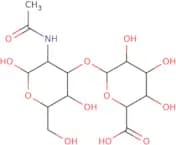
CAS:<p>2-(Acetylamino)-2-deoxy-3-O-β-D-glucopyranuronosyl-β-D-glucopyranose is an analog of atropine that has shown potential as an anticancer agent. It acts as a kinase inhibitor, specifically targeting protein kinases involved in cancer cell growth and survival. This compound has been found in Chinese urine and has been shown to induce apoptosis in human tumor cells. As a potent inhibitor of kinases, it may have potential as a therapeutic agent for the treatment of various types of cancer.</p>Formula:C14H23NO12Purity:Min. 95%Molecular weight:397.33 g/molD-Galactono-1,5-lactone
CAS:<p>D-Galactono-1,5-lactone is a sugar with the chemical formula HOOC-(CHOH)CO-(CHOH)COOH. It is a colorless to white crystalline solid that has a sweet taste. D-Galactono-1,5-lactone is naturally found in some fruits and vegetables such as apples, carrots, potatoes, and pumpkin. D-Galactono-1,5-lactone can be synthesized by reacting glycerol with an acid chloride in the presence of a base. This reaction generates the lactone ring via addition of water to the double bond between carbons 1 and 5 of glycerol. The lactone ring is then opened by hydrolysis to form D-galactonic acid which can be converted into D-galactonolactone by adding an enolate salt generated from an alcohol.</p>Formula:C6H10O6Purity:Min. 95%Molecular weight:178.14 g/molZearalenone 14-glucuronide
CAS:<p>Zearalenone 14-glucuronide is a custom synthesis. It is a complex carbohydrate, which is an oligosaccharide that has been modified by methylation and glycosylation. Zearalenone 14-glucuronide is a polysaccharide with a saccharide backbone and various modifications at the ends of the sugar chains. This product has been fluorinated to provide high purity.</p>Formula:C24H30O11Purity:(%) Min. 95%Color and Shape:PowderMolecular weight:494.49 g/molEthyl D-glucopyranoside
CAS:<p>Ethyl D-glucopyranoside is a reaction product that contains the fatty acid erythritol and inulin. It can be used as a control agent to test for urinary tract infections, as well as being an active enzyme that inhibits microbial growth. Ethyl D-glucopyranoside has been shown to have an inhibitory effect on microbes, with a crystalline cellulose carrier having the best inhibitory effect. This substance is also used in detergent compositions to prevent microbial growth and maintain cleaning efficiency.</p>Formula:C8H16O6Purity:Min. 95%Molecular weight:208.21 g/molb-L-Arabinose-1-phosphate potassium
<p>b-L-Arabinose-1-phosphate potassium is a sugar that is used in the synthesis of oligosaccharides and polysaccharides. It can be used as an anti-inflammatory agent.</p>Formula:C5H9O8P·2KPurity:Min. 95%Molecular weight:306.29 g/molMethyl 2-deoxy-2-fluoro-β-D-glucopyranoside
CAS:<p>Methyl 2-deoxy-2-fluoro-b-D-glucopyranoside is a synthetic glycosylation product that is prepared by monosaccharide and polysaccharide modification. This fluorinated sugar has high purity and is easy to handle. It can be used in the synthesis of oligosaccharides, sugar chains, and other complex carbohydrate molecules. The CAS number for Methyl 2-deoxy-2-fluoro-b-D-glucopyranoside is 39110–58–2.</p>Formula:C7H13FO5Purity:Min. 95%Molecular weight:196.17 g/molTri-b-GalNAc-b-alanine-NH2
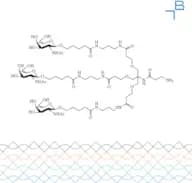
<p>Tri-b-GalNAc-b-alanine-NH2 boasts three terminal beta-N-acetylgalactosamine (GalNAc) sugars, mimicking natural ligands for efficient binding to Ashwell-Morell receptors (C-type lectin of ASGPR) on hepatocytes. The beta-alanine linker connects the GalNAc unit to a terminal amino group (NH2), a key conjugation site for attaching various therapeutic molecules via amide bond formation. This design validates tri-b-GalNAc-b-alanine-NH2 as a valuable tool in medicinal chemistry for developing liver-specific drug delivery systems, allowing researchers to exploit this ligand to create targeted conjugates, like drug-GalNAc conjugates, for specific delivery of therapeutics directly to hepatocytes, potentially improving treatment efficacy and reducing side effects.</p>Formula:C64H115N11O28Purity:Min. 95%Molecular weight:1,486.67 g/molMethyl 3,5-di-O-(2,4-dichlorobenzyl)-2-keto-a-D-ribofuranoside
CAS:<p>Methyl 3,5-di-O-(2,4-dichlorobenzyl)-2-keto-a-D-ribofuranoside is a synthetic carbohydrate that can be used as a building block in the synthesis of complex carbohydrates. This product is custom synthesized and has high purity. It is also glycosylated and methylated.</p>Formula:C20H18Cl4O5Purity:Min. 95%Molecular weight:480.16 g/mol
![N-Acetyl-D-[UL-13C6,15N]glucosamine](/_next/image/?url=https%3A%2Fstatic.cymitquimica.com%2Fproducts%2F3D%2Fthumb-webp%2FMA15631.webp&w=3840&q=75)