Glycoscience
Subcategories of "Glycoscience"
- Aminosugars(108 products)
- Glyco-Related Antibodies(283 products)
- Glycolipids(46 products)
- Glycosaminoglycans (GAGs)(55 products)
- Glycosides(419 products)
- Monosaccharides(6,619 products)
- Oligosaccharides(3,712 products)
- Polysaccharides(505 products)
Found 11026 products of "Glycoscience"
Chitobiose dihydrochloride
CAS:Chitobiose 2HCl is a synthetic sugar that has been modified using Click chemistry. It is a fluorescent sugar that can be used as an indicator for protein-sugar interactions. Chitobiose 2HCl is soluble in water and has a molecular weight of 258.078 g/mol.Formula:C12H24N2O9•(HCl)2Purity:Min. 95%Molecular weight:413.25 g/mol(4S,5R)-4,5-Dihydroxyhexanal
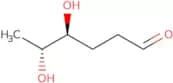
CAS:(4S,5R)-4,5-Dihydroxyhexanal is a conjugate of 4-hydroxy-5-oxononanoic acid and phosphite. It is a hybridized molecule that has been synthesized using an asymmetric synthesis. (4S,5R)-4,5-Dihydroxyhexanal can be used as an analog for digitalis. The compound has the ability to activate cardiac glycoside receptors in the heart and increase the force of contraction of cardiac muscle cells. The effective dose for this drug is not yet known, although it has been shown to have cardiotonic steroid properties.Formula:C6H12O3Purity:Min. 95%Molecular weight:132.16 g/mol2-O-Acetyl-3,4,6-tri-O-benzyl-a-D-glucopyranosyl trichloroacetimidate
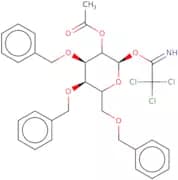
CAS:2-O-Acetyl-3,4,6-tri-O-benzyl-a-D-glucopyranosyl trichloroacetimidate is a custom synthesis. It is a modified oligosaccharide with a fluorinated carbon atom in the 2 position of the acetyl group. This chemical has been shown to be effective for click modification and glycosylation reactions. The CAS number for this chemical is 108869-64-3.Purity:Min. 95%Methyl 2,3-di-O-acetyl-4,6-O-(4-methoxybenzylidene)-a-D-mannopyranoside
Methyl 2,3-di-O-acetyl-4,6-O-(4-methoxybenzylidene)-a-D-mannopyranoside is a custom synthesis that contains a fluorinated sugar with a methyl group attached to the 4 position. The oligosaccharide is synthesized through click chemistry and has been modified with an acetate at the 6 position. The CAS number is 108739-53-0. The carbohydrate is a complex carbohydrate that can be found in nature or synthesized in the laboratory.
Formula:C19H24O9Purity:Min. 95%Molecular weight:396.4 g/molBenzyl 2-acetamido-2-deoxy-6-O-trityl-a-D-glucopyranoside
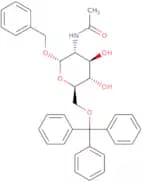
CAS:Benzyl 2-acetamido-2-deoxy-6-O-trityl-a-D-glucopyranoside is a glycosylation of benzyl 2,3,4,6-tetraacetamido-2,3,4,6-tetra deoxyglucopyranoside. It is a complex carbohydrate that can be modified with methyl groups or fluorine atoms. This product is often used in Click chemistry and as a building block for oligosaccharides and polysaccharides. Benzyl 2-acetamido-2-deoxy 6O trityl a D glucopyranoside has CAS number 33493 71 9 and can be custom synthesized to meet individual requirements.
Formula:C34H35NO6Purity:Min. 95%Color and Shape:White PowderMolecular weight:553.64 g/molEthyl 4,6-O-benzylidene-β-D-thioglucopyranoside
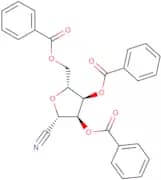
CAS:A protected thioglucose sugarFormula:C15H20O5SPurity:Min. 95%Color and Shape:PowderMolecular weight:312.38 g/mol2,3,5-Tri-O-benzoyl-β-D-ribofuranosyl cyanide
CAS:Building block for C-nucleoside synthesisFormula:C27H21NO7Purity:Min. 98 Area-%Color and Shape:White PowderMolecular weight:471.46 g/mol2-Acetamido-2-deoxy-a-D-galactopyranosyl serine
CAS:2-Acetamido-2-deoxy-a-D-galactopyranosyl serine (2AGPS) is a naturally occurring glycosaminoglycan. It has been shown to inhibit the growth of cancer cells and to reduce the size of mouse tumors in vivo. This compound also inhibits viral replication in vitro, and its antiviral properties have been shown to work on several different types of viruses, including herpes simplex virus type 1, human cytomegalovirus, and influenza A virus. 2AGPS is also a potent inducer of toll-like receptor 4 signaling pathways in macrophages and dendritic cells. 2AGPS can be synthesized by using a polymerase chain reaction (PCR) technique with synthetic oligosaccharides as a template.Formula:C11H20N2O8Purity:Min. 90 Area-%Color and Shape:Off-White Yellow PowderMolecular weight:308.29 g/mol(2R,2'R,3S,3'S,4R,4'R,5S,5'S)-6,6'-(1,4-Phenylenebis(ethyne-2,1-diyl))bis(2-(hydroxymethyl)tetrahydro-2H-pyran-3,4,5-triol
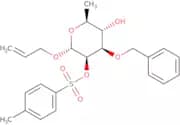
CAS:Please enquire for more information about (2R,2'R,3S,3'S,4R,4'R,5S,5'S)-6,6'-(1,4-Phenylenebis(ethyne-2,1-diyl))bis(2-(hydroxymethyl)tetrahydro-2H-pyran-3,4,5-triol including the price, delivery time and more detailed product information at the technical inquiry form on this pageFormula:C22H26O10Molecular weight:450.44 g/molAllyl 3-O-benzyl-2-O-p-toluenesulfonyl-a-L-rhamnopyranoside
CAS:Allyl 3-O-benzyl-2-O-p-toluenesulfonyl-a-L-rhamnopyranoside (ABTS) is a synthetic sugar derivative that is used in the modification and synthesis of saccharides. ABTS can be modified by fluorination, glycosylation, methylation, or other modifications to produce new compounds. ABTS has a CAS number of 940274-22-6.Formula:C23H28O7SPurity:Min. 95%Molecular weight:448.54 g/mol4-O-β-D-Galactopyranosyl-D-glucitol
CAS:Lactitol is a polyol sugar alcohol that has been used in the treatment of chronic viral hepatitis. It is also used to treat constipation, irritable bowel syndrome, and other gastrointestinal disorders. Lactitol is metabolized by certain types of bacteria and can have a laxative effect. Lactitol is not absorbed in the human intestine and thus does not cause an increase in blood sugar levels. Lactitol has been shown to be effective against microbial translocation and bacterial overgrowth in the gut, which may be due to its ability to lower pge2 levels and inhibit histological changes.
Formula:C12H24O11Purity:Min. 98.0 Area-%Molecular weight:344.31 g/molRef: 3D-W-109090
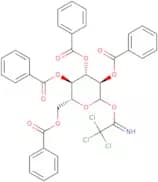
1kgTo inquire5kgTo inquire10kgTo inquire500gTo inquire2500gTo inquire-Unit-kgkgTo inquire2,3,4,6-Tetra-O-benzoyl-a-D-glucopyranosyl trichloroacetimidate
CAS:A calibration system is a device that utilizes a set of parameters to calibrate or correct for errors in measurement. The device utilizes the properties of the signal, such as amplitude and frequency, to compensate for electronic distortion. A calibration system can be used in many different fields including biology, medicine and telecommunications. The optical system includes a sensor that interacts with an organism or cell culture to measure the concentration of a substance. The sensor may utilize light-emitting diodes (LEDs) or photodetectors to detect changes in current or voltage. Calibration is needed to ensure accuracy when using this type of sensor. A linearized data base stores information about polypeptides such as their linear sequence and how they interact with other molecules. This data base can be accessed by programs that calculate the sequence of new polypeptides and predict their function in cells and organisms.Formula:C36H28Cl3NO10Purity:Min. 95%Color and Shape:PowderMolecular weight:740.97 g/molN-Acetyl-D-galactosamine
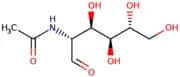
CAS:N-acetyl D-galactosamine (GalNAc) is an aldohexose (2-acetamido-2-deoxygalactose) in which the hydroxyl group at position 2 is replaced by a N-acetyl group (Collins, 2006). GalNAc forms a key part of both N- and O-linked glycoproteins, glycolipids, gangliosides, blood groups, glycosaminoglycans (chondroitin and dermatan sulfate) and human milk oligosaccharides. The number of GalNAc residues attached to the IgA O-linked glycans of Crohns Disease patients was significantly decreased, and strongly correlated with clinical activity. It is suggested that alterations of GalNAc attachment in IgA may be useful as a novel diagnostic and prognostic marker of Crohns Disease (Inoue, 2012).Formula:C8H15NO6Purity:Min. 99.0 Area-%Molecular weight:221.21 g/molN-Acetyl-D-glucosamine
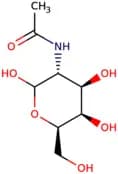
CAS:N-acetyl D-glucosamine (GlcNAc) is an aldohexose (2-acetamido-2-deoxyglucose) in which the hydroxyl group at position 2 is replaced by NHAc (Collins, 2006). N-acetyl D-glucosamine forms the exoskeletons of molluscs and insects as the building block of the polysaccharide chitin (Rudrapatnam, 2003). N-acetyl D-glucosamine is a key component of N- and O-linked glycans, present in glycolipids and the glycosaminoglycan hyaluronic acid (Fallacara, 2018). A recent study has suggested that N-acetyl D-glucosamine may have therapeutic potential for COVID-19 as it affects the spike protein-ACE2 receptor interaction during the infection with SARS-CoV-2 virus (Baysal, 2021).
Formula:C8H15NO6Purity:Min. 98.0 Area-%Molecular weight:221.21 g/molRef: 3D-A-1200
5gTo inquire1kgTo inquire5kgTo inquire100gTo inquire2500gTo inquire-Unit-kgkgTo inquire1,2:5,6-Di-O-isopropylidene-α-D-ribo-hexofuranose-3-ulose hydrate
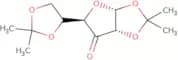
CAS:This is a sugar that is found in the urine of reindeer and caribou. It was first identified in the urine of animals captured in Alaska during the winter months. It has been shown to be present in human urine, as well, but at lower concentrations. Radiocarbon dating has revealed that this sugar is produced seasonally, with higher levels being found during the winter months. The seasonal variation may be due to changes in diet or metabolism.Formula:C12H18O6Purity:Min. 95%Color and Shape:PowderMolecular weight:258.27 g/mol4-O-{4-O-[[2,4-Di-O-acetyl-3-O-[2,4-di-O-(3,4,6-tri-O-acetyl-2-deoxy-2-phthalimido-β-D-glucopyranosyl)-3,6-di-O-benzyl-α-D-mannopyra nosyl]-6-O-[3,4-di-O-acetyl-2,6-di-O-(3,4,6-tri-O-acetyl-2-deoxy-2-phthalimido-β-D-glucopyranosyl)-α-D-mannopyranosyl]
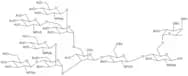
CAS:4-O-{4-O-[[2,4-Di-O-acetyl-3-O-[2,4-di-O-(3,4,6-tri-O-acetyl-2-deoxy-2--phthalimido--bD--glucopyranosyl)-3,6--di--O--benzyl aDmannopyra nosyl]-6--O-[3,4--di--O--acetyl 2,6--di--O-(3,4,6--tri - O - acetyl 2 - deoxy 2 - phthalimido bDglucopyranosyl) aDmannopyranosyl] } is a synthetic complex carbohydrate. It is an oligosaccharide that can be used in glycosylation reactions. This carbohydrate has been custom synthesized and modified to include methyl groups. The CAS number for this compound is 9461642899.Formula:C196H200N6O72Purity:Min. 95%Molecular weight:3,791.68 g/mol5-O-Allyl-2,3,4-tri-O-benzyl-D-ribitol
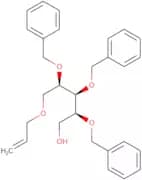
CAS:5-O-Allyl-2,3,4-tri-O-benzyl-D-ribitol is an acid that has been used in preparative organic chemistry. It is a benzyloxymethyl derivative of ribose, which can be converted to the corresponding methyl ether by hydrolysis with sodium methoxide in methanol. 5-O-Allyl-2,3,4-tri-O-benzyl-D-ribitol functions as an isomer and dimerization reagent for the preparation of propenyl derivatives. 5-O-Allyl 2,3,4 tri O benzyl D ribitol has been shown to inhibit Influenza A H1N1 strains in vitro with a 50% inhibitory concentration (IC50) of 1 μM.Formula:C29H34O5Purity:Min. 90.0 Area-%Color and Shape:Yellow Clear LiquidMolecular weight:462.58 g/mol(2R, 3S, 4R, 5S) -3,4-Di-O-Isopropylidene-2- methyl- 1- nonyl-3, 4, 5- piperidinetriol
2R, 3S, 4R, 5S) -3,4-Di-O-Isopropylidene-2- methyl- 1- nonyl-3, 4, 5- piperidinetriol is a modification of the oligosaccharide. It is synthesized by custom synthesis and has high purity. This product can be found under CAS No. 9062-16-7 and has a molecular weight of 873. The chemical formula is (C6H10O5)n and the structural formula is CHNO. This product is an Oligosaccharide and Carbohydrate.Purity:Min. 95%1,2,3,4-Tetra-O-pivaloyl-6-O-trityl-b-D-galactopyranose
Tetra-O-pivaloyl-6-O-trityl-b-D-galactopyranose is a sugar that can be used in the synthesis of glycosylation, complex carbohydrate, methylation, click modification, polysaccharide, fluorination, saccharide and modification. Tetra-O-pivaloyl-6-O-trityl-b-D-galactopyranose is a white or colorless crystalline powder that has a melting point of about 160°C. The chemical formula for this compound is C24H34N2O4 and its molecular weight is 432.53 g/mol. Tetra -O -pivaloyl -6 - O -trityl -b - D -galactopyranose has CAS No. 15892–06–8 (EINECS No. 259–737–3) and it can be customFormula:C45H58O10Purity:Min. 95%Molecular weight:758.94 g/molN-Acetyl-3-fluoro-neuraminic acid sodium
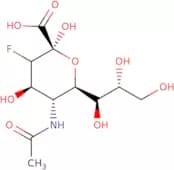
CAS:N-Acetyl-3-fluoro-neuraminic acid sodium (AFNA) is an inhibitor that binds to the terminal sialic acid residue of the glycoprotein neuraminidase in influenza viruses, preventing the virus from attaching to cells. AFNA is a fluorinated derivative of mannosamine and is synthesized by reacting an aldolase with sulfur trifluoride. AFNA has been shown to inhibit sialidases and utilising enzymes, which are necessary for viral replication. AFNA also inhibits bacterial sialidases, which are required for the synthesis of cell wall components.
Formula:C11H18FNO9•Nax327Purity:Min. 95%Color and Shape:PowderMolecular weight:326.25 g/mol