Glycoscience
Glycoscience is the study of carbohydrates and their derivatives, as well as the interactions and biological functions they participate in. This field of research is crucial for understanding a wide variety of biological processes, including cell recognition, signaling, immune response, and disease development. Glycoscience has important applications in biotechnology, medicine, and the development of new drugs and therapies. At CymitQuimica, we offer a wide selection of high-quality, high-purity products for glycoscience research. Our catalog includes monosaccharides, oligosaccharides, polysaccharides, glycoconjugates, and specific reagents, designed to support researchers in their studies on the structure, function, and applications of carbohydrates in biological systems. These resources are intended to facilitate scientific discoveries and practical applications in various areas of bioscience and medicine.
Subcategories of "Glycoscience"
- Aminosugars(108 products)
- Glyco-Related Antibodies(282 products)
- Glycolipids(46 products)
- Glycosaminoglycans (GAGs)(55 products)
- Glycosides(419 products)
- Monosaccharides(6,622 products)
- Oligosaccharides(3,682 products)
- Polysaccharides(503 products)
Found 11041 products of "Glycoscience"
Sort by
Purity (%)
0
100
|
0
|
50
|
90
|
95
|
100
D-Galactose-BSA
<p>D-Galactose-BSA is a modified carbohydrate that is synthesized by the selective substitution of the hydroxyl group on the beta-carbon of D-galactose. This modification enhances the binding affinity of D-galactose to bovine serum albumin (BSA), which is used as a carrier protein for many biological assays. The fluorination step in this synthesis creates reactive sites on the molecule, which are then available for chemical modifications such as methylation or glycosylation. D-Galactose-BSA can be custom synthesized to meet your specifications for purity, stability, and activity.</p>Color and Shape:White PowderD-Fructose-6-phosphate sodium hydrate
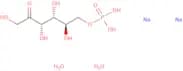
CAS:<p>D-Fructose-6-phosphate sodium hydrate is a polyvalent bioactive compound that can be found in plants, fungi, and bacteria. It has been used as a sealant for wounds and to treat damaged skin. D-Fructose-6-phosphate sodium hydrate is also used to activate the hydrophobic or dextran molecules in some drug delivery systems. This compound can be found in many products such as polyester fabrics, thermoplastic materials, and hydrophilic plastics. D-Fructose-6-phosphate sodium hydrate is an important intermediate in the metabolic pathways of glucose and sucrose.</p>Formula:C6H13O9P·2NaH2O)Purity:Min. 95%Molecular weight:342.1 g/mol5-Aldo-1,2-O-isopropylidene-a-D-xylofuranose
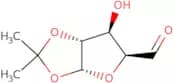
CAS:<p>5-Aldo-1,2-O-isopropylidene-a-D-xylofuranose is a synthetic monosaccharide with the chemical formula C5H6O4. It can be used to synthesize oligosaccharides and polysaccharides. This compound is a fluorinated sugar with a methyl group at the 5 position and an isopropylidene group at the 2 position. 5-Aldo-1,2-O-isopropylidene-a-D-xylofuranose can be modified by click chemistry reactions, which are reactions that use copper catalysts to form carbon–carbon bonds in a single step. This modification can be done on either the sugar or its glycosylation partner. The CAS number for this compound is 531671166.</p>Formula:C8H12O5Purity:Min. 95%Molecular weight:188.18 g/molBenzyl 2-acetamido-3-O-(2,3,4,6-tetra-O-acetyl-b-D-galactopyranosyl)-2-deoxy-4,6-O-isopropylidene-D-galactopyranose
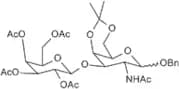
<p>This is a custom synthesized, high purity and complex carbohydrate. The synthesis process involves the following steps: 1) Acetylation of a monosaccharide, 2) Fluorination, 3) Methylation, 4) Oligosaccharide formation, 5) Polysaccharide formation with glycosylation and 6) Click modification. <br>Benzyl 2-acetamido-3-O-(2,3,4,6-tetra-O-acetyl-b-D-galactopyranosyl)-2-deoxy-4,6-O-isopropylidene-D-galactopyranose is an oligosaccharide that has been modified by methylation and click chemistry. It has CAS No. 77562-20-0 and can be used as a sugar in various applications.</p>Formula:C32H43NO15Purity:Min. 95%Molecular weight:681.7 g/molKifunensine diacetonide
CAS:<p>Kifunensine diacetonide is a modification of the natural oligosaccharide kifunensine. It is a complex carbohydrate with a high degree of purity, and is synthesized from a monosaccharide methylated and glycosylated with an oxygen-containing group. Kifunensine diacetonide has been shown to have anti-inflammatory effects in mice, which may be due to its ability to inhibit the production of prostaglandins. The molecular weight ranges from 500 to 1000 Daltons.</p>Formula:C14H20N2O6Purity:Min. 95%Color and Shape:PowderMolecular weight:312.32 g/molUndecylenyl b-D-maltoside
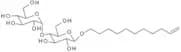
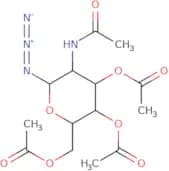
<p>Undecylenyl b-D-maltoside is a high purity sugar that can be custom synthesized. It is fluorinated at the hydroxyl group, glycosylated, and methylated. This product is also available in various configurations including oligosaccharides, monosaccharides, and complex carbohydrates. <br>Undecylenyl b-D-maltoside is a carbohydrate that can be used as a synthetic building block for the synthesis of other sugars. It can also be used for glycosylation reactions to create new glycoconjugates with improved properties. Undecylenyl b-D-maltoside is an oligosaccharide with a saccharide chain consisting of 10 units of D-glucose and one unit of D-mannose. The individual units are linked together by alpha 1,6 bonds.</p>Formula:C23H42O11Purity:Min. 95%Molecular weight:494.57 g/molAzido 2-acetamido-2-deoxy-3,4,6-tri-o-acetyl-β-D-galactopyranosyl
CAS:<p>Azido 2-acetamido-2-deoxy-3,4,6-tri-O-acetyl-β-D-galactopyranosyl is a high purity and custom synthesis sugar. Azido 2-acetamido-2-deoxy-3,4,6-triO acetyl βD galactopyranosyl can be fluorinated, glycosylated, modified with methylation and other methods. It can also be used to synthesize oligosaccharides or monosaccharides. This carbohydrate is used in complex carbohydrates.</p>Formula:C14H20N4O8Purity:Min. 95%Molecular weight:372.33 g/molNonanoyl-N-Hydroxyethylglucamide
CAS:<p>Nonanoyl-N-Hydroxyethylglucamide is a novel methylation and click modification reagent that has been shown to be highly effective for the methylation of carbohydrates. It is also a potent fluorinating agent, which can be used for the preparation of complex carbohydrates, such as oligosaccharides and polysaccharides. Nonanoyl-N-Hydroxyethylglucamide is available in high purity and with various modifications.</p>Formula:C17H35NO7Purity:Min. 95%Molecular weight:365.46 g/molOctyl D-galactofuranoside tetraacetate
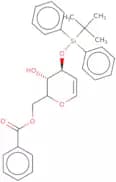
CAS:<p>Octyl D-galactofuranoside tetraacetate is a fluorinated monosaccharide that is synthesized from octyl galactopyranoside. It is a synthetic oligosaccharide with a molecular weight of 806. Octyl D-galactofuranoside tetraacetate has been modified for glycosylation, methylation, and click modification. The chemical name is 4-O-(2-deoxy-beta-D-glucopyranosyl)galactopyranose 1,2,3,4,6-pentaacetate and it has CAS No. 223412-29-1. This product can be custom synthesized to order in high purity as per the customer's requirements.</p>Formula:C22H36O10Purity:Min. 95%Molecular weight:460.52 g/mol6-O-Benzoyl-3-O-tert-butyldiphenylsilyl-D-galactal
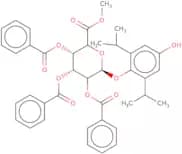
<p>6-O-Benzoyl-3-O-tert-butyldiphenylsilyl-D-galactal is an oligosaccharide with a complex carbohydrate structure. It is prepared by the modification of D-galactal with benzoyl chloride and subsequent reaction with tert-butyl diphosphite. This compound has been shown to have antihypertensive properties and to inhibit the growth of tumor cells in culture. 6-O-Benzoyl-3-O-tert butyldiphenylsilyl D galactal is a fluorinated, high purity, synthetic sugar that is effective for inhibiting tumor growth in culture.</p>Formula:C29H32O5SiPurity:Min. 95%Molecular weight:488.65 g/molPropofol 2,3,4-tri-O-benzoyl-b-D-glucuronide methyl ester
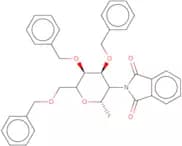
<p>Propofol is a general anesthetic that is used to induce and maintain anesthesia. It binds to GABA receptors in the brain, leading to suppression of neuronal activity. Propofol is metabolized by esterases in the liver, resulting in its active form 2,3,4-tri-O-benzoyl-b-D-glucuronide methyl ester. This active form inhibits glycolysis by inhibiting the conversion of glucose to fructose 1,6-bisphosphate and glyceraldehyde 3-phosphate by phosphoglucose isomerase and triose phosphate isomerase respectively. It also inhibits protein synthesis by binding to the ribosomes and preventing peptide bond formation on amino acids.</p>Formula:C40H40O10Purity:Min. 95%Molecular weight:680.74 g/mol3,4,6-Tri-O-benzyl-2-deoxy-2-phthalimdo-b-D-glucopyranosyl fluoride
<p>3,4,6-Tri-O-benzyl-2-deoxy-2-phthalimdo-b-D-glucopyranosyl fluoride is a modified sugar that is synthesized by the addition of a benzyl group to the 3' hydroxyl group. It's a white powder that is soluble in water and ethanol. This product has been shown to be stable in acid environments and can be used in glycosylation reactions.</p>Formula:C35H32FNO6Purity:Min. 95%Molecular weight:581.63 g/molNeocarratetraose-41-O-sulfate sodium salt
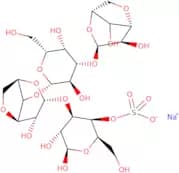
CAS:<p>Neocarratetraose-41-O-sulfate sodium salt is a high purity, synthetic oligosaccharide with a CAS number of 108321-78-4. It is an oligosaccharide that has been modified with methylation, saccharide, and Click modification. Neocarratetraose-41-O-sulfate sodium salt is used in the synthesis of complex carbohydrates and glycosylations. <br>Neocarratetraose-41-O-sulfate sodium salt is synthesized by reacting the sugar neocarratetraose with sulfuryl chloride to form the corresponding sulfonic acid chloride. The resulting compound is then treated with sodium hydroxide to produce its sodium salt form.</p>Formula:C24H37NaO22SPurity:Min. 95%Color and Shape:PowderMolecular weight:732.59 g/molPhenyl 3-azido-2,4,6-tri-O-benzyl-3-deoxy-b-D-thioglucopyranoside
CAS:<p>Phenyl 3-azido-2,4,6-tri-O-benzyl-3-deoxy-b-D-thioglucopyranoside is a custom synthesis. The compound is an oligosaccharide and polysaccharide with a complex carbohydrate structure. Phenyl 3-azido-2,4,6-tri-O-benzyl-3-deoxyglucopyranoside has been modified by methylation and glycosylation. It has also been fluorinated and synthesized.</p>Formula:C33H36N3O4SPurity:Min. 95%Molecular weight:570.72 g/mol17b-Estradiol 3-O-benzyl 17-(2,3,4-tri-O-acetyl-b-D-glucuronide methyl ester)
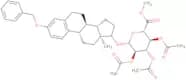
CAS:<p>17b-Estradiol 3-O-benzyl 17-(2,3,4-tri-O-acetyl-b-D-glucuronide methyl ester) is a modification of estradiol with an attached sugar. It is synthesized from the carbohydrate complex oligosaccharide. The synthesis starts by attaching an acetyl group to the sugar at the 3 position and then reacting it with benzyl alcohol to form a glycosidic linkage. The synthesis ends with a fluorination and saccharide cleavage.</p>Formula:C38H46O11Purity:Min. 95%Molecular weight:678.77 g/molAllo-3a-tetrahydro cortisol 21-O-b-D-glucuronide
CAS:<p>Allo-3a-tetrahydro cortisol 21-O-b-D-glucuronide (A4C21) is a complex carbohydrate with a high degree of modification. The A4C21 is synthesized by the glycosylation and methylation of 3,5,6,7,8,9,10,11-hexahydrodehydrocortisol 21-O-b-D-glucuronide. The synthesis starts with the formation of an acetal between the two hydroxyl groups on one side of the steroid nucleus and two chloroform molecules in order to protect the reactant from further reactions. The reaction product is then subjected to a ketalization reaction with thioglycolic acid to yield an alpha/beta unsaturated ketone which is then reacted with ethylene diamine to produce an amide linkage. This amide linkage is then cleaved to yield an aldol condensation product</p>Formula:C27H42O11Purity:Min. 95%Molecular weight:542.62 g/molAldehydo-D-glucose phthalazin-1-yl hydrazone
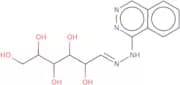
CAS:<p>Aldehydo-D-glucose phthalazin-1-yl hydrazone is a synthetic glycosylation agent that can be used in the synthesis of complex carbohydrates, such as polysaccharides, saccharides and oligosaccharides. It has been shown to be useful for the modification of saccharides and oligosaccharides. This compound can also be used for fluorination reactions, fluoroalkylations, click chemistry reactions, methylations and polymerizations. Aldehydo-D-glucose phthalazin-1-yl hydrazone has not yet been assigned CAS number.</p>Formula:C14H18N4O5Purity:Min. 95%Molecular weight:322.32 g/mol1,2,3,4-Tetra-O-acetyl-a-D-arabinopyranose
CAS:<p>1,2,3,4-Tetra-O-acetyl-a-D-arabinopyranose is an Oligosaccharide that is a synthetic derivative of the natural sugar arabinose. It has a tetra acetyl group attached to one of its hydroxyl groups. This modification gives the molecule unique properties that make it useful in glycosylation and other biochemical applications. 1,2,3,4-Tetra-O-acetyl-a-D-arabinopyranose can be used for synthesis of complex carbohydrates and saccharides with Click modifications. The compound is also CAS No. 19186-37-9.</p>Formula:C13H18O9Purity:Min. 95%Molecular weight:318.31 g/mol3,5-Bis-O-(2,4-Dichlorobenzyl)-2-C-methyl-a-D-ribofuranose
<p>3,5-Bis-O-(2,4-Dichlorobenzyl)-2-C-methyl-a-D-ribofuranose is a custom synthesis that can be modified by fluorination, methylation, and monosaccharide or oligosaccharide addition. This sugar has a molecular weight of 476.28 g/mol and CAS No. 94629-04-0. It is a polysaccharide that is glycosylated with sugar at carbons 1 and 2. 3,5-Bis-O-(2,4-Dichlorobenzyl)-2-C-methyl-a-D-ribofuranose is used as an intermediate in the synthesis of complex carbohydrates such as Glycogenin A (CAS No. 94629 04 0), which has been shown to have antihyperglycemic effects.</p>Purity:Min. 95%Methyl 1-thiolincosaminide
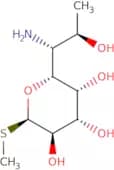
CAS:<p>Intermediate in the production of biosynthetic antibiotics</p>Formula:C9H19NO5SPurity:Min. 95%Molecular weight:253.32 g/mol