Glycoscience
Glycoscience is the study of carbohydrates and their derivatives, as well as the interactions and biological functions they participate in. This field of research is crucial for understanding a wide variety of biological processes, including cell recognition, signaling, immune response, and disease development. Glycoscience has important applications in biotechnology, medicine, and the development of new drugs and therapies. At CymitQuimica, we offer a wide selection of high-quality, high-purity products for glycoscience research. Our catalog includes monosaccharides, oligosaccharides, polysaccharides, glycoconjugates, and specific reagents, designed to support researchers in their studies on the structure, function, and applications of carbohydrates in biological systems. These resources are intended to facilitate scientific discoveries and practical applications in various areas of bioscience and medicine.
Subcategories of "Glycoscience"
- Aminosugars(108 products)
- Glyco-Related Antibodies(282 products)
- Glycolipids(46 products)
- Glycosaminoglycans (GAGs)(55 products)
- Glycosides(419 products)
- Monosaccharides(6,622 products)
- Oligosaccharides(3,682 products)
- Polysaccharides(503 products)
Found 11041 products of "Glycoscience"
Sort by
Purity (%)
0
100
|
0
|
50
|
90
|
95
|
100
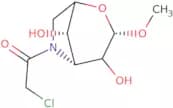
Methyl 3,6-dideoxychloroacetamido-a-D-mannopyranoside
CAS:<p>Methyl 3,6-dideoxychloroacetamido-a-D-mannopyranoside is a complex carbohydrate that has been modified by fluorination and methylation. It is an important building block in the synthesis of oligosaccharides and polysaccharides. This product is also used in click chemistry, where it can be reacted with a variety of thiols to form new linkages. Methyl 3,6-dideoxychloroacetamido-a-D-mannopyranoside can also be used to modify saccharides or sugars by click chemistry. This compound is highly pure and custom synthesized to customer specifications.</p>Formula:C9H14ClNO5Purity:Min. 95%Molecular weight:251.66 g/molb-D-Fructofuranosyl-a-D-galactopyranoside
CAS:<p>The b-D-Fructofuranosyl-a-D-galactopyranoside is a sugar molecule that is a carbohydrate. It contains sugar phosphates and an aldehyde group. The hydroxyl groups on the molecule can be found on the hydroxyl, ketone, and alcohols that are present. This carbohydrate also has hemiketal and sugar alcohol groups. These molecules have six carbon atoms in their molecular structure with one oxygen atom and one hydrogen atom attached to each of them. The deoxy form of this molecule is not active for DNA synthesis or protein synthesis but it can be used as an intermediate in the production of other sugars such as maltose, cellobiose, and sucrose.</p>Formula:C12H22O11Purity:Min. 95%Molecular weight:342.3 g/molN-Methylglucamine antimonate
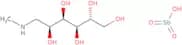
CAS:<p>N-Methylglucamine antimonate is a drug that is used to treat cutaneous leishmaniasis. It is not active against the visceral form of the disease. The drug binds to antimony in a 1:1 stoichiometry and inhibits the polymerase chain reaction (PCR) in the parasite, which prevents DNA replication and transcription. This inhibition leads to cell death and eventual elimination of Leishmania parasites from the host. N-Methylglucamine antimonate is only effective against Leishmania parasites and has no effect on other bacteria or viruses, such as bowel disease. The drug can be given orally or intravenously, but should not be given to patients with bowel diseases because this may lead to intestinal ulceration or perforation.</p>Formula:C7H17NO5·HSbO3Purity:Min. 95%Color and Shape:White PowderMolecular weight:365.98 g/molHeparin derived dp20 saccharide ammonium salt
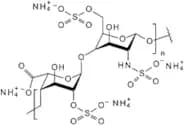
<p>Heparin derived dp20 saccharide ammonium salt is a synthetic, high purity, complex carbohydrate that has been modified with fluorination and methylation. It is a polysaccharide composed of repeating units of D-glucosamine and D-mannose, which are linked by alternating alpha 1-6 and alpha 1-4 glycosidic bonds. This product can be used as a monosaccharide or sugar in the synthesis of oligosaccharides or polysaccharides.</p>Purity:Of Main Disaccharide Unit Approx. 75%Color and Shape:White Off-White PowderMolecular weight:~5750 (Average)Methyl 2-O-allyl-4,6-O-benzylidene-a-D-mannopyranoside
CAS:<p>Methyl 2-O-allyl-4,6-O-benzylidene-a-D-mannopyranoside is a complex carbohydrate that has been synthesized from mannose and allyl bromide. This compound is a monosaccharide with a linear structure that contains an allyl group at C2 and a benzylidene group at C4. Methyl 2-O-allyl-4,6-O-benzylidene-a-D-mannopyranoside has been modified by fluorination and saccharification. It can be used in the synthesis of oligosaccharides or as a custom synthesis for monosaccharides. Methyl 2-O-allyl-4,6-O--benzylidene--a--D--mannopyranoside is available in high purity and is made to order.</p>Formula:C17H22O6Purity:Min. 95%Molecular weight:322.35 g/mol2,4,7,8,9-Penta-O-acetyl-N-acetyl-3-fluoro-D-neuraminic acid methyl ester
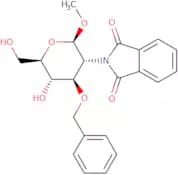
CAS:<p>Cell-permeable sialic acid analog</p>Formula:C22H30FNO14Purity:Min. 95%Color and Shape:White Off-White PowderMolecular weight:551.47 g/molMethyl 3-O-benzyl-2-deoxy-2-phthalimido-b-D-glucopyranoside
CAS:<p>Methyl 3-O-benzyl-2-deoxy-2-phthalimido-b-D-glucopyranoside is a synthetic, fluorinated saccharide that can be used as a glycosylation or Click modification reagent. It can be used for the synthesis of oligosaccharides and polysaccharides and has been shown to be capable of introducing methyl groups in saccharides. Methyl 3-O-benzyl-2-deoxy-2-phthalimido-b-D-glucopyranoside is also a potent inhibitor of bacterial RNA polymerase.</p>Formula:C22H23NO7Purity:Min. 95%Molecular weight:413.42 g/mol3,4,6-Tri-O-acetyl-2-deoxy-2-trichloroacetamido-D-glucopyranose
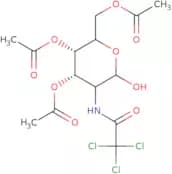
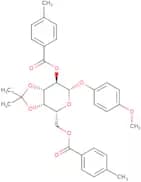
<p>3,4,6-Tri-O-acetyl-2-deoxy-2-trichloroacetamido-D-glucopyranose is an oligosaccharide that can be synthesized with a high purity. It is used as an intermediate in the synthesis of saccharides and complex carbohydrates. 3,4,6-Tri-O-acetyl-2-deoxy-2-trichloroacetamido-D-glucopyranose can also be fluorinated, glycosylated and methylated to generate new compounds. The CAS number for this compound is 4953–59–3. This compound is made up of three sugars: a hexose, a pentose and a triose. The carbohydrate that is produced from this compound has the following formula: C6H12O6 • H2O • O4CCH(OH)CH(OH)CH(OH)COO</p>Formula:C14H18Cl3NO9Purity:Min. 95%Molecular weight:450.66 g/mol4-Methoxyphenyl 3,4-O-isopropylidene-2,6-bis-O-(4-methylbenzoyl)-β-D-galactopyranoside
CAS:<p>4-Methoxyphenyl 3,4-O-Isopropylidene-2,6-bis-O-(4-methylbenzoyl)-b-D-galactopyranoside is a galactoside that acts as an inhibitor of calcium ion influx. It inhibits actin filament assembly and expression by binding to the N terminus of proteins in the actin filament regulatory complex. 4MPBIG has been shown to have anti-cancer effects through microstructural changes in cancer cells. This compound also inhibits cation channels and prevents the release of neurotransmitters from nerve cells. 4MPBIG has strong thermodynamic and kinetic profiles that can be used for profiling and identification purposes. The irreversible oxidation of the hydroxy group at C2 is a sequence specific process that can be used for identification purposes. The kinase domain contains carbides, which are useful for sequencing purposes due to their stability under acidic conditions.</p>Formula:C32H34O9Purity:Min. 95%Molecular weight:562.61 g/molMethyl 4-deoxy-a-D-glucopyranoside
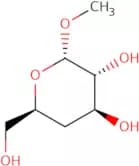
CAS:<p>Methyl 4-deoxy-a-D-glucopyranoside is a high purity synthetic sugar with the molecular formula C5H10O5. It has been custom synthesized for Click modification, fluorination, glycosylation and methylation. Methyl 4-deoxy-a-D-glucopyranoside is used in glycosylation as a monosaccharide or saccharide to form complex carbohydrates. This product can be used in the synthesis of oligosaccharides and polysaccharides.</p>Formula:C7H14O5Purity:Min. 95%Molecular weight:178.19 g/mol(2R,3R,4S,5R,6S)-3,4,5-Trihydroxy-2-hydroxymethyl-7,9-diaza-1-oxa-spiro[4,5]decane-10-one-8-thione
CAS:<p>(2R,3R,4S,5R,6S)-3,4,5-Trihydroxy-2-hydroxymethyl-7,9-diaza-1-oxa-spiro[4,5]decane-10-one-8-thione is a custom synthesis of a polysaccharide. It has been modified to include fluorination and methylation. The monosaccharides present are glucose and galactose. This polysaccharide also has a saccharide linkage to an oligosaccharide that contains glycosylation sites for sugar groups.</p>Formula:C8H12N2O6SPurity:Min. 95%Molecular weight:264.26 g/molClofibric acid acyl-b-D-glucuronide
CAS:<p>Clofibric acid acyl-b-D-glucuronide is a reactive chemical species that has been shown to have genotoxic effects. It binds to DNA and forms covalent adducts, leading to mutations in the DNA sequence. Clofibric acid acyl-b-D-glucuronide is a metabolite of clofibrate, which is used for the treatment of hyperlipidemia and atherosclerosis. This metabolite can be detected in human blood, serum, and liver samples by GC/MS, with a limit of detection of 0.1 ng/mL (0.0003 µg/L).</p>Formula:C16H19ClO9Purity:Min. 95%Molecular weight:390.77 g/molScopolamine O-b-D-glucuronide
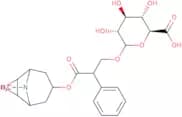
CAS:<p>Scopolamine O-b-D-glucuronide is a methylated derivative of scopolamine. It is an oligosaccharide that is synthesized through glycosylation and has a high purity. Scopolamine O-b-D-glucuronide is used in the synthesis of complex carbohydrates.</p>Formula:C23H29NO10Purity:Min. 95%Molecular weight:479.48 g/mol1,2,3,4,5,6-Hexa-O-acetyl-D-mannitol
CAS:<p>1, 2, 3, 4, 5, 6-Hexa-O-acetyl-D-mannitol (1,2,3,4,5,6-HOM) is a glycoside that belongs to the group of pentose sugars. It is the only natural hexose sugar that contains an acetate residue in its structure. 1,2,3,4,5,6-HOM is found in plants and animals and has been shown to have anti-cancer properties. The reaction products of 1 with various enzymes are also studied for their cancer inhibitory effects. This molecule has also been shown to inhibit lipid peroxidation in mitochondria.<br>1,2,3,4,5,6-HOM binds to cell surface receptors on cancer cells and inhibits growth by inhibiting the synthesis of DNA and RNA.</p>Formula:C18H26O12Purity:Min. 95%Color and Shape:PowderMolecular weight:434.39 g/mol4-Methylumbelliferyl 2,3,4-tri-O-acetyl-a-L-idopyranosiduronic acid methyl ester
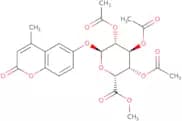
CAS:<p>4-Methylumbelliferyl 2,3,4-tri-O-acetyl-a-L-idopyranosiduronic acid methyl ester is a custom synthesis of a monosaccharide. It is fluorinated, methylated, and modified with the click reaction. This product has been used in the modification of oligosaccharides and polysaccharides.</p>Formula:C23H24O12Purity:Min. 95%Molecular weight:492.43 g/mol1-O-Acetyl-3,5-di-O-benzoyl-2-deoxy-D-ribofuranose
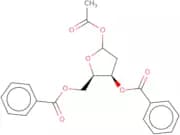
CAS:<p>1-O-Acetyl-3,5-di-O-benzoyl-2-deoxy-D-ribofuranose is a custom synthesis product. When fully synthesized and modified, it is a complex carbohydrate with glycosylation, methylation, click modification, fluorination and saccharide modifications. It has CAS No. 2155800-38-5 and Mw of 486.8 g/mol. 1-O-Acetyl-3,5-di-O-benzoyl--2--deoxy--D--ribofuranose can be used as an intermediate for the synthesis of oligosaccharides or monosaccharides or custom synthesis products. This product is available in high purity with >99% purity by HPLC analysis.</p>Formula:C21H20O7Purity:Min. 95%Molecular weight:384.38 g/molMethyl 2,3,5-tri-O-benzyl-a-D-arabinofuranoside
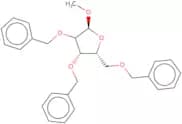
<p>Methyl 2,3,5-tri-O-benzyl-a-D-arabinofuranoside is a methylated sugar that belongs to the group of saccharides. It is often used as a Click modification and in custom synthesis of oligosaccharides. This product is also used for glycosylation and high purity modifications. Methyl 2,3,5-tri-O-benzyl-a-D-arabinofuranoside can be synthesized from arabinose and benzaldehyde with fluorination. The CAS number for this product is 51469-61-1.</p>Formula:C27H30O5Purity:Min. 95%Molecular weight:434.52 g/molMethylphenyl 2,3,4-tri-O-benzyl-b-L-thiorhamnopyranose
<p>Methylphenyl 2,3,4-tri-O-benzyl-b-L-thiorhamnopyranose is a modification of the natural sugar thiorhamnopyranose. It has been synthesized by methylation and glycosylation of the monosaccharide. This carbohydrate has been custom synthesized with high purity and CAS number. The chemical formula is C18H22O11. Methylphenyl 2,3,4-tri-O-benzyl-b-L-thiorhamnopyranose is a complex carbohydrate that can be used in biomedical applications.</p>Purity:Min. 95%2-Acetamido-2,4-dideoxy-4-fluoro-D-galactopyranose
CAS:<p>2-Acetamido-2,4-dideoxy-4-fluoro-D-galactopyranose (2ADF) is a synthetic ligand that binds to selectins, which are receptors expressed on the surface of cells. 2ADF has been shown to have a pharmacological effect in inhibiting inflammatory diseases by binding to and blocking the function of selectins. This drug has also been shown to inhibit leukocyte trafficking and chemotaxis by preventing the binding of selectins with their ligands, galectin 1 or galectin 3. 2ADF does not bind to glycan structures found on the cell membrane, but instead binds to glycan structures found on the surfaces of cells.</p>Formula:C8H14FNO5Purity:Min. 95%Molecular weight:223.2 g/molFurosemide acyl-b-D-glucuronide
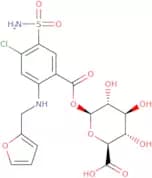
CAS:<p>Furosemide acyl-b-D-glucuronide is a derivative of Furosemide. It is a potent diuretic that has been used in the treatment of hypertension and congestive heart failure. The drug is excreted by the kidney, and its clearance is dependent on urine flow rate. Furosemide acyl-b-D-glucuronide can be detected in human serum and urine samples following oral administration, but its detection in urine may be delayed due to its low solubility. This active form of the drug may also cause drug reactions, such as nausea and vomiting, which are most likely due to the acidic nature of this form. Hydrochloric acid increases the absorption of Furosemide acyl-b-D-glucuronide, so it is recommended to take this medication with an acidic beverage containing hydrochloric acid or food high in pyridinium content. The elimination half life for this active</p>Formula:C18H19ClN2O11SPurity:Min. 95%Color and Shape:Yellow PowderMolecular weight:506.87 g/mol




![(2R,3R,4S,5R,6S)-3,4,5-Trihydroxy-2-hydroxymethyl-7,9-diaza-1-oxa-spiro[4,5]decane-10-one-8-thione](/_next/image/?url=https%3A%2Fstatic.cymitquimica.com%2Fproducts%2F3D%2Fthumb-webp%2FMT01909.webp&w=3840&q=75)