Glycoscience
Glycoscience is the study of carbohydrates and their derivatives, as well as the interactions and biological functions they participate in. This field of research is crucial for understanding a wide variety of biological processes, including cell recognition, signaling, immune response, and disease development. Glycoscience has important applications in biotechnology, medicine, and the development of new drugs and therapies. At CymitQuimica, we offer a wide selection of high-quality, high-purity products for glycoscience research. Our catalog includes monosaccharides, oligosaccharides, polysaccharides, glycoconjugates, and specific reagents, designed to support researchers in their studies on the structure, function, and applications of carbohydrates in biological systems. These resources are intended to facilitate scientific discoveries and practical applications in various areas of bioscience and medicine.
Subcategories of "Glycoscience"
- Aminosugars(108 products)
- Glyco-Related Antibodies(282 products)
- Glycolipids(46 products)
- Glycosaminoglycans (GAGs)(55 products)
- Glycosides(419 products)
- Monosaccharides(6,622 products)
- Oligosaccharides(3,682 products)
- Polysaccharides(503 products)
Found 11041 products of "Glycoscience"
Sort by
Purity (%)
0
100
|
0
|
50
|
90
|
95
|
100
Phenyl 2,3,4,6-tetra-O-benzoyl-b-D-thiogalactopyranoside
CAS:<p>Phenyl 2,3,4,6-tetra-O-benzoyl-b-D-thiogalactopyranoside is a sugar that can be custom synthesized. It has a high purity and can be fluorinated or glycosylated. This compound is used for the synthesis of oligosaccharides and saccharides. Phenyl 2,3,4,6-tetra-O-benzoyl-b-D-thiogalactopyranoside is used in the modification of complex carbohydrates.</p>Purity:Min. 95%o-(A-D-Galactopyranosyl)-D-galactose
CAS:<p>O-(A-D-Galactopyranosyl)-D-galactose is a sugar that is used in the synthesis of complex carbohydrates. O-(A-D-Galactopyranosyl)-D-galactose can be fluorinated and methylated to produce o-(A-D-Galactopyranosyl)-2,6-dideoxy--glucose. This sugar has been shown to inhibit the growth of bacteria such as Mycobacterium tuberculosis and Mycobacterium avium complex. Synthesis of this sugar is done through a custom synthesis process with high purity and quality.</p>Formula:C12H22O11Purity:Min. 95%Molecular weight:342.3 g/mol2C-Hydroxymethyl-2,3:5,6-di-O-isopropylidene-D-talono-1,4-lactone
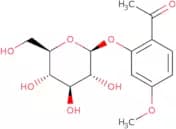
CAS:<p>2C-Hydroxymethyl-2,3:5,6-di-O-isopropylidene-D-talono-1,4-lactone is a synthetic monosaccharide that is used in the synthesis of oligosaccharides and polysaccharides. It can be fluorinated or methylated to form 2C-Fluoromethyl-2,3:5,6-di-O-(methyl)idene)-D-(talono)-1,4-lactone or 2C-(Methoxy)methyl -2,3:5,6 -di -O-(methyl)idene)-D-(talono)-1,4 -lactone. This product has been shown to have antiviral properties against HIV and influenza A virus.</p>Formula:C13H20O7Purity:Min. 95%Molecular weight:288.29 g/mol2-Acetyl-5-methoxyphenyl β-D-Glucopyranoside
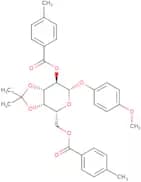
CAS:<p>2-Acetyl-5-methoxyphenyl beta-D-glucopyranoside is a flavonoid that belongs to the group of dihydroquercetin. It can be prepared by liquid chromatography. 2-Acetyl-5-methoxyphenyl beta-D-glucopyranoside inhibits tumor cells in vitro and in vivo, through the inhibition of protein synthesis and DNA replication. In addition, it has been shown to inhibit the growth of leptadenia species with a high degree of selectivity. It also exhibits an antitumor effect on mouse sarcoma 180 cells, as well as on human melanoma cells. This compound binds to macroporous adsorbents such as sephadex and tricusposide, which are used for purification purposes.</p>Formula:C15H20O8Purity:Min. 95%Molecular weight:328.31 g/mol4-Methoxyphenyl 3,4-O-isopropylidene-2,6-bis-O-(4-methylbenzoyl)-β-D-galactopyranoside
CAS:<p>4-Methoxyphenyl 3,4-O-Isopropylidene-2,6-bis-O-(4-methylbenzoyl)-b-D-galactopyranoside is a galactoside that acts as an inhibitor of calcium ion influx. It inhibits actin filament assembly and expression by binding to the N terminus of proteins in the actin filament regulatory complex. 4MPBIG has been shown to have anti-cancer effects through microstructural changes in cancer cells. This compound also inhibits cation channels and prevents the release of neurotransmitters from nerve cells. 4MPBIG has strong thermodynamic and kinetic profiles that can be used for profiling and identification purposes. The irreversible oxidation of the hydroxy group at C2 is a sequence specific process that can be used for identification purposes. The kinase domain contains carbides, which are useful for sequencing purposes due to their stability under acidic conditions.</p>Formula:C32H34O9Purity:Min. 95%Molecular weight:562.61 g/mol(3aR,3bS,6aR,7aR)-2,2-Dimethylhexahydrofuro[2',3':4,5]furo[2,3-d][1,3]dioxol-5-ol
CAS:<p>(3aR,3bS,6aR,7aR)-2,2-Dimethylhexahydrofuro[2',3':4,5]furo[2,3-d][1,3]dioxol-5-ol is a novel compound that induces the expression of an inducible gene. This compound has been shown to activate guanine and guanosine receptors and modulate the activity of guanosine triphosphatase. It has been shown to be effective in cancer cells and may have diagnostic applications. The mechanism of action for this drug is not fully understood but it has been suggested that it may act as a neuromodulator.</p>Purity:Min. 95%Agarodiitol
<p>Disaccharide alcohol from agarobiose by reduction with Na borohydride</p>Formula:C12H22O10Purity:Min. 95%Molecular weight:326.3 g/molHydroxyethyl cellulose, Mw about 250'000
CAS:<p>Hydroxyethyl cellulose (HEC) is a polysaccharide that is used as a thickener and emulsifier in the pharmaceutical industry. It has been shown to be effective in treating human serum with detrusor muscle contractions. HEC is also used as a negative control for experiments involving the effect of drugs on HIV infection. When mixed with isoxsuprine hydrochloride, HEC can be used to measure the concentration of basic proteins in human serum. The fluorescence probe can bind to specific regions of the protein, which will cause an increase in fluorescence when exposed to a wavelength of light. The optimum concentration of HEC for binding fluorescence probes was found using Langmuir adsorption isotherm measurements and fluorescence detector experiments. HEC has been shown to be an effective antimicrobial agent against bacteria and fungi, such as Staphylococcus aureus and Candida albicans. The benzalkonium chloride in HEC may</p>Methyl 2,3,4-tri-O-benzyl ribopyranose
CAS:<p>Methyl 2,3,4-tri-O-benzyl ribopyranose is a glycosylation product of Riboflavin. It is an oligosaccharide that is used in the synthesis of saccharides and polysaccharides. Methyl 2,3,4-tri-O-benzyl ribopyranose has a CAS number of 20787-20-6. It can be modified with fluorination or methylation. This product can be custom synthesized to meet your requirements.</p>Purity:Min. 95%Sucrose monopalmitate
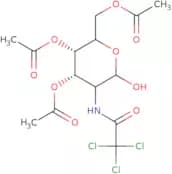
CAS:<p>Sucrose monopalmitate is a fatty acid that is used as a surfactant and emulsifier. It has been shown to have surface-active properties in vitro, which may be due to its ability to interact with the surface of cells. Sucrose monopalmitate is used in diagnostic agents such as active analogues, which are compounds that bind specifically to an analyte or target molecule. These compounds can then be detected by other methods such as radioactive labelling or enzyme-linked immunosorbent assay (ELISA). This product also has been shown to be useful in detergent compositions, including nanoemulsions and solid dispersions.</p>Formula:C28H52O12Purity:Min. 95%Molecular weight:580.71 g/mol3,4,6-Tri-O-acetyl-2-deoxy-2-trichloroacetamido-D-glucopyranose
<p>3,4,6-Tri-O-acetyl-2-deoxy-2-trichloroacetamido-D-glucopyranose is an oligosaccharide that can be synthesized with a high purity. It is used as an intermediate in the synthesis of saccharides and complex carbohydrates. 3,4,6-Tri-O-acetyl-2-deoxy-2-trichloroacetamido-D-glucopyranose can also be fluorinated, glycosylated and methylated to generate new compounds. The CAS number for this compound is 4953–59–3. This compound is made up of three sugars: a hexose, a pentose and a triose. The carbohydrate that is produced from this compound has the following formula: C6H12O6 • H2O • O4CCH(OH)CH(OH)CH(OH)COO</p>Formula:C14H18Cl3NO9Purity:Min. 95%Molecular weight:450.66 g/mola-D-Glucuronic acid 1-phosphate tripotassium salt pentahydrate
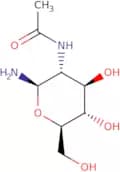
CAS:<p>1. Product Name: a-D-Glucuronic acid 1-phosphate tripotassium salt pentahydrate</p>Formula:C6H8O10PNa3Purity:Min. 95%Molecular weight:340.06 g/molN-(2-Amino-2-deoxy-β-D-glucopyranosyl)acetamide
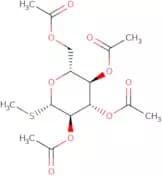
CAS:<p>Etanercept is a recombinant protein that is used to treat ankylosing spondylitis and other inflammatory diseases. It is a TNF blocker that binds to soluble TNF receptors, preventing them from activating the TNF receptors on cells. Etanercept has been shown to be effective in both adults and children with these disease. Etanercept also has an immunogenicity of about 10%.</p>Formula:C8H16N2O5Purity:Min. 95%Color and Shape:SolidMolecular weight:220.22 g/molMethyl 2,3,4,6-tetra-O-acetyl-b-D-thioglucopyranoside
CAS:<p>Methyl 2,3,4,6-tetra-O-acetyl-b-D-thioglucopyranoside is a sugar that has been modified with fluorination. It is synthesized by glycosylation and methylation of the sugar. Methyl 2,3,4,6-tetra-O-acetyl-b-D-thioglucopyranoside is a synthetically produced compound that is used as an intermediate in the synthesis of oligosaccharides and saccharides. It can be used as a monosaccharide or part of a complex carbohydrate.</p>Formula:C15H22O9SPurity:Min. 95%Molecular weight:378.4 g/mol4-O-Acetyl-2,5-anhydro-1,3-O-isopropylidene-6-[bis(2-cyanoethyl)phosphoryl]-D-glucitol
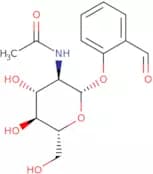
CAS:<p>4-O-Acetyl-2,5-anhydro-1,3-O-isopropylidene-6-[bis(2-cyanoethyl)phosphoryl]-D-glucitol is a synthetic carbohydrate that can be used as a pharmaceutical intermediate. 4-O-Acetyl-2,5-anhydro-1,3,-O isopropylidene 6-[bis(2 cyanoethyl)phosphoryl]-D glucitol is a sugar that has been fluorinated and methylated. It is an oligosaccharide sugar with glycosylation and click modification.</p>Formula:C17H25N2O9PPurity:Min. 95%Molecular weight:432.36 g/mol2-Formylphenyl 2-acetamido-2-deoxy-b-D-glucopyranoside
CAS:<p>2-Formylphenyl 2-acetamido-2-deoxy-b-D-glucopyranoside is a custom synthesis that is modified with a fluorination. It is an oligosaccharide that contains a methylation and glycosylation. This product is an Oligosaccharide, which is a complex carbohydrate. The synthesis of this product is high purity and has been synthesized by the methylation and glycosylation of monosaccharides. This compound has been synthesized from high purity chemicals, including saccharides, such as glucose or fructose. The compound's CAS number is 15430-78-1.</p>Formula:C15H19NO7Purity:Min. 95%Molecular weight:325.31 g/mol1,4-Di-[(Trishydroxymethyl)aminomethane]-1,4-tertratamide
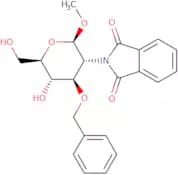
<p>1,4-Di-[(Trishydroxymethyl)aminomethane]-1,4-tertratamide is a methylated saccharide that can be used as a reagent for the click modification of polysaccharides and oligosaccharides. The fluorinated analogue of 1,4-di-[(trishydroxymethyl)aminomethane]-1,4-tertratamide has been shown to be an effective inhibitor of bacterial growth in vitro. This compound is also suitable for glycosylation and high purity synthesis.</p>Purity:Min. 95%Methyl 3-O-benzyl-2-deoxy-2-phthalimido-b-D-glucopyranoside
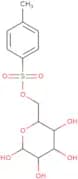
CAS:<p>Methyl 3-O-benzyl-2-deoxy-2-phthalimido-b-D-glucopyranoside is a synthetic, fluorinated saccharide that can be used as a glycosylation or Click modification reagent. It can be used for the synthesis of oligosaccharides and polysaccharides and has been shown to be capable of introducing methyl groups in saccharides. Methyl 3-O-benzyl-2-deoxy-2-phthalimido-b-D-glucopyranoside is also a potent inhibitor of bacterial RNA polymerase.</p>Formula:C22H23NO7Purity:Min. 95%Molecular weight:413.42 g/mol6-O-Tosyl-D-glucopyranose
CAS:<p>6-O-Tosyl-D-glucopyranose is an Oligosaccharide, Carbohydrate and Custom synthesis. It is a complex carbohydrate. This product is a monosaccharide that has been methylated, glycosylated, and polysaccharide modified. The CAS No. for this product is 26391-80-0 and its molecular weight is 598.6 g/mol. This product can be used in the synthesis of 6-O-Tosyl-D-[3H]glucopyranose (CAS No. 131552-01-8) which can be used as a radioactive marker in biological research or in the diagnosis of diseases such as cancer.</p>Purity:Min. 95%b-L-Fucopyranosyl nitromethane
<p>b-L-Fucopyranosyl nitromethane is a synthetic carbohydrate that has been modified by fluorination and methylation. It can be used as a building block for the synthesis of complex carbohydrates including saccharides, oligosaccharides, and monosaccharides.</p>Formula:C7H13NO6Purity:Min. 95%Molecular weight:207.2 g/mol



![(3aR,3bS,6aR,7aR)-2,2-Dimethylhexahydrofuro[2',3':4,5]furo[2,3-d][1,3]dioxol-5-ol](/_next/image/?url=https%3A%2Fstatic.cymitquimica.com%2Fproducts%2F3D%2Fthumb-webp%2FMD45372.webp&w=3840&q=75)



![4-O-Acetyl-2,5-anhydro-1,3-O-isopropylidene-6-[bis(2-cyanoethyl)phosphoryl]-D-glucitol](/_next/image/?url=https%3A%2Fstatic.cymitquimica.com%2Fproducts%2F3D%2Fthumb-webp%2FMA05705.webp&w=3840&q=75)
![1,4-Di-[(Trishydroxymethyl)aminomethane]-1,4-tertratamide](/_next/image/?url=https%3A%2Fstatic.cymitquimica.com%2Fproducts%2F3D%2Fthumb-webp%2FMD12057.webp&w=3840&q=75)