Antifungals
Antifungals are compounds specifically designed to stop, prevent, and eliminate the growth of fungi. In this category, you will find a wide variety of antifungal agents essential for research and therapeutic applications. These compounds are crucial in treating fungal infections and preventing their recurrence, making them vital tools in both medical and agricultural settings. Researchers and healthcare professionals can explore numerous antifungals to understand their mechanisms, optimize their efficacy, and develop new treatments to combat resistant fungal strains. The extensive selection of antifungals supports ongoing advancements in fungal research and the development of effective antifungal therapies.
Found 837 products of "Antifungals"
Sort by
Purity (%)
0
100
|
0
|
50
|
90
|
95
|
100
Amphotericin A
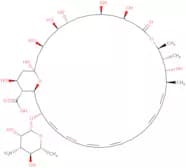
CAS:<p>Amphotericin A is a polyene macrolide antibiotic, which is derived primarily from the soil bacterium *Streptomyces nodosus*. This compound functions by binding to ergosterol, an essential component of fungal cell membranes. This binding creates pores in the membrane, increasing its permeability and ultimately leading to cell death. Unlike its more widely used counterpart Amphotericin B, Amphotericin A is less frequently utilized but is critical in the study and understanding of antifungal activity.</p>Formula:C47H75NO17Purity:Min. 95%Molecular weight:926.09 g/molExalamide
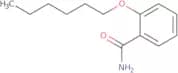
CAS:<p>Exalamide is an arenecarboxamide antifungal agent with action on fungal growth inhibition and is used for research on fungal infections.</p>Formula:C13H19NO2Purity:Min. 95%Molecular weight:221.3 g/molButoconazole nitrate
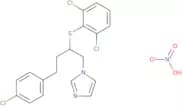
CAS:<p>Butoconazole nitrate is an antifungal agent and is used for the treatment of vaginal yeast infections. It inhibits the synthesis of ergosterol, disrupting the fungal cell membrane.</p>Formula:C19H18Cl3N3O3SPurity:Min. 98 Area-%Color and Shape:White PowderMolecular weight:474.79 g/molFolpet-d4
CAS:<p>Folpet-d4 is a deuterated compound of Folpet. Folpet has a CAS number of 133-07-3. Folpet,a widely used dicarboximide fungicide,induces tumors in the mouse gastrointestinal tract,primarily in the duodenum,and is also cytotoxic effect on human bronchial epithelial cells.</p>Formula:C9D4H0Cl3NO2SColor and Shape:SolidMolecular weight:300.58o-Tolylglyoxylic Acid Methyl Ester
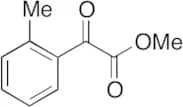
CAS:Controlled Product<p>Applications o-Tolylglyoxylic Acid Methyl Ester is an intermediate in the synthesis of Trifloxystrobin (T778900), a broad-spectrum foliar fungicide used in plant protection.<br></p>Formula:C26H33NO6Color and Shape:NeatMolecular weight:455.5434-(4-Chlorophenyl)-1-(4H-1,2,4-triazol-4-yl)butan-2-one
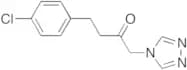
CAS:Controlled Product<p>Applications 4-(4-Chlorophenyl)-1-(4H-1,2,4-triazol-4-yl)butan-2-one is an impurity in the synthesis of 5-(4-Chlorophenyl)-2,2-dimethyl-3-(1H-1,2,4-triazol-1-ylmethyl)-1,3-pentanediol (C377885), which is a hydroxy tebuconazole conjugate. Tebuconazole (T013000) is an ergosterol biosynthesis inhibitor. Fungicide.<br>References Gent, D., et al.: Plant Dis., 87, 591 (2003), Wang, C., et al.: Pestic. Biochem. Physiol., 87, 1 (2007),<br></p>Formula:C12H12ClN3OColor and Shape:NeatMolecular weight:249.7R406
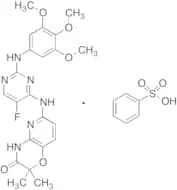
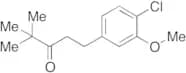
CAS:<p>Applications R406 is a potent Syk inhibitor which affects Dectin-1-mediated signalling in mammilian cells. R406 thus acts an anti-fungal agent. Also a potential anti-leukemia agent, through modulation of sphingosine-1 phosphate receptor 1 (S1PR1).<br>References Borge, M. et al.: J. Immunol., 193, 3165 (2014); Kimura, Y. et al.: J. Biol. Chem., 289, 31565 (2014);<br></p>Formula:C22H23FN6O5·(C6H6O3S)Color and Shape:Light BrownMolecular weight:470.45 + (158.18)1-(4-Chloro-3-methoxyphenyl)-4,4-dimethylpentan-3-one
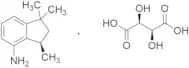
CAS:Controlled ProductFormula:C14H19ClO2Color and Shape:NeatMolecular weight:254.75(R)-4-Amino-1,1,3-trimethylindane D-Tartaric Acid
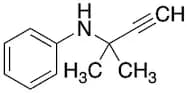
CAS:Controlled ProductFormula:C12H17N·C4H6O6Color and Shape:NeatMolecular weight:175.27 + 150.093-Methyl-3-phenylamino-1-butyne
CAS:Controlled Product<p>Applications 3-Methyl-3-phenylamino-1-butyne is an intermediate in the synthesis of Endophenazine A which is a new phenazine antibiotic isolated from the arthropod associated endosymbiont Streptomyces anulatus and shows antimicrobial activities against Gram-positive bacteria and some filamentous fungi, and herbicidal activity against Lemna minor (duckweed).<br>References Gebhardt, K., et al.: J. Antibiot., 55, 794 (2002)<br></p>Formula:C11H13NColor and Shape:NeatMolecular weight:159.232-[[[1-(4-Chlorophenyl)-1H-pyrazol-3-yl]oxy]methyl]benzenamine
CAS:Controlled Product<p>Applications 2-[[[1-(4-Chlorophenyl)-1H-pyrazol-3-yl]oxy]methyl]benzenamine is an intermediate used in the synthesis of (P840402), which is an isotope labelled Pyraclostrobin, a fungicide for use in seed grass and food crops.<br>References Gyldenkaerne, S., et al.: Pestic Sci., 55, 1210 (1999), Pennington, D., et al.: Environ. Sci. Technol., 39, 1119 (2005), Wang, S., et al.: Food Control., 18, 731 (2007),<br></p>Formula:C16H14ClN3OColor and Shape:NeatMolecular weight:299.75(5E)-5-(3-Bromopropylidene)-5,11-dihydro-10H-dibenzo[a,d]cyclohepten-10-one
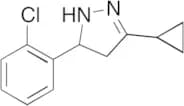
CAS:Controlled Product<p>Applications (5E)-5-(3-Bromopropylidene)-5,11-dihydro-10H-dibenzo[a,d]cyclohepten-10-one is an intermediate in the synthesis of 10-Hydroxy (E)-Amitriptyline (D462790). (5E)-5-[3-(dimethylamino)propylidene]-10,11-dihydro-5H-dibenzo[a,d]cyclohepten-10-ol is a metabolite of amitriptyline (A633350) which is a dibenzocycloheptadiene derivative and an antidepressant (1). Amitriptyline is also a TrkA and TrkB receptor agonist and exhibits neurotrophic and anti-inflammatory activities (2,3). Drinking water contaminant candidate list 3 (CCL 3) compound as per United States Environmental Protection Agency (EPA).<br></p>Formula:C18H15BrOColor and Shape:NeatMolecular weight:327.225-(2-Chlorophenyl)-3-cyclopropyl-4,5-dihydro-1H-pyrazole
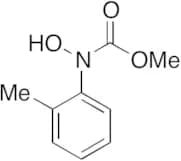
CAS:Controlled Product<p>Applications 5-(2-Chlorophenyl)-3-cyclopropyl-4,5-dihydro-1H-pyrazole is an intermediate in synthesizing Sedaxane (S242000), a broad-spectrum seed treatment fungicide used for control of seed- and soil-borne diseases in a broad range of crops. It inhibits fungal respiration by binding to the succinate dehydrogenase complex in the fungal mitochondrium.<br>References Zeun, R., et al.: Pest Manag. Sci., 69, 527 (2013); Oostendorp, M., et al.: Phytopathology, 101, S133 (2011); Olaya, G., et al.: Phytopathology, 101, S132 (2011)<br></p>Formula:C20H22N2O3Color and Shape:NeatMolecular weight:338.4Methyl N-Hydroxy-2-methylphenylcarbamate
CAS:Controlled ProductFormula:C9H11NO3Color and Shape:NeatMolecular weight:181.19Methyl 2-[2-[(2,5-Dimethylphenoxy)methyl]phenyl]-2-(hydroxy)acetic Acid Ester
CAS:Controlled Product<p>Applications Methyl 2-[2-[(2,5-Dimethylphenoxy)methyl]phenyl]-2-(hydroxy)acetic Acid Ester is an intermediate used in the synthesis of Mandestrobin (M162555), which is a novel fungicide having a methoxyacetamid structure. Mandestrobin also shows safer profiles for human health and the environment.<br>References Hirotomi, D., & Kiguchi, S.: PCT Int. Appl., WO 2017026526 A1 20170216 (2017)<br></p>Formula:C18H20O4Color and Shape:NeatMolecular weight:300.352-[(6-Chloro-4-pyrimidinyl)oxy]-α-(dimethoxymethyl)benzeneacetic Acid Methyl Ester
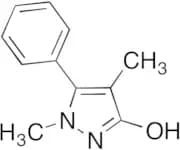
CAS:Controlled Product<p>Applications 2-[(6-Chloro-4-pyrimidinyl)oxy]-α-(dimethoxymethyl)benzeneacetic Acid Methyl Ester is an impurity of Azoxystrobin (A965150), an strobilurin fungicide.<br>References Liu H.J., et al.: J. Chin. Chem. Soc., 60, 27 (2013);<br></p>Formula:C16H17ClN2O5Color and Shape:NeatMolecular weight:352.771,4-Dimethyl-5-phenyl-1H-pyrazol-3-ol
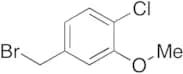
CAS:Controlled ProductFormula:C11H12N2OColor and Shape:NeatMolecular weight:188.234-(Bromomethyl)-1-chloro-2-methoxybenzene
CAS:Controlled ProductFormula:C8H8BrClOColor and Shape:NeatMolecular weight:235.51Mandestrobin 2-Demethyl
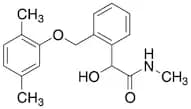
CAS:Controlled Product<p>Applications 2-Demethyl Mandestrobin is an intermediate used in the synthesis of Mandestrobin (M162555), which is a novel fungicide having a methoxyacetamid structure. Mandestrobin also shows safer profiles for human health and the environment.<br>References Hirotomi, D., & Kiguchi, S.: PCT Int. Appl., WO 2017026526 A1 20170216 (2017)<br></p>Formula:C18H21NO3Color and Shape:NeatMolecular weight:299.36Propiolic Acid Sodium Salt (90%)
CAS:Controlled Product<p>Applications A bactericidal and fungicidal.<br>References Schoppelrei, J., et al.: J. Phys. Chem., 100, 14343 (1996), Kolb, H., et al.: Drug Discovery Today, 8, 1128 (2003),<br></p>Formula:C3HNaO2Purity:90%Color and Shape:NeatMolecular weight:92.03




![2-[[[1-(4-Chlorophenyl)-1H-pyrazol-3-yl]oxy]methyl]benzenamine](/_next/image/?url=https%3A%2Fstatic.cymitquimica.com%2Fproducts%2FTR%2Fthumb-webp%2FC877890.webp&w=3840&q=75)
![(5E)-5-(3-Bromopropylidene)-5,11-dihydro-10H-dibenzo[a,d]cyclohepten-10-one](/_next/image/?url=https%3A%2Fstatic.cymitquimica.com%2Fproducts%2FTR%2Fthumb-webp%2FB471360.webp&w=3840&q=75)
![Methyl 2-[2-[(2,5-Dimethylphenoxy)methyl]phenyl]-2-(hydroxy)acetic Acid Ester](/_next/image/?url=https%3A%2Fstatic.cymitquimica.com%2Fproducts%2FTR%2Fthumb-webp%2FM153970.webp&w=3840&q=75)
![2-[(6-Chloro-4-pyrimidinyl)oxy]-α-(dimethoxymethyl)benzeneacetic Acid Methyl Ester](/_next/image/?url=https%3A%2Fstatic.cymitquimica.com%2Fproducts%2FTR%2Fthumb-webp%2FC380245.webp&w=3840&q=75)