Primary Antibodies
Primary antibodies are immunoglobulins that bind specifically to an antigen of interest, allowing for the detection and quantification of proteins, peptides, or other biomolecules. These antibodies are critical tools in a wide range of applications, including Western blotting, immunohistochemistry, and ELISA. At CymitQuimica, we offer an extensive selection of high-quality primary antibodies that provide specificity and sensitivity for various research needs, including cancer, immunology, and cell biology studies.
Subcategories of "Primary Antibodies"
- Cancer Research Antibodies(3,609 products)
- Cardiovascular Antibodies(2 products)
- Developmental Biology(746 products)
- Epigenetics Antibodies(162 products)
- Immunology Antibodies(2,609 products)
- Metabolism Antibodies(278 products)
- Microbiology Antibodies(736 products)
- Signal Transduction(2,710 products)
- Tags & Cellular Markers(33 products)
Show 1 more subcategories
Found 75080 products of "Primary Antibodies"
Sort by
Purity (%)
0
100
|
0
|
50
|
90
|
95
|
100
CDY2 rabbit pAb
This intronless gene encodes a protein containing a chromodomain and a histone acetyltransferase catalytic domain. Chromodomain proteins are components of heterochromatin-like complexes and can act as gene repressors. This protein is localized to the nucleus of late spermatids where histone hyperacetylation takes place. Histone hyperacetylation is thought to facilitate the transition in which protamines replace histones as the major DNA-packaging protein. Two nearly identical copies of this gene are found in a palindromic region on chromosome Y; this record represents the telomeric copy. Chromosome Y also contains a pair of closely related genes in another more telomeric palindrome as well as several related pseudogenes. [provided by RefSeq, Jul 2008],LBX1 rabbit pAb
This gene and the orthologous mouse gene were found by their homology to the Drosophila lady bird early and late homeobox genes. In the mouse, this gene is a key regulator of muscle precursor cell migration and is required for the acquisition of dorsal identities of forelimb muscles. [provided by RefSeq, Jul 2008],Flag-Tag(HRP Conjugated) Mouse mAb
The DYKDDDDK peptide (Flag-tag) is a small component of an epitope which does not appear to interfere with the bioactivity or the biodistribution of the recombinant protein. It has been used extensively as a general epitope tag in expression vectors. It can be used for affinity chromatography, then used to separate recombinant, overexpressed protein from wild-type protein expressed by the host organism. It can also be used in the isolation of protein complexes with multiple subunits.A Flag-tag can be used in many different assays that require recognition by an antibody. If there is no antibody against the studied protein, adding a Flag-tag to this protein allows one to follow the protein with an antibody against the Flag sequence.MTHFR rabbit pAb
The protein encoded by this gene catalyzes the conversion of 5,10-methylenetetrahydrofolate to 5-methyltetrahydrofolate, a co-substrate for homocysteine remethylation to methionine. Genetic variation in this gene influences susceptibility to occlusive vascular disease, neural tube defects, colon cancer and acute leukemia, and mutations in this gene are associated with methylenetetrahydrofolate reductase deficiency.[provided by RefSeq, Oct 2009],THIM rabbit pAb
The encoded protein catalyzes the last step of the mitochondrial fatty acid beta-oxidation spiral. Unlike most mitochondrial matrix proteins, it contains a non-cleavable amino-terminal targeting signal. [provided by RefSeq, Jul 2008],S6A13 rabbit pAb
function:Terminates the action of GABA by its high affinity sodium-dependent reuptake into presynaptic terminals.,similarity:Belongs to the sodium:neurotransmitter symporter (SNF) family.,tissue specificity:Expressed in brain, kidney, lung, liver and testis.,ERLN2 rabbit pAb
This gene encodes a member of the SPFH domain-containing family of lipid raft-associated proteins. The encoded protein is localized to lipid rafts of the endoplasmic reticulum and plays a critical role in inositol 1,4,5-trisphosphate (IP3) signaling by mediating ER-associated degradation of activated IP3 receptors. Mutations in this gene are a cause of spastic paraplegia-18 (SPG18). Alternatively spliced transcript variants encoding multiple isoforms have been observed for this gene. [provided by RefSeq, Feb 2012],ZN713 rabbit pAb
zinc finger protein 713(ZNF713) Homo sapiens The protein encoded by this gene contains C2H2 zinc finger domains. In some individuals, a CGG-repeat expansion from 5-22 repeats to 68-450 repeats has been identified in the first intron of this gene. This mutation is thought to effect the expression of this gene and it has been proposed that it may be associated with Autistic Spectrum Disorder. [provided by RefSeq, Jul 2016],ACSS1 rabbit pAb
This gene encodes a mitochondrial acetyl-CoA synthetase enzyme. A similar protein in mice plays an important role in the tricarboxylic acid cycle by catalyzing the conversion of acetate to acetyl CoA. Alternatively spliced transcript variants encoding multiple isoforms have been observed for this gene. [provided by RefSeq, Nov 2011],TLK2 rabbit pAb
This gene encodes a nuclear serine/threonine kinase that was first identified in Arabidopsis. The encoded protein is thought to function in the regulation of chromatin assembly in the S phase of the cell cycle by regulating the levels of a histone H3/H4 chaperone. This protein is associated with double-strand break repair of DNA damage caused by radiation. Pseudogenes of this gene are present on chromosomes 10 and 17. Alternate splicing results in multiple transcript variants. [provided by RefSeq, Sep 2013],REEP1 rabbit pAb
This gene encodes a mitochondrial protein that functions to enhance the cell surface expression of odorant receptors. Mutations in this gene cause spastic paraplegia autosomal dominant type 31, a neurodegenerative disorder. Alternative splicing results in multiple transcript variants. [provided by RefSeq, Sep 2009],RGS1 rabbit pAb
This gene encodes a member of the regulator of G-protein signalling family. This protein is located on the cytosolic side of the plasma membrane and contains a conserved, 120 amino acid motif called the RGS domain. The protein attenuates the signalling activity of G-proteins by binding to activated, GTP-bound G alpha subunits and acting as a GTPase activating protein (GAP), increasing the rate of conversion of the GTP to GDP. This hydrolysis allows the G alpha subunits to bind G beta/gamma subunit heterodimers, forming inactive G-protein heterotrimers, thereby terminating the signal. [provided by RefSeq, Jul 2008],CDHR5 rabbit pAb
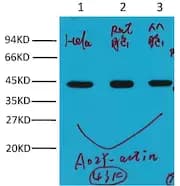
cadherin related family member 5(CDHR5) Homo sapiens This gene is a novel mucin-like gene that is a member of the cadherin superfamily. While encoding nonpolymorphic tandem repeats rich in proline, serine and threonine similar to mucin proteins, the gene also contains sequence encoding calcium-binding motifs found in all cadherins. The role of the hybrid extracellular region and the specific function of this protein have not yet been determined. Alternatively spliced transcript variants encoding different isoforms have been described. [provided by RefSeq, Jan 2010],β-actin Mouse mAb
β-actin is one of six different actin isoforms that have been identified. The actin molecules found in cells of various species and tissues tend to be very similar in their immunological and physical properties. Therefore, antibodies against β-actin are useful as loading controls for Western Blotting. However it should be noted that levels of β-actin may not be stable in certain cells. For example, expression of β-actin in adipose tissue is very low and therefore β-actin should not be used as loading control for these tissues.NDP rabbit pAb
This gene encodes a secreted protein with a cystein-knot motif that activates the Wnt/beta-catenin pathway. The protein forms disulfide-linked oligomers in the extracellular matrix. Mutations in this gene result in Norrie disease and X-linked exudative vitreoretinopathy. [provided by RefSeq, Feb 2009],Bcl-6 (phospho Ser333) rabbit pAb
The protein encoded by this gene is a zinc finger transcription factor and contains an N-terminal POZ domain. This protein acts as a sequence-specific repressor of transcription, and has been shown to modulate the transcription of STAT-dependent IL-4 responses of B cells. This protein can interact with a variety of POZ-containing proteins that function as transcription corepressors. This gene is found to be frequently translocated and hypermutated in diffuse large-cell lymphoma (DLCL), and may be involved in the pathogenesis of DLCL. Alternatively spliced transcript variants encoding different protein isoforms have been found for this gene. [provided by RefSeq, Aug 2015],