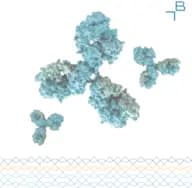
Primary Antibodies
Primary antibodies are immunoglobulins that bind specifically to an antigen of interest, allowing for the detection and quantification of proteins, peptides, or other biomolecules. These antibodies are critical tools in a wide range of applications, including Western blotting, immunohistochemistry, and ELISA. At CymitQuimica, we offer an extensive selection of high-quality primary antibodies that provide specificity and sensitivity for various research needs, including cancer, immunology, and cell biology studies.
Subcategories of "Primary Antibodies"
- Cancer Research Antibodies(3,620 products)
- Cardiovascular Antibodies(2 products)
- Developmental Biology(751 products)
- Epigenetics Antibodies(162 products)
- Immunology Antibodies(2,776 products)
- Metabolism Antibodies(279 products)
- Microbiology Antibodies(736 products)
- Signal Transduction(2,717 products)
- Tags & Cellular Markers(33 products)
Show 1 more subcategories
Found 75326 products of "Primary Antibodies"
Sort by
Purity (%)
0
100
|
0
|
50
|
90
|
95
|
100
GP9 antibody
<p>GP9 antibody was raised in rabbit using the middle region of GP9 as the immunogen</p>Goat anti Pig IgG (H + L) (Alk Phos)
<p>Goat anti-pig IgG (H + L) (Alk Phos) was raised in goat using porcine IgG, (H & L) as the immunogen.</p>CREB antibody
<p>The CREB antibody is a highly effective anti-CD33 antibody that is widely used in the Life Sciences field. It specifically targets the growth factor-1 receptor and has been extensively studied for its therapeutic potential. The CREB antibody has shown promising results in preclinical studies, demonstrating its ability to inhibit tumor growth and proliferation. Additionally, it has been found to synergize with other antibodies such as trastuzumab (anti-HER2 antibody) and insulin-like acidic inhibitors, further enhancing its efficacy. This antibody can be used in various applications, including Western blotting, immunoprecipitation, and immunofluorescence. Its high specificity and sensitivity make it an essential tool for researchers studying protein signaling pathways and cellular processes. The CREB antibody is produced using state-of-the-art techniques and undergoes rigorous quality control to ensure optimal performance. With its exceptional binding affinity and reliability, this antibody is an invaluable asset for any laboratory or research facility.</p>MET antibody
The MET antibody is a mouse monoclonal antibody that belongs to the class of Polyclonal Antibodies. It has been extensively studied and proven effective in various biological applications within the field of Life Sciences. The MET antibody specifically targets the parathyroid hormone-related peptide (PTHrP), an important regulator of cell proliferation, angiogenesis, and bone metabolism.Podoplanin antibody
<p>Podoplanin antibody was raised in mouse using gp36 (podoplanin)-expressing MDCK cells as the immunogen.</p>FGF1 antibody
<p>The FGF1 antibody is a powerful globulin that acts as a family kinase inhibitor, specifically targeting endothelial growth. This antibody is widely used in the field of Life Sciences and is highly effective in inhibiting cdk4/6, a crucial enzyme involved in cell cycle regulation. Additionally, the FGF1 antibody has shown remarkable neutralizing properties against caspase-9, an enzyme responsible for initiating apoptosis. With its polyclonal nature, this antibody exhibits high specificity and affinity towards alpha-fetoprotein, making it an ideal tool for research involving adipose tissue. Furthermore, the FGF1 antibody has demonstrated antiviral activity and can effectively target molecules associated with viral infections. Its colloidal formulation ensures stability and ease of use. Researchers also utilize this antibody as an anti-VEGF agent due to its ability to counteract vascular endothelial growth factor.</p>PGS1 antibody
<p>PGS1 antibody was raised using the C terminal of PGS1 corresponding to a region with amino acids RVQLQEYWRRGWTFHAKGLWLYLAGSSLPCLTLIGSPNFGYRSVHRDLEA</p>SLC36A3 antibody
SLC36A3 antibody was raised using a synthetic peptide corresponding to a region with amino acids MSLLGRDYNSELNSLDNGPQSPSESSSSITSENVHPAGEAGLSMMQTLIHREEP1 antibody
REEP1 antibody was raised using the C terminal of REEP1 corresponding to a region with amino acids ERLRSFSMQDLTTIRGDGAPAPSGPPPPGSGRASGKHGQPKMSRSASESAPurity:Min. 95%APOA1BP antibody
<p>The APOA1BP antibody is a highly specific monoclonal antibody that targets the phosphatase enzyme. It has been extensively studied for its ability to inhibit epidermal growth factor signaling pathways. This antibody is widely used in research and diagnostic applications, including the detection of various proteins such as insulin, alpha-fetoprotein, and dopamine. The APOA1BP antibody can be used in a variety of assays, including tyrosine phosphorylation assays and neutralizing assays for growth factors. It is available in both polyclonal and monoclonal forms, providing researchers with options for their specific experimental needs. With its high specificity and sensitivity, this antibody is an invaluable tool for studying cellular signaling pathways and protein interactions.</p>MMP14 antibody
<p>The MMP14 antibody is a powerful tool in the field of molecular biology and research. It is an insulin-like growth factor-binding protein that plays a crucial role in various cellular processes. This antibody specifically targets and binds to MMP14, also known as matrix metalloproteinase 14, which is involved in the degradation of extracellular matrix components.</p>KLRA1 antibody
<p>KLRA1 antibody was raised using the N terminal of KLRA1 corresponding to a region with amino acids NDQGEIYSTLRFLQSPSESQNRLRPDDTQRPGKTDDKEFSVPWHLIAVTL</p>Purity:Min. 95%GPR120 antibody
<p>The GPR120 antibody is a highly specialized monoclonal antibody used in the field of Life Sciences. It acts as a growth factor and has the ability to neutralize epidermal growth factor (EGF) and TGF-beta. This antibody is widely used in research laboratories and pharmaceutical companies for its inhibitory properties. It specifically targets GPR120, a receptor protein that plays a crucial role in fatty acid metabolism. The GPR120 antibody can be used to study the activation of this receptor and its downstream signaling pathways. Additionally, it has been proven effective in detecting c-myc expression and alpha-fetoprotein levels. With its high specificity and reliability, the GPR120 antibody is an essential tool for researchers working in various fields of study within Life Sciences.</p>SYDE1 antibody
<p>SYDE1 antibody was raised using a synthetic peptide corresponding to a region with amino acids PYLRPKRQPPLHLPLADPEVVTRPRGRGGPESPPSNRYAGDWSVCGRDFL</p>DCX antibody
<p>DCX antibody was raised using a synthetic peptide corresponding to a region with amino acids TAGPKASPTPQKTSAKSPGPMRRSKSPADSANGTSSSQLSTPKSKQSPIS</p>Purity:Min. 95%Thyroid Peroxidase antibody
<p>Thyroid Peroxidase antibody is a monoclonal antibody used in Life Sciences research. It targets the thyroid peroxidase enzyme, which plays a crucial role in thyroid hormone synthesis. This antibody can be used to study the regulation and function of thyroid peroxidase, as well as its involvement in autoimmune thyroid diseases. Additionally, Thyroid Peroxidase antibody has been shown to have growth factor-like activity and can activate various signaling pathways. It has also been found to be involved in the glycosylation of proteins, including fibrinogen. Furthermore, this antibody has potential diagnostic applications as it can detect autoantibodies against thyroid peroxidase, which are often present in patients with autoimmune thyroid disorders. Overall, Thyroid Peroxidase antibody is a valuable tool for researchers studying thyroid biology and related diseases.</p>HPGDS antibody
The HPGDS antibody is a highly specialized monoclonal antibody that targets the enzyme hematopoietic prostaglandin D synthase (HPGDS). HPGDS plays a crucial role in the synthesis of prostaglandin D2 (PGD2), which is involved in various physiological processes such as inflammation and allergic responses. This antibody specifically binds to HPGDS, inhibiting its activity and preventing the production of PGD2.Histone H2Ax antibody
<p>The Histone H2Ax antibody is a highly specialized monoclonal antibody used in Life Sciences research. This antibody specifically targets and binds to the acidic histone protein H2Ax, which plays a crucial role in DNA repair and damage response. By detecting the presence of H2Ax, researchers can gain valuable insights into various cellular processes, including fibrinogen activation, growth factor signaling, and multidrug resistance.</p>C19ORF21 antibody
<p>C19ORF21 antibody was raised using the C terminal Of C19Orf21 corresponding to a region with amino acids RRNALFPEVFSPTPDENSDQNSRSSSQASGITGSYSVSESPFFSPIHLHS</p>LGALS14 antibody
<p>LGALS14 antibody was raised using the N terminal of LGALS14 corresponding to a region with amino acids MSSLPVPYTLPVSLPVGSCVIITGTPILTFVKDPQLEVNFYTGMDEDSDI</p>CD5 antibody (Spectral Red)
CD5 antibody (Spectral Red) was raised in rat using CD5/Lyt-1 as the immunogen.LCK antibody
<p>The LCK antibody is a powerful tool in the field of Life Sciences. It is a cytotoxic antibody that specifically targets and binds to LCK (lymphocyte-specific protein tyrosine kinase), an enzyme involved in T-cell signaling. This antibody can be used for various applications, including immunohistochemistry, flow cytometry, and Western blotting.</p>APLP2 antibody
<p>The APLP2 antibody is a highly specialized growth factor that plays a crucial role in protein kinase signaling pathways. This monoclonal antibody is designed to specifically target and bind to the APLP2 antigen, facilitating an antigen-antibody reaction that leads to neutralizing its activity. The APLP2 antibody has been extensively tested and proven effective in various life science applications, including research studies focused on understanding the role of APLP2 in disease progression and therapeutic interventions. Additionally, this antibody has shown promising results as an anti-MERTK antibody, blocking the activation of MERTK protein and interfering with interferon signaling pathways. With its high specificity and affinity for the target molecule, the APLP2 antibody is a valuable tool for researchers working in the field of immunology and molecular biology.</p>XRCC4 antibody
<p>The XRCC4 antibody is a monoclonal antibody used in Life Sciences research. It specifically targets the XRCC4 protein, which plays a crucial role in DNA repair and recombination. The antibody binds to the histidine-tagged XRCC4 protein, allowing for its detection and analysis in various experimental settings. This XRCC4 antibody is commonly used in studies involving pluripotent cells, collagen synthesis, lipoprotein lipase regulation, and immune response modulation. Additionally, it has been shown to interact with other proteins such as interferon, TGF-beta, and endothelial growth factors. The XRCC4 antibody offers researchers a valuable tool for investigating DNA repair mechanisms and understanding their implications in various biological processes.</p>