Nucleosides
Found 3569 products of "Nucleosides"
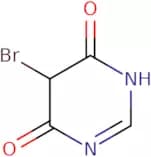
5-Bromopyrimidine-4,6(1H,5H)-dione
CAS:5-Bromopyrimidine-4,6(1H,5H)-dione is a novel nucleoside analogue. It can be used as an antiviral agent and an anticancer drug. It inhibits viral DNA replication by competitively binding to the viral DNA polymerase, thereby blocking the incorporation of deoxyribonucleotides into the growing DNA chain. 5-Bromopyrimidine-4,6(1H,5H)-dione also has antitumour activity. It has been shown to inhibit the growth of human cancer cells in vitro and in vivo.
Purity:Min. 95%N4-(tert-Butylphenoxyacetyl)-5'-O-DMT-2'-O-methylcytidine 3'-CE phosphoramidite
N4-(tert-Butylphenoxyacetyl)-5'-O-DMT-2'-O-methylcytidine 3'-CE phosphoramidite is a modified nucleoside that inhibits DNA synthesis by inhibiting the activity of DNA polymerase. It has been shown to have anticancer effects in vitro and in vivo by inducing apoptosis and cell cycle arrest. This compound has also been shown to be more potent than other nucleosides, such as cytidine 5'-diphosphate (CDP) or cytidine 5'-monophosphate (CMP). This chemical is not yet commercially available but can be custom synthesized for research purposes.Formula:C52H64N5O10PPurity:Min. 95%Molecular weight:950.07 g/mol2'-Deoxy-2'-fluorouridine-5'-triphosphate lithium salt - 100mM aqueous solution
2'-Deoxy-2'-fluorouridine-5'-triphosphate lithium salt is an antiviral drug that inhibits viral DNA replication by inhibiting viral polymerase. It is a novel nucleoside analogue with antiviral activity against RNA viruses, including influenza virus and HIV. 2'-Deoxy-2'-fluorouridine-5'-triphosphate lithium salt can be used as a precursor for the synthesis of modified monophosphate nucleosides, ribonucleosides and phosphoramidites. This product is supplied in high purity (98%) and high quality.Formula:C9H14N2O14P3F·xLiPurity:Min. 95%Molecular weight:486.13 g/mol7-Deaza-2'-deoxy-5'-O-DMT-N2-isobutyrylguanosine
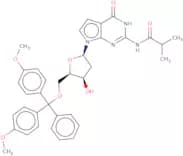
7-Deaza-2'-deoxy-5'-O-DMT-N2-isobutyrylguanosine is an activator that has been shown to stimulate the production of DNA and RNA. This compound is a novel synthetic nucleoside with high purity and quality. 7-Deaza-2'-deoxy-5'-O-DMT-N2-isobutyrylguanosine is effective against viruses and cancer cells by inhibiting viral protein synthesis and by stimulating the immune system. This drug has also been shown to be an anticancer agent, which may be due to its ability to inhibit cell division, induce apoptosis, or inhibit cellular proliferation.Formula:C36H38N4O7Purity:Min. 95%Molecular weight:638.73 g/molO6-Benzyl-N2,3-etheno guanosine
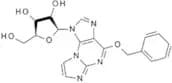
CAS:O6-Benzyl-N2,3-etheno guanosine is a phosphoramidite that can be used in the synthesis of DNA. It is a novel nucleoside analog with antiviral and anticancer properties. O6-Benzyl-N2,3-etheno guanosine has been shown to increase the antitumor activity of cisplatin in vitro and in vivo, as well as its ability to inhibit human immunodeficiency virus type 1 (HIV-1) replication. This compound also inhibits the replication of herpes simplex virus type 2 (HSV-2) without affecting the expression of cellular proteins. O6-Benzylguanosine is synthesized by reacting N2,3-ethenoguanosine with benzaldehyde in dichloromethane under microwave irradiation.Formula:C19H19N5O5Purity:Min. 95%Molecular weight:397.38 g/molent-idoxuridine
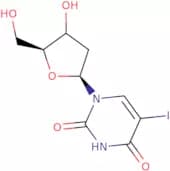
CAS:Ent-idoxuridine is a cytosolic DNA synthesis inhibitor that blocks the conversion of deoxycytidine to deoxyadenosine by inhibiting the enzyme deoxycytidine kinase. It is also an enantiomer of idoxuridine, which has the same mechanism of action. Ent-idoxuridine is not active against herpes simplex virus type 1 (HSV-1) or type 2 (HSV-2). In contrast to idoxuridine, ent-idoxuridine is resistant to exonucleases and has been shown to be effective in treating immunodeficiency caused by HIV.Formula:C9H11IN2O5Purity:Min. 95%Molecular weight:354.1 g/molThymidine-3',5'-tetrabenzyldiphosphate
Thymidine-3',5'-tetrabenzyldiphosphate is a monophosphate analog of thymidine. It has been used as a building block for the synthesis of DNA, RNA, and phosphoramidites. Thymidine-3',5'-tetrabenzyldiphosphate is a novel nucleoside compound that has been shown to have anticancer and antiviral activities. This product is intended for research purposes only.Formula:C38H40N2O11P2Purity:Min. 95%Molecular weight:762.68 g/mol4'-Hydroxymethyl-4,5',8-trimethylpsoralen (hmt)
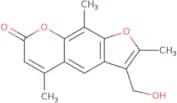
CAS:4'-Hydroxymethyl-4,5',8-trimethylpsoralen (HMT) is an analog of psoralen that has been shown to have potent anti-tumor activity. HMT acts as an inhibitor of human tumor kinase and has been shown to induce apoptosis in cancer cells. This drug has also been found to enhance the effects of other cancer treatments, such as nintedanib. HMT has demonstrated potential for the treatment of diabetes by acting as an inhibitor of glucose uptake and metabolism in Chinese hamster ovary cells. Additionally, HMT has been found to have inhibitory effects on enzymes such as apomorphine, glimepiride, and vanillin. Overall, HMT holds great promise for the development of novel cancer therapies and diabetes treatments.Formula:C15H14O4Purity:Min. 95%Molecular weight:258.27 g/molb-Methylcrotonyl coenzyme A lithium salt
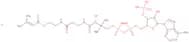
CAS:b-Methylcrotonyl coenzyme A lithium salt is a phosphoramidite that has antiviral and anticancer properties. It is used as an activator in the synthesis of DNA, as well as a novel deoxyribonucleoside monophosphate. b-Methylcrotonyl coenzyme A lithium salt also has high purity and high quality.Purity:Min. 95%3'-Amino-N6-benzoyl-2'-O-tert-butyldimethylsilyl-5'-O-DMT-3'-deoxyadenosine
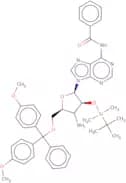
3'-Amino-N6-benzoyl-2'-O-tert-butyldimethylsilyl-5'-O-DMT-3'-deoxyadenosine is a nucleoside that is synthesized by the modification of deoxyadenosine. It has antiviral and anticancer properties, as well as other novel applications. The synthesis of this compound can be achieved in two steps: first, the amino group is attached to the 3' carbon atom of the sugar ring by reacting with N6-(benzoyl)adenine. In the second step, a silyl group is attached to the 5' carbon atom of the sugar ring by reacting with tert-butyldimethylchlorosilane and DMT (dimethoxytrityl).Formula:C44H50N6O6SiPurity:Min. 95%Molecular weight:786.99 g/mol5'-O-DMT-inosine
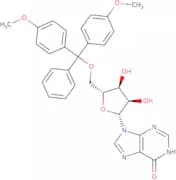
CAS:5'-O-DMT-inosine is a novel monophosphate nucleotide analogue. It is modified by the attachment of an aminooxy group to the 5' position of the pentose. This modification prevents ribonucleotide reductase from converting it into deoxyribonucleotides, which are then incorporated into DNA. 5'-O-DMT-inosine has been shown to be cytotoxic in human leukemia cells due to its ability to inhibit the synthesis of DNA and RNA.
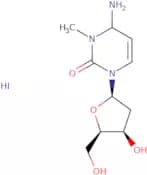
Formula:C31H30N4O7Purity:Min. 95%Molecular weight:570.59 g/mol2'-Deoxy-N3-methylcytidine hydroiodide salt
CAS:2'-Deoxy-N3-methylcytidine hydroiodide salt is a nucleoside and phosphoramidite. It is used as an anticancer agent that inhibits DNA synthesis. It also has antiviral and antitumor effects. The chemical name for 2'-deoxy-N3-methylcytidine hydroiodide salt is 2'-deoxy-N3-methylcytidine, monophosphate salt with hydroiodic acid. This drug does not have a CAS number because it's not commercially available.Formula:C10H17N3O4·HIPurity:Min. 95%Color and Shape:PowderMolecular weight:371.17 g/mol3'-Deoxy-N6-lauroyladenosine
CAS:3'-Deoxy-N6-lauroyladenosine is a nucleoside analog that is used to treat cancer. It is a phosphoramidite compound and it has been shown to be highly active against cancer cells. 3'-Deoxy-N6-lauroyladenosine is an antiviral agent that inhibits viral DNA synthesis by competing with the natural substrate, deoxyribonucleosides, for incorporation into the growing DNA chain. It also prevents the replication of RNA viruses by inhibiting their transcription and translation processes. 3'-Deoxy-N6-lauroyladenosine also inhibits inflammation in the body and may act as a chemotherapeutic agent in other diseases such as diabetes, Alzheimer's disease, and Parkinson's disease.
Formula:C22H35N5O4Purity:Min. 95%Molecular weight:433.54 g/mol7-Deaza-2'-deoxy-O6-methylguanosine
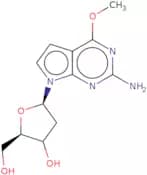
7-Deaza-2'-deoxy-O6-methylguanosine is a novel nucleoside phosphoramidite that is the first of its kind to have been shown to be an antiviral agent. It is also anticancerous and stimulates diphosphate synthesis. 7-Deaza-2'-deoxy-O6-methylguanosine is a highly reactive nucleoside phosphoramidite that reacts with DNA in the same manner as deoxyribonucleotides. The monophosphate form of this compound has been shown to be anticancerous and stimulate diphosphate synthesis. This novel compound has been shown to inhibit replication of human immunodeficiency virus type 1 (HIV-1) in vitro.
Formula:C12H16N4O4Purity:Min. 95%Molecular weight:280.28 g/mol7-Deaza-7-iodoguanosine
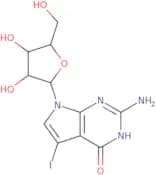
CAS:7-Deaza-7-iodoguanosine is a novel, synthetic nucleoside analog that has antiviral and anticancer activity. It is modified by the addition of a 7-deaza substituent at the 2′ position of the ribose ring. The phosphoramidite form of this compound can be used to synthesize DNA and RNA for use in research and gene therapy. 7-Deaza-7-iodoguanosine may have anticancer activity due to its ability to inhibit protein synthesis by binding to diphosphate kinase, which prevents ATP production and inhibits protein synthesis.Purity:Min. 95%2'-Deoxy-2'-fluoroinosine 5'-monophosphate lithium salt
2'-Deoxy-2'-fluoroinosine 5'-monophosphate lithium salt is a nucleoside analog that has been modified to contain a fluorine atom at the 2' position of the ribose sugar. This agent is an activator of DNA polymerase and can be used in the synthesis of oligonucleotides. It is also an antiviral and anticancer agent.Formula:C10H12FN4O7P·xLiPurity:Min. 95%Molecular weight:350.2 g/molN2-Methylguanosine-3',5'-cyclic monophosphate
CAS:N2-Methylguanosine-3',5'-cyclic monophosphate is a synthetic nucleoside that is the cyclic monophosphate analog of guanosine. It has antiviral, anticancer, and anti-inflammatory properties. N2-Methylguanosine-3',5'-cyclic monophosphate has been shown to inhibit viral replication in cells by inhibiting the synthesis of viral DNA and RNA. This compound also inhibits cancer cell growth in culture. The antiviral activity may be due to methylation at the 2' position of the sugar moiety, which prevents viral reverse transcriptase from copying viral RNA into DNA. The anticancer activity may be due to inhibition of ribonucleotide reductase and deoxyribonucleotide reductase, which are enzymes that maintain nucleotide pools necessary for DNA synthesis.Formula:C11H13N5O7P·NaPurity:Min. 95%Molecular weight:381.21 g/molL-Cystine dihydrochloride
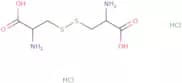
CAS:L-Cystine dihydrochloride is a white crystalline powder that is used to treat acute radiation syndrome. It is an amino acid that contains two cysteine residues linked by a disulfide bond. Cysteine is necessary for the formation of proteins and peptides, which are important in antibody production. L-Cystine dihydrochloride has been shown to increase the uptake of radioactive substances in cells. This drug also increases the amount of bioactive molecules such as glutathione, which protects cells from oxidative damage caused by radiation. The effects of L-cystine dihydrochloride are dose dependent, with higher doses leading to greater cellular death.
The unpaired cysteines in L-cystine dihydrochloride can react with each other, forming a new molecule called S-thiolactone. This reaction is catalyzed by porcine pancreatic lipase (PPLL), a membrane protein found in pancreatFormula:C6H14Cl2N2O4S2Purity:Min. 95%Molecular weight:313.2 g/molSPACER-C 12 CEP
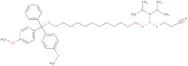
CAS:Please enquire for more information about SPACER-C 12 CEP including the price, delivery time and more detailed product information at the technical inquiry form on this pageFormula:C42H61N2O5PPurity:Min. 95%Molecular weight:704.9 g/mol5-Aminoallyl-2'-deoxycytidine
5-Aminoallyl-2'-deoxycytidine is an activator that has been shown to be a novel anticancer drug. It is an analogue of cytidine and is synthesized by the phosphoramidite method. 5-Aminoallyl-2'-deoxycytidine inhibits viral replication in human cells, but also has antiviral activity against HIV and influenza A virus. The compound has been shown to be active against small cell lung cancer in animal models.Purity:Min. 95%