Nucleosides
Nucleosides are fundamental building blocks of nucleic acids, composed of a nitrogenous base attached to a sugar molecule. In this section, you can find a wide variety of nucleosides essential for research in molecular biology, biochemistry, and pharmacology. These compounds play crucial roles in the synthesis of DNA and RNA, and are also vital in various metabolic processes. Nucleosides are used in studying genetic material, developing antiviral and anticancer therapies, and understanding cellular mechanisms. At CymitQuimica, we provide high-quality nucleosides to support your research and development needs, ensuring purity and reliability for your experimental applications.
Found 3567 products of "Nucleosides"
Sort by
Purity (%)
0
100
|
0
|
50
|
90
|
95
|
100
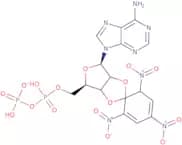
2'/3'-O-Trinitrophenyl-adenosine-5'-diphosphate triethylammonium salt
CAS:<p>2'/3'-O-Trinitrophenyl-adenosine-5'-diphosphate triethylammonium salt (TPENAP) is an irreversible inhibitor of the enzyme adenosine kinase. TPENAP binds to the active site of the enzyme and blocks ATP synthesis, resulting in a rapid decrease in ATP levels. TPENAP is a potent fluorescence probe that reacts with tryptophan residues in proteins, thereby enhancing the fluorescence intensity. It has been shown to inhibit actin polymerization and depolymerize actin filaments, which may be due to its ability to inhibit ATP production.</p>Formula:C16H16N8O16P2Purity:Min. 95%Molecular weight:638.29 g/mol5′-O-DMT-LNA N-dmf guanosine
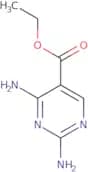
CAS:<p>5′-O-DMT-LNA N-dmf guanosine is a modified nucleoside that has anticancer, antiviral, and anti-inflammatory activities. It binds to the ribonucleotide reductase enzyme, which is an enzyme required for the production of new DNA and RNA. This binding prevents the synthesis of new DNA and RNA in cells, leading to cell death. 5′-O-DMT-LNA N-dmf guanosine has been shown to be active against cancer cells in vitro and in vivo. In addition, it also inhibits replication of human immunodeficiency virus type 1 (HIV) by binding to reverse transcriptase (RT), which is an enzyme critical for HIV replication.</p>Formula:C35H36N6O7Purity:Min. 95%Molecular weight:652.7 g/molEthyl-2,4-diamino-pyrimidine-5-carboxylate
CAS:<p>Ethyl-2,4-diamino-pyrimidine-5-carboxylate is a nucleoside that is used in the synthesis of ribonucleosides and deoxyribonucleosides. It has been shown to be an activator for DNA polymerase and an antiviral agent. Ethyl-2,4-diamino-pyrimidine-5-carboxylate binds to the enzyme DNA polymerase and stimulates its activity by facilitating the conversion of RNA into DNA. This drug also inhibits the replication of virus cells by inhibiting viral RNA synthesis.</p>Formula:C7H10N4O2Purity:Min. 95%Molecular weight:182.18 g/mol5-Fluorouridine-5'-monophosphate sodium salt - 10mM aqueous solution
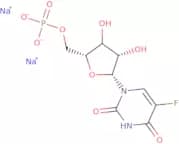
CAS:<p>5-Fluorouridine-5'-monophosphate sodium salt is a nucleoside analog that is used as an antiviral drug. It inhibits viral DNA synthesis by competitive inhibition of thymidylate, which is a precursor for DNA synthesis. 5-Fluorouridine-5'-monophosphate sodium salt has been shown to be active against human pathogens and cancer cells in vitro. The enzyme activity of 5-fluorouridine-5'-monophosphate sodium salt can be inhibited by the presence of p-nitrophenyl phosphate, which is also a product of the enzymatic reaction. This may lead to synergistic effects in cells with both enzymes present.</p>Formula:C9H12FN2O9PPurity:Min. 95%Color and Shape:Colorless PowderMolecular weight:342.17 g/molS4-(2-Cyanoethyl)-5'-o-(dimethoxytrityl)-4-thiothymidine
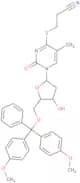
CAS:<p>S4-(2-Cyanoethyl)-5'-o-(dimethoxytrityl)-4-thiothymidine is a DNA analog that inhibits the growth of tumor cells. It binds to purine nucleosides and prevents the synthesis of DNA and RNA, which can lead to cell death. S4-(2-Cyanoethyl)-5'-o-(dimethoxytrityl)-4-thiothymidine has been shown to inhibit the growth of tumor cells in vitro. It is an effective inhibitor of HIV replication in vitro, but it does not have any antiviral activity against other viruses. This drug is a modified form of thymidine, which is an important component of DNA.</p>Formula:C34H35N3O6SPurity:Min. 95%Molecular weight:613.7 g/mol3',5'-Bis-O-(t-butyldimethylsilyl)thymidine
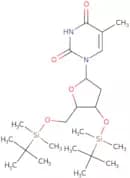
CAS:<p>3',5'-Bis-O-(t-butyldimethylsilyl)thymidine is a novel nucleoside phosphoramidite that can be used in the synthesis of oligonucleotides. This compound has antiviral and anticancer activities and is an excellent building block for the synthesis of modified nucleosides. 3',5'-Bis-O-(t-butyldimethylsilyl)thymidine is a high quality, high purity chemical with a CAS number of 40733-26-4.</p>Formula:C22H42N2O5Si2Purity:Min. 95%Molecular weight:470.7 g/mol2',3'-Di-O-acetyl-5'-deoxy-5-fluoro-N4-(pentoxycarbonxyl)cytidine
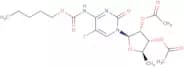
CAS:<p>2',3'-Di-O-acetyl-5'-deoxy-5-fluoro-N4-(pentoxycarbonxyl)cytidine is a nucleoside analog that inhibits DNA polymerase and RNA polymerase, which are enzymes vital for the production of DNA and RNA, respectively. This drug has been shown to be effective in treating cancer cells that are resistant to other chemotherapeutic agents. 2',3'-Di-O-acetyl-5'-deoxy-5-fluoro-N4-(pentoxycarbonxyl)cytidine has also been shown to inhibit viral replication by inhibiting viral reverse transcriptase.</p>Formula:C19H26FN3O8Purity:Min. 95%Molecular weight:443.43 g/mol2'-Deoxyadenosine-5'-carboxylic acid
CAS:<p>dA oxidised at the 5'-position.</p>Formula:C10H11N5O4Purity:Min. 95%Molecular weight:265.23 g/molN1-Methyladenosine hydroiodide
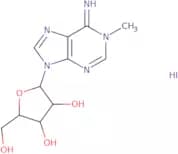
CAS:<p>N1-Methyladenosine hydroiodide is a novel nucleoside analogue that inhibits viral replication by preventing the formation of viral DNA. It also inhibits the growth of cancer cells and is used as an anticancer drug. N1-Methyladenosine hydroiodide has been shown to be an activator of RNA polymerase II, increasing the production of messenger RNA (mRNA) in human cells. The phosphoramidite form of this compound is used for the synthesis of oligodeoxyribonucleotides, which are chemically modified in order to improve their stability and inhibit degradation by nucleases. N1-Methyladenosine hydroiodide is highly pure and has CAS No. 34308-25-3.</p>Formula:C11H15N5O4·HIPurity:Min. 95%Molecular weight:409.18 g/mol3'-O-Allylcytidine
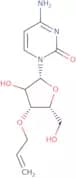
<p>3'-O-Allylcytidine is a phosphoramidite nucleoside that is synthesized by the coupling of cytidine with allyl bromoacetate. It has antiviral activity, and has been shown to be active against herpes simplex virus type 1 (HSV-1) and hepatitis B virus (HBV). 3'-O-Allylcytidine has also been shown to inhibit the growth of cells in culture, suggesting that it may have anticancer properties. 3'-O-Allylcytidine is a novel monophosphate nucleoside that has not been previously reported.br></p>Formula:C12H17N3O5Purity:Min. 95%Color and Shape:PowderMolecular weight:283.28 g/molBiotin-5-deoxyuridine-5'-triphosphate, lithium salt - 1 mM aqueous solution
<p>Biotin-5-deoxyuridine-5'-triphosphate, lithium salt is a novel phosphoramidite. It has been shown to be an anticancer agent and antiviral agent. Biotin-5-deoxyuridine-5'-triphosphate, lithium salt inhibits the growth of cancer cells by binding to the ribonucleotide reductase enzyme, thereby preventing synthesis of DNA and RNA.</p>Formula:C22H34N5O16P3S·xLiPurity:Min. 95%Molecular weight:749.52 g/mol2',5'-Dideoxyinosine
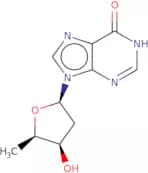
CAS:<p>2',5'-Dideoxyinosine is a nucleoside that can be used as an antiviral or anticancer agent. It is synthesized from the natural nucleoside inosine by phosphorylation of the hydroxyl group on position 5 of the sugar ring and replacement of the hydroxyl group on position 2 with a deoxyribose. The resulting product has a higher potency than the natural form, and is more stable to enzymatic hydrolysis. 2',5'-Dideoxyinosine has been shown to inhibit DNA polymerase in vitro, and also inhibits RNA synthesis, leading to cell death. In addition, it has been shown to be active against leukemia cells as well as breast cancer cells in vivo.</p>Formula:C10H12N4O3Purity:Min. 95%Molecular weight:236.23 g/mol5'-ODMT cEt N-Bzm5 C Phosphoramidite
CAS:<p>Please enquire for more information about 5'-ODMT cEt N-Bzm5 C Phosphoramidite including the price, delivery time and more detailed product information at the technical inquiry form on this page</p>Formula:C49H56N5O9PMolecular weight:889.97 g/mol5-[3-(Trifluoroacetamido)-E-1-propenyl]-2’- deoxyuridine
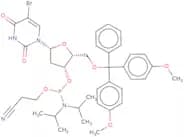
CAS:<p>5-[3-(Trifluoroacetamido)-E-1-propenyl]-2’-deoxyuridine is a monophosphate nucleoside analog that inhibits DNA synthesis by inhibiting the activity of ribonucleotide reductase. It is also antiviral, and has been shown to inhibit the growth of human erythroleukemia cells in vitro and to produce cytotoxic effects on murine leukemia cells. 5-[3-(Trifluoroacetamido)-E-1-propenyl]-2’-deoxyuridine is an anticancer drug that has been shown to be effective against a variety of cancers, including those of the breast, lung, prostate, and colon. It has also been shown to have high quality as it does not cause any significant side effects or show cross resistance with other cancer drugs.</p>Formula:C14H16F3N3O6Purity:Min. 95%Molecular weight:379.29 g/mol5-Bromo-2'-deoxy-5'-O-DMT-uridine 3'-CE phosphoramidite
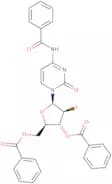
CAS:<p>5-Bromo-2'-deoxy-5'-O-DMT-uridine 3'-CE phosphoramidite is a nucleoside analog and a potential anticancer drug. It is an excellent monophosphate, which can be used as a building block for synthesis of DNA. 5-Bromo-2'-deoxy-5'-O-DMT-uridine 3'-CE phosphoramidite has antiviral activity against HIV and herpes simplex virus, as well as antifungal activity against Candida albicans. This compound has also been shown to have antitumor activity in vitro in the presence of other anticancer drugs.</p>Formula:C39H46BrN4O8PPurity:Min. 95%Molecular weight:809.7 g/mol3',5'-Di-O-Benzoyl-N4-benzoyl-2'-deoxy-2'-fluoroarabinocytidine
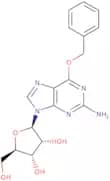
CAS:<p>3',5'-Di-O-Benzoyl-N4-benzoyl-2'-deoxy-2'-fluoroarabinocytidine is a novel nucleoside analogue that has been synthesized to inhibit the activity of DNA polymerase. This compound is also an activator of diphosphate and ribonucleoside monophosphate. 3',5'-Di-O-Benzoyl-N4-benzoyl-2'-deoxy-2'-fluoroarabinocytidine has been shown to inhibit the replication of herpes simplex virus type 1 in cell culture and the replication of human cytomegalovirus in cell culture. 3',5'-Di-O-Benzoyl-N4-benzoyl-2'-deoxy-- 2'-fluoroarabinocytidine does not have any antiviral activity against HIV.</p>Purity:Min. 95%O6-Benzyl guanosine
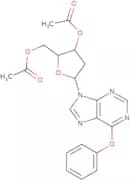
CAS:<p>O6-Benzyl guanosine is a polymerized compound that has been shown to have anticancer efficacy. It has been tested in mice with medulloblastoma, a type of brain tumor, and in rats with breast cancer. O6-Benzyl guanosine was found to be hydrophobic and bound to the methyltransferase enzyme, which resulted in the inhibition of DNA synthesis. The polymerized compound is able to form conjugates with other molecules such as iron oxide nanoparticles or hydrazone derivatives, which can be used for treatments that involve bioconjugate chemistry.</p>Formula:C17H19N5O5Purity:Min. 95%Molecular weight:373.36 g/mol3',5'-Di-o-acetyl-O6-phenyl-2'-deoxyinosine
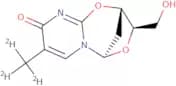
CAS:<p>3',5'-Di-O-acetyl-O6-phenyl-2'-deoxyinosine is a nucleoside analog that has antiviral and anticancer activities. It is an activator of the enzyme ribonucleotide reductase and has been shown to be effective against herpes simplex virus type 1 and 2, cytomegalovirus, Epstein Barr virus, human immunodeficiency virus type 1, and Kaposi sarcoma cells. 3',5'-Di-O-acetyl-O6-phenyl-2'-deoxyinosine also inhibits the production of tumor necrosis factor alpha (TNFα), which can cause inflammatory reactions in the body. This compound is a modified nucleoside with high purity and quality. It has CAS number 133471-06-4.</p>Formula:C20H20N4O6Purity:Min. 95%Molecular weight:412.4 g/mol2,3'-Anhydrothymidine, methyl-D3
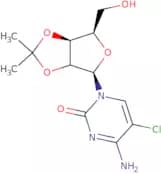
Controlled Product<p>2,3'-Anhydrothymidine, methyl-D3 is a monophosphate nucleoside analogue that has antiviral and anticancer properties. It is a synthetic compound that has been modified to have some of the characteristics of natural DNA. 2,3'-Anhydrothymidine, methyl-D3 is an activator of ribonucleotide reductase and inhibits the synthesis of deoxyribonucleotides in cells. This compound can also be used as an anticancer agent due to its ability to inhibit DNA synthesis in cells.</p>Formula:C10H9D3N2O4Purity:Min. 95%Molecular weight:227.23 g/mol5-Chloro-2',3'-O-isopropylidenecytidine
<p>5-Chloro-2',3'-O-isopropylidenecytidine is a synthetic nucleoside that is activated by phosphorylation to form the corresponding nucleotide. It has antiviral and anticancer properties, and can be used as a building block for synthesis of other nucleosides. 5-Chloro-2',3'-O-isopropylidenecytidine is synthesized from 2,4-dichlorophenoxyacetic acid (DCA) and 2,5-dichloroaniline in the presence of sodium cyanide. The compound was first synthesized in 1972 and its chemical structure was determined in 1974. 5-Chloro-2',3'-O-isopropylidenecytidine has been shown to inhibit DNA synthesis by binding to viral diphosphate and deoxyribonucleosides. This compound also inhibits the activity of bacterial DNA gyrase and DNA top</p>Formula:C12H16ClN3O5Purity:Min. 95%Molecular weight:317.73 g/mol





![5-[3-(Trifluoroacetamido)-E-1-propenyl]-2’- deoxyuridine](/_next/image/?url=https%3A%2Fstatic.cymitquimica.com%2Fproducts%2F3D%2Fthumb-webp%2FNT57550.webp&w=3840&q=75)