Nucleosides
Found 3574 products of "Nucleosides"
Thymidine 5’-triphosphate sodium hydrate
Thymidine 5’-triphosphate (dTTP) sodium hydrate is a fundamental building block in chemical biology. As one of the four natural deoxynucleotides, it plays a crucial role in DNA replication and repair, where dTTP is incorporated into growing DNA strands by DNA polymerases, ensuring fidelity during genetic duplication. The use of dTTP spans various applications, including PCR, DNA sequencing, and site-directed mutagenesis.
Purity:Min. 95%DdCTP trilithium
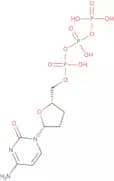
CAS:2',3'-Dideoxycytidine-5'-triphosphate trilithium salt (ddCTP) is a nucleoside analogue that has been shown to inhibit the enzyme activity of DNA polymerase. The ddCTP is a prodrug, which is activated by phosphorylation catalyzed by cellular kinases and then hydrolyzed to its active form, dideoxycytidine triphosphate (ddCTP). This drug also inhibits the synthesis of DNA and RNA. In vitro studies have shown that ddCTP causes cell lysis in murine sarcoma virus-infected cells, although it does not affect uninfected cells. 2',3'-Dideoxycytidine-5'-triphosphate trilithium salt has been shown to be an effective inhibitor of HIV reverse transcriptase and HIV protease in biochemical assays. It has also been found to be an effective inhibitor of mouse monoclon
Formula:C9H13N3Li3O12P3Purity:Min. 95%Color and Shape:LiquidMolecular weight:468.96 g/molN4-Acetyl-5'-O-DMT-cytidine 3'-CE phosphoramidite
N4-Acetyl-5'-O-DMT-cytidine 3'-CE phosphoramidite is a monophosphate nucleoside that is an important building block in nucleic acid synthesis. It has been shown to be effective against cancer cells and HIV infection. N4-Acetyl-5'-O-DMT-cytidine 3'-CE phosphoramidite also inhibits the production of viral proteins, including new viral particles, by binding to the RNA polymerase enzyme in cells. This compound can be used as a novel antiviral agent for the treatment of human immunodeficiency virus type 1 (HIV1) infections.Purity:Min. 95%6-Methylcytidine
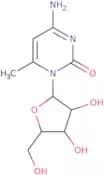
CAS:6-Methylcytidine is a nucleoside that is structurally related to uridine, which is an acceptor in DNA and RNA synthesis. It is synthesized from 8-bromoadenosine, which undergoes deamination by cytidine deaminase. 6-Methylcytidine can be used as a building block for the synthesis of other nucleosides with different conformational properties. It has been shown to inhibit the replication of pancreatic cancer cells and has been used in molecular modeling studies. However, its uptake into cells has been found to be very low. This may be due to its conformational properties and the presence of 8-oxoguanosine, which inhibits adenosine uptake into cells.Formula:C10H15N3O5Purity:Min. 95%Molecular weight:257.24 g/mol2'-Deoxy-N2-isobutyryl-a-cytidine
2'-Deoxy-N2-isobutyryl-a-cytidine (DBIC) is a modified nucleoside that is used in the synthesis of DNA. It is an activator that can be used to enhance the antitumor effects of other drugs. DBIC has been shown to inhibit the proliferation of human tumor cells by inactivating the p53 protein, which regulates cell cycle progression and suppresses tumorigenesis. This drug also has antiviral, anticancer, and anti-inflammatory properties.Formula:C13H19N3O5Purity:Min. 95%Molecular weight:297.31 g/molN4-Acetyl-2'-Deoxy-5'-O-DMT-cytidine 3'-succinyl CPG 1000 Å
N4-Acetyl-2'-Deoxy-5'-O-DMT-cytidine 3'-succinyl CPG 1000 Å is a nucleoside analog. It is an antiviral and anticancer agent that inhibits the synthesis of DNA. This compound has a high purity, reactivity and solubility. N4-Acetyl-2'-Deoxy-5'-O-DMT-cytidine 3'-succinyl CPG 1000 Å can be used in the synthesis of oligonucleotides for research purposes or as pharmaceutical ingredients.Purity:Min. 95%4-Amino-5-(2-deoxy-b-D-ribofuranosyl)-1-methyl-2(1H)-pyrimidinone
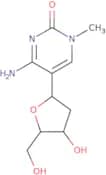
CAS:4-Amino-5-(2-deoxy-b-D-ribofuranosyl)-1-methyl-2(1H)-pyrimidinone is a novel activator that is a ribonucleoside and deoxyribonucleoside diphosphate, as well as phosphoramidite and modified nucleosides. It has been shown to have anticancer, antiviral, and antimalarial activities in vitro. This compound has been synthesized in high purity and high quality with CAS No. 1166395-05-6.Formula:C10H15N3O4Purity:Min. 95%Molecular weight:241.24 g/mol3'-Deoxy-N6-propionyladenosine
CAS:3'-Deoxy-N6-propionyladenosine is a prodrug that is modified in the body to form adenosine. It has been shown to have a high bioavailability and pharmacokinetic profile, with a high initial concentration and rapid elimination. 3'-Deoxy-N6-propionyladenosine has been shown to be effective against tuberculosis and leprosy, with a half-life of approximately 1 hour. The pharmacokinetic curves for this drug have exceeded those of other drugs used for these diseases.Formula:C13H17N5O4Purity:Min. 95%Molecular weight:307.31 g/mol2'-Deoxy-2'-fluoro-2'-C-methylcytidine
CAS:2'-Deoxy-2'-fluoro-2'-C-methylcytidine is a nucleoside analog with modifications on both the sugar and the nucleobase. It is a derivative of cytidine, with fluorine attached to the 2' carbon of the sugar (deoxyribose) and a methyl group at the 2' carbon of the sugar as well. These modifications provide the compound with unique properties, such as potnetial increased resistance to enzymatic degradation, which can make it useful in antiviral and anticancer applications.Formula:C10H14FN3O4Purity:Min. 95%Color and Shape:PowderMolecular weight:259.23 g/mol3'-Deoxy-3'-fluoro-2'-C-methylguanosine
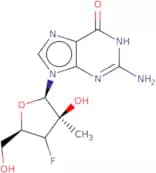
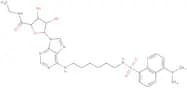
CAS:3'-Deoxy-3'-fluoro-2'-C-methylguanosine is a nucleoside analog that is used in the treatment of cancer. It is an activator of the anticancer drug 5-FU, which inhibits DNA synthesis and cell division. 3'-Deoxy-3'-fluoro-2'-C-methylguanosine may also be used as a starting material for the synthesis of other nucleosides, such as 2',3'-deoxyadenosine and 3',5' -deoxycytidine.Formula:C11H14FN5O4Purity:Min. 95%Molecular weight:299.26 g/molN6-Dansylhexyl-5'-ethylcarboxamidoadenosine
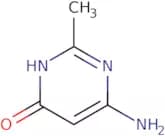
CAS:N6-Dansylhexyl-5'-ethylcarboxamidoadenosine is a fluorescent molecule that can be used in the field of microscopy and cytometry. It has been shown to be an adenosine receptor agonist, which may be due to its ability to bind to the adenosine receptor and activate it. This ligand has also been shown to bind with high affinity to the fluorescence resonance transfer protein, resulting in a fluorescent signal. In addition, this molecule is a linker for fluorescence resonance energy transfer between two molecules that are not close enough for direct contact.Formula:C30H40N8O6SPurity:Min. 95%Molecular weight:640.75 g/mol4-Amino-6-hydroxy-2-methylpyrimidine
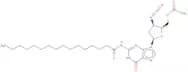
CAS:4-Amino-6-hydroxy-2-methylpyrimidine (4AMMP) is a heterocyclic compound that belongs to the group of pyrimidines. It has been shown to react with morpholine and acrylic acid in an oxidation sequence. The reaction proceeds through an elimination, forming formaldehyde, which condenses with hydrolyzed piperazine to give the final product. 4AMMP can also be alkylated with a variety of reagents such as methyl iodide or dimethyl sulfate.Formula:C5H7N3OPurity:Min. 95%Color and Shape:PowderMolecular weight:125.13 g/mol5'-O-Acetyl-3'-azido-2',3'-dideoxy-N2-palmitoylguanosine
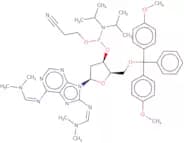
CAS:5'-O-Acetyl-3'-azido-2',3'-dideoxy-N2-palmitoylguanosine is a novel antiviral and anticancer agent. It is an analogue of the natural nucleoside guanosine. It has been modified with an acetyl group at the 5' position of the pentose moiety and an azido group at the 2' and 3' positions of the ribose moiety. The acetyl group makes this compound more water soluble, which means it can be easily administered intravenously for treatment of cancer or infection.Formula:C28H44N8O5Purity:Min. 95%Molecular weight:572.7 g/mol8-Amino-2'-deoxy-N6,N8-di-DMF-5'-O-DMT-adenosine 3'-CE phosphoramidite
CAS:8-Amino-2'-deoxy-N6,N8-di-DMF-5'-O-DMT-adenosine 3'-CE phosphoramidite is a novel nucleoside analog with antiviral and anticancer properties. It is synthesized by reacting 8-aminoimidazo[2,1-b]thiazole 1,3(2H)-dione (AITD) with N6,N8-diisopropyl dATP to form the aminothiazole phosphate intermediate. This intermediate is then reacted with 5'-O-(4,4'-dimethoxytrityl)-2',3',5' triphosphate (DMTrP) to produce the desired product. The synthesis of 8AAODMTAP has been shown to be more efficient than other synthesized nucleosides due to its high purity and lack of impurities.Formula:C46H59N10O6PPurity:Min. 95%Molecular weight:879 g/mol2'-Deoxy-5'-O-DMT-N4-(hexyloxylevulinyl)-5-methylcytidine 3'-CE phosphoramidite
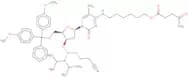
2'-Deoxy-5'-O-DMT-N4-(hexyloxylevulinyl)-5-methylcytidine 3'-CE phosphoramidite is a novel modified nucleoside that can be used in the synthesis of oligonucleotides. 2'-Deoxy-5'-O-DMT-N4-(hexyloxylevulinyl)-5-methylcytidine 3'-CE phosphoramidite is an activator of adenovirus, herpes simplex virus and human immunodeficiency virus type 1 (HIV-1). It is also an anticancer agent that has been shown to inhibit proliferation of various tumor cells. This product has high purity, high quality and is available at CAS No. 216837-27-3.Formula:C51H68N5O10PPurity:Min. 95%Molecular weight:942.11 g/mol4-Amino-2,6-dimethyl-8-(2'-deoxy-3',5'-di-O-toluoyl-D-ribofuranosyl)-7-pteridone
4-Amino-2,6-dimethyl-8-(2'-deoxy-3',5'-di-O-toluoyl-D-ribofuranosyl)-7-pteridone is an activator that has been shown to be a novel antiviral agent. It inhibits the activity of viral RNA polymerase and prevents the synthesis of viral RNA. This drug also has anticancer activity, which may be due to its ability to inhibit DNA synthesis. 4-Amino-2,6-dimethyl-8-(2'-deoxy-3',5'-di-O-toluoyl) -7 pteridone is a nucleoside with phosphoramidite chemistry.Formula:C29H29N5O6Purity:Min. 95%Molecular weight:543.57 g/mol2',3'-Dideoxyguanosine-5'-O-(1-thiotriphosphate)
CAS:2',3'-Dideoxyguanosine-5'-O-(1-thiotriphosphate) (2,3'-ddGTP) is a nucleoside that is synthesized using phosphoramidite chemistry. It has antiviral and anticancer activity, as well as the ability to activate cellular transcription. 2,3'-Dideoxyguanosine-5'-O-(1-thiotriphosphate) can be used in the synthesis of modified nucleosides or in the synthesis of novel nucleosides. The compound was found to inhibit DNA replication by binding to the enzyme ribonucleotide reductase. 2,3'-Dideoxyguanosine-5'-O-(1-thiotriphosphate) can also be used for DNA sequencing and as a cytotoxic agent in cancer chemotherapy.Formula:C10H16N5O11P3SPurity:Min. 95%Molecular weight:507.25 g/mol8-Bromo-N6-(dimethylaminomethylidene)-2'-deoxyadenosine
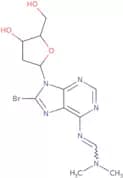
CAS:8-Bromo-N6-(dimethylaminomethylidene)-2'-deoxyadenosine is a phosphoramidite that is used in the preparation of antiviral nucleosides and monophosphate. It has been shown to have anticancer activity. 8-Bromo-N6-(dimethylaminomethylidene)-2'-deoxyadenosine is synthesized by reacting an acid halide with a 2'-deoxyribonucleotide. This reaction produces a 2'-bromo adenosine derivative, which is then reacted with dimethylamine to produce the desired product. The synthesis of 8-bromo-N6-(dimethylaminomethylidene)-2'-deoxyadenosine can be performed on a large scale using an automated process.Formula:C13H17BrN6O3Purity:Min. 95%Molecular weight:385.22 g/molN4-Benzoyl-2'-deoxy-3'-O-DMT-cytidine
CAS:N4-Benzoyl-2'-deoxy-3'-O-DMT-cytidine is a novel nucleoside phosphoramidite with antiviral and anticancer activities. It is synthesized from 2'-deoxycytidine and 4-aminobenzoyl chloride in the presence of tetrazole as a catalyst. The cytidine moiety of N4-benzoyl-2'-deoxy-3'-O-DMT-cytidine is activated by diphosphate, which leads to phosphorylation. This nucleotide has shown potential in inhibiting cancer cell growth and may be used for treatment of leukemia, lymphomas, and myeloma.Formula:C37H35N3O7Purity:Min. 95%Molecular weight:633.69 g/mol1,5-Anhydro-4,6-O-benzylidene-2,3-dideoxy-2-(N6-benzoyladenin-1-yl)-D-glucitol
1,5-Anhydro-4,6-O-benzylidene-2,3-dideoxy-2-(N6-benzoyladenin-1-yl)-D-glucitol is a modified nucleoside that is used as an anticancer agent. It is a synthetic analogue of 2'-deoxyadenosine 5'-monophosphate (dAMP) and has been shown to be a DNA activator. It also has antiviral properties against herpes simplex virus type 1 and influenza A virus. This drug is a novel high purity and high quality product that can be used for research purposes.Formula:C25H23N5O4Purity:Min. 95%Molecular weight:457.49 g/mol