Nucleosides
Found 3573 products of "Nucleosides"
2,2-Crylo-5-methyluridine
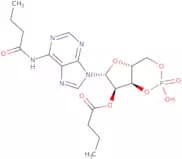
2,2-Crylo-5-methyluridine is a synthetic diphosphate nucleotide that has been shown to be an activator of DNA synthesis. It is used in the synthesis of oligonucleotides and as a monophosphate for the synthesis of 2'-O-methyl ribonucleosides. 2,2-Crylo-5-methyluridine has been shown to have anticancer activity, which may be due to its ability to inhibit tumor proliferation or induce apoptosis.Purity:Min. 95%Dibutyryladenosine cyclic 3',5'-monophosphate
CAS:Dibutyryladenosine cyclic 3',5'-monophosphate (DBACMP) is a mitochondrial function regulator that inhibits the synthesis of ATP by binding to the methyltransferase enzyme. DBACMP also has an inhibitory effect on other enzymes, such as dna binding activity and enzyme activities involved in cellular energy metabolism. DBACMP inhibits infectious diseases by altering signal pathways, which leads to the production of cytokines and chemokines that have pro-inflammatory effects and stimulate axonal growth. The drug may also bind to the atp-binding cassette transporter and inhibit mitochondrial calcium uptake. DBACMP binds to polymorphonuclear leucocytes and alters cytosolic calcium levels, which may lead to an increased production of protein genes for cell growth.Formula:C18H24N5O8PPurity:Min. 95%Molecular weight:469.39 g/mol5-Amino-1-(b-D-ribofuranosyl)imidazole-4-carboxamide-5'-phosphate
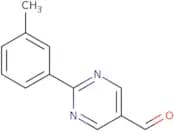
5-Amino-1-(b-D-ribofuranosyl)imidazole-4-carboxamide-5'-phosphate is a ribonucleoside monophosphate. It is an antiviral agent that inhibits the synthesis of RNA by preventing the attachment of ribonucleotides to the 5' end of RNA. This drug is also used in anticancer therapy, as it has been shown to inhibit DNA synthesis and induce cell differentiation. 5-Amino-1-(b-D-ribofuranosyl)imidazole-4-carboxamide-5'-phosphate is synthesized from 1-(2'-deoxyribofuranosyl)-5-(2'-deoxyribofuranosyl)imidazole, which can be made from 2,4,6,-triaminopyrimidine and 2,3,-dideoxyribose. This product has CAS number 13Purity:Min. 95%2-(3-Methylphenyl)pyrimidine-5-carbaldehyde
CAS:2-(3-Methylphenyl)pyrimidine-5-carbaldehyde is a monophosphate nucleoside analog that can be used as an antiviral drug. It has shown cytotoxic activity against cells with a high DNA content, and it inhibits the synthesis of RNA and DNA. This compound could be useful for the treatment of HIV and other viral diseases.Formula:C12H10N2OPurity:Min. 95%Molecular weight:198.22 g/molN6-Benzoyl-5'-O-DMT-2'-O-(2-Ethoxy-2-oxoethyl)adenosine
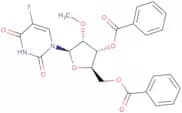
N6-Benzoyl-5'-O-DMT-2'-O-(2-Ethoxy-2-oxoethyl)adenosine is a phosphoramidite that is used in the synthesis of oligonucleotides. It is an activator of ribonucleotides and diphosphate for RNA synthesis. Its high purity and quality make it suitable for use in the synthesis of DNA, RNA, or other nucleoside analogues.Purity:Min. 95%3',5'-Di-O-benzoyl-5-fluoro-2'-O-methyluridine
CAS:3',5'-Di-O-benzoyl-5-fluoro-2'-O-methyluridine is a nucleoside that acts as an activator and phosphoramidite. The di-O-benzoyl group is used to protect the 2'-hydroxyl group during the synthesis of oligonucleotides. 3',5'-Di-O-benzoyl-5-fluoro-2'-O-methyluridine has been shown to have anticancer activity against human breast cancer cells. It also inhibits the replication of DNA viruses, such as HIV, hepatitis B virus and herpes simplex virus type 1, and is active against influenza A virus. This compound has also been shown to inhibit the production of inflammatory cytokines in vitro.Formula:C24H21FN2O8Purity:Min. 95%Molecular weight:484.44 g/mol2',3'-Stannyluridine
2',3'-Stannyluridine is a novel modified ribonucleoside. It is synthesized by the condensation of 2'-deoxyuridine and 3'-hydroxy-2-methylpropiophenone. This product has been shown to have anticancer and antiviral activities. 2',3'-Stannyluridine inhibits the synthesis of DNA, RNA, and protein in cells by binding to the ribonucleotide reductase enzyme. It also has an effect on phosphoramidite synthesis, which is an important step in DNA replication. The CAS number for this product is 57824-03-1.
Purity:Min. 95%5'-O-DMT-2'-O-(2-methylacetamido)-5-methyluridine 3'-CE phosphoramidite
5'-O-DMT-2'-O-(2-methylacetamido)-5-methyluridine 3'-CE phosphoramidite is a high purity, diphosphate, Anticancer, Modified, Phosphoramidites, DNA, High quality, Novel, Activator. It is CAS No. 106433-85-6 and has the molecular formula C15H14N4O8P. 5'-O-DMT-2'-O-(2-methylacetamido)-5-methyluridine 3'-CE phosphoramidite is not found in nature. This product is a monophosphate nucleoside that belongs to the group of nucleosides and deoxyribonucleosides. It can be used for synthesis of DNA and RNA, as well as for the treatment of cancer cells.
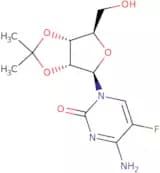
Purity:Min. 95%5-Fluoro-2',3'-O-isopropylidenecytidine
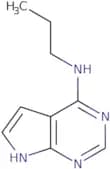
CAS:5-Fluoro-2',3'-O-isopropylidenecytidine is a modified nucleoside that has antiviral and anticancer properties. It is a diphosphate of cytidine, with a fluorine atom in the 2'-position and an isopropyl group in the 3'-position. 5-Fluoro-2',3'-O-isopropylidenecytidine is synthesized by reacting 5-fluorocytidine with isopropylamine. This novel compound has been shown to have high quality, high purity, and improved biological activity as compared to other nucleosides.Formula:C12H16FN3O5Purity:Min. 95%Molecular weight:301.27 g/mol6-Propylamino-7-deazapurine
CAS:6-Propylamino-7-deazapurine is a synthetic nucleoside with antiviral and anticancer properties. It is an activator of DNA synthesis and is modified to have a high quality. 6-Propylamino-7-deazapurine has been shown to be effective against HIV and other viruses in vitro, as well as in animal models, but it is not yet approved for use in humans.6-Propylamino-7-deazapurine has also been shown to inhibit the growth of cancer cells in vitro and in vivo.
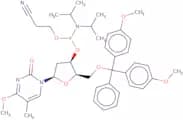
Formula:C9H12N4Purity:Min. 95%Molecular weight:176.22 g/mol5'-O-DMT-4-methoxythymidine 3'-CE phosphoramidite
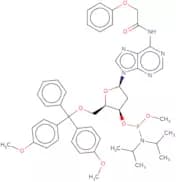
5'-O-DMT-4-methoxythymidine 3'-CE phosphoramidite is a high purity, modified nucleoside with anticancer potential. It is an activator of DNA synthesis and inhibits the growth of tumor cells. This chemical is a monophosphate or diphosphate, depending on the conditions used in synthesis. 5'-O-DMT-4-methoxythymidine 3'-CE phosphoramidite is used to synthesize DNA, RNA, and deoxyribonucleosides. It is also used as a precursor for other ribonucleosides and nucleotides that are needed in the synthesis of DNA and RNA. 5'-O-DMT-4-methoxythymidine 3'-CE phosphoramidite can be synthesized from commercially available starting materials such as 4-(2-deoxyribofuranosyl)thymidine, 5-(3,Formula:C41H51N4O8PPurity:Min. 95%Molecular weight:758.86 g/mol2'-Deoxy-5'-O-DMT-N6-phenoxyacetyladenosine 3'-Me phosphoramidite
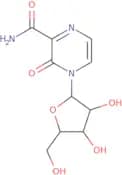
2'-Deoxy-5'-O-DMT-N6-phenoxyacetyladenosine 3'-Me phosphoramidite is a novel nucleoside analog with antiviral and anticancer activities. It inhibits viral replication by inhibiting the viral polymerase and cellular DNA polymerases. 2'-Deoxy-5'-O-DMT-N6-phenoxyacetyladenosine 3'-Me phosphoramidite also inhibits tumor growth by arresting cells in the G2/M phase of the cell cycle. This compound has been shown to be effective against human leukemia, lymphoma, breast cancer, and colon cancer cells.Formula:C46H53N6O8PPurity:Min. 95%Color and Shape:SolidMolecular weight:848.94 g/mol3,4-Dihydro-3-oxo-4-b-D-ribofuranosyl-2-pyrazinecarboxamide
CAS:3,4-dihydro-3-oxo-4-(2-pyrimidinyl)-2,5-dioxopyrrolidine carboxamide is an analog of acyclovir that has antiviral activity against a variety of viruses. It binds to the receptor binding site on the virus and prevents viral replication. 3,4-Dihydro-3-oxo-4-(2-pyrimidinyl)-2,5-dioxopyrrolidine carboxamide is effective against human influenza A virus (H1N1) and hepatitis B virus. This drug also has been shown to inhibit the growth of phlebovirus in cell culture by preventing the synthesis of viral RNA.Formula:C10H13N3O6Purity:Min. 95%Molecular weight:271.23 g/molN2-Acetyl-6-[2-(4-nitrophenyl)ethoxy]-2'-O-trifluoromethanesulfonyl-3',5'-di-O-tritylguanosine
N2-Acetyl-6-[2-(4-nitrophenyl)ethoxy]-2'-O-trifluoromethanesulfonyl-3',5'-di-O-tritylguanosine is a novel nucleotide that is activated by the addition of 2'-deoxyribonucleosides and has antiviral activity. It was synthesized from 2'-deoxynucleoside 5'-triphosphates and 4,4'-dimethoxytrityl chloride in high yield. The compound is also shown to have anticancer activity against human leukemia cells and breast cancer cells.Purity:Min. 95%2-[[4-[2-(tert-Butoxycarbonyl)ethyl]phenylethyl]amino]2',3'-O-isopropylideneadenosine-5'-N-ethylcarboxamide
CAS:2-[[4-[2-(tert-Butoxycarbonyl)ethyl]phenylethyl]amino]2',3'-O-isopropylideneadenosine-5'-N-ethylcarboxamide is a novel nucleoside that inhibits DNA synthesis and viral replication. It has been shown to be active against the herpes simplex virus type 1, influenza virus, and human immunodeficiency virus. 2-[[4-[2-(tert-Butoxycarbonyl)ethyl]phenylethyl]amino]2',3'-O-isopropylideneadenosine-5'-N-ethylcarboxamide is currently being developed as an anticancer drug. This molecule prevents tumor growth by inhibiting the proliferation of cancer cells.Formula:C30H41N7O6Purity:Min. 95%Molecular weight:595.69 g/molCholesteryl-TEG Phosphoramidite
CAS:Cholesteryl-TEG Phosphoramidite is a phosphoramidite that is used in the synthesis of DNA. It is also known as cholesterol-1,2,3,4,5-pentaethyleneglutamate phosphoramidite. Cholesteryl-TEG Phosphoramidite has been shown to have antiviral and anticancer activity. The novel properties of this compound make it an interesting candidate for further study. This chemical is synthesized by reacting cholesteryl chloride with triethylene glycol monophosphate. It is also a modified nucleoside that contains a deoxyribonucleoside and an activated ribonucleoside.
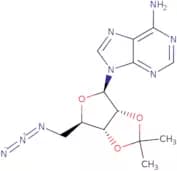
Formula:C70H106N3O11PPurity:Min. 95%Molecular weight:1,196.6 g/mol5'-Azido-5'-deoxy-2',3'-O-isopropylideneadenosine
CAS:5'-Azido-5'-deoxy-2',3'-O-isopropylideneadenosine (5ADeA) is a novel nucleoside with antiretroviral and antitumor activity. It is an activator of the innate immune system, which stimulates the production of cytokines such as TNF-α and IL-1β. This agent also inhibits viral replication by inhibiting viral RNA synthesis through its effect on the enzyme ribonucleotide reductase. 5ADeA monophosphate has been shown to be an effective antiviral against HIV and hepatitis C virus, as well as being active against human papilloma virus and Epstein-Barr virus. 5ADeA is synthesized in high purity and has a CAS number of 34245-48-2.Formula:C13H16N8O3Purity:Min. 95%Molecular weight:332.32 g/mol5'-O-(4,4'-Dimethoxy-4''-(1H,1H,2H,2H-perfluorodecyl)trityl)thymidine 3'-CE phosphoramidite
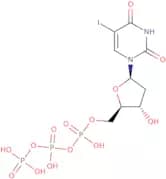
CAS:Controlled Product5'-O-(4,4'-Dimethoxy-4''-(1H,1H,2H,2H-perfluorodecyl)trityl)thymidine 3'-CE phosphoramidite is a novel nucleoside with antiviral activity. It is synthesized through the condensation of 5-bromo-2′-deoxyuridine and 4,4′-dimethoxytrityl chloride. This compound has been shown to inhibit the synthesis of DNA and RNA in vitro. It also has anticancer properties and can be used for the treatment of leukemia.Formula:C50H52F17N4O9PPurity:Min. 95%Molecular weight:1,206.92 g/mol2'-Deoxy-5-iodouridine-5'-triphosphate sodium salt - 10mM aqueous solution
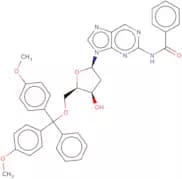
CAS:2'-Deoxy-5-iodouridine-5'-triphosphate sodium salt is a potent inhibitor of thymidylate synthase, an enzyme that catalyzes the conversion of deoxyuridine to thymidylate. 2'-Deoxy-5-iodouridine-5'-triphosphate sodium salt has been found to have a noncompetitive inhibition effect on bacterial DNA replication and is used as a chemotherapeutic agent in the treatment of cancer. It is also used as a radioprotectant during radiation therapy. The optimum concentration for 2'-deoxy-5-iodouridine-5'-triphosphate sodium salt is 10mM, which inhibits bacterial enzymes but does not inhibit mammalian enzymes.Formula:C9H10N2O14P3I·4NaPurity:Min. 95%Molecular weight:681.97 g/molN2-Benzoyl-9-(2'-deoxy-5'-O-DMT-2'-deoxy-b-D-ribofuranosyl)purine
N2-Benzoyl-9-(2'-deoxy-5'-O-DMT-2'-deoxy-b-D-ribofuranosyl)purine is a phosphoramidite that is used as a precursor for the synthesis of modified oligonucleotides. It is also active against cancer and antiviral pathogens. N2-Benzoyl-9-(2'-deoxy-5'-O-DMT-2'-deoxy-b-D ribofuranosyl)purine has been shown to inhibit viral replication in vitro by inhibiting the formation of viral DNA, RNA, and protein. This drug has been shown to inhibit the growth of mouse leukemia cells in vivo. It also inhibits DNA synthesis by binding to the enzyme DNA polymerase, which is required for replication of bacterial and viral DNA.Formula:C38H35N5O6Purity:Min. 95%Molecular weight:657.71 g/mol






![N2-Acetyl-6-[2-(4-nitrophenyl)ethoxy]-2'-O-trifluoromethanesulfonyl-3',5'-di-O-tritylguanosine](/_next/image/?url=https%3A%2Fstatic.cymitquimica.com%2Fproducts%2F3D%2Fthumb-webp%2FNA34795.webp&w=3840&q=75)
![2-[[4-[2-(tert-Butoxycarbonyl)ethyl]phenylethyl]amino]2',3'-O-isopropylideneadenosine-5'-N-ethylca…](/_next/image/?url=https%3A%2Fstatic.cymitquimica.com%2Fproducts%2F3D%2Fthumb-webp%2FNB16642.webp&w=3840&q=75)