Nucleosides
Found 3571 products of "Nucleosides"
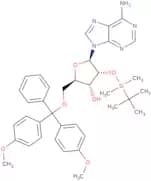
2'-O-tert-Butyldimethylsilyl-5'-O-DMT-adenosine
CAS:2'-O-tert-Butyldimethylsilyl-5'-O-DMT-adenosine is a modified nucleoside that is used to synthesize oligonucleotides. It is a phosphoramidite, and can be used in the synthesis of DNA or RNA. 2'-O-tert-Butyldimethylsilyl-5'-O-DMT-adenosine is an antiviral agent that has been shown to have anticancer activity in animal models. It has been shown to inhibit the production of tumor necrosis factor alpha (TNFα) and serum enzymes, such as dismutase activity, in mice with lung cancer. This drug also has a toxic effect on respiratory system cells, which may be due to its ability to induce apoptosis.
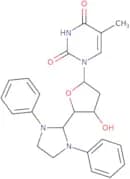
Purity:Min. 95%5'-Deoxy-5'-(1,3-diphenyl-2-imidazolidinyl)thymidine
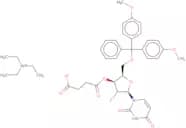
CAS:5'-Deoxy-5'-(1,3-diphenyl-2-imidazolidinyl)thymidine is a modified nucleoside analog that inhibits the growth of viruses. It has been shown to be active against herpes simplex virus type 1 and 2, varicella zoster virus, cytomegalovirus, and Epstein-Barr virus. This drug is used as an antiviral medication in the treatment of viral infections.Formula:C24H26N4O4Purity:Min. 95%Molecular weight:434.5 g/mol2'-Deoxy-5'-O-DMT-2'-fluorouridine 3'-O-succinate triethylammonium salt
2'-Deoxy-5'-O-DMT-2'-fluorouridine 3'-O-succinate triethylammonium salt is a nucleoside that is modified with a 2,2,2-trifluoroethoxycarbonyl group on the 5' position of the sugar moiety. It is an activator for phosphoramidites in DNA synthesis and has been shown to have anticancer activity. It is also used as an antiviral agent and to treat HIV and herpes virus infections. This compound has a molecular weight of 439.5 g/mol and its CAS number is 62273-03-3.
Formula:C34H32FN2O10·C6H16NPurity:Min. 95%Color and Shape:SolidMolecular weight:749.84 g/mol2'-Deoxyadenosine 5'-a-thiotriphosphate sodium salt
2'-Deoxyadenosine 5'-a-thiotriphosphate sodium salt is an antiviral nucleotide analog that has been modified to have a novel structure. It is phosphorylated in vivo to form 2'-deoxyadenosine 5'-a-thiotriphosphate. The nucleoside can inhibit viral DNA synthesis and help prevent the spread of HIV, herpes virus type I, herpes virus type II, influenza virus, and other viruses. This compound also has anticancer activity and has been shown to be effective against leukemia cells.Purity:Min. 95%Guanosine 3',5'-diphosphate tetralithium salt
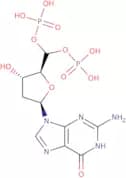
CAS:Guanosine 3',5'-diphosphate tetralithium salt is a nucleoside that has antiviral and anticancer properties. It is synthesized by reacting guanosine with lithium tetrabutylammonium tetraiodide. This nucleotide can be used as a precursor for DNA synthesis, deoxyribonucleosides, and phosphoramidites. Guanosine 3',5'-diphosphate tetralithium salt has been shown to activate the synthesis of proteins in the absence of adenosine triphosphate (ATP).Formula:C10H11Li4N5O11P2Purity:Min. 95%Molecular weight:466.93 g/mol5'-O-Trityl-3'-b-hydroxythymidine
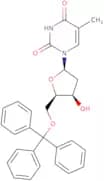
CAS:5'-O-Trityl-3'-b-hydroxythymidine is a nucleoside that is synthesized by the reduction of a pyrimidine with xylene. This molecule has been shown to have antibacterial activity, and also activates p53 in human cells. 5'-O-Trityl-3'-b-hydroxythymidine has been shown to inhibit the growth of cancer cells in a dose dependent manner. The functional theory for this finding is that 5'-O-Trityl-3'-b-hydroxythymidine may bind to DNA, preventing RNA polymerase from transcribing DNA into mRNA.
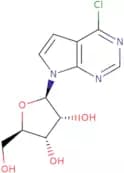
Formula:C29H28N2O6Purity:Min. 95%Molecular weight:500.54 g/mol6-Chloro-7-deaza-9-(a-D-ribofuranosyl)purine
CAS:6-Chloro-7-deaza-9-(a-D-ribofuranosyl)purine is an anticancer drug that belongs to the class of nucleosides. It inhibits DNA and RNA synthesis by blocking the incorporation of nucleotides into DNA or RNA. This drug may also inhibit viral replication by blocking viral polymerase activity. 6-Chloro-7-deaza-9-(a-D-ribofuranosyl)purine has been shown to be a potent activator of phosphoramidites, which are used in chemical synthesis. This novel compound is synthesized using modified diphosphate chemistry and purified to high purity.Formula:C11H12ClN3O4Purity:Min. 95%Molecular weight:285.68 g/molGuanosine 2',3'-cyclic phosphate triethylamine salt
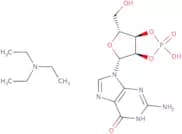
CAS:Guanosine 2',3'-cyclic phosphate triethylamine salt is a synthetic nucleoside that has antiviral and anticancer activity. It is a modified nucleoside with a cyclic phosphate group attached to the 2' position of the sugar ring. This modification prevents hydrolysis of the nucleotide by phosphodiesterases, which are enzymes that break down RNA and DNA. Guanosine 2',3'-cyclic phosphate triethylamine salt has been shown to be active against HIV-1, herpes simplex virus type 1 (HSV-1), HSV-2, and cytomegalovirus (CMV). It also inhibits the proliferation of various cancer cell lines including those from breast, prostate, lung, colon, and leukemia.Formula:C16H27N6O7PPurity:Min. 95%Molecular weight:446.4 g/molN4-Benzoyl-5'-O-DMT-2'-O-(2-methoxyethyl)cytidine
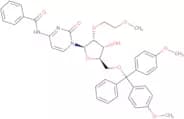
CAS:N4-Benzoyl-5'-O-DMT-2'-O-(2-methoxyethyl)cytidine is a novel ribonucleotide that has been shown to inhibit the growth of cancer cells. It has been synthesized in high purity and quality, with a high phosphoramidite content, and is available in various quantities. This product is an activator of DNA polymerase and can be used as a monophosphate or diphosphate precursor for nucleic acid synthesis. It has antiviral properties, and may be useful in the treatment of HIV infection.Formula:C40H41N3O9Purity:Min. 95%Color and Shape:White Off-White PowderMolecular weight:707.77 g/mol2'/3'-(N-Methylanthraniloyl)-adenosine-5'-triphosphate triethylammonium salt
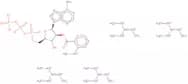
CAS:2'/3'-(N-Methylanthraniloyl)-adenosine-5'-triphosphate triethylammonium salt is a phosphoramidite, deoxyribonucleoside that is active as an antiviral. It inhibits the production of viral DNA and RNA by binding to the polymerase enzyme that copies the viral genome. This drug has been shown to be effective in vitro and in vivo against a wide range of viruses, including HIV, herpes simplex virus type 1 and 2, cytomegalovirus, varicella zoster virus, influenza A virus, and poliovirus. It also has anticancer activity by inhibiting cell proliferation.Formula:C18H23N6O14P3Purity:Min. 95%Molecular weight:640.33 g/molN4-Benzoyl-3'-O-tert-butyldimethylsilyl-2'-deoxycytidine
N4-Benzoyl-3'-O-tert-butyldimethylsilyl-2'-deoxycytidine is a monophosphate nucleoside analogue. It has antiviral and anticancer properties, as well as the ability to activate DNA synthesis. This product is synthesized from 2'-deoxycytidine and 4-benzoyl chloride in the presence of tert-butyldimethylsilyl chloride. It is available for sale as a white powder with a purity of 99%.Formula:C22H31N3O5SiPurity:Min. 95%Color and Shape:PowderMolecular weight:445.58 g/mol3',5'-O-(1,1,3,3-Tetraisopropyl-1,3-disiloxanediyl)-2'-(p-nitrophenylcarbonyloxy)uridine
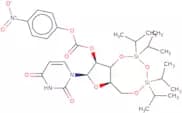
CAS:3',5'-O-(1,1,3,3-Tetraisopropyl-1,3-disiloxanediyl)-2'-(p-nitrophenylcarbonyloxy)uridine is a novel phosphoramidite. It is modified with p-nitrophenyl carbonyloxy group at the 3' position of the uracil moiety. This phosphoramidite has antiviral activity against Hepatitis C and HIV. It also has anticancer activity in vitro and in vivo. 3',5'-O-(1,1,3,3-Tetraisopropyl-1,3-disiloxanediyl)-2'-(p-nitrophenylcarbonyloxy)uridine is a nucleoside that can be used for DNA synthesis or as a monophosphate or diphosphate for RNA synthesis. It is synthesized from deoxyFormula:C28H41N3O11Si2Purity:Min. 95%Molecular weight:651.81 g/molN6-Benzoyl-5'-O-DMT-adenosine 3'-CE phosphoramidite
N6-Benzoyl-5'-O-DMT-adenosine 3'-CE phosphoramidite is a novel nucleoside that has been modified to protect the 2' hydroxyl group from attack by nucleases. This modification makes N6-Benzoyl-5'-O-DMT-adenosine 3'-CE phosphoramidite resistant to degradation and allows for its use in a variety of applications, such as anticancer, antiviral, and DNA sequencing.Purity:Min. 95%E-5-(2-Carbomethoxyvinyl)-2'-deoxy-5'-O-DMT-uridine
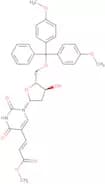
CAS:E-5-(2-Carbomethoxyvinyl)-2'-deoxy-5'-O-DMT-uridine is a monophosphate nucleoside analog that has been modified to be resistant to antiviral ribonucleases. This drug is phosphorylated in vivo to the corresponding diphosphate and triphosphate, which inhibits viral DNA synthesis and thus prevents the virus from replicating. E-5-(2-Carbomethoxyvinyl)-2'-deoxy-5'-O-DMT-uridine can be used as an antiviral agent against herpes simplex virus (HSV).Formula:C34H34N2O9Purity:Min. 95%Molecular weight:614.66 g/molS-(4-Nitrobenzyl)-6-thioguanosine
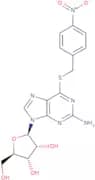
CAS:S-(4-Nitrobenzyl)-6-thioguanosine is a transport inhibitor that has been shown to be active against leukemia. This drug inhibits the uptake of leukocytes into the bone marrow, which prevents their proliferation and development. S-(4-Nitrobenzyl)-6-thioguanosine also inhibits the synthesis of adenosine in erythrocytes, which leads to the accumulation of uridine and then to an increase in the levels of ATP. This drug can be used to treat chronic lymphocytic leukemia.Formula:C17H18N6O6SPurity:Min. 95%Molecular weight:434.43 g/molN6-Benzoyl-2'-deoxy-3'-O-levulinoyladenosine
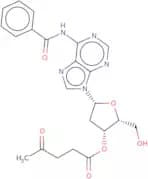
N6-Benzoyl-2'-deoxy-3'-O-levulinoyladenosine is an antiviral monophosphate nucleoside that has been shown to have significant activity against HIV and herpes simplex virus. It is also an anticancer drug and a novel synthetic nucleoside. N6-Benzoyl-2'-deoxy-3'-O-levulinoyladenosine has been shown to inhibit the growth of cancer cells in culture, as well as in animal models. It also inhibits the production of DNA and RNA, which may be due to its ability to act as a competitive inhibitor of DNA polymerase or RNA polymerase.
Formula:C22H23N5O6Purity:Min. 95%Molecular weight:453.46 g/molBenzyl-N, N-diisopropylchlorophosphoramidite
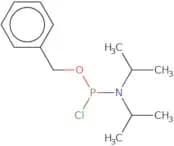
CAS:Benzyl-N, N-diisopropylchlorophosphoramidite is a novel nucleoside phosphoramidite with anticancer activity. It is synthesized from benzyl alcohol and diisopropylamine by reaction with phosphorus oxychloride in the presence of a base. This compound can be used to activate DNA for subsequent coupling reactions or for modification of DNA. Benzyl-N, N-diisopropylchlorophosphoramidite has been shown to have antiviral and antitumour activities in vitro and in vivo.Formula:C13H21NOPClPurity:Min. 95%Molecular weight:273.74 g/mol5-[N-(2-Aminoethyl)-3-E-acrylamido]-2'-deoxy-5'-O-DMT-uridine
CAS:5-[N-(2-Aminoethyl)-3-E-acrylamido]-2'-deoxy-5'-O-DMT-uridine is a novel, activator ribonucleoside phosphoramidite. It is used in the synthesis of oligodeoxynucleotides and has antiviral, anticancer, and antimalarial activities. 5-[N-(2-Aminoethyl)-3-E-acrylamido]-2'-deoxy-5'-O-DMT-uridine is synthesized from 2'-deoxyadenosine monophosphate (dAMP) and N-(2 aminopropyl)-3-(E acryloyl) aminopropylphosphoramidite (APEAP). This nucleoside can be used as a building block for DNA synthesis or for other purposes such as the treatment of cancer and HIV.Formula:C35H38N4O8Purity:Min. 95%Molecular weight:642.72 g/mol2'-Deoxyuridine-5'-diphosphate sodium
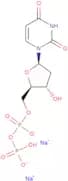
CAS:2'-Deoxyuridine-5'-diphosphate sodium salt is a novel antiviral agent that inhibits viral replication by inhibiting the activity of viral DNA polymerase. It is a synthetic nucleoside that is not found in nature, but is an analog of deoxyuridine monophosphate. This compound has been shown to be effective against tumor cells and has high purity with a CAS number 102814-06-2. 2'-Deoxyuridine-5'-diphosphate sodium salt is also used as an activator for phosphoramidites and modified nucleosides.Formula:C9H14N2O11P2•Na2Purity:Min. 95%Color and Shape:PowderMolecular weight:434.14 g/molBiotin-5-deoxycytidine-5'-triphosphate, lithium salt - 1 mM aqueous solution
Biotin-5-deoxycytidine-5'-triphosphate, lithium salt - 1 mM aqueous solution is a modified nucleoside with antiviral activity. It is a phosphoramidite that can be used for the synthesis of DNA, RNA and other nucleic acids. Biotin-5-deoxycytidine-5'-triphosphate, lithium salt - 1 mM aqueous solution is an active ingredient in many research laboratories.Formula:C22H35N6O15P3SPurity:Min. 95%Molecular weight:748.53 g/mol




![5-[N-(2-Aminoethyl)-3-E-acrylamido]-2'-deoxy-5'-O-DMT-uridine](/_next/image/?url=https%3A%2Fstatic.cymitquimica.com%2Fproducts%2F3D%2Fthumb-webp%2FNA08231.webp&w=3840&q=75)