Nucleosides
Found 3569 products of "Nucleosides"
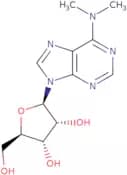
6-Dimethylamino-9-(b-D-ribofuranosyl)purine
CAS:6-Dimethylamino-9-(b-D-ribofuranosyl)purine (6-DMAP) is an analog of adenine that has been shown to have anticancer activity in human serum and tissue culture. 6-DMAP can inhibit the synthesis of ATP, leading to cell death by significantly inhibiting cellular processes such as glycolysis and DNA replication. 6-DMAP also has a significant cytotoxicity on various types of cancer cells and plant tissues. The mechanism of action for the anticancer activity of 6-DMAP is not yet known, but it may be due to its ability to interfere with purine metabolism or its ability to form covalent bonds with DNA.
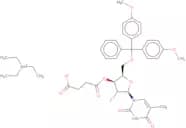
Formula:C12H17N5O4Purity:Min. 98 Area-%Color and Shape:White PowderMolecular weight:295.3 g/mol1-(2'-Deoxy-5'-O-DMT-2'-fluoro-β-D-arabinofuranosyl)thymine 3'-O-succinate triethylammonium
1-(2'-Deoxy-5'-O-DMT-2'-fluoro-b-D-arabinofuranosyl)thymine 3'-O-succinate triethylammonium salt is a compound used in the synthesis of oligonucleotides. The synthesis of such compounds often involves the use of protecting groups, such as the 4,4'-dimethoxytrityl (DMT) group, to prevent unwanted reactions during the synthesis process. The 2'-fluoro modification is of particular interest due to its potential to alter the chemical and biological properties of the resulting oligonucleotides. Fluorinated nucleosides and their analogs have been extensively studied for their antiviral and anticancer activitiesFormula:C35H34FN2O10•C6H16NPurity:Min. 95%Molecular weight:763.87 g/mol5’-O-Acetyl-5-acetyloxymethyluridine
CAS:5’-O-Acetyl-5-acetyloxymethyluridine is an activated nucleoside that is a phosphoramidite. It can be used in the synthesis of oligonucleotides and has antiviral, anticancer, and antiretroviral activities. This product is a novel compound that can be used to synthesize high quality deoxyribonucleosides and diphosphate ribonucleosides. 5’-O-Acetyl-5-acetyloxymethyluridine is an activator for DNA polymerases and RNA polymerases with a high degree of purity.Formula:C14H18N2O9Purity:Min. 95%Molecular weight:358.3 g/mol5’(R)-C-Methyl-5-fluorouridine
5’(R)-C-Methyl-5-fluorouridine is a nucleoside that has been shown to activate both ribonucleosides and deoxyribonucleosides. 5’(R)-C-Methyl-5-fluorouridine is a novel nucleotide with the potential to be used in anticancer therapy. It can be used as a building block for DNA synthesis, as well as being able to act as an anticancer drug by inhibiting the growth of cancer cells. This product is made from high quality raw materials and has a purity of at least 98%. It is available in powder form.Purity:Min. 95%2'-O-(2-Methoxyethyl)-5-methylcytidine 5'-monophosphate
2'-O-(2-Methoxyethyl)-5-methylcytidine 5'-monophosphate is a novel nucleoside analog that is phosphorylated to its active form, 5'-O-(4,4'-dimethoxytrityl)-2'-O-(2-methoxyethyl)-5-methylcytidine monophosphate, which has antiviral and anticancer properties. It can be used as an activator for oligonucleotide synthesis and DNA synthesis. This product is available in high purity (>98%) and high quality. CAS No.: 181297-76-7Purity:Min. 95%4-Demethylwyosine
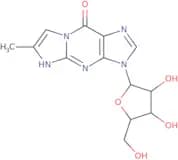
CAS:4-Demethylwyosine is a metabolite found in the bacterium Pyrococcus furiosus. It is an intermediate in the biosynthesis of 2-amino-3,5-dimethyoxybenzoic acid. 4-Demethylwyosine has been shown to inhibit cancer cell proliferation by inhibiting the synthesis of lysine residues and base formation. This inhibition may be due to its methyl transferase activity, which leads to decreased levels of methionine, or it may be due to its ability to act as a carboxylate group donor. 4-Demethylwyosine has also been shown to bind with DNA and RNA, regulating posttranscriptional processes such as protein translation and transcription.Formula:C13H15N5O5Purity:Min. 80 Area-%Color and Shape:PowderMolecular weight:321.29 g/mol3'-O-[(Propan-2-ylidene)amino]-thymidine 5'-triphosphate
CAS:3'-O-[(Propan-2-ylidene)amino]-thymidine 5'-triphosphate is an antiviral and anticancer agent that is used for the synthesis of DNA and RNA. It is a novel nucleoside analog that has been modified to be activated by phosphoramidite chemistry. 3'-O-[(Propan-2-ylidene)amino]-thymidine 5'-triphosphate is synthesized from 2,6-diisopropylaniline, methyl 3-(aminomethyl)-1H-pyrrole-2,4-dicarboxylate, and propylamine in cyclohexane at reflux.Formula:C13H22N3O14P3Purity:Min. 95%Molecular weight:537.25 g/mol4-Amino-6-hydroxypyrazolo(3,4-D)pyrimidine
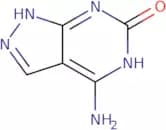
CAS:4-Amino-6-hydroxypyrazolo(3,4-D)pyrimidine is an anti-inflammatory drug that is used to treat bowel disease. It is also used as a polymer conjugate to treat cancer, and in the prevention of transplant rejection. 4-Amino-6-hydroxypyrazolo(3,4-D)pyrimidine has been shown to have antioxidant properties and may be effective in preventing inflammatory diseases such as inflammatory bowel disease. It has also been shown to act as an antihypertensive agent by inhibiting angiotensin I converting enzyme (ACE).Formula:C5H5N5OPurity:Min. 95%Molecular weight:151.13 g/mol3'-Azido-N4-benzoyl-5'-O-benzoyl-2',3'-dideoxycytidine
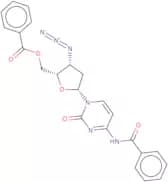
3'-Azido-N4-benzoyl-5'-O-benzoyl-2',3'-dideoxycytidine is a synthetic nucleoside with antiviral and anticancer properties. It is a modified nucleoside that has been synthesized from 2,3'-dideoxycytidine. 3'-Azido-N4-benzoyl-5'-O-benzoyl-2',3'-dideoxycytidine has shown to be effective against HIV and influenza virus. 3'-Azido-N4-benzoyl-5'-O-benzoyl-2',3'-dideoxycytidine binds to the viral RNA polymerase, preventing the production of viral mRNA. This drug also inhibits DNA synthesis by binding to deoxynucleotide triphosphates (dNTPs) and prevents DNA synthesis by inhibiting the enzyme DNA polymerase.Formula:C23H20N6O5Purity:Min. 95%Molecular weight:460.44 g/molGuanosine 5'-monophosphate calcium salt
CAS:guanosine 5'-monophosphate calcium salt is a dietary supplement that contains calcium carbonate and guanosine 5'-monophosphate. This product is a light-exposed supplement that contains phenolic acids, polycarboxylic acids, and cyclic nucleotide phosphodiesterases. It is used to maintain ATP levels in the body. Guanosine 5'-monophosphate calcium salt should not be taken by people with a history of kidney stones or those taking other supplements containing calcium. This product may contain preservatives, excipients, or pharmaceutical ingredients for potency and stability purposes.
Formula:C10H12CaN5O8PPurity:Min. 95%Molecular weight:401.28 g/molN6-Benzoyl-5'-O-DMT-2'-O-[([triisopropylsilyl]oxy])methyl]-adenosine
CAS:N6-Benzoyl-5'-O-DMT-2'-O-[([triisopropylsilyl]oxy])methyl]-adenosine is a novel nucleoside that is chemically modified with an ortho-benzoyl group and a triisopropylsilyl ether moiety. It is used as a precursor for the synthesis of phosphoramidites, which are then used to synthesize DNA, RNA, and antiviral agents. N6-Benzoyl-5'-O-DMT-2'-O-[([triisopropylsilyl]oxy])methyl]-adenosine has shown anticancer activity in vitro against human tumor cell lines. The results showed that this agent inhibited the proliferation of tumor cells and induced apoptosis in these cells. This compound also has antiviral properties by inhibiting viral replication at the level of DNA synthesis and RNA transcription.Formula:C48H57N5O8SiPurity:Min. 95%Molecular weight:860.08 g/molAdenosine 5′-phosphosulfate triethylammonium salt
Adenosine 5′-phosphosulfate triethylammonium salt serves as a donor of sulfate groups in biochemical processes, such as in the synthesis of sulfate esters. The triethylammonium salt form improves the solubility and stability of the compound, making it useful in laboratory applications involving enzymatic assays and the synthesis of sulfated biomolecules.
Formula:C10H14N5O10PS·xC6H15NPurity:Min. 98.0 Area-%Color and Shape:PowderMolecular weight:427.29 g/mol9-(2'-O-Acetyl-3'-deoxy-3'-fluoro-5'-O-toluoyl-b-D-ribofuranosyl)-6-phenylpurine
9-(2'-O-Acetyl-3'-deoxy-3'-fluoro-5'-O-toluoyl-b-D-ribofuranosyl)-6-phenylpurine (FTC) is a novel antiviral nucleoside analog that inhibits the synthesis of DNA by inhibiting the enzyme DNA polymerase. It has been shown to be effective against HIV in vitro. FTC exhibits anticancer activity through inhibition of DNA synthesis and induction of apoptosis. FTC also has high purity and quality, as it is synthesized chemically without any purification steps.Purity:Min. 95%N4-Acetyl-2'-O-tert-butyldimethylsilyl-5'-O-DMT-cytidine 3'-CE phosphoramidite
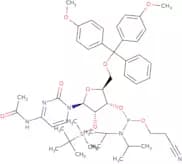
CAS:N4-Acetyl-2'-O-tert-butyldimethylsilyl-5'-O-DMT-cytidine 3'-CE phosphoramidite is a novel nucleoside analogue with antiviral and anticancer potential. It is a modified nucleoside that contains an acetyl group at the 4' position. The 3'-OH group has been replaced by a tertiary butyldimethylsilyl group, which renders the compound resistant to deamination by nucleases. N4-Acetyl-2'-O-tert-butyldimethylsilyl-5'-O-DMT-cytidine 3'-CE phosphoramidite also shows high purity and high quality.Formula:C47H64N5O9PSiPurity:Min. 98 Area-%Color and Shape:White PowderMolecular weight:902.11 g/molCholest-5-en-3-ol, 3-CEphosphoramidite
CAS:Cholest-5-en-3-ol, 3-CEphosphoramidite is a modified nucleoside that is used in the synthesis of DNA and RNA. It has antiviral and anticancer properties. Cholest-5-en-3-ol, 3-CEphosphoramidite inhibits tumor growth by inhibiting DNA synthesis in cells. The drug also has antiviral activity because it inhibits viral replication by blocking the incorporation of deoxyribonucleotides into viral DNA. Cholest-5-en-3-ol, 3-CEphosphoramidite can be used in the synthesis of oligodeoxyribonucleotides containing modified bases or phosphodiester linkages or both. It is also used to synthesize other novel compounds with anticancer properties.Purity:Min. 95%N4-Methylcytidine 5'-triphosphate triethylammonium salt
N4-Methylcytidine 5'-triphosphate triethylammonium salt is a novel nucleoside analog that inhibits the growth of tumor cells. It is synthesized by reacting N4-methylcytidine with phosphoramidite in an amine base, and then treated with triethylamine to produce a triethylammonium salt. This nucleoside analog inhibits DNA synthesis by inhibiting the enzyme ribonucleotide reductase, which converts ribonucleotides to deoxyribonucleotides. The resulting monophosphate compound has been shown to be effective in cancer treatment and may also be used as an antiviral agent.Formula:C10H18N3O14P3Purity:Min. 95%Molecular weight:497.18 g/molN3-Cyanoethyl-5’-O-DMT-2’-O-methyluridine
N3-Cyanoethyl-5’-O-DMT-2’-O-methyluridine is a nucleoside that is synthesized from 5'-O-DMT-2’-O-methyluridine. It has antiviral and anticancer properties, as well as an inhibitory effect on DNA synthesis. N3-Cyanoethyl-5’-O-DMT-2’-O methyluridine is a novel nucleoside with DMT and methylated uracil at the 3' position of the sugar moiety. Synthesis may be achieved by using phosphoramidites or modified nucleosides such as N3-(cyanoethyl)-5'-0-(dimethoxytrityl)thymidine. This product meets high purity standards, with a CAS number of 68719–77–8.Purity:Min. 95%5'-O-[Bis(4-methoxyphenyl)(phenyl)methyl]-2'-deoxy-N-isobutyrylguanosine
CAS:5'-O-[Bis(4-methoxyphenyl)(phenyl)methyl]-2'-deoxy-N-isobutyrylguanosine is a synthetic nucleoside that is used as a building block in the synthesis of oligonucleotides. This chemical has an electronegativity value of 1.7, which means that it is more electronegative than guanine (1.0). It also has a conjugated system and is stable under a range of conditions. 5'-O-[Bis(4-methoxyphenyl)(phenyl)methyl]-2'-deoxy-N-isobutyrylguanosine reacts with tetrazole in the presence of phosphoramidite, yielding the corresponding 5'-O-(4,4'-dimethoxytrityl)-2'-deoxy-N-isobutyrylguanosine, which can then be used toFormula:C35H37N5O7Purity:Min. 98 Area-%Color and Shape:White PowderMolecular weight:639.71 g/mol3'-(N-Methyl-anthraniloyl)-2'-deoxy-adenosine-5'-triphosphate triethylammonium salt
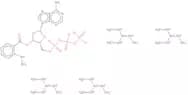
CAS:3'-(N-Methyl-anthraniloyl)-2'-deoxy-adenosine-5'-triphosphate triethylammonium salt is an antiviral agent that inhibits the synthesis of viral RNA. It is a modified nucleoside monophosphate with antiviral activity, which has been shown to be effective against HIV and other retroviruses. 3'-(N-Methyl-anthraniloyl)-2'-deoxy-adenosine-5'-triphosphate triethylammonium salt is also used as a building block for novel anticancer drugs that inhibit cell proliferation by inhibiting DNA synthesis and inducing programmed cell death (apoptosis). This compound has been shown to be an activator of transcription factors, including NFκB, AP1, and SP1.Formula:C18H23N6O13P3Purity:Min. 95%Molecular weight:624.33 g/molS-Adenosyl-L-methionine disulfate tosylate
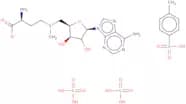
CAS:S-Adenosyl-L-methionine disulfate tosylate (SAMe) is a dietary supplement that is used to treat depression and liver disease. It is also a metabolite of the amino acid methionine, which is formed by the enzyme S-adenosylmethionine synthase. SAMe has been shown to inhibit the activation of caspase 3, which causes apoptosis in cells, and may be useful for treating cancer and other diseases. The chromatographic method used to separate SAMe from other compounds relies on its evaporative properties, due to its high water solubility.Formula:C22H34N6O16S4Purity:Min. 95 Area-%Color and Shape:White PowderMolecular weight:766.8 g/mol




![3'-O-[(Propan-2-ylidene)amino]-thymidine 5'-triphosphate](/_next/image/?url=https%3A%2Fstatic.cymitquimica.com%2Fproducts%2F3D%2Fthumb-webp%2FNP145591.webp&w=3840&q=75)

![N6-Benzoyl-5'-O-DMT-2'-O-[([triisopropylsilyl]oxy])methyl]-adenosine](/_next/image/?url=https%3A%2Fstatic.cymitquimica.com%2Fproducts%2F3D%2Fthumb-webp%2FNB172672.webp&w=3840&q=75)





![5'-O-[Bis(4-methoxyphenyl)(phenyl)methyl]-2'-deoxy-N-isobutyrylguanosine](/_next/image/?url=https%3A%2Fstatic.cymitquimica.com%2Fproducts%2F3D%2Fthumb-webp%2FND02998.webp&w=3840&q=75)