Nucleosides
Nucleosides are fundamental building blocks of nucleic acids, composed of a nitrogenous base attached to a sugar molecule. In this section, you can find a wide variety of nucleosides essential for research in molecular biology, biochemistry, and pharmacology. These compounds play crucial roles in the synthesis of DNA and RNA, and are also vital in various metabolic processes. Nucleosides are used in studying genetic material, developing antiviral and anticancer therapies, and understanding cellular mechanisms. At CymitQuimica, we provide high-quality nucleosides to support your research and development needs, ensuring purity and reliability for your experimental applications.
Found 3567 products of "Nucleosides"
Sort by
Purity (%)
0
100
|
0
|
50
|
90
|
95
|
100
5'-O-DMT-2'-O-methyl-5-iodouridine 3'-CE-phosphoramidite
<p>5'-O-DMT-2'-O-methyl-5-iodouridine 3'-CE-phosphoramidite is a novel nucleoside, which has been synthesized by the activation of 5'-O-DMT-2'-O-methyluridine 3'-CE with phosphorous tribromide. It has been tested for antiviral and anticancer activities, as well as its ability to inhibit HIV replication in vitro. This compound is also useful for the synthesis of other nucleosides.</p>Purity:Min. 95%2',3'-Dideoxy-3'-fluorouridine
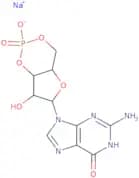
CAS:<p>2',3'-Dideoxy-3'-fluorouridine is a synthetic analog of uridine with chemical modifications that disrupt RNA and DNA synthesis. Because of this, it’s often studied or used as an antiviral or anticancer agent.</p>Formula:C9H11FN2O4Purity:Min. 95%Color and Shape:White PowderMolecular weight:230.2 g/molcGMP sodium salt - Bio-X ™
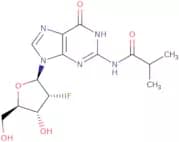
CAS:<p>Cyclic guanosine monophosphate (cyclic GMP) is a guanine nucleotide that is a cellular regulatory agent and is used to increase the levels of various hormones. This molecule is said to increase levels of hormones such as insulin, oxytocin and acetylcholine. Studies have found this molecule to also activate protein kinases.</p>Formula:C10H12N5O7P•NaPurity:Min. 95%Color and Shape:PowderMolecular weight:368.2 g/mol2'-Deoxy-2'-fluoro-N2-isobutyrylguanosine
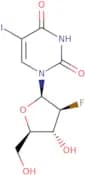
CAS:<p>2'-Deoxy-2'-fluoro-N2-isobutyrylguanosine is a modified nucleoside analog for research applications</p>Formula:C14H18FN5O5Purity:Min. 95%Color and Shape:White PowderMolecular weight:355.33 g/molFialuridine - Bio-X ™
CAS:<p>This product is part of our Bio-X ™ Range. These products are aimed at life science researchers who need high quality ready-to-use products for assay development, screening or other R&D work. With a solubility datasheet and convenient vials, all of our Bio-X ™ products are in stock across our global warehouses for rapid delivery and ease of use.</p>Formula:C9H10FIN2O5Purity:Min. 95%Color and Shape:PowderMolecular weight:372.09 g/mol2'-Deoxy-6-thioguanosine - Bio-X ™
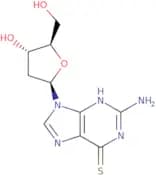
CAS:<p>This product is part of our Bio-X ™ Range. These products are aimed at life science researchers who need high quality ready-to-use products for assay development, screening or other R&D work. With a solubility datasheet and convenient vials, all of our Bio-X ™ products are in stock across our global warehouses for rapid delivery and ease of use.</p>Formula:C10H13N5O3SPurity:Min. 95%Color and Shape:PowderMolecular weight:283.31 g/mol5'-O-DMT-N4-ethylcytidine
<p>5'-O-DMT-N4-ethylcytidine is a novel nucleoside analogue. It has been used as a building block for the synthesis of modified oligonucleotides. 5'-O-DMT-N4-ethylcytidine is an antiviral agent that inhibits HIV replication by inhibiting reverse transcriptase, which is an enzyme that is necessary for the production of viral DNA from host cell RNA. The drug also has anticancer activity, which may be due to its ability to inhibit DNA synthesis and cellular proliferation.</p>Formula:C32H35N3O7Purity:Min. 95%Molecular weight:573.64 g/mol9-(b-D-Arabinofuranosyl)-8-chloroadenine
CAS:<p>9-(b-D-arabinofuranosyl)-8-chloroadenine is a deoxyribonucleoside that is structurally related to adenosine. It has antiviral properties and has been shown to be active against herpes virus, influenza A virus, and cytomegalovirus. 9-(b-D-Arabinofuranosyl)-8-chloroadenine is an activator of cellular DNA polymerase δ and has been shown to inhibit the replication of HIV in human T lymphocytes. 9-(b-D-Arabinofuranosyl)-8-chloroadenine also inhibits the proliferation of tumor cells and is being investigated as a potential chemotherapeutic agent for cancer treatment.</p>Purity:Min. 95%N1-Methylpseudouridine-5'-triphosphate trisodium
<p>Please enquire for more information about N1-Methylpseudouridine-5'-triphosphate trisodium including the price, delivery time and more detailed product information at the technical inquiry form on this page</p>Formula:C10H14N2Na3O15P3Molecular weight:564.11 g/molN′-[9-(2-Deoxy-2-fluoro-β-D-arabinofuranosyl)-6,9-dihydro-6-oxo-1H-purin-2-yl]-N,N-dimethylmethanimidamide
CAS:<p>Please enquire for more information about N′-[9-(2-Deoxy-2-fluoro-β-D-arabinofuranosyl)-6,9-dihydro-6-oxo-1H-purin-2-yl]-N,N-dimethylmethanimidamide including the price, delivery time and more detailed product information at the technical inquiry form on this page</p>Formula:C13H17FN6O4Purity:Min. 95%Molecular weight:340.31 g/molTetrahydrouridine
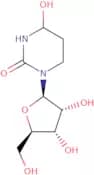
CAS:<p>Tetrahydrouridine is a pyrimidine nucleoside that has been shown to have inhibitory properties in clinical pathology. Tetrahydrouridine is a natural product derived from the amino acid histidine and is found in the cells of many living organisms. It is believed that tetrahydrouridine may be useful as an adjuvant to radiation therapy, and it has been shown to reduce the toxicity of chemotherapy drugs, such as decitabine and Ara-C. Tetrahydrouridine inhibits enzymes involved in DNA methylation, which can lead to cancer cell death.br><br>Tetrahydrouridine also has inhibitory effects on enzymes that produce cytidine from uracil, which can help prevent the formation of cancerous cells.br><br>Tetrahydrouridine inhibits deaminase activity, which produces uracil from cytosine. This inhibition prevents the production of uracil-cytosine</p>Formula:C9H16N2O6Purity:Min. 95%Color and Shape:White Off-White PowderMolecular weight:248.23 g/mol5'-O-Acetyl-2',3'-dideoxy-2',3'-didehydro-5-fluorouridine
CAS:<p>5'-O-Acetyl-2',3'-dideoxy-2',3'-didehydro-5-fluorouridine is a nucleoside analog. It is synthesized by substituting the hydroxyl group of uridine with a fluorine atom and the 2' position of ribose with a 5'-O-acetyl group. This modification prevents the incorporation of this nucleoside into DNA or RNA, making it an effective antiviral and anticancer agent. 5'-O-Acetyl-2',3'-dideoxy-2',3'-didehydro-5-fluorouridine has been shown to be highly active against tumor cells but not normal cells in vitro.</p>Formula:C11H11N2O5Purity:Min. 95%Molecular weight:251.22 g/mol2'-O-Acetyl-3'-azido-5'-O-(4-methylbenzoyl)-3'-deoxyuridine
CAS:<p>2'-O-Acetyl-3'-azido-5'-O-(4-methylbenzoyl)-3'-deoxyuridine (2'AAZ) is a modified nucleoside that has antiviral and anticancer activities. This compound blocks the synthesis of DNA, RNA, and proteins. 2'AAZ inhibits cell proliferation by interfering with the replication of DNA and by inhibiting protein synthesis. It has been shown to inhibit the growth of cancer cells in vitro and in vivo. The IC50 values for 2'AAZ are 5 μM for herpes simplex virus type 1 (HSV1) infection in Vero cells, 4 μM for HSV2 infection in Vero cells, 3 μM for influenza A virus (H1N1) infection in MDCK cells, and 0.5 μM for human immunodeficiency virus type 1 (HIV-1) infection in CEM-SS cells.</p>Purity:Min. 95%N6-Benzoyl-2'-deoxy-2'-fluoroadenosine
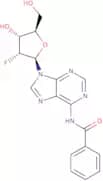
CAS:<p>N6-Benzoyl-2'-deoxy-2'-fluoroadenosine is an oligonucleotide that can be used to modulate the expression of survivin. It inhibits the expression of this protein by binding to its mRNA and preventing translation. N6-Benzoyl-2'-deoxy-2'-fluoroadenosine has shown potential for use in cancer treatment due to its ability to inhibit tumor growth and metastasis. It may also be used in the treatment of autoimmune diseases, such as rheumatoid arthritis, where it can inhibit the production of inflammatory cytokines.</p>Formula:C17H16FN5O4Purity:Min. 95%Color and Shape:White PowderMolecular weight:373.34 g/molN4-Methylcytidine 5'-triphosphate triethylammonium salt
<p>N4-Methylcytidine 5'-triphosphate triethylammonium salt is a novel nucleoside analog that inhibits the growth of tumor cells. It is synthesized by reacting N4-methylcytidine with phosphoramidite in an amine base, and then treated with triethylamine to produce a triethylammonium salt. This nucleoside analog inhibits DNA synthesis by inhibiting the enzyme ribonucleotide reductase, which converts ribonucleotides to deoxyribonucleotides. The resulting monophosphate compound has been shown to be effective in cancer treatment and may also be used as an antiviral agent.</p>Formula:C10H18N3O14P3Purity:Min. 95%Molecular weight:497.18 g/molN4-Acetyl-2'-deoxy-5'-O-tritylcytidine
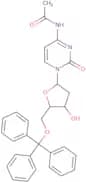
CAS:<p>N4-Acetyl-2'-deoxy-5'-O-tritylcytidine is a novel nucleoside that is synthesized by modifying cytidine to form an acetylated nucleotide. It has been found to be an effective inhibitor of DNA synthesis and antiviral agent.</p>Formula:C30H29N3O5Purity:Min. 95%Molecular weight:511.57 g/mol5'-O-Benzoyl-2'-deoxy-N2-isobutyrylguanosine 3'-CE phosphoramidite
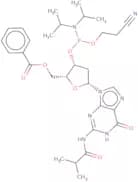
<p>5'-O-Benzoyl-2'-deoxy-N2-isobutyrylguanosine 3'-CE phosphoramidite is a novel nucleoside phosphoramidite. It is an activator that can be used in the synthesis of oligonucleotide analogues, such as ribonucleosides and deoxyribonucleosides. 5'-O-Benzoyl-2'-deoxy-N2-isobutyrylguanosine 3'-CE phosphoramidite has shown anticancer activity.</p>Formula:C30H40N7O7PPurity:Min. 95%Molecular weight:641.67 g/molPalmitoyl coenzyme A potassium salt
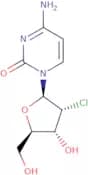
CAS:<p>Palmitoyl coenzyme A potassium salt is a novel, modified nucleoside that has antiviral and anticancer activities. It is a phosphoramidite with a phosphate group at one end and a palmitoyl group at the other. The phosphate group is attached to the 5' position of the sugar, while the palmitoyl group is attached to the 3' position of the sugar. Palmitoyl coenzyme A potassium salt can be used in DNA synthesis.</p>Formula:C37H65N7O17P3SKPurity:Min. 95%Color and Shape:White PowderMolecular weight:1,044.03 g/mol2'-Chloro-2'-deoxycytidine
CAS:<p>2'-Chloro-2'-deoxycytidine is a synthetic nucleoside analog. It is a modified deoxycytidine with a chlorine atom at the 2'-position of the deoxyribose sugar. This molecule can be used in research applications</p>Formula:C9H12ClN3O4Purity:Min. 95%Color and Shape:PowderMolecular weight:261.66 g/molInosine-3',5'-cyclic-monophosphate triethylammonium - 10 mM aqueous solution
<p>Inosine-3',5'-cyclic-monophosphate triethylammonium is a synthetic nucleoside that functions as an activator of the deoxyribonucleotide synthesis. It has antiviral and anticancer properties, and has been shown to have anti-inflammatory activities. Inosine-3',5'-cyclic-monophosphate triethylammonium has been shown to inhibit the growth of cells in culture and induce apoptosis. This is due to its ability to inhibit DNA synthesis by inhibiting the enzyme ribonucleotide reductase.</p>Formula:C10H11N4O7P·NC6H15Purity:Min. 95%Molecular weight:431.38 g/mol





![N′-[9-(2-Deoxy-2-fluoro-β-D-arabinofuranosyl)-6,9-dihydro-6-oxo-1H-purin-2-yl]-N,N-dimethylmethani…](/_next/image/?url=https%3A%2Fstatic.cymitquimica.com%2Fproducts%2F3D%2Fthumb-webp%2FNF183584.webp&w=3840&q=75)