Others
Found 6307 products of "Others"
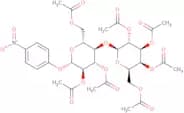
4-Nitrophenyl b-D-cellobioside heptaacetate
4-Nitrophenyl b-D-cellobioside heptaacetate is a chromogenic substrate for enzymes that catalyze the hydrolysis of glycosidic bonds. This product is used as a diagnostic tool for identifying and characterizing glycosidases and other enzymes that degrade glycosidic bonds. 4-Nitrophenyl b-D-cellobioside heptaacetate is also used in culture media to measure the activity of cellulase enzymes by measuring the release of reducing sugars. The color change of this substrate can be detected at 405 nm, 490 nm, or 550 nm.Purity:Min. 95%Molecular weight:757.65 g/mol4-Nitrophenyl 2,3,4-tri-O-acetyl-6-O-(2,3,4,6-tetra-O-[4-methoxybenzyl]-a-D-glucopyranosyl)-a-D-glucopyranoside
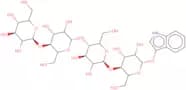
Introducing our 4-Nitrophenyl 2,3,4-tri-O-acetyl-6-O-(2,3,4,6-tetra-O-[4-methoxybenzyl]-a-D-glucopyranosyl)-a-D-glucopyranoside, an advanced chromogenic pNP enzyme substrate designed for high performance and superior results. This cutting-edge substrate ensures excellent outcomes in various enzymatic assays, including glycosidase and glycosyltransferase, due to its unique composition and significant sensitivity. Offering rapid color development and clear visualization, this substrate is perfect for research or industrial applications.Purity:Min. 95%Molecular weight:1,126.03 g/mol3-Indolyl b-D-cellotetraoside
3-Indolyl b-D-cellotetraoside is a chemiluminescent substrate that is used as an indicator in the detection of aminoglycosides. The ligand is a cell wall component that has been shown to bind specifically to the active site of bacterial β-lactamases, which are enzymes that catalyze the hydrolysis of β-lactam antibiotics. 3-Indolyl b-D-cellotetraoside can be used for bacterial identification and enumeration, food testing, and enzyme substrate for diagnostics. It fluoresces in response to electron excitation with a wavelength of about 590 nm.Purity:Min. 95%Molecular weight:781.71 g/mol4-Nitrophenyl b-D-cellobioside heptacetate
CAS:4-Nitrophenyl b-D-cellobioside heptacetate is a fluorogenic substrate that is used in food testing and environmental testing. The product is an enzyme substrate that can be used as a conjugate to produce chemiluminescence or bioluminescence. 4-Nitrophenyl b-D-cellobioside heptacetate has CAS number 69948-03-4 and is of high purity and quality. It has been shown to have good fluorescence properties, which makes it ideal for use in fluorescence microscopy applications.Purity:Min. 95%Molecular weight:757.65 g/mol5-Bromo-4-chloro-3-indoxyl phosphate, p-toluidine salt - micronized
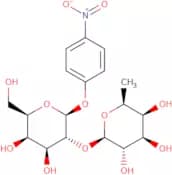
CAS:5-Bromo-4-chloro-3-indoxyl phosphate, p-toluidine salt - micronized is a chemiluminescent substrate used in diagnostic assays. It is an enzyme substrate that is commonly used to detect peroxidase activity and has been shown to be effective in detecting various types of bacteria. This product is a high quality chemical with a purity of at least 98% and has been tested for environmental safety. 5-Bromo-4-chloro-3-indoxyl phosphate, p-toluidine salt - micronized can be used as a fluorogenic substrate for the detection of proteases and aminopeptidases.Purity:Min. 95%4-Nitrophenyl 2-O-(b-L-fucopyranosyl)-b-D-galactopyranoside
CAS:4-Nitrophenyl 2-O-(b-L-fucopyranosyl)-b-D-galactopyranoside is a high-quality chromogenic substrate with excellent sensitivity specifically designed for enzymes' activity detection. This pNP substrate enables rapid, accurate, and measurable colorimetric visualization of enzymatic hydrolysis reactions. Researchers can easily and effectively monitor the release of 4-nitrophenol as a yellow product under laboratory conditions, allowing for convenient comparative analysis and identification of enzyme levels in various samples.Purity:Min. 95%Color and Shape:White SolidMolecular weight:447.39 g/mol4-Nitrophenyl hepta-O-acetyl-1-thio-b-lactoside
CAS:4-Nitrophenyl hepta-O-acetyl-1-thio-b-lactoside is an inorganic molecule that binds to the surface of bacteria. It has been used as a fingerprinting tool for a variety of organisms, including corynebacterium glutamicum. The molecule can be used to measure the metabolic activity of corynebacterium glutamicum with a technique called incremental acidification. This technique is based on the observation that the concentration of 4-nitrophenol decreases by one unit for each glucose metabolized by corynebacterium glutamicum. The use of 4NPHTBL and other primers can also be useful in diagnosing patients with autoimmune diseases such as celiac disease and inflammatory bowel disease.Purity:Min. 95%4-Nitrophenyl 2-acetamido-3,6-di-O-acetyl-2-deoxy-b-D-glucopyranoside
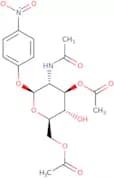
CAS:4-Nitrophenyl 2-acetamido-3,6-di-O-acetyl-2-deoxy-b-D-glucopyranoside is a versatile chromogenic pNP enzyme substrate designed to offer superior results for detecting enzyme activity in research and diagnostic applications. This substrate enables faster, more accurate, and reliable detection of hydrolase enzymes, making it ideal for various research and testing needs, such as studying enzyme kinetics, screening inhibitors, and profiling enzyme specificity.Purity:Min. 95%Molecular weight:426.37 g/molTetrabutylphosphonium p-toluenesulfonate
CAS:Tetrabutylphosphonium p-toluenesulfonate is a fluorogenic substrate that is used in the diagnosis of cytochrome P450 enzymes. It is a ligand that binds to metal ions, such as copper and zinc. This compound is also used for the preparation of bioluminescent substrates for use in diagnostics and research.Formula:C16H36P•C7H7O3SPurity:Min. 95%Molecular weight:430.63 g/mol5-Bromo-4-chloro-3-indolyl N-acetyl-a-D-neuraminic acid methyl ester
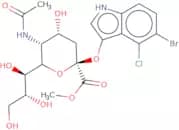
CAS:5-Bromo-4-chloro-3-indolyl N-acetyl-a-D-neuraminic acid methyl ester is a chromogenic substrate that reacts with enzymes to produce a colored product. It can be used in diagnostic tests for the detection of various bacteria, including Salmonella and Brucella, as well as for the determination of concentration in food testing or environmental testing. 5B4C3INA can also be conjugated to other substances, such as biotin or an antibody, which allows it to be used in immunoassays.Formula:C20H24BrClN2O9Purity:Min. 95%Molecular weight:551.77 g/molAldol® 515 β-D-xylopyranoside, Biosynth Patent: EP 2427431 and US 8940909
CAS:Aldol® 515 beta-D-xylopyranoside is a chromogenic substrate that is used in food testing. It is an alternative to the more common glucose and sucrose, which are not suitable for some types of assays. Aldol® 515 beta-D-xylopyranoside is also used in diagnostics as a ligand for fluorescent antibody staining and chemiluminescence assays. It has been shown to increase the sensitivity of these tests by up to 10 times. The substrate has been tested extensively and is safe for use with a wide range of bacteria including E. coli, S. typhimurium, M. tuberculosis, and C. albicans at concentrations up to 100 mM without any inhibitory effects on growth or viability.
END>.Formula:C28H34N2O6Purity:Min. 95.0 Area-%Molecular weight:494.59 g/mol2-Nitrophenyl 2-acetamido-3,6-di-O-acetyl-4-O-[2-O-(2,3,4-tri-O-benzoyl-a-L-fucopyranosyl)]-2-deoxy-b-D-glucopyranoside
2-Nitrophenyl 2-acetamido-3,6-di-O-acetyl-4-O-[2-O-(2,3,4-tri-O-benzoyl-a-L-fucopyranosyl)]--2-deoxy--bDglucopyranoside is an acylated glucopyranoside that is used as a substrate for the enzyme β -galactosidase. When hydrolyzed by β -galactosidase, it yields a blue product that has been widely used in chemiluminescence and bioluminescence assays. It also can be used for staining and ligand binding studies.
Purity:Min. 95%Molecular weight:884.83 g/mol4-Nitrophenyl 3-O-(2,3,4,6-tetra-O-acetyl-a-D-mannopyranosyl)-2,4-di-O-benzoyl-b-D-mannopyranoside
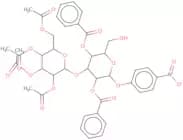
CAS:4-Nitrophenyl 3-O-(2,3,4,6-tetra-O-acetyl-a-D-mannopyranosyl)-2,4-di-O-benzoyl-b-D-mannopyranoside is a bioactive metabolite that can be found in the gene expression profile of a human genome. It has been shown to have an effect on gene expression levels and cellular function. This metabolite is found in the environment and has been shown to be mediated by environmental factors. The high level of gene expression has been shown to be due to its ability to bind to DNA.Purity:Min. 95%Molecular weight:839.75 g/mol2-Nitrophenyl 2,3,4-tri-O-acetyl-b-D-galactopyranoside
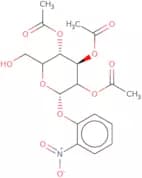
CAS:2-Nitrophenyl 2,3,4-tri-O-acetyl-b-D-galactopyranoside is a fluorogenic substrate that can be used to detect β-galactosidase activity. This specific substrate is one of the most commonly used substrates for detecting β-galactosidase activity in diagnostic assays. It reacts with the enzyme to produce a blue color and has a fluorescence emission maximum at about 480 nm. The product is available in high purity and high quality and it is also an enzyme substrate.Purity:Min. 95%Molecular weight:427.36 g/mol4-Nitrophenyl 2-acetamido-6-O-(2-acetamido-3,4,6-tri-O-acetyl-2-deoxy-b-D-glucopyranosyl)-3-O-(2,3,4,6-tetra-O-acetyl-b-D-galactopyr anosyl)-2-deoxy-a-D-galactopyranoside
4-Nitrophenyl 2-acetamido-6-O-(2-acetamido-3,4,6-tri-O-acetyl-2-deoxy-b-D-glucopyranosyl)-3-O-(2,3,4,6-tetra -O acetyl -b D galactopyranosyl)-2 deoxy a D galactopyranoside is a high purity fluorogenic substrate for the enzyme β galactosidase. It can be used for the detection of β galactosidase in biological samples. 4NPAG can also be used as a ligand for various types of chromogenic substrates. This product is also commonly used in diagnostics and conjugates to detect β galactosidase activity or as a culture media supplement.Purity:Min. 95%Molecular weight:1,001.89 g/mol4-Nitrophenyl 2,3-di-O-(b-D-glucopyranosyl)-b-D-glucopyranoside
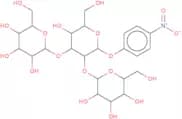
4-Nitrophenyl 2,3-di-O-(b-D-glucopyranosyl)-b-D-glucopyranoside is a chromogenic substrate that can be used to detect the presence of β-glucuronidase in human and animal tissue. The compound is also a fluoroquinolone substrate for the detection of β-lactamase activity. 4NPBG is used in diagnostics as well as food testing, due to its ability to detect bacteria in both food and water samples. 4NPBG is a chemiluminescent substrate that emits light upon hydrolysis by β-glucuronidase or β-lactamase. The compound has been shown to be an excellent ligand for binding to protein A or protein G and can be used for immunoassays such as ELISA or Western blotting.Purity:Min. 95%Molecular weight:625.53 g/mol4-Nitrophenyl 2-acetamido-3-O-(2-acetamido-3,4,6-tri-O-acetyl-b-D-glucopyranosyl)-4,6-di-O-acetyl-2-deoxy-a-D-galactopyranoside
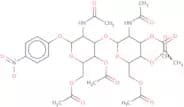
4-Nitrophenyl 2-acetamido-3-O-(2-acetamido-3,4,6-tri-O-acetyl-b-D-glucopyranosyl)-4,6-di-O-acetyl-2deoxy--aDgalactopyranoside is a substrate for enzymes such as beta galactosidase and alpha amylase. It can be used for the detection of these enzymes in biological samples, including culture media and body fluids. 4NPAG has also been used as a chromogenic substrate to measure the activity of NADH oxidase in neutrophils. 4NPAG is fluorescent in aqueous solution and can be used to detect bioluminescence reactions.Purity:Min. 95%Molecular weight:755.68 g/mol4-Nitrophenyl O-(N-acetyl-a-neuraminosyl)-(2-3)-b-D-galactopyranosyl-(1-4)-2-acetamido-2-deoxy-b-D-glucopyranoside
CAS:4-Nitrophenyl O-(N-acetyl-a-neuraminosyl)-(2-3)-b-D-galactopyranosyl-(1-4)-2-acetamido-2-deoxybDglucopyranoside is a fluorescent compound that has been used as a substrate in enzyme assays. It has been shown to be an effective ligand for the enzyme beta galactosidase, which hydrolyzes the substrate to produce 4nitrophenol and o-(Nacetyl)a-neuraminic acid. This product is CAS No. 501427-92-5 and can be used as a high purity, high quality reagent for conjugation.Purity:Min. 95%Molecular weight:795.7 g/mol4-Nitrophenyl hepta-O-acetyl-b-lactoside
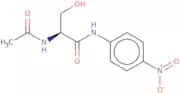
CAS:4-Nitrophenyl hepta-O-acetyl-b-lactoside is a high-quality chromogenic pNP enzyme substrate that exhibits excellent sensitivity and specificity in enzyme assays. This synthetic compound is designed to react with β-galactosidase enzymes, generating a yellow product (4-nitrophenol) upon cleavage. The resulting color change allows for quantitative measurement of enzyme activity, providing valuable insights in various research applications including enzyme kinetics, screening of inhibitors, drug discovery, and molecular diagnostics. Our product ensures consistent results with minimal interference, making it a reliable choice for a wide range of biochemical applications.Purity:Min. 95%Molecular weight:757.65 g/molN-Acetyl-L-serine p-nitroanilide
N-Acetyl-L-serine p-nitroanilide is a fluorescent probe used for the detection of glucose in urine. It has a high purity and is suitable for use as a substrate for many enzymes, including alkaline phosphatase, β-galactosidase, and peroxidase. N-Acetyl-L-serine p-nitroanilide has been shown to be an excellent indicator of bacterial growth in culture media.
Formula:C11H12N2O6Purity:Min. 95%Color and Shape:White powder.Molecular weight:268.22 g/mol


![4-Nitrophenyl 2,3,4-tri-O-acetyl-6-O-(2,3,4,6-tetra-O-[4-methoxybenzyl]-a-D-glucopyranosyl)-a-D-gl…](/_next/image/?url=https%3A%2Fstatic.cymitquimica.com%2Fproducts%2F3D%2Fthumb-webp%2FEN04817.webp&w=3840&q=75)





![2-Nitrophenyl 2-acetamido-3,6-di-O-acetyl-4-O-[2-O-(2,3,4-tri-O-benzoyl-a-L-fucopyranosyl)]-2-deox…](/_next/image/?url=https%3A%2Fstatic.cymitquimica.com%2Fproducts%2F3D%2Fthumb-webp%2FEN04919.webp&w=3840&q=75)